Quick verdict
Choose AutoRFP.ai for software and finance teams answering structured RFPs in Word and Excel who want accuracy-first drafts, responses written to win, and a workflow that is easy to run; choose SiftHub for B2B SaaS presales teams handling DDQs and security questionnaires. AutoRFP.ai lists a starting price of $899/mo, while SiftHub is quote-only. In our capability model AutoRFP.ai leads on RFPs, answer library, approval workflows, integrations and self-serve setup, while SiftHub leads on security questionnaires.
Both profiles reviewed Jul 2026
2 of 70 profiles, one scoring modelNo paid placementSources checked: 12Choose AutoRFP.ai or SiftHub
AU Choose AutoRFP.ai when
- Software and finance teams answering structured RFPs in Word and Excel who want accuracy-first drafts, responses written to win, and a workflow that is easy to run.
- You need stronger RFPs, answer library and approval workflows than SiftHub offers.
- You want a listed starting price: $899/mo.
SI Choose SiftHub when
- B2B SaaS presales teams handling DDQs and security questionnaires.
- You need stronger security questionnaires than AutoRFP.ai offers.
Side-by-side comparison
| Capability | AutoRFP.ai | SiftHub | Edge |
|---|---|---|---|
| Best for | Software and finance teams answering structured RFPs in Word and Excel who want accuracy-first drafts, responses written to win, and a workflow that is easy to run. | B2B SaaS presales teams handling DDQs and security questionnaires. | - |
| Starting price | $899/mo | Custom | AutoRFP.ai |
| Free tier | No | No | Match |
| RFPs | 3/3 | 2/3 | AutoRFP.ai |
| DDQs | 3/3 | 3/3 | Match |
| Security questionnaires | 2/3 | 3/3 | SiftHub |
| AI drafting | 3/3 | 3/3 | Match |
| Answer library | 3/3 | 2/3 | AutoRFP.ai |
| Source attribution | 3/3 | 3/3 | Match |
| Workflow & approvals | 3/3 | 1/3 | AutoRFP.ai |
| Integrations | 3/3 | 2/3 | AutoRFP.ai |
| Self-serve onboarding | 2/3 | 1/3 | AutoRFP.ai |
| ISO 27001 | ISO 27001:2022 | ISO 27001 | - |
| SOC 2 | SOC 2 Type II | SOC 2 | - |
| US hosting | Yes (US West, Oregon) | Not listed | - |
| EU hosting | Yes (EU Central, Frankfurt) | Not listed | - |
| Slack | Slack | Slack | - |
| Microsoft Teams | Microsoft Teams | Not listed | - |
| AWS, Azure, GCP | AWS, Azure, GCP | Not listed | - |
| Listed integrations | Salesforce, HubSpot, Microsoft Dynamics 365, Slack, Microsoft Teams, SharePoint, OneDrive, Google Drive, Confluence, Notion, Drata, Vanta, Okta, Excel, Word, Browser extension, MCP server (Claude, ChatGPT, Microsoft Copilot) | Slack, Salesforce, Confluence | - |
| Certifications | ISO 27001:2022, SOC 2 Type II | SOC 2, ISO 27001 | - |
What they look like
AU AutoRFP.ai

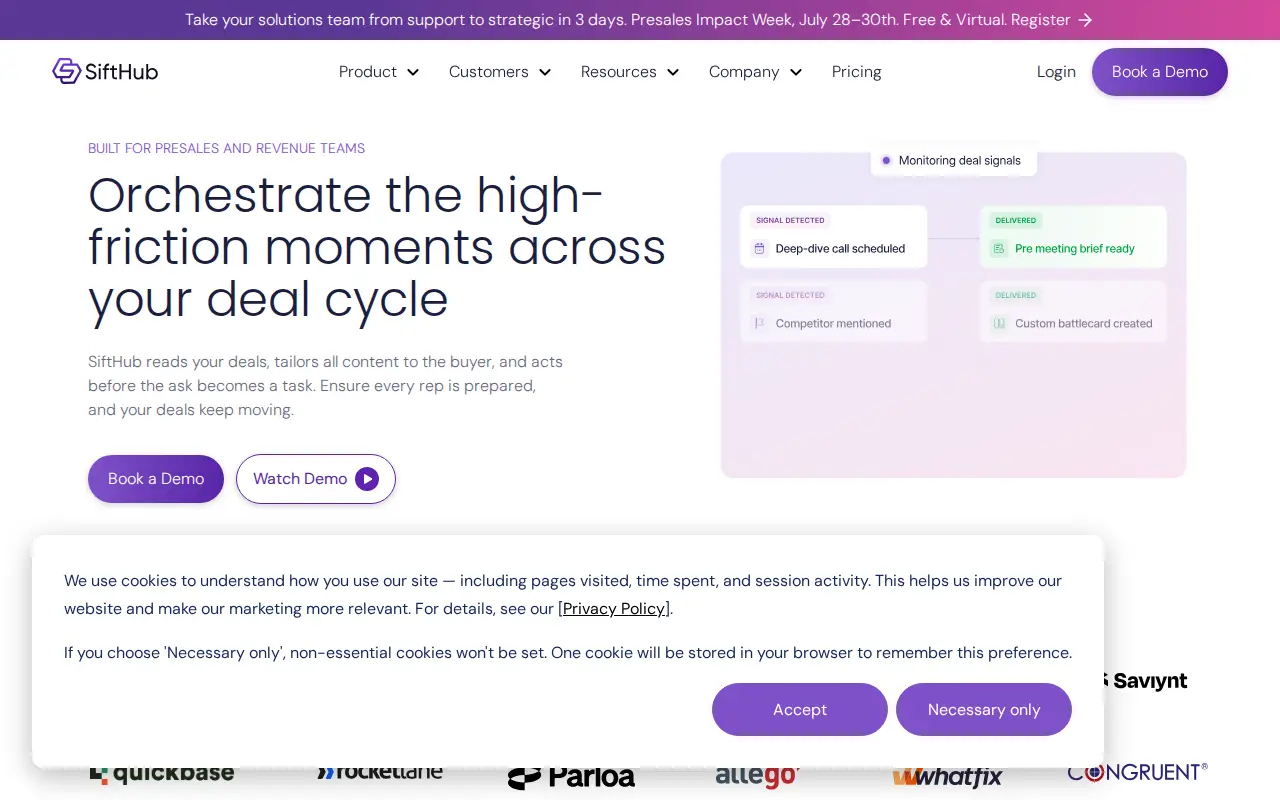
SI SiftHub
Security: ISO 27001, SOC 2, and regional hosting
Put AutoRFP.ai and SiftHub through the same three questions a security reviewer will ask: ISO 27001, SOC 2, and whether you can keep the tenancy in the US or the EU. Cells say Not listed when we could not find the claim on a public vendor page.
| Check | AutoRFP.ai | SiftHub |
|---|---|---|
| ISO 27001 | ISO 27001:2022 autorfp.ai, 2026-08 | ISO 27001 |
| SOC 2 | SOC 2 Type II autorfp.ai, 2026-08 | SOC 2 |
| US hosting | Yes (US West, Oregon) autorfp.ai, 2026-08 | Not listed |
| EU hosting | Yes (EU Central, Frankfurt) autorfp.ai, 2026-08 | Not listed |
Slack and Microsoft Teams
During a live questionnaire, SMEs get pinged in Slack or Teams, not in a vendor portal. Here is what AutoRFP.ai and SiftHub publish for those two connections.
| Connection | AutoRFP.ai | SiftHub |
|---|---|---|
| Slack | Slack autorfp.ai, 2026-08 | Slack |
| Microsoft Teams | Microsoft Teams autorfp.ai, 2026-08 | Not listed |
Subprocessors: the big three clouds, then the niche names
Compare AutoRFP.ai and SiftHub on AWS, Azure and GCP first. Then scan for niche processors a reviewer should pause on: third-party LLMs, session replay, or support that leaves the region you elected.
| Layer | AutoRFP.ai | SiftHub |
|---|---|---|
| AWS, Azure, GCP | AWS, Azure, GCP | Not listed |
| Watch-outs |
| No niche processors flagged in our sourced list. |
The quickest way to choose between AutoRFP.ai and SiftHub is to ask where your response pain actually lives. If it lives in documents (the sprawling Excel RFP, the DDQ in Word, the vendor portal that times out), you want a response workspace that is strict about sources and gives the buyer back their own file. If it lives in the deal (reps pinging sales engineers in Slack, a prospect asking a security question live on a call, a one-pager needed by Friday), you want a presales assistant that reaches into every system the revenue team touches.
AutoRFP.ai is the first kind: the accuracy-first tool for writing winning responses in a workflow that is easy to run. SiftHub is mostly the second kind, with a capable RFP and questionnaire agent attached. That overlap is why buyers shortlist both, and it is also why the right pick is usually obvious once you name the job. Facts, quotes, and prices below come from each company’s website, read in October 2026.
Key takeaways
- Different centers of gravity: AutoRFP.ai is a response workspace for structured RFPs, DDQs, and security questionnaires in Word and Excel. SiftHub, founded in 2023 in San Francisco, is a presales AI platform whose agents cover RFPs and questionnaires plus in-call answers (Pulse), battlecards, buyer research, and sales collateral.
- Pricing models: AutoRFP.ai publishes flat plans at $899/mo (24 projects a year) and $1,299/mo (50 projects a year), billed annually, with unlimited users, all features, and implementation. SiftHub publishes no prices and quotes on a transaction-based consumption model with no free trial.
- Verification: Both cite sources. AutoRFP.ai labels each line of a draft by origin (document, person, or AI) and gives every draft a Trust Score. SiftHub shows citations with last-updated timestamps on every answer.
- Where SiftHub is stronger: security questionnaire breadth (SIG, CAIQ, VSAQ, NIST 800-171 and more, in 50+ languages, inside Word, Excel, Google Docs, and Sheets) and live connections to revenue systems such as Gong, Highspot, and Zendesk.
- Limitations: AutoRFP.ai has project caps per plan and a 12-month minimum after its first 30 days. SiftHub’s transaction usage varies with request complexity and by contract, its published accuracy figures differ from page to page, and this guide rates its approval workflow as limited.
What each one is built for
AutoRFP.ai
AutoRFP.ai was founded in Brisbane in 2022 and does one job: answering structured bids. You import the RFP, DDQ, or security questionnaire (Word, Excel, PDF, or a portal through its browser extension), it drafts every answer from your approved library, documents, and past projects, and you export the finished answers back into the original file. Every approved answer is saved back into the library automatically, tagged, with the customer’s name swapped for a placeholder, so the library grows as the team works.
The pitch to a reviewer is simple: you can see where every line came from. Each answer lists the sources it used, each line is traced to a file, a person, or the model, and the Trust Score tells you which drafts to read first. When nothing in your content supports a question, the draft is withheld and the question is flagged for the team.
SiftHub
SiftHub bills itself as “AI RFP Software & Deal Orchestration Platform” for sales and presales teams. Its agents include an RFP Agent (“Built to tackle complex RFPs & security questionnaires”), an Answer Agent for instant answers (reps can also ask through a Slack bot), a Search Agent, a Battlecard Agent, a BuyerIQ Agent for personalized messaging, and Pulse, an in-call assistant that answers buyer questions live without a bot joining the meeting. There is also an MCP connector that brings SiftHub’s deal knowledge into other AI tools.
The company raised a $5.5 million seed round in April 2024, led by Matrix Partners India and Blume Ventures, and lists customers including Superhuman, Sirion, Zycus, Rocketlane, and Allego. Its sweet spot, by this guide’s reading, is a B2B SaaS presales team where questionnaires are one stream of work among many.
Where the work happens
This is the practical difference you will feel in week one.
SiftHub goes to the document. Its security questionnaire page says it works “natively inside Microsoft Word, Excel, Google Docs, and Google Sheets,” with “No portal login. No reformatting.” For a sales engineer who lives in Google Sheets, filling the buyer’s file in place is a genuine convenience, and the Slack bot means reps can ask “do we support SAML with Azure AD?” without opening anything at all.
AutoRFP.ai brings the document to a workspace. The file is imported, each worksheet or bundled file becomes its own unit, and AI autodetection proposes the question, answer, and compliance columns for you to confirm. The team drafts, assigns, reviews, and approves inside one project, and when you export to the original file, the answers land in the buyer’s own workbook or document while its formulas, macros, and dropdown lists keep working. PDFs are answered in the product and export as Word documents rather than the original PDF.
Which model suits you depends on how many people touch an answer. One sales engineer finishing a questionnaire alone will enjoy working in place. A bid with several reviewers, a deadline, and a compliance sign-off benefits from a shared project with assignments, reminders, and a record of who approved what.
Grounding, accuracy, and what to test
Both vendors say their answers come from your approved content. The useful question is how each one shows its work.
SiftHub says it “eliminates AI hallucinations by grounding every RFP and questionnaire response in your verified, approved content,” and every answer carries citations with the source and a last-updated timestamp. Admins can mark “golden answers,” set review and expiry dates, and get flagged when an answer references an expired certification or a superseded policy. Those freshness controls are a real strength for security work, where an out-of-date SOC 2 date is the classic embarrassing error.
SiftHub also publishes accuracy percentages, and they do not agree with each other. Its homepage FAQ says the system “consistently achieve[s] >99% response accuracy,” its pricing page lists “AI answer accuracy > 99.2%,” and its security questionnaire page promises first-pass responses “with 90% autofill accuracy” (all read October 2026). None of the three comes with a published method. Ask in the demo what was measured, on which documents, and who checked it.
AutoRFP.ai does not lead with an accuracy number. Its mechanism is visible instead: retrieval scoped by the project’s tags and sources, verbatim reuse when an approved answer already fits, a quality gate that withholds weak drafts, and a flag on any sentence its sources do not support. Pulling from the open web is opt-in and clearly tagged when used. The Trust Score breakdown shows how each answer was produced, how well its tags matched, and how old the content is. For a reviewer, that is the difference between trusting a percentage and checking an answer.
Review and approval
This is the dimension where the two tools are furthest apart, and this guide rates SiftHub’s workflow approvals as limited.
SiftHub does have workflow features. Its security questionnaire page shows open tasks, answers pending review, and approvals waiting on sign-off in a single view, plus reassignment, version history, and source attribution on every response. Its pricing page lists automatic task assignment to SMEs and custom roles. What it does not offer, in our assessment, is the multi-step, deadline-driven review chain that a proposal desk runs on a long formal RFP.
AutoRFP.ai’s project workflow covers assignments, review requests, comments, @mentions, deadline reminders, and a daily digest, delivered in Slack, Teams, or email by each person’s preference. Every edit and approval is recorded, so you can show an auditor who signed off on an answer about data retention. If more than a couple of people touch your typical bid, this is the section that should decide it.
Pricing: transactions versus projects
SiftHub publishes no prices. Its pricing page offers two starting points, the RFP Agent or the full platform, with “pricing tailored to your team.” It runs on transactions: “Every action you take in SiftHub, from answering a question and generating a proposal to building collateral or retrieving deal insights, consumes transactions.” The number consumed “depends on the complexity, size, and number of processing steps,” and consumption rates and limits “may vary depending on your specific plan or contract.” There is no free trial.
AutoRFP.ai prints its prices: $899 a month on Scale (24 projects a year) and $1,299 a month on Accelerate (50), paid annually, which comes to $10,788 or $15,588, with Enterprise quoted above that. Projects are counted per bid rather than per question, so a 500-question spreadsheet and a 50-question security questionnaire each use one. Every plan includes unlimited users, all features, and implementation, with a 30-day money-back guarantee and a free 14-day proof of concept on your own documents.
The forecasting difference is the point. With AutoRFP.ai you can budget from your bid count. With SiftHub, the bill tracks AI activity across RFPs, Slack answers, and collateral, which can be fair value for a team using all of it, but you should ask for a usage estimate based on last quarter’s real volume before signing.
Integrations and stack fit
Concede this one honestly: SiftHub connects to more of the revenue team’s live systems as inputs for answers. Its connector list includes Salesforce, HubSpot, Slack, Microsoft Teams, Gong, Highspot, Seismic, Zendesk, Confluence, Notion, SharePoint, OneDrive, and Google Drive. Pulling call context from Gong or a support history from Zendesk is something AutoRFP.ai is not trying to do.
AutoRFP.ai’s integrations are built around the response job: Salesforce (an AppExchange package that shows live RFP status on the opportunity and can start intakes), HubSpot, Microsoft Dynamics 365, Slack, Teams, SharePoint, OneDrive, Google Drive, Confluence, Notion, Drata and Vanta, Okta, and an MCP server for AI assistants such as Claude, ChatGPT, and Microsoft Copilot. Knowledge sources sync admin-selected content on a daily cadence, which is a governance choice: you decide what the drafting engine is allowed to read.
Sync timing is worth one question in either demo. SiftHub’s homepage says it syncs connected systems “in near real-time,” while its own Salesforce connector article says new or changed Salesforce content can take up to 6 hours to appear.
What to bring to each demo
Bring the same three files to both calls: your messiest recent Excel questionnaire, a DDQ with a few questions your library cannot answer, and one long RFP section. Then watch for specific things.
- Gaps: What happens on the questions your content does not cover? You want to see a flag routed to a person, not a confident paragraph.
- The export: Does the finished file open with the buyer’s formulas, dropdowns, and column layout intact? Open it in Excel, not in the vendor’s preview.
- Review: Can a second reviewer see who changed an answer, and when, without asking the first one?
- Cost: For SiftHub, ask how many transactions those three files would consume. For AutoRFP.ai, confirm how your bid count maps to 24 or 50 projects a year.
- Freshness: Change one fact in a connected source and ask how long until a new draft reflects it.
Known issues and watch-outs
Sourced and dated. Nothing here is a reason to skip a demo; all of it is a reason to ask a sharper question in one.
SiftHub
- Unpredictable usage cost. Transaction consumption depends on request complexity, and rates and limits vary by plan or contract (SiftHub pricing, October 2026). No public price and no free trial.
- Accuracy figures that disagree. “>99%” (homepage FAQ), “> 99.2%” (pricing page), and “90% autofill accuracy” (security questionnaire page), all read in October 2026, with no published method.
- Salesforce lag. Salesforce content can take up to 6 hours to appear in SiftHub (SiftHub help center, October 2026).
- Lighter approvals. This guide rates SiftHub’s approval workflow as limited compared with dedicated response workspaces, and rates it as capable rather than core on full RFPs (SiftHub profile).
AutoRFP.ai
- Annual terms. Billing is yearly, and once the 30-day window closes the contract has a 12-month minimum (AutoRFP.ai pricing, October 2026). The refund only applies if you used the product during that window, which AutoRFP.ai defines as importing three old responses, inviting two colleagues, setting up a project, approving five answers, and exporting once.
- Project caps. 24 projects a year on Scale and 50 on Accelerate; above that you negotiate Enterprise (AutoRFP.ai pricing, October 2026).
- Narrower scope. No in-call assistant, battlecards, or sales collateral builder, and no bundled trust center (it connects to Drata and Vanta instead). Long persuasive narrative and US federal capture work are outside its focus (AutoRFP.ai profile).
- Security questionnaires rated a notch lighter. This guide scores SiftHub stronger on dedicated security questionnaire coverage, mainly for its framework list and in-place Google Sheets work.
Pick SiftHub if
- Your presales team wants one AI layer across Slack questions, live calls, battlecards, collateral, and questionnaires.
- Security questionnaires (SIG, CAIQ, VSAQ) are your main document type, and they often arrive in Google Docs or Sheets.
- Call recordings in Gong and content in Highspot or Seismic should feed your answers.
- Answering in 50+ languages inside the same workflow matters to you.
- You are comfortable with a sales-led quote and a consumption model, and you will check the usage estimate.
Pick AutoRFP.ai if
- Your work is structured RFPs, DDQs, and questionnaires that arrive as Word or Excel files and must go back in the same file.
- Several reviewers touch each bid, and you need assignments, reminders, and a record of approvals.
- You want each line traced to its source before anyone signs, with a Trust Score to triage review.
- You want a published price you can budget by bid count, with unlimited users and implementation included.
- You would rather prove it on your own documents in a free 14-day proof of concept before paying.
The verdict
These tools overlap on questionnaires and diverge everywhere else. SiftHub is the better fit for a presales organization that wants an AI assistant across the whole deal, with questionnaires as one stream and live revenue systems as inputs. AutoRFP.ai is the better fit for a response team whose deliverable is the completed buyer document, where cited answers, a real approval chain, and a clean export back into the original file decide whether the bid goes out on time.
If you genuinely need both jobs done, it is reasonable to run a presales assistant for rep questions and a response workspace for formal bids. If you only have budget for one, count last quarter’s work. Mostly Slack questions and calls points to SiftHub. Mostly files with deadlines and sign-offs points to AutoRFP.ai.
Read the full AutoRFP.ai review or SiftHub review, or browse all RFP & DDQ software.
Frequently asked questions
What is the difference between AutoRFP.ai and SiftHub?
AutoRFP.ai: Accuracy-first, AI-native, source-grounded platform for RFPs, security questionnaires, and DDQs. SiftHub: AI sales assistant for presales DDQs and questionnaires. AutoRFP.ai is best for software and finance teams answering structured RFPs in Word and Excel who want accuracy-first drafts, responses written to win, and a workflow that is easy to run. SiftHub is best for B2B SaaS presales teams handling DDQs and security questionnaires.
Which is cheaper, AutoRFP.ai or SiftHub?
AutoRFP.ai publishes a starting price ($899/mo). SiftHub is quote-only, so request a quote for the same scope before comparing cost.
Is AutoRFP.ai or SiftHub better for DDQs and security questionnaires?
SiftHub scores higher on DDQ and security-questionnaire handling in our capability model, though both support them.
Do AutoRFP.ai and SiftHub both handle RFPs?
AutoRFP.ai: yes, a core strength. SiftHub: yes, a core strength.
Which should you choose, AutoRFP.ai or SiftHub?
AutoRFP.ai is the pick for software and finance teams answering structured RFPs in Word and Excel who want accuracy-first drafts, responses written to win, and a workflow that is easy to run. SiftHub is the pick for B2B SaaS presales teams handling DDQs and security questionnaires.
Are there alternatives to AutoRFP.ai and SiftHub?
Yes. Browse the full directory of RFP, DDQ, and security-questionnaire platforms for more options and side-by-side comparisons.
Do AutoRFP.ai and SiftHub list ISO 27001, SOC 2, and US or EU hosting?
AutoRFP.ai: ISO 27001 ISO 27001:2022, SOC 2 SOC 2 Type II, US Yes (US West, Oregon), EU Yes (EU Central, Frankfurt), Slack Slack, Teams Microsoft Teams, clouds AWS, Azure, GCP. SiftHub: ISO 27001 ISO 27001, SOC 2 SOC 2, US Not listed, EU Not listed, Slack Slack, Teams Not listed, clouds Not listed. Confirm both on the vendor sites.
Source registry
Every page we read for these profiles, with the month it was last checked. Anything without a source is shown as not publicly disclosed. Spot an outdated fact? Send it from the corrections page.
AutoRFP.ai
Pricing
- No pricing source URL recorded. Treat pricing as not publicly disclosed until the vendor confirms it.
Security and compliance
Product and integrations
Third-party reviews
SiftHub
Pricing
Security and compliance
- No security source URL recorded. Treat certifications and hosting as not publicly disclosed.
Product and integrations
Third-party reviews