Quick verdict
Choose GovDash for US government contractors running US federal bids from capture through proposal; choose Sweetspot for GovCon teams that want opportunity discovery and drafting under one roof. Neither publishes a comparable starting price, so quote both on the same scope. In our capability model GovDash leads on approval workflows and self-serve setup, while Sweetspot leads on RFPs, AI drafting and source attribution.
Both profiles reviewed Oct 2026
2 of 70 profiles, one scoring modelNo paid placementSources checked: 17Choose GovDash or Sweetspot
GO Choose GovDash when
- US government contractors running US federal bids from capture through proposal.
- You need stronger approval workflows and self-serve setup than Sweetspot offers.
SW Choose Sweetspot when
- GovCon teams that want opportunity discovery and drafting under one roof.
- You need stronger RFPs, AI drafting and source attribution than GovDash offers.
Side-by-side comparison
| Capability | GovDash | Sweetspot | Edge |
|---|---|---|---|
| Best for | US government contractors running US federal bids from capture through proposal. | GovCon teams that want opportunity discovery and drafting under one roof. | - |
| Starting price | Custom | Custom | Match |
| Free tier | No | No | Match |
| RFPs | 2/3 | 3/3 | Sweetspot |
| DDQs | 1/3 | 1/3 | Match |
| Security questionnaires | 1/3 | 1/3 | Match |
| AI drafting | 2/3 | 3/3 | Sweetspot |
| Answer library | 2/3 | 2/3 | Match |
| Source attribution | 1/3 | 2/3 | Sweetspot |
| Workflow & approvals | 2/3 | 1/3 | GovDash |
| Integrations | 2/3 | 2/3 | Match |
| Self-serve onboarding | 1/3 | 0/3 | GovDash |
| ISO 27001 | Not listed | Not listed | - |
| SOC 2 | Not listed | SOC 2 Type II | - |
| US hosting | Yes (Azure Commercial Central US; Azure Government and customer-hosted options) | Not listed | - |
| EU hosting | Not listed | Not listed | - |
| Slack | Slack (@Dash) | Slack | - |
| Microsoft Teams | Microsoft Teams (@Dash) | Not listed | - |
| AWS, Azure, GCP | Azure | Not listed | - |
| Listed integrations | eBuy, SharePoint, Slack, Microsoft Teams | Salesforce, SharePoint, Microsoft 365, GovWin, GSA eBuy, Slack | - |
| Certifications | FedRAMP Moderate Equivalent, FedRAMP Ready, CUI Protection | CMMC Level 2, SOC 2 Type II | - |
What they look like
GO GovDash

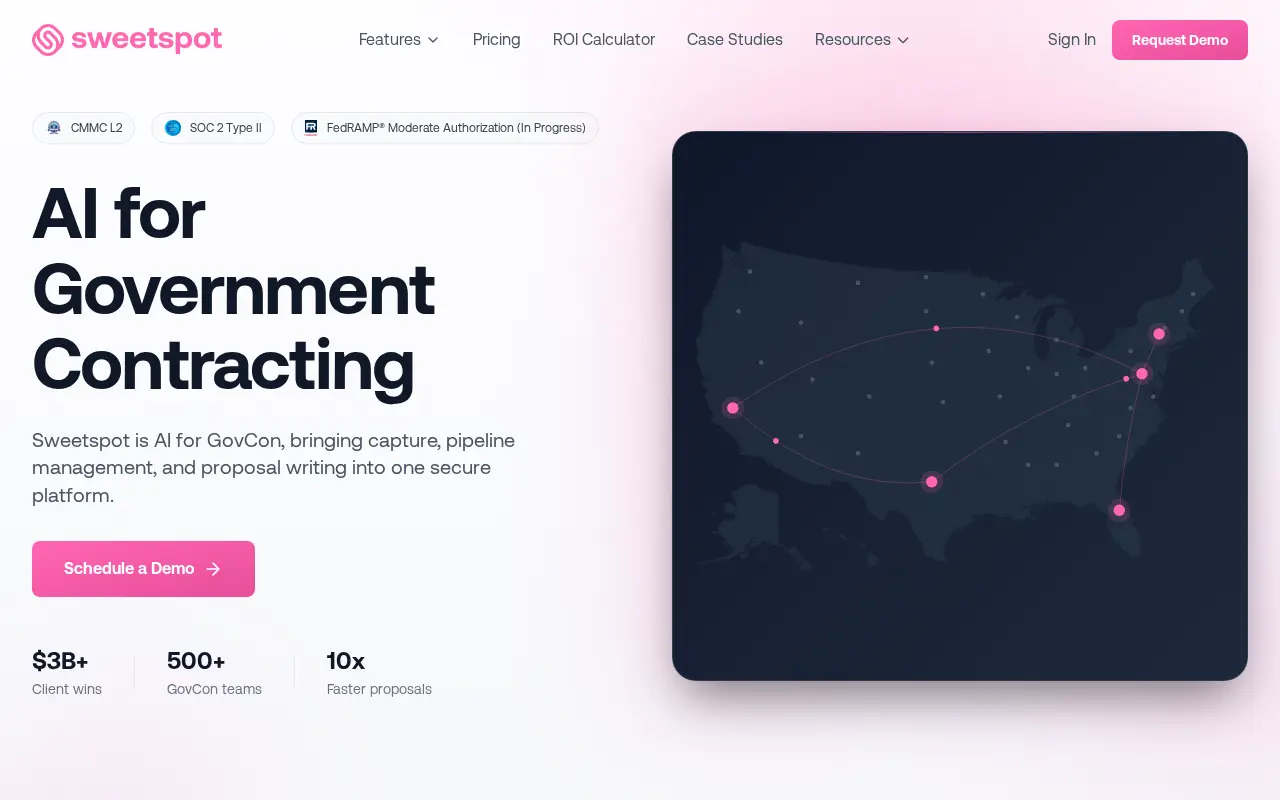
SW Sweetspot
Security: ISO 27001, SOC 2, and regional hosting
Put GovDash and Sweetspot through the same three questions a security reviewer will ask: ISO 27001, SOC 2, and whether you can keep the tenancy in the US or the EU. Cells say Not listed when we could not find the claim on a public vendor page.
| Check | GovDash | Sweetspot |
|---|---|---|
| ISO 27001 | Not listed | Not listed |
| SOC 2 | Not listed | SOC 2 Type II |
| US hosting | Yes (Azure Commercial Central US; Azure Government and customer-hosted options) govdash.com, 2026-08 | Not listed |
| EU hosting | Not listed | Not listed |
Slack and Microsoft Teams
During a live questionnaire, SMEs get pinged in Slack or Teams, not in a vendor portal. Here is what GovDash and Sweetspot publish for those two connections.
| Connection | GovDash | Sweetspot |
|---|---|---|
| Slack | Slack (@Dash) govdash.com, 2026-08 | Slack |
| Microsoft Teams | Microsoft Teams (@Dash) govdash.com, 2026-08 | Not listed |
Subprocessors: the big three clouds, then the niche names
Compare GovDash and Sweetspot on AWS, Azure and GCP first. Then scan for niche processors a reviewer should pause on: third-party LLMs, session replay, or support that leaves the region you elected.
| Layer | GovDash | Sweetspot |
|---|---|---|
| AWS, Azure, GCP | Azure | Not listed |
| Watch-outs | No niche processors flagged in our sourced list. Support docs place the federal environment on Azure Commercial in Central US. Confirm the current subprocessor pack in the GovDash Trust Center. | No niche processors flagged in our sourced list. |
Unlike most pairs in this directory, GovDash and Sweetspot really are competing for the same desk. Both are AI-native platforms for US government contractors. Both find opportunities, track pursuits, shred solicitations into compliance matrices, and draft proposals from your past performance. Both were founded recently, both are based in New York, and both came through Y Combinator. If you are a GovCon BD lead choosing between them, you are not choosing a category. You are choosing a vendor.
So the useful question is narrower than “which one does more.” It is: where does each one go deeper, what does each one cost you to run at your size, and which security story fits the contracts you hold? Our short answer, unpacked below: GovDash is the broader operating system with pricing and contract modules and more enterprise structure; Sweetspot is the sharper discovery and market-intelligence tool with a capable proposal engine and a form-filling agent that handles the paperwork nobody wants to touch.
Key takeaways
- Same lane, different centers of gravity: GovDash spans Discover, Capture, Pricer, Proposal, and Contract. Sweetspot spans discovery, market intelligence, pursuits, a Proposal Engine, and AI Form Fill, with no pricing or contract module.
- Market data is Sweetspot’s calling card: it says it indexes more than 167 million federal awards for incumbent, recompete, and agency research, alongside federal contracts, grants, DIBBS, SBIR/STTR, and state and local search.
- Security splits by contract type: GovDash claims FedRAMP Moderate Equivalency for CUI and is listed as FedRAMP Ready. Sweetspot lists SOC 2 Type II and CMMC Level 2, with FedRAMP Moderate Authorization in progress.
- Neither prints a price: both are Custom. GovDash publishes its plan rules (annual terms, Growth from 8 Full seats). Sweetspot’s pricing page is a demo form; at its August 2024 seed round it quoted $720 a year for search and $3,600 a year for the full suite, which we treat as historical.
- Limitations: GovDash gates SSO and custom roles to Growth and has one G2 review. Sweetspot limits SSO to enterprise organizations and offers eBuy ingestion on request only.
Two quick portraits
GovDash closed its Series B in January 2026: $30 million, per SiliconANGLE, with Mucker Capital and BCI leading. It says more than 300 teams use the platform. Its agent, Dash, runs across every module and in Slack and Microsoft Teams. It offers three deployment models: its own cloud, a dedicated Azure Government tenant, or your environment. Named customers in our records: The Brite Group, JANUS, OneZero Solutions.
Sweetspot was founded in 2023 and raised a $2.2 million seed round in August 2024 led by 1984 Ventures. It started as a contract search engine and has since added pipeline management, a proposal engine, and form filling. Named customers in our records include Oshkosh Defense, DEFTEC, and Ops Tech Alliance.
Funding is not a feature, but it is a signal about roadmap pace and how long the vendor will be around to support you. GovDash has the larger war chest. Sweetspot is the leaner team.
Finding the work
Sweetspot’s roots show here. Its docs describe natural-language search across federal contracts, federal grants, DIBBS, SBIR/STTR, and state and local sources, plus saved searches, shared bookmarks, and Monitors that watch vendors, agencies, opportunities, and the open web and push updates to your inbox or a Slack channel. The Federal Market Intelligence layer is where its award data lives: incumbents, recompetes, forecasts, and agency spending.
GovDash covers the same sourcing ground through integrations rather than a separate intelligence product. Its integrations page lists SAM.gov (synced every three minutes), GSA eBuy vehicles including OASIS+, MAS, and Polaris, a GovWin API connection, PIEE for defense solicitations, and state procurement portals for all 50 states.
If your BD team’s biggest pain is spotting recompetes early and researching incumbents, Sweetspot was built for exactly that, and you may be able to drop a separate intelligence subscription. If your pain is getting opportunities from five sources into one pipeline without retyping, GovDash’s feeds do that job well.
Writing the proposal
Both proposal engines follow the same shape: shred, outline, draft, edit. The details differ.
Sweetspot’s Proposal Engine reads Sections C, L, and M and builds a compliance-mapped outline in which each passage has a content plan: what it should say, what it should look like, and which content the AI should reference. You edit the plan before any prose exists, which Sweetspot rightly treats as the review point that matters most, since everything downstream follows the plan. The full draft pulls from your Organization Library, citing back to the solicitation documents. The editor works like Word, and every AI edit arrives as a suggestion you accept or reject. Export goes to Word, optionally through a branded .docx template.
GovDash builds its compliance matrix from the whole package, including attachments and amendments, and keeps it current as amendments land. Outlines map requirements, evaluation criteria, and task areas to sections. Drafting can happen in GovDash or inside Word through its add-in, which inserts sourced content with citations. Past performance is matched to requirements from the Data Library.
Two differences matter in practice. First, GovDash’s amendment reconciliation is front and center in its marketing; Sweetspot’s docs focus on the initial shred. Ask both to show amendment handling live. Second, Sweetspot’s per-passage content plan gives reviewers a structured checkpoint before drafting, which some proposal managers will love and some will find slow.
The paperwork nobody wants
Proposals are not the only documents a contractor fills out. Sweetspot launched AI Form Fill for RFIs, past performance questionnaires, security questionnaires, vendor onboarding packets, and teaming agreements. The launch post says it finds fields even in poorly structured PDFs, fills them from your company data, asks you about gaps once and remembers the answer, and supports e-signatures. For a small BD team drowning in SF forms and supplier packets, that is a real time saver, and GovDash does not market an equivalent.
A caution: “security questionnaires” in a GovCon form-fill context means the forms primes and agencies send you, not a 400-row commercial SIG. Neither vendor is a substitute for a dedicated questionnaire platform if your company also sells commercially.
Living with it day to day
The agent layer is where the two products feel most different once the demo is over.
GovDash puts Dash everywhere. You can tag @Dash in a Slack or Teams thread and ask what needs attention in the pipeline this week; it reads the thread, searches your GovDash data, and answers. Every plan includes Microsoft 365 add-ins for Word, Excel, and PowerPoint, a browser extension, and MCP connectors, so the agent can reach into other systems you approve. Full users also get personal memory and skills, which means the tool learns how each capture manager likes things done.
Sweetspot’s equivalent is Ask AI, which lets you chat with a single solicitation, a pursuit, or your whole organization’s library, with citations on every answer. Playbooks save your best prompts for reuse, and Memories store durable preferences (house style, preferred past-performance writeups) that the AI recalls in every session. Monitors post alerts into the Slack channel you pick. It is a tighter, more document-centered assistant than Dash, and arguably easier to trust because it stays inside your files.
CRM and the rest of the stack
Most mid-market contractors already have a CRM, and both tools respect that.
GovDash syncs contacts and opportunities with Salesforce, including custom field mapping, and lists HubSpot, Okta and Google SSO, Google Drive, SharePoint, webhooks for external CRMs, and work tools such as Jira, Confluence, and Gong on its integrations page. It also ships its own GovCon CRM and CLM modules if you would rather consolidate.
Sweetspot offers a bi-directional Salesforce sync with stage mapping, so BD can work in Sweetspot while leadership reporting stays in the CRM, plus a built-in Companies and Contacts module for teams without one. Microsoft 365 is the other big connection: Outlook, Word, PowerPoint, OneDrive, SharePoint, and Teams, with admins able to limit which SharePoint sites the AI can see.
Neither will annoy a Salesforce shop. HubSpot users should note that only GovDash lists it.
Pricing and seat economics
GovDash (Custom; “Custom pricing; demo-led sales.”). Its pricing page sets out three plans on annual terms. Starter begins with one Full seat. Growth has an eight-Full-seat floor and is where SSO, custom roles, an account manager, guided onboarding, and quarterly reviews appear. Enterprise covers divisions, subsidiaries, and custom deployment. All plans include unlimited Flex seats with no seat fee; Flex users and Full users who exceed their monthly allowance draw on shared team credits. Seat prices and credit allotments come from sales.
Sweetspot (Custom; “No public pricing: the pricing page routes to a demo booking. At its August 2024 seed round Sweetspot quoted $720/yr for search and $3,600/yr for the full suite, so treat those figures as historical.”). Those 2024 numbers suggest the product started life priced for small businesses. Whether today’s quotes still look like that, especially for the proposal engine and form fill, is something only a quote will tell you.
What to model: for GovDash, your seat count at peak plus a credit estimate for your busiest month. For Sweetspot, which modules are in the quote and whether SSO (enterprise organizations only, per its docs) pushes you into a higher tier.
Security for the defense industrial base
Both vendors are serious about CUI. They have taken different routes.
GovDash’s security page claims FedRAMP Moderate Equivalency, assessed by a 3PAO against all 323 Moderate controls, which is the DoD benchmark for cloud services handling CUI under DFARS 252.204-7012. It also offers a dedicated, single-tenant Azure Government deployment for buyers who want isolation.
Sweetspot’s enterprise security page lists CMMC Level 2 and SOC 2 Type II, says all AI models run on FedRAMP High infrastructure with zero-day data retention at the model providers, and serves requests from US data centers on AWS, Azure, and GCP. Its Microsoft 365 integration supports Commercial, GCC, and GCC High tenants. FedRAMP Moderate Authorization is listed as in progress.
If you are a DoD subcontractor whose prime asks for FedRAMP Moderate equivalency for any cloud holding your CUI, GovDash has the clearer published answer today. If your prime asks about your vendors’ CMMC posture, Sweetspot’s certification speaks directly to it.
Getting started
Setup effort is closer than you might expect, and in both cases most of it is your content, not the software.
Sweetspot’s quickstart walks you through creating the account, running a first search, and qualifying an opportunity. The setup work that pays off is in the organization profile (NAICS codes, PSC codes, and set-asides drive matching) and the Library, where the docs recommend specific subfolders so the AI can search precisely. A clean SharePoint sync shortcuts a lot of that.
GovDash on Starter relies on its Help Center, Academy, and shared support, so you onboard yourself. Growth adds guided onboarding and quarterly reviews with a named account manager. The Data Library, past performance, and opportunity feeds need the same care as Sweetspot’s Library.
Either way, plan a week of someone senior curating past proposals before judging draft quality. Garbage in still applies.
Known issues and watch-outs
GovDash
- FedRAMP listing versus authorization. On the FedRAMP Marketplace, GovDash appears as Legacy FedRAMP Ready with no recorded ATOs (as of April 28, 2026). Equivalency and Ready status are not the same as an agency authorization.
- SSO costs you a tier. The plan comparison (October 2026) shows SSO and custom roles only from Growth, with its eight-Full-seat minimum.
- Credits are a variable cost. Allotments and overage pricing are not public.
- Almost no third-party reviews. One G2 review as of July 2026.
Sweetspot
- FedRAMP is pending. Its security page (October 2026) lists FedRAMP Moderate Authorization as in progress.
- SSO is for enterprise organizations. Stated in the settings documentation.
- Two integrations need extra steps. Per the integrations docs, GSA eBuy ingestion is available on request and works by forwarding RFQ notification emails, and GovWin requires your own Deltek GovWin account.
- CUI mode trims features. The settings docs say turning on CUI compliance mode disables features that cross the CUI boundary. Ask which ones before you rely on them.
Which team shape fits which tool
A five-person small business chasing set-asides. Sweetspot is the natural first look. Discovery, award research, pursuit tracking, a guided proposal engine, and form fill cover most of what a small team does in a week, and you will not need GovDash’s division management.
A 50 to 200 person mid-market contractor with a dedicated proposal shop. This is the real contest. If pricing and contract tracking are separate pain points, GovDash covers them; if the BD team spends its week researching recompetes, Sweetspot’s intelligence layer earns its place. Run both on a live pursuit.
A venture-backed defense-tech company living on SBIRs and OTAs. Sweetspot’s SBIR/STTR and grants search, plus form fill for the supplier packets primes keep sending, fits a company whose BD team is two people and a founder. Revisit GovDash once program-of-record bids and a real pricing function arrive.
A large contractor with divisions and subsidiaries. GovDash’s Enterprise plan is explicitly built for segregated divisions with leadership roll-up, and its dedicated Azure Government deployment fits stricter IT teams. Sweetspot can scope access by team and pursuit, but it does not market multi-entity structure the same way.
Verdict
Same category, different strengths. Pick GovDash when you want one system from notice to contract modification, need CUI coverage under FedRAMP Moderate Equivalency, or run multiple business units. Pick Sweetspot when finding and researching the right opportunities is the bottleneck and a small team needs one tool that also writes the proposal and fills the forms.
Credit where due: GovDash’s Pricer and Contract modules go further downstream than Sweetspot attempts, and Sweetspot’s award-data search and form-fill agent go further into the unglamorous corners than GovDash does.
Bring a live solicitation with an amendment to both demos. The one that handles your amendment cleanly is probably the one your proposal manager will forgive at midnight.
Read the full GovDash review or Sweetspot review, or browse all RFP & DDQ software.
Frequently asked questions
What is the difference between GovDash and Sweetspot?
GovDash: Capture-to-proposal AI built for US government contractors. Sweetspot: Federal opportunity discovery plus proposal AI. GovDash is best for US government contractors running US federal bids from capture through proposal. Sweetspot is best for govCon teams that want opportunity discovery and drafting under one roof.
Which is cheaper, GovDash or Sweetspot?
Neither publishes a comparable starting price, so request quotes for the same scope before comparing cost.
Is GovDash or Sweetspot better for DDQs and security questionnaires?
They are level on DDQ and security-questionnaire handling in our capability model, so test both on one of your own questionnaires.
Do GovDash and Sweetspot both handle RFPs?
GovDash: yes, a core strength. Sweetspot: yes, a core strength.
Which should you choose, GovDash or Sweetspot?
GovDash is the pick for US government contractors running US federal bids from capture through proposal. Sweetspot is the pick for govCon teams that want opportunity discovery and drafting under one roof.
Are there alternatives to GovDash and Sweetspot?
Yes. Browse the full directory of RFP, DDQ, and security-questionnaire platforms for more options and side-by-side comparisons.
Do GovDash and Sweetspot list ISO 27001, SOC 2, and US or EU hosting?
GovDash: ISO 27001 Not listed, SOC 2 Not listed, US Yes (Azure Commercial Central US; Azure Government and customer-hosted options), EU Not listed, Slack Slack (@Dash), Teams Microsoft Teams (@Dash), clouds Azure. Sweetspot: ISO 27001 Not listed, SOC 2 SOC 2 Type II, US Not listed, EU Not listed, Slack Slack, Teams Not listed, clouds Not listed. Confirm both on the vendor sites.
Source registry
Every page we read for these profiles, with the month it was last checked. Anything without a source is shown as not publicly disclosed. Spot an outdated fact? Send it from the corrections page.
GovDash
Pricing
Security and compliance
Product and integrations
Third-party reviews
Sweetspot
Security and compliance
Product and integrations
- docs.sweetspotgov.com/proposals/proposal-engine
- ycombinator.com/launches/O2i-sweetspot-ai-form-fill
- docs.sweetspotgov.com/ai/ask-ai
- docs.sweetspotgov.com/quickstart
- semafor.com/article/08/07/2024/ai-startup-sweetspot-raises-22-m…
- sweetspot.so/features/enterprise-security
- docs.sweetspotgov.com/settings/settings
- docs.sweetspotgov.com/settings/integrations
Third-party reviews
- No review-site source recorded.