Quick verdict
Choose Realm for software vendors selling to enterprise who want AI across RFPs and wider sales deliverables; choose Tenderbolt for European bid teams that want AI tender responses with data kept in the EU. Neither publishes a comparable starting price, so quote both on the same scope. In our capability model Realm leads on integrations, and the two match everywhere else.
Both profiles reviewed Oct 2026
2 of 70 profiles, one scoring modelNo paid placementSources checked: 15Choose Realm or Tenderbolt
RE Choose Realm when
- Software vendors selling to enterprise who want AI across RFPs and wider sales deliverables.
- You need stronger integrations than Tenderbolt offers.
TE Choose Tenderbolt when
- European bid teams that want AI tender responses with data kept in the EU.
- EU hosting and AES-256 encryption appeal to European buyers.
Side-by-side comparison
| Capability | Realm | Tenderbolt | Edge |
|---|---|---|---|
| Best for | Software vendors selling to enterprise who want AI across RFPs and wider sales deliverables. | European bid teams that want AI tender responses with data kept in the EU. | - |
| Starting price | Custom | Custom | Match |
| Free tier | No | No | Match |
| RFPs | 3/3 | 3/3 | Match |
| DDQs | 2/3 | 2/3 | Match |
| Security questionnaires | 2/3 | 2/3 | Match |
| AI drafting | 3/3 | 3/3 | Match |
| Answer library | 2/3 | 2/3 | Match |
| Source attribution | 3/3 | 3/3 | Match |
| Workflow & approvals | 2/3 | 2/3 | Match |
| Integrations | 3/3 | 2/3 | Realm |
| Self-serve onboarding | 0/3 | 0/3 | Match |
| ISO 27001 | ISO 27001 | Not listed | - |
| SOC 2 | Not listed | SOC 2 Type II | - |
| US hosting | Not listed | Not listed | - |
| EU hosting | Not listed | Not listed | - |
| Slack | Slack | Not listed | - |
| Microsoft Teams | Microsoft Teams | Microsoft Teams | - |
| AWS, Azure, GCP | Not listed | Not listed | - |
| Listed integrations | Slack, Notion, Jira, HubSpot, Salesforce, Microsoft Teams, Google Drive | SharePoint, Google Drive, Notion, Microsoft Teams | - |
| Certifications | ISO 27001, GDPR, HIPAA | SOC 2 Type II | - |
What they look like
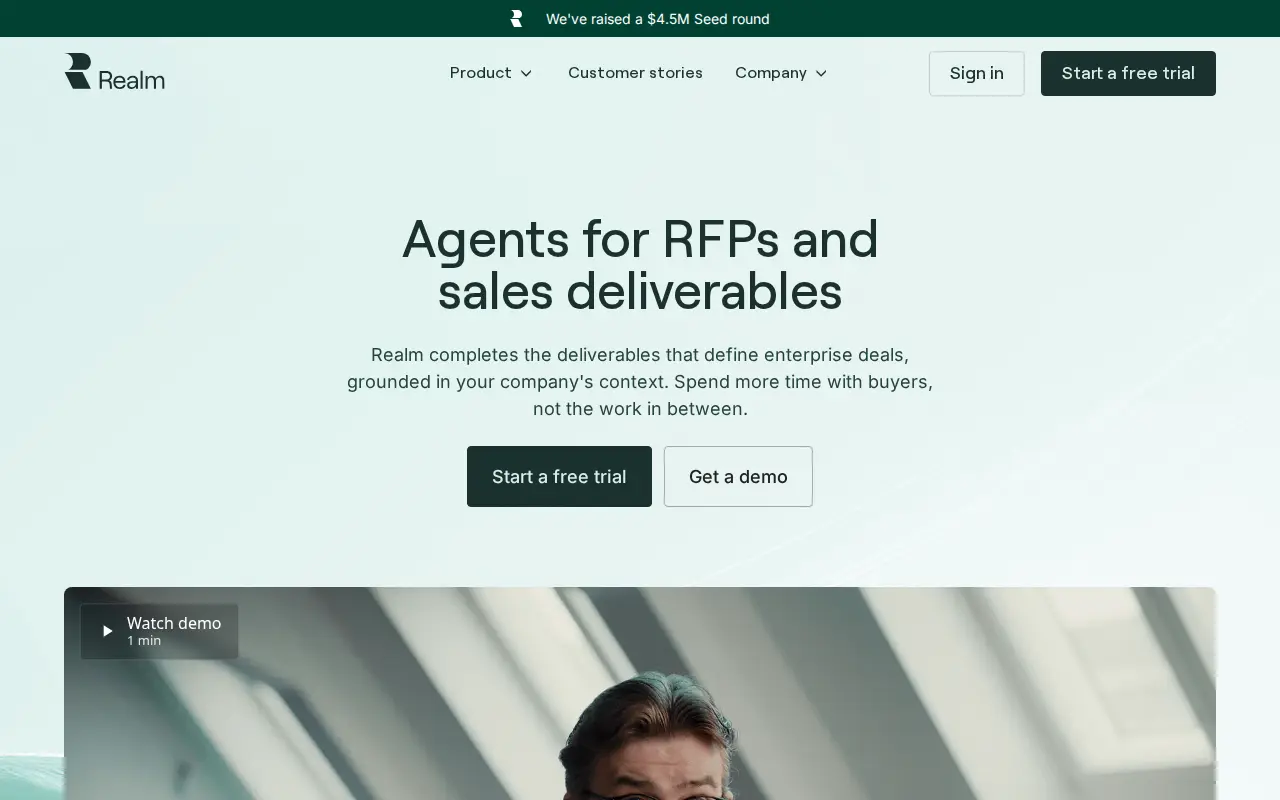
RE Realm
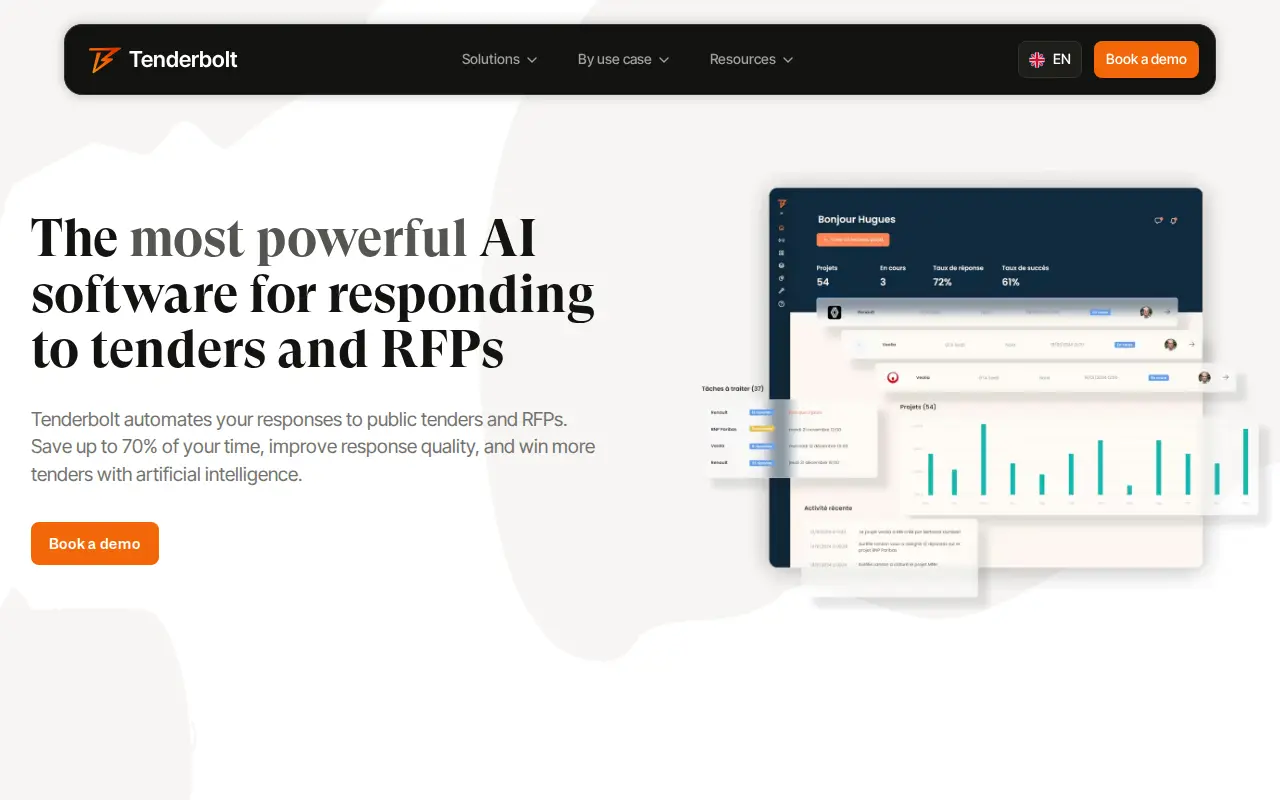
TE Tenderbolt
Security: ISO 27001, SOC 2, and regional hosting
Put Realm and Tenderbolt through the same three questions a security reviewer will ask: ISO 27001, SOC 2, and whether you can keep the tenancy in the US or the EU. Cells say Not listed when we could not find the claim on a public vendor page.
| Check | Realm | Tenderbolt |
|---|---|---|
| ISO 27001 | ISO 27001 | Not listed |
| SOC 2 | Not listed | SOC 2 Type II |
| US hosting | Not listed | Not listed |
| EU hosting | Not listed | Not listed |
Slack and Microsoft Teams
During a live questionnaire, SMEs get pinged in Slack or Teams, not in a vendor portal. Here is what Realm and Tenderbolt publish for those two connections.
| Connection | Realm | Tenderbolt |
|---|---|---|
| Slack | Slack | Not listed |
| Microsoft Teams | Microsoft Teams | Microsoft Teams |
Subprocessors: the big three clouds, then the niche names
Compare Realm and Tenderbolt on AWS, Azure and GCP first. Then scan for niche processors a reviewer should pause on: third-party LLMs, session replay, or support that leaves the region you elected.
| Layer | Realm | Tenderbolt |
|---|---|---|
| AWS, Azure, GCP | Not listed | Not listed |
| Watch-outs | No niche processors flagged in our sourced list. | No niche processors flagged in our sourced list. |
Realm and Tenderbolt are both young European AI response platforms, both keep customer data in the EU, and both will run a Go/No-Go analysis on a tender before your team writes a word. On a shortlist they look like neighbours. In practice they are built for different bids. Realm, founded in Helsinki in 2023, is a workspace for software companies selling to larger buyers, where RFPs share a home with chat, search and custom agents for the whole revenue team. Tenderbolt, founded in Paris in 2024, is a tender response platform with particular depth in French public procurement, and it does one job Realm does not advertise at all: matching a buyer’s pricing schedule, line by line, to your product catalogue.
If you sell SaaS to European enterprises, read this as a check on whether Tenderbolt’s public-sector depth matters to you. If you bid on public contracts with technical memoirs and pricing grids, read it as a check on whether Realm’s broader workspace is worth the switch in focus. Product and pricing details are as of October 2026.
Key takeaways
- Different bid profiles: Realm targets software vendors answering RFPs, security questionnaires and DDQs inside a broader revenue workspace. Tenderbolt targets bid teams answering public tenders, RFQs and private RFPs, with built-in handling of French procurement documents such as the DCE, CCTP, DC1, DC2 and DUME.
- Pricing schedules are Tenderbolt-only: Tenderbolt matches RFQ line items to your catalogue or PIM and writes the result back into the buyer’s Excel file. Realm does not describe an equivalent.
- The wider workspace is Realm-only: Realm adds a revenue-team chat assistant, enterprise search, custom agents with triggers, a Slack app, an API and an MCP server around its RFP module.
- Both are EU-hosted: Realm stores data on Google Cloud in Finland and the Netherlands and holds ISO 27001. Tenderbolt advertises EU hosting, SOC 2 Type II, AES-256 encryption and SSO/SAML.
- Both are quote-only: Neither publishes current prices or offers a trial; both sell through a demo.
- Limitations: Tenderbolt is available in French and English and has almost no independent user reviews yet. Realm’s default AI setup mixes US and EU language models, with EU-only models on request.
Same continent, different bids
The easiest way to see the split is to picture the documents each one expects.
Realm’s documentation talks about questionnaires parsed from Excel, CSV, PDF and Word, narrative “document responses,” Go/No-Go analysis across dimensions you define, and a project checklist of every document the buyer’s files ask for. Its named customers (LeadDesk, Sievo, Sympa, Hostaway) are software companies, and its connectors reach into Jira, GitHub, Linear and support desks because that is where a software vendor’s product truth lives. The RFP is one surface of a knowledge platform; reps also use the same knowledge through chat and Slack between bids.
Tenderbolt’s material talks about tender packs, compliance grids, technical response frameworks, executive summaries and pricing schedules. Its FAQ lists open, restricted, negotiated and simplified adaptive procedures, administrative qualification files (DC1, DC2, DUME) and French marchés publics documents (DCE, CCTP, CCAP, RC). Named customers include Bechtle, Bunzl, Diot Siaci, Generix, Crit, AFPA and Roux TP, spanning IT services, distribution, insurance broking, software, staffing, training and public works. That reads as a public-procurement and B2B services customer base more than a SaaS one.
Neither tool is in the wrong category for RFP and questionnaire work. They are in the right category for different buyers.
Reading the tender and deciding whether to bid
Both platforms start where a good bid manager starts: should we even answer this?
Realm’s Go/No-Go reads every project file, extracts requirements, and sorts each one as a qualification, capability, commercial term or procedural item. Qualification and capability requirements get checked against your knowledge base; commercial and procedural items are listed but never scored. With admin-defined dimensions (say legal fit, commercial fit, delivery capacity), it returns a 1 to 5 score per dimension with blockers, strengths and open questions, recommends an action and records the decision. It can also compare a re-tender against the previous round.
Tenderbolt runs Go/No-Go on the tender documents with scored, source-linked reasoning, extracts deadlines, evaluation criteria, technical requirements, compliance obligations and risk factors, and presents the result in a collaborative analysis grid. Tenderbolt says a DCE analysis takes under 10 minutes; we have not timed it.
For a French public tender, Tenderbolt’s native reading of the DCE, CCTP and RC is the practical advantage. For a private RFP from a multinational buyer with five bid criteria your committee already scores, Realm’s configurable dimensions fit better.
Answering grids, questionnaires and portals
Both fill structured questionnaires from a knowledge base and keep the buyer’s format.
Tenderbolt auto-fills multi-tab Excel grids (security, GDPR, ESG, technical and functional requirements, DDQs), accepts Word, PDF and procurement portal links as input, assigns questions to named contributors such as the CISO or DPO, and writes approved answers straight back into the client’s Excel file. Each answer is sourced from the knowledge base with citations and reasoning, verifiable in one click in the original document, and questions it cannot support are flagged rather than answered.
Realm parses spreadsheet, PDF and Word questionnaires into a grid, proposes a fill plan that skips headings and spacer rows, and drafts each cell with an answer quality score (Very High to Low) based on source trustworthiness and topic sensitivity. A Partial answer marker shows when a reply misses part of a multi-part question. Rows can carry their own reviewer, and an organization setting can block export until every row is approved. Answer profiles control length and tone at the organization, RFP and section level.
On portals, neither documents a portal-autofill extension. Tenderbolt lists “security portals” and portal links as questionnaire inputs; Realm’s browser extension is documented for search and chat. If your buyers use web portals heavily, test both on one.
Writing technical proposals
This is the part of a public tender that eats the most expert hours, and both vendors have invested in it.
Tenderbolt drafts a technical proposal (the mémoire technique in French tenders) structured point by point against the client’s requirements and evaluation grid, cites every paragraph back to the knowledge base, routes sections to experts for final review with comments and version history, and exports to Word or PowerPoint. It also fills technical response frameworks supplied in Excel or Word and generates an executive summary.
Realm’s document responses work in a similar shape for narrative RFPs: it reads the RFP, proposes an outline, and where section-by-section planning is on, lists each section with instructions, requirements, emphasis and a word budget before drafting. The checklist suggests documents the tender asks for that nobody has started yet, quoting the sentence that demanded each one.
Both will produce a cited first draft. The difference is the template they assume: Tenderbolt’s is the public-sector evaluation grid; Realm’s is a buyer’s RFP and the documents it requests.
Pricing schedules and RFQs
Tenderbolt has a capability here with no Realm counterpart. You upload the buyer’s pricing schedule or RFQ file; Tenderbolt extracts each line item, volume, unit of measure and technical requirement, and matches it to references in your catalogue or PIM. You can steer the matching toward cheapest, most eco-friendly or best availability, see a side-by-side spec comparison with the reasoning, adjust any match, and export into the correct cells of the original file.
If you are a distributor, reseller or manufacturer answering RFQs with hundreds of line items, this feature alone can justify the shortlist. If you sell subscriptions with a three-line price sheet, it is irrelevant, and Realm’s broader workspace is the better use of budget.
Language, jurisdiction and where data sits
Tenderbolt says the platform is available in French and English, with its deepest support built for French public procurement. Its legal notice places the company near Paris under French law. For a French or Belgian bid team that is reassuring; for a team bidding in German, Dutch or the Nordics it is a question to raise early.
Realm handles multilingual work through a working-language setting: a questionnaire in another language can be translated once for drafting while exports default to the original document language, and Go/No-Go summaries can be written in the project language. Its security documentation lists ISO/IEC 27001:2022, GDPR, HIPAA and CCPA, with data stored on Google Cloud in Finland and the Netherlands and single-tenant deployment for enterprise customers. The fine print matters if everything must stay inside the EU: Realm’s default model setup draws on both US-based and EU-based LLM providers, and an EU-only configuration is something you request.
Tenderbolt advertises EU hosting, SOC 2 Type II, AES-256 encryption, SSO/SAML and client data isolated from other customers, and says it does not retain data without consent.
What it costs
Neither vendor will quote you online.
Tenderbolt’s FAQ says pricing is tailored to team size and RFP volume and that it does not offer a generic pricing grid; every call to action leads to a demo. Realm’s pricing page now returns a 404 and its free-trial signup is offline. Through June 2026 the public page showed four tiers: Starter for €600 a month (10 users, no RFP automation), RFP Starter for €850 a month (10 users and up to 50 RFPs a year), then Scale (up to 100 RFPs a year) and Enterprise (above 100), both quoted. That is a useful anchor for how Realm thinks about volume, though not a current quote.
Ask both the same questions: what volume band you fall into, whether reviewers count as users, whether onboarding is separate, and what the minimum term is. Tenderbolt’s RFQ matching and catalogue integration may involve setup work (its own case study describes integrating a client’s PIM and training on historical matches), so ask whether that is priced as a project.
Integrations
Realm’s catalogue runs long. Native sources include Google Drive, Microsoft Teams, Salesforce, GitHub, Linear, HubSpot, Confluence, Jira, Notion and Slack, and the docs add SharePoint, Zendesk, Freshdesk, Intercom and Gong among others, with permission mirroring for Slack, Drive and SharePoint. It also exposes a REST API and an MCP server.
Tenderbolt lists SharePoint, Google Drive, Notion and Microsoft Teams, CRM and ERP systems, and a REST API, with real-time sync as documentation changes. The list is shorter but aimed at where a bid team’s material sits: shared drives, past proposals, certifications and policies.
How to run a fair evaluation
With no trial on either side, the demo is your test. Make it a real one.
- Pick one recent bid you lost or nearly missed. Give both vendors the same tender pack, your relevant policies and two or three past responses, and ask for a Go/No-Go and a first draft of the hardest questionnaire.
- Check the citations, not the prose. Open five answers at random and follow each source. A fluent answer pointing at last year’s insurance certificate is worse than a flagged gap.
- Test the format round trip. Have each tool return the buyer’s Excel grid with merged cells and dropdowns intact. For Tenderbolt, include a pricing schedule; for Realm, include a narrative section that runs through its document editor.
- Ask who reviews what. Walk through how your legal, security and pricing owners would be assigned, notified and recorded as approvers.
- Get the commercial terms in writing. Volume band, user definition, onboarding, minimum term and any catalogue integration work.
A vendor that will not run step one on your own material is telling you something useful.
Known issues and watch-outs
Sources and dates sit next to each item.
Realm
- No current price list or trial. The pricing page returns a 404 and buying runs through a demo; the last published tiers are from June 2026 (archived Realm pricing).
- Mixed-origin models by default. Realm’s security page says inference runs on a blend of US and EU providers unless a customer asks for an EU-only setup (Realm security docs, October 2026).
- Coarser permissions on some sources. HubSpot and Notion use user-level rather than document-level access checks “due to API limitations” (same page, October 2026).
- Session policies via support. Organization-wide session expiry and idle timeouts are set up on request, not in the admin panel (same page, October 2026).
Tenderbolt
- No published pricing. Pricing is “tailored to your team’s size and your RFP volume” with no generic grid, and every path leads to a demo (Tenderbolt, October 2026).
- Two languages, one home market. The platform “is available in French and English, with particular depth in French public procurement” (Tenderbolt RFP solution, October 2026).
- Little independent feedback. Its Trustpilot page showed 0 reviews in October 2026 (Trustpilot). The site quotes figures such as 70% time saved and a 25% higher win rate “reported by clients”; without third-party reviews, treat them as the vendor’s own numbers.
Pick Realm when
- You are a software company and most of your bids are private RFPs, security questionnaires and DDQs from enterprise buyers.
- Your answers live in Jira, GitHub, Confluence and support tickets as much as in proposal folders.
- You want the same knowledge serving reps through chat, Slack and agents between bids.
- You need ISO 27001, HIPAA support or a defined EU storage location for procurement.
- Your bid committee wants Go/No-Go scored on its own named dimensions.
Pick Tenderbolt when
- Public tenders, especially French marchés publics, are a large share of your pipeline.
- You routinely produce technical memoirs against an evaluation grid and need Word or PowerPoint output.
- You answer RFQs or pricing schedules with long product lists and want catalogue matching.
- Your team works in French and English and wants a vendor that knows DC1, DC2 and DUME without explanation.
- EU hosting and SOC 2 Type II meet your buyers’ security expectations.
Bottom line
These two solve different problems that happen to share the word “tender.” Realm is the stronger pick for a European software vendor that wants RFP response folded into a wider AI workspace with deep connectors and documented security controls. Tenderbolt is the stronger pick for bid teams that live in public procurement, write technical proposals against scoring grids, and fill pricing schedules from a catalogue. If you do both kinds of bidding, run one recent tender through each and see which first draft needs less rescuing.
Read the full Realm review or Tenderbolt review, or browse all RFP & DDQ software.
Frequently asked questions
What is the difference between Realm and Tenderbolt?
Realm: AI RFPs and sales deliverables for software vendors. Tenderbolt: AI responses for public tenders, hosted in the EU. Realm is best for software vendors selling to enterprise who want AI across RFPs and wider sales deliverables. Tenderbolt is best for european bid teams that want AI tender responses with data kept in the EU.
Which is cheaper, Realm or Tenderbolt?
Neither publishes a comparable starting price, so request quotes for the same scope before comparing cost.
Is Realm or Tenderbolt better for DDQs and security questionnaires?
They are level on DDQ and security-questionnaire handling in our capability model, so test both on one of your own questionnaires.
Do Realm and Tenderbolt both handle RFPs?
Realm: yes, a core strength. Tenderbolt: yes, a core strength.
Which should you choose, Realm or Tenderbolt?
Realm is the pick for software vendors selling to enterprise who want AI across RFPs and wider sales deliverables. Tenderbolt is the pick for european bid teams that want AI tender responses with data kept in the EU.
Are there alternatives to Realm and Tenderbolt?
Yes. Browse the full directory of RFP, DDQ, and security-questionnaire platforms for more options and side-by-side comparisons.
Do Realm and Tenderbolt list ISO 27001, SOC 2, and US or EU hosting?
Realm: ISO 27001 ISO 27001, SOC 2 Not listed, US Not listed, EU Not listed, Slack Slack, Teams Microsoft Teams, clouds Not listed. Tenderbolt: ISO 27001 Not listed, SOC 2 SOC 2 Type II, US Not listed, EU Not listed, Slack Not listed, Teams Microsoft Teams, clouds Not listed. Confirm both on the vendor sites.
Source registry
Every page we read for these profiles, with the month it was last checked. Anything without a source is shown as not publicly disclosed. Spot an outdated fact? Send it from the corrections page.
Realm
Security and compliance
- No security source URL recorded. Treat certifications and hosting as not publicly disclosed.
Product and integrations
Third-party reviews
Tenderbolt
Pricing
Security and compliance
- No security source URL recorded. Treat certifications and hosting as not publicly disclosed.
Product and integrations
Third-party reviews
- No review-site source recorded.