Quick verdict
Choose TrustCloud for enterprise GRC teams that already run their control program in TrustCloud and want questionnaires answered from it; choose Vanta for companies already running SOC 2 or ISO 27001 in Vanta that want questionnaire answers drawn from the same evidence. Neither publishes a comparable starting price, so quote both on the same scope. They match on every capability we score, so fit and price decide it.
Both profiles reviewed Oct 2026
2 of 70 profiles, one scoring modelNo paid placementSources checked: 24Choose TrustCloud or Vanta
TR Choose TrustCloud when
- Enterprise GRC teams that already run their control program in TrustCloud and want questionnaires answered from it.
- Answers sync from your live TrustCloud security program instead of a separately maintained answer library.
VA Choose Vanta when
- Companies already running SOC 2 or ISO 27001 in Vanta that want questionnaire answers drawn from the same evidence.
- Questionnaire answers draw on the same policies and evidence you maintain for audits, so you are not running a second library.
Side-by-side comparison
| Capability | TrustCloud | Vanta | Edge |
|---|---|---|---|
| Best for | Enterprise GRC teams that already run their control program in TrustCloud and want questionnaires answered from it. | Companies already running SOC 2 or ISO 27001 in Vanta that want questionnaire answers drawn from the same evidence. | - |
| Starting price | Custom | Custom | Match |
| Free tier | No | No | Match |
| RFPs | 0/3 | 0/3 | Match |
| DDQs | 1/3 | 1/3 | Match |
| Security questionnaires | 2/3 | 2/3 | Match |
| AI drafting | 3/3 | 3/3 | Match |
| Answer library | 2/3 | 2/3 | Match |
| Source attribution | 2/3 | 2/3 | Match |
| Workflow & approvals | 3/3 | 3/3 | Match |
| Integrations | 3/3 | 3/3 | Match |
| Self-serve onboarding | 1/3 | 1/3 | Match |
| ISO 27001 | ISO 27001:2022 | ISO 27001 | - |
| SOC 2 | SOC 2 Type II | SOC 2 Type II | - |
| US hosting | Yes (AWS, United States) | Yes (US region, app.vanta.com) | - |
| EU hosting | Not listed | Yes (AWS Frankfurt, app.eu.vanta.com) | - |
| Slack | Slack (task status tracking) | Slack (assignments, comments, answering) | - |
| Microsoft Teams | Not listed | Not listed | - |
| AWS, Azure, GCP | AWS | AWS | - |
| Listed integrations | Slack, Jira, Salesforce, HubSpot, ServiceNow, Splunk | AWS, Azure, Google Cloud Platform, GitHub, Jira, Okta, Slack, Salesforce, HubSpot | - |
| Certifications | SOC 2 Type II, ISO 27001, ISO 27701 | SOC 2 Type II, ISO 27001, ISO 42001, HIPAA | - |
What they look like
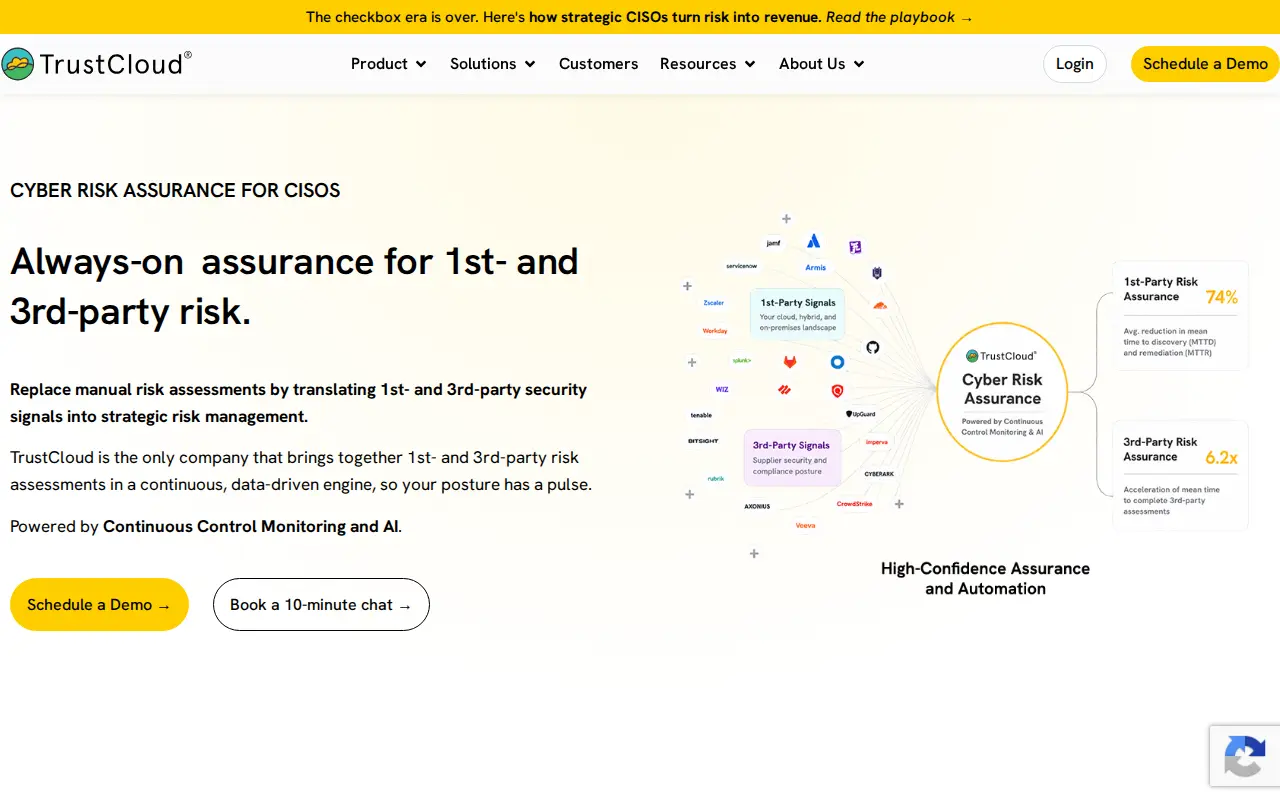
TR TrustCloud
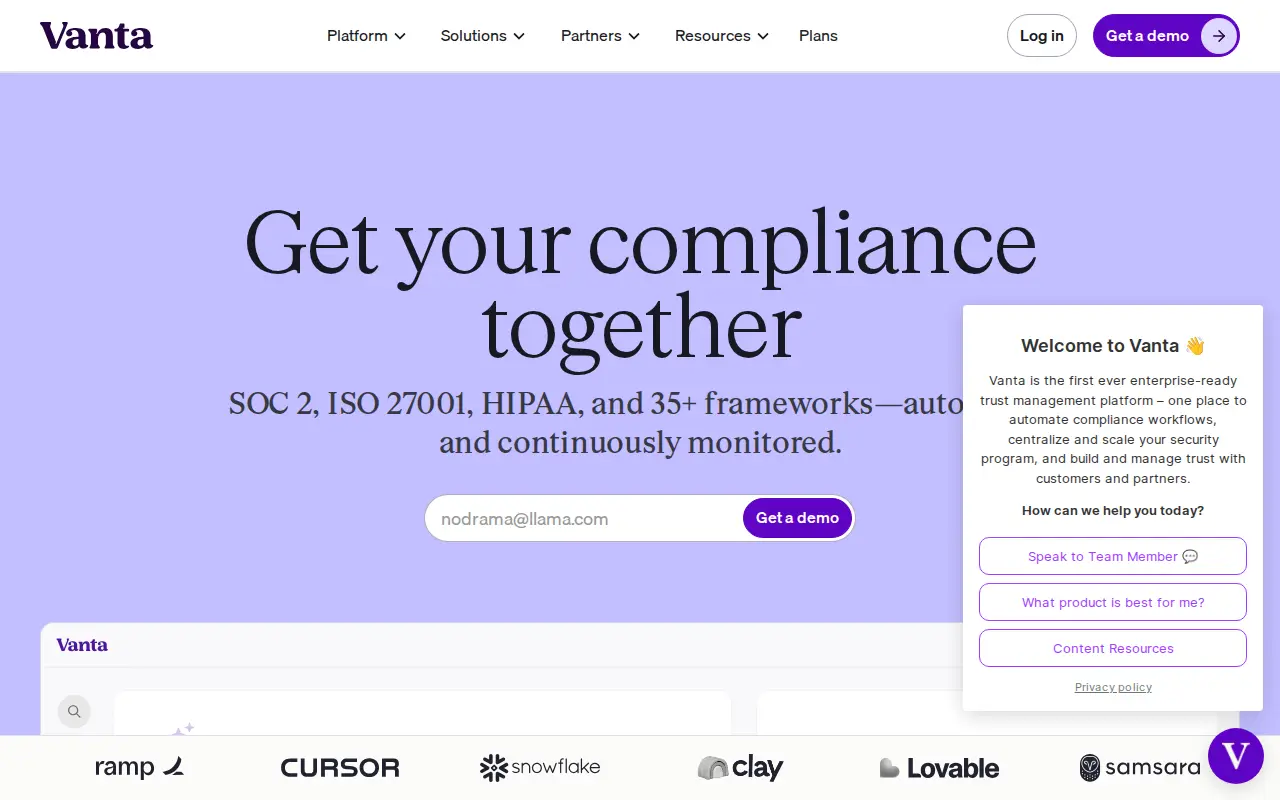
VA Vanta
Security: ISO 27001, SOC 2, and regional hosting
Put TrustCloud and Vanta through the same three questions a security reviewer will ask: ISO 27001, SOC 2, and whether you can keep the tenancy in the US or the EU. Cells say Not listed when we could not find the claim on a public vendor page.
| Check | TrustCloud | Vanta |
|---|---|---|
| ISO 27001 | ISO 27001:2022 trust.trustcloud.ai, 2026-10 Audited by Mastermind; ISO 27701 (processor) is listed alongside it. ISO 42001 and NIST AI RMF are shown as in progress. | ISO 27001 vanta.com, 2026-10 Vanta says its ISO 27001 certificate and SOC 2 Type II report are available on its Trust Center. |
| SOC 2 | SOC 2 Type II trust.trustcloud.ai, 2026-10 Audited by KLR; report is private and requested through the trust portal. | SOC 2 Type II vanta.com, 2026-10 |
| US hosting | Yes (AWS, United States) trust.trustcloud.ai, 2026-10 | Yes (US region, app.vanta.com) help.vanta.com, 2026-10 |
| EU hosting | Not listed | Yes (AWS Frankfurt, app.eu.vanta.com) vanta.com, 2026-10 |
Slack and Microsoft Teams
During a live questionnaire, SMEs get pinged in Slack or Teams, not in a vendor portal. Here is what TrustCloud and Vanta publish for those two connections.
| Connection | TrustCloud | Vanta |
|---|---|---|
| Slack | Slack (task status tracking) trustcloud.ai, 2026-10 | Slack (assignments, comments, answering) vanta.com, 2026-10 |
| Microsoft Teams | Not listed | Not listed |
Subprocessors: the big three clouds, then the niche names
Compare TrustCloud and Vanta on AWS, Azure and GCP first. Then scan for niche processors a reviewer should pause on: third-party LLMs, session replay, or support that leaves the region you elected.
| Layer | TrustCloud | Vanta |
|---|---|---|
| AWS, Azure, GCP | AWS | AWS |
| Watch-outs |
The published list also includes SendGrid (Twilio), Salesforce and Google, all in the United States. | No niche processors flagged in our sourced list. Vanta links a subprocessor list from its security page (trust.vanta.com/subprocessors), which renders client-side; read the current list there or in the DPA during review. |
Short answer: Pick TrustCloud if your control program runs in TrustCloud (or is about to) and you want questionnaire answers synced straight from those controls and policies, held in a Needs Approval queue until an authorized person signs off, and tied back to Salesforce or HubSpot deals. Pick Vanta if your SOC 2 or ISO 27001 evidence already lives in Vanta, you need the tenant in Frankfurt or Australia rather than only the US, and your questionnaire volume fits a published cap of 25, 144 or 288 a year. Neither vendor prints a price, and neither offers a free plan or trial. Both are GRC platforms first. The questionnaire tooling is what this page compares, because that is the job most readers here are hiring for.
If you spend your week answering security questionnaires and keeping a trust page current, the real question is not which compliance suite is bigger. It is where the answer to “do you encrypt data at rest?” comes from, who has to approve it, and what happens when the buyer sends a 40-tab workbook on a Thursday.
Key takeaways
- Answer source: TrustCloud’s TrustShare drops the static library and syncs answers from your TrustCloud security and privacy program, plus previously submitted answers. Vanta keeps a knowledge base built from past questionnaires and the policies and documents already in Vanta.
- Vendor-claimed prefill: TrustCloud says GraphAI can prefill up to 90% of a questionnaire. Vanta says its AI answers 80% or more of questions automatically, with results varying by knowledge base. Both are marketing figures, not independent benchmarks.
- Volume and packaging: Vanta meters questionnaires: an add-on on Essentials, 25 a year on Plus, 144 on Professional, 288 on Advanced Questionnaire Automation. TrustCloud publishes no tiers at all, only a proposal after a demo.
- Hosting: Vanta names a US region, an EU region on AWS in Frankfurt, and an Australian region. TrustCloud’s subprocessor list names AWS in the United States and no EU option.
- Review sample: Vanta shows 4.5 out of 5 from 2,721 G2 reviews (October 2026). TrustCloud shows 4.6 out of 5 from 49 G2 reviews (July 2026). Same neighborhood, very different sample sizes.
- Limitations: TrustCloud’s import path can mean reformatting into its template or waiting up to 48 hours for white-glove import. Vanta’s approval workflows sit only in the Advanced questionnaire tier, and Capterra reviewers call it expensive.
Overview
TrustCloud
TrustCloud is a GRC platform aimed at enterprise security teams. Its compliance side, TrustOps, handles controls and evidence. Its customer-facing side, TrustShare, combines a live trust portal (NDA click-wrap, invitation-only data rooms) with GraphAI questionnaire prefill. Named customers on its customer assurance page include DataRobot, Cribl, ThoughtSpot, Sevco Security, Volpara Health, AtScale and Corelight. Its company page names Tola Capital, OpenView, ServiceNow Ventures, Cisco Investments and Presidio Ventures as investors, without amounts.
Vanta
Vanta, founded in 2018, is a compliance-automation and trust platform. It connects to cloud, identity, HR and other tools (Vanta cites 400+), collects audit evidence, and sells Questionnaire Automation as a module inside its plans or standalone. Logos on its site include GitHub, Duolingo, Intercom, Samsara, Atlassian, Ramp, Snowflake and Icelandair, and its questionnaire page cites Restaurant365 and SonarSource.
Where the answers come from
This is the biggest design difference, and it should drive the decision more than any feature checklist.
TrustCloud argues that static answer libraries are a pain to keep current, so TrustShare syncs answers from your live TrustCloud program instead. When a question lands, the AI looks at related controls and previously submitted answers. If your controls and policies in TrustCloud are current, you skip a whole category of library upkeep. If they are not, the prefill inherits that staleness. Nobody gets to paper over a missing policy with a nicely worded library entry.
Vanta takes a more familiar route. Its knowledge base is fed by your past questionnaires plus the policies and documents already sitting in the platform, with policies synced in. When a new questionnaire arrives, the AI makes a first pass at every question: exact matches come straight from the knowledge base, and the rest get a generated answer for review. You can tag knowledge base content by product, region or industry, which matters when an EU healthcare prospect needs a different answer set than a US fintech. Vanta’s published review in this guide also notes answers can go out in Spanish, French, German or Portuguese.
In practice, both products reward the same thing: a compliance program that is genuinely maintained inside them. The difference is whether there is a separate answer store you can tidy. Vanta has one. TrustCloud deliberately does not.
Citations, confidence and the “I don’t know” case
Both vendors show where an answer came from. Neither shows a confidence score.
TrustCloud’s docs say you can view the source of an answer, meaning the related TrustOps controls or the previously submitted answers it drew on. The more interesting detail is how it behaves when unsure. If the AI lacks high confidence, it offers suggestions rather than writing a prefill. That keeps weak answers out of the Pre-filled tab, which is exactly where a tired reviewer would wave them through.
Vanta describes its generated answers as well-cited, ready for someone to review. The record in this guide does not describe a confidence indicator or a separate low-confidence path. For a security questionnaire, the citation is what lets you spot-check quickly, so test it: open five generated answers and confirm each one points at the right policy, not just a plausible one.
Getting the questionnaire in, and back out
Here Vanta has the cleaner story on paper, and TrustCloud has the more honest documentation about effort.
Vanta says it imports questions from third-party portals, spreadsheets, DOCX and PDF files, then exports the finished questionnaire back in its original format. That round trip is what you want when a buyer insists on their own workbook with their own formulas.
TrustCloud’s docs describe three ways in. Standard templates cover SIG, CAIQ and VSA. A self-serve import uses TrustCloud’s template, which means reformatting the buyer’s file so the AI can read it. A white-glove import has TrustCloud staff do the formatting, and the docs say it typically takes 2 to 3 hours and can take up to 48 hours depending on size and queue. A Chrome extension covers web portal assessments.
That 48-hour figure is the number to circle. Standard frameworks are the easy case for any tool. The 400-row custom spreadsheet from a bank’s procurement team, due tomorrow at noon, is the one that tests the workflow. If those arrive weekly, ask TrustCloud what the queue looks like in your contract.
Review, ownership and approval
TrustCloud ships its approval stage as part of the core workflow. Vanta gates its version behind a higher tier.
In TrustCloud, questions carry owners and move through three tabs: Pre-filled, Needs Answers and Needs Approval. Anything in the approval tab waits for an authorized individual or subject matter expert, who can approve, reject or comment. Task status can be tracked in Slack, and Jira is on the integration list. For audit-minded teams that want a named human on every outbound answer, that explicit gate is a real strength.
Vanta lets you assign a whole questionnaire or single questions to subject matter experts, comment on answers, and reply directly from Slack. Approval workflows with owners and approvers for each review stage exist, but they sit in Advanced Questionnaire Automation, alongside custom tagging and SCIM. Check which version your quote includes before you assume the approval chain is there.
Trust portal versus trust center
Both products try to stop questionnaires before they start. Each one’s deflection layer reflects its larger bet.
TrustShare is a live trust portal with NDA click-wrap and invitation-only data rooms, so a prospect can read your posture without sending a spreadsheet. TrustCloud adds a business intelligence view that can sync with Salesforce or HubSpot, linking trust activity to pipeline. If your CISO has to justify the security team’s time to the CRO, a report that ties security reviews to deals is a useful argument.
Vanta’s Trust Center offers gated documents, NDA collection that connects to Salesforce, HubSpot, DocuSign or Ironclad, and an optional AI chatbot that answers buyer questions from the trust center content. Essentials includes a Trust Center. Professional, the plan Vanta marks as most popular, upgrades it to an Advanced Trust Center. The chatbot is the feature to try with a hostile question, since anything it says is effectively an answer you published.
Pricing and the meter
No dollars from either vendor. What differs is how much of the shape you can see before the first call.
| TrustCloud | Vanta | |
|---|---|---|
| How you buy | Proposal after a demo | Personalized pricing after a demo |
| Published tiers | None | Essentials, Plus, Professional, Enterprise |
| Questionnaire volume | Not published | Add-on on Essentials, 25 a year on Plus, 144 on Professional |
| Standalone questionnaire product | Not described | 144 a year, or 288 on Advanced |
| Approval workflows | In the core questionnaire workflow | Advanced Questionnaire Automation |
| Free plan or trial | No | No |
TrustCloud’s pricing page says every GRC journey is different and offers to “put together a proposal that fits.” The only call to action is to schedule a demo.
Vanta lists its plans by name, then routes every one to a demo. The useful public detail is the meter. If your team handles 180 security reviews a year, Professional’s 144 does not cover you, and Advanced’s 288 does. Do that arithmetic before the call, because the plan that fits your compliance scope may not be the plan that fits your questionnaire volume.
With TrustCloud, there is no meter to model. That is either refreshing or unnerving, depending on how much you trust the proposal. Ask in writing whether questionnaire volume, users or frameworks drive the number.
Security: ISO 27001, SOC 2, and regional hosting
Both vendors hold the two certificates a security reviewer looks for first. Hosting is where they split.
TrustCloud’s trust portal lists SOC 2 Type II (audited by KLR, with the report private and requested through the portal), ISO 27001:2022 (audited by Mastermind) and ISO 27701 as a processor. ISO 42001 and the NIST AI RMF are shown as in progress. Hosting is AWS in the United States, and no EU option is listed.
Vanta states a SOC 2 Type II attestation and ISO 27001 certification, and says both are available on its Trust Center. Its security page also lists HIPAA and GDPR, and the facts in this guide record ISO 42001, PCI DSS and CCPA with medium confidence. Vanta runs a US region (app.vanta.com), an EU region on AWS in Frankfurt (app.eu.vanta.com), and an Australian region. Its help center adds a fair caveat: a regional tenant does not guarantee that every supporting service or subprocessor operates only in that region.
If your buyers ask for EU data residency, that is close to a deciding fact. On these records, Vanta can offer a named EU region and TrustCloud does not list one.
Slack and Microsoft Teams
Slack is on both profiles. Microsoft Teams is on neither.
TrustCloud uses Slack for task status tracking around questionnaires. Vanta goes further on the questionnaire side: assignments, comments and answering directly from Slack. If your subject matter experts live in Teams, neither record shows a native path, so ask both vendors before assuming one exists.
Subprocessors
TrustCloud publishes a readable list. Vanta links one that is harder to inspect from the outside.
TrustCloud’s list names Amazon Web Services (cloud provider, United States), Microsoft (office tools plus sales and product AI models), Auth0 (customer SSO), SendGrid, Salesforce and Google, all in the United States. It also names OpenAI and Anthropic with no stated role or data location. If your customers’ questionnaires contain sensitive architecture detail, ask TrustCloud which content reaches those two.
Vanta names AWS for infrastructure, key management and the Frankfurt data centre. Its security page links a subprocessor list at trust.vanta.com/subprocessors, which renders client-side, so read the current list there or in the DPA during your review.
Integrations and the rest of the stack
Both platforms connect widely on the compliance side. The questionnaire-relevant integrations are fewer.
TrustCloud’s TrustOps lists 100+ API-based evidence collection integrations, plus Slack and Jira. TrustShare analytics sync with Salesforce or HubSpot, and ServiceNow and Splunk have dedicated pages.
Vanta says it pulls data from 400+ tools across cloud, identity, HRIS, task management, CRM and communication platforms. Named examples include AWS, Azure, Google Cloud Platform, GitHub, Jira, Okta, Slack, Salesforce and HubSpot, with DocuSign and Ironclad on the trust center side.
The overlap that matters for questionnaire work is Slack, Jira, Salesforce and HubSpot. Vanta’s catalog is larger by its own count. TrustCloud’s ServiceNow and Splunk pages will interest enterprise security teams already standardized on those tools.
What reviewers say
Vanta has the bigger and noisier sample. TrustCloud’s is small enough that single reviews move the picture.
Vanta holds 4.5 out of 5 from 2,721 reviews on G2 (October 2026), 4.4 from 71 on Gartner (July 2026) and 4.2 from 33 on Capterra (October 2026). Cost is the recurring complaint. Capterra reviewers wrote “I do think Vanta is very expensive” (May 2025) and “The pricing was too high” (October 2025). G2’s May 2026 review summary says some reviewers found the interface disorganized, the AI features overly relied upon, and customer support slow or lacking in some areas.
TrustCloud holds 4.6 out of 5 from 49 reviews on G2 (July 2026) and 4.0 from 4 on Capterra (October 2026). One Capterra reviewer, an IT admin writing in January 2025, found it “very hard to understand the merit of using the product” without onboarding and said there were few instructions. Four reviews is a thin base, so treat that as a prompt to ask about onboarding, not a verdict.
Pros and cons
TrustCloud pros
- Answers sync from your live TrustCloud controls and policies, so there is no separate library to keep in step.
- Low-confidence questions get suggestions instead of a prefill, which keeps the Pre-filled tab cleaner.
- A built-in Needs Approval stage with owners, approve, reject and comment actions.
- Trust portal analytics tie security reviews to Salesforce or HubSpot pipeline.
- A readable subprocessor list on its trust portal.
TrustCloud cons
- No published prices, tiers, free plan or trial.
- Custom questionnaires need reformatting into TrustCloud’s template, or a white-glove import that can take up to 48 hours.
- US hosting only on the published list, and OpenAI and Anthropic appear without a stated role.
- A small review sample, including one Capterra complaint about onboarding.
Vanta pros
- Imports portal, spreadsheet, DOCX and PDF questionnaires and exports back to the original format.
- A tagged knowledge base for product, region and industry variants.
- US, EU (Frankfurt) and Australian regions.
- A large review base and a 400+ tool integration catalog, by Vanta’s count.
Vanta cons
- No published prices, free plan or trial.
- Questionnaire volume is capped by plan, and approval workflows require the Advanced tier.
- Capterra reviewers call it expensive, and G2’s summary flags interface and support complaints.
Who should pick TrustCloud
- Your GRC team runs its control program in TrustCloud, or is choosing a GRC platform now and wants questionnaires fed from the same controls.
- You want every outbound answer to wait for a named approver, without paying for a higher questionnaire tier to get that gate.
- Most incoming questionnaires are SIG, CAIQ or VSA, or you can tolerate the import step on custom files.
- Your CISO wants to show the CRO how security reviews connect to Salesforce or HubSpot deals.
- Your customers are content with US hosting.
Who should pick Vanta
- Your SOC 2 or ISO 27001 evidence already lives in Vanta, and you want questionnaire answers drawn from it.
- Buyers send questionnaires as portals, PDFs and Word files as often as spreadsheets, and they want their own format back.
- You sell into the EU or Australia and need a named regional tenant.
- Your yearly volume maps cleanly to 25, 144 or 288 questionnaires.
- You value a large review base and a wide integration catalog over a smaller vendor’s attention.
The RFP and DDQ question
Neither product is built for commercial RFPs or investor DDQs. TrustCloud positions TrustShare for security reviews and does not market RFP or due-diligence response, though it can import custom assessments. Vanta describes its module for security questionnaires and makes no RFP claim. If your team answers a 90-page sales RFP or an investor DDQ in the same week as a security review, plan on a separate response tool alongside whichever compliance platform you choose. Many teams run both.
Final verdict
These two solve the same job from different starting points. TrustCloud bets that your controls are the answer library, then wraps them in a strict approval queue and a trust portal that reports into the CRM. Vanta bets on a familiar knowledge base, wider file handling, regional hosting and a published questionnaire meter, backed by a much larger public review base.
Best for answers synced from controls with a hard sign-off: TrustCloud. Best for format flexibility and EU or Australian residency: Vanta. Before signing, run one real custom questionnaire from last quarter through each, time the import, open the sources on five answers, and push one through approval. The tool whose output your own security lead would send without rewriting is the one to buy.
Read the full TrustCloud review or Vanta review, or browse all RFP & DDQ software.
Sources checked
- TrustCloud pricing page (checked October 2026)
- TrustCloud TrustShare page (checked October 2026)
- TrustCloud TrustOps page (checked October 2026)
- TrustCloud company page (investors) (checked October 2026)
- TrustCloud customer assurance page (checked October 2026)
- TrustCloud docs: importing a questionnaire (checked October 2026)
- TrustCloud docs: questionnaire workflow (checked October 2026)
- TrustCloud docs: business intelligence (checked October 2026)
- TrustCloud trust portal (checked October 2026)
- TrustCloud reviews on G2 (checked July 2026)
- TrustCloud reviews on Capterra (checked October 2026)
- Vanta pricing (checked October 2026)
- Vanta questionnaire automation (checked October 2026)
- Vanta trust center (checked October 2026)
- Vanta homepage (checked October 2026)
- Vanta integrations (checked October 2026)
- Vanta security (checked October 2026)
- Vanta about page (founded) (checked October 2026)
- Vanta EU data centre announcement (checked October 2026)
- Vanta regional hosting help (checked October 2026)
- Vanta on G2 (checked October 2026)
- Vanta reviews on Gartner (checked July 2026)
- Vanta reviews on Capterra (checked October 2026)
Frequently asked questions
What is the difference between TrustCloud and Vanta for security questionnaires?
Both are compliance platforms with a buyer-facing trust site and AI that drafts questionnaire answers. TrustCloud's TrustShare skips the classic answer library and syncs answers from the controls, policies and past submissions in your TrustCloud program. Vanta, founded in 2018, builds a knowledge base from past questionnaires plus the policies and documents already in Vanta, then takes an AI first pass at every question.
How much do TrustCloud and Vanta cost?
Neither publishes a price. TrustCloud's pricing page offers a proposal after a demo, and Vanta's pricing page asks you to request a demo for personalized pricing. Neither lists a free plan or a trial. Vanta does publish its questionnaire caps: an add-on on Essentials, 25 a year on Plus, 144 on Professional, and 288 on Advanced Questionnaire Automation.
Can TrustCloud or Vanta handle questionnaires in customer portals?
Both have a path. TrustCloud offers a Chrome extension for web portal assessments. Vanta says it imports questions from third-party portals, spreadsheets, DOCX and PDF files, and exports the finished questionnaire back in its original format.
Where do TrustCloud and Vanta host customer data?
TrustCloud's subprocessor list names AWS in the United States, and no EU hosting option is listed. Vanta runs a US region, an EU region on AWS in Frankfurt, and an Australian region, with a help-center note that a regional tenant does not guarantee every supporting service or subprocessor stays in that region.
Do TrustCloud or Vanta answer RFPs and investor DDQs?
Not as a marketed job. TrustCloud positions TrustShare for security reviews and does not market RFP or due-diligence response, though it can import custom assessments. Vanta describes its module for security questionnaires and makes no RFP claim. Teams with commercial RFPs or investor DDQs usually need a separate response tool.
Should I choose TrustCloud or Vanta?
Choose TrustCloud if your control program lives, or will live, in TrustCloud and you want answers synced from it with a hard approval step and analytics that tie security reviews to Salesforce or HubSpot deals. Choose Vanta if your SOC 2 or ISO 27001 evidence already sits in Vanta, you need an EU region, and your yearly volume fits 25, 144 or 288 questionnaires.
Do TrustCloud and Vanta list ISO 27001, SOC 2, and US or EU hosting?
TrustCloud: ISO 27001 ISO 27001:2022, SOC 2 SOC 2 Type II, US Yes (AWS, United States), EU Not listed, Slack Slack (task status tracking), Teams Not listed, clouds AWS. Vanta: ISO 27001 ISO 27001, SOC 2 SOC 2 Type II, US Yes (US region, app.vanta.com), EU Yes (AWS Frankfurt, app.eu.vanta.com), Slack Slack (assignments, comments, answering), Teams Not listed, clouds AWS. Confirm both on the vendor sites.
Source registry
Every page we read for these profiles, with the month it was last checked. Anything without a source is shown as not publicly disclosed. Spot an outdated fact? Send it from the corrections page.
TrustCloud
Pricing
Security and compliance
Product and integrations
- trustcloud.ai/trustshare
- community.trustcloud.ai/docs/trustshare/questionnaires/importin…
- community.trustcloud.ai/docs/trustshare/questionnaires/question…
- trustcloud.ai/trustops
- community.trustcloud.ai/docs/trustshare/dashboard/business-inte…
- trustcloud.ai
- trustcloud.ai/customer-assurance
- trustcloud.ai/company
Third-party reviews
Vanta
Security and compliance
Product and integrations