TrustCloud review: pricing, features and alternatives (2026)
Quick answer
TrustCloud is security questionnaire software for enterprise GRC teams that already run their control program in TrustCloud and want questionnaires answered from it. TrustCloud does not publish a price, so buying is quote-only. Check before buying: Self-serve import means reformatting into TrustCloud's template; white-glove import usually takes 2 to 3 hours and up to 48.
GRC platform with a trust portal and AI questionnaire prefill
- Overall score: 4.3/5 across 9 capability dimensions.
- Best for: Enterprise GRC teams that already run their control program in TrustCloud and want questionnaires answered from it.
- Pricing: Custom on a quote-only basis.
- Standout strength: Answers sync from your live TrustCloud security program instead of a separately maintained answer library.
- Ecosystem: 6 integrations; SOC 2 Type II, ISO 27001, ISO 27701.
- Limitations: No published prices, free plan or trial; pricing is a proposal after a demo.
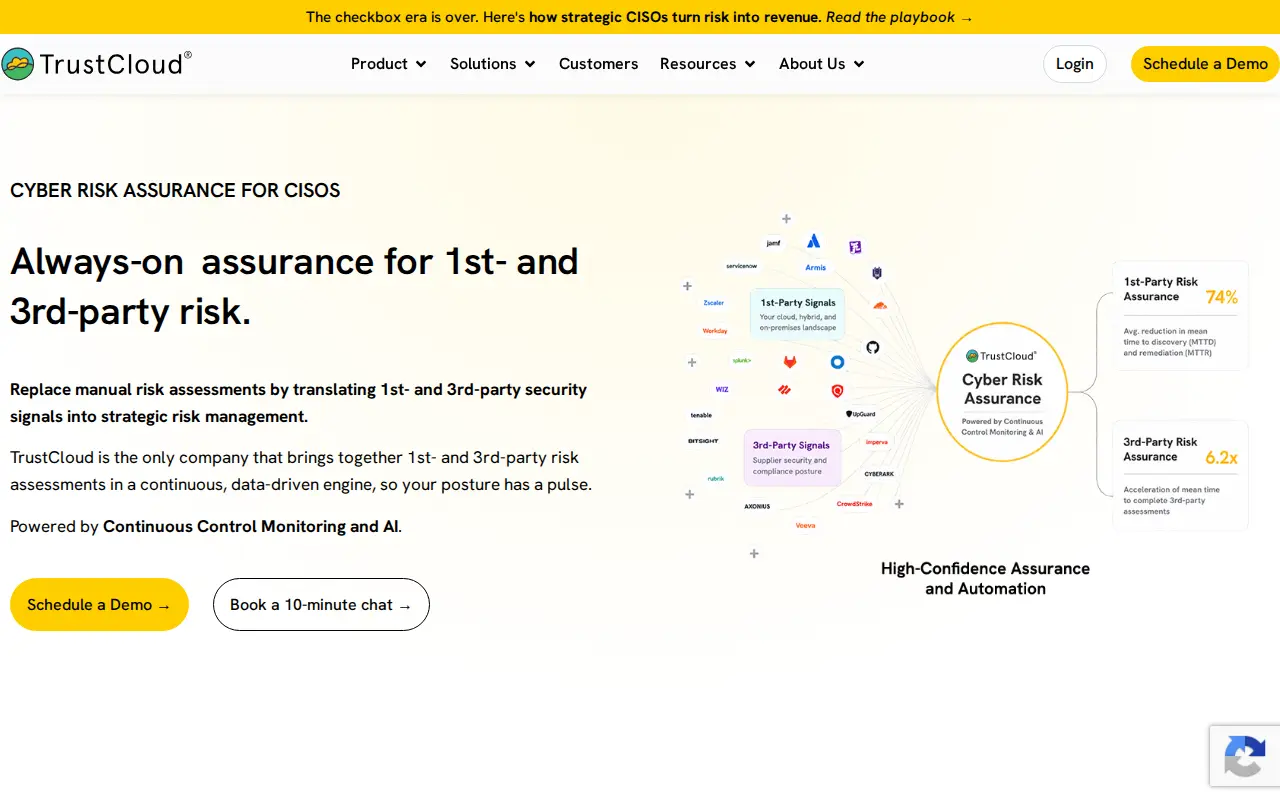
TrustCloud is a GRC platform for enterprise security teams, and its questionnaire tooling makes the most sense when your control program already lives inside it. The questionnaire side, called TrustShare, is a trust portal plus AI that prefills answers from your TrustCloud controls and policies. Bought on its own as a questionnaire responder, it’s a harder case to make.
The job it actually does
TrustCloud’s pitch to buyers has two halves. First, deflection: TrustShare gives prospects a live trust portal, with NDA click-wrap and invitation-only data rooms, so they can read your posture without sending a spreadsheet. Second, when a questionnaire is unavoidable, TrustCloud says its GraphAI can prefill up to 90% of it and leave you to review and approve.
The unusual design choice is the answer library, or the lack of one. TrustCloud calls static answer libraries a pain to keep current and says TrustShare instead syncs answers directly from your security and privacy program. In practice that means the quality of your questionnaire answers is only as good as the controls, policies and documents you maintain in TrustCloud. If that program is current, you skip a whole category of library upkeep. If your truth lives somewhere else, this design works against you.
What you get on paper
The docs describe three ways in. A white-glove import has TrustCloud staff format your file, a self-serve import uses their template, and standardized templates cover SIG, CAIQ and VSA. A Chrome extension handles web portal assessments.
Once imported, questions sort into tabs. One holds what the AI pre-filled, another what still needs an answer, and a third what needs approval. Questions have owners, answers can be approved or rejected with comments, and anything in the approval tab waits for an authorized person or subject matter expert. That explicit sign-off step is a real plus for teams with audit-minded reviewers. When the AI isn’t confident, it offers suggestions instead of a prefill, drawing on related controls and previously submitted answers, and the docs say you can view the source of an answer.
Around that sit task tracking through Slack and Jira, a business intelligence view that can sync with Salesforce or HubSpot to tie security reviews to pipeline, and TrustOps on the compliance side with 100+ API-based evidence integrations.
On its own security, TrustCloud’s trust portal lists SOC 2 Type II, ISO 27001:2022 and ISO 27701, with ISO 42001 and the NIST AI RMF marked as in progress. Its subprocessor list puts hosting on AWS in the United States and names Microsoft (including product AI models), OpenAI and Anthropic. The last two have no stated role or location, which is worth a question if your customers’ questionnaires contain sensitive detail.
Pricing reality
There are no published prices. The pricing page says every GRC journey is different and offers to “put together a proposal that fits” after a demo. No free plan or trial is listed.
The catch
The import path is the first thing I’d poke at. Self-serve import means reformatting the customer’s questionnaire into TrustCloud’s template so the AI can read it. White-glove import takes that off your plate, but the docs say it typically takes 2 to 3 hours and can take up to 48 hours depending on size and queue. For a questionnaire due tomorrow, that wait matters.
Onboarding is the second. A January 2025 Capterra reviewer found it hard to see the product’s merit without proper onboarding and noted there weren’t many instructions. Capterra’s sample is tiny, four reviews averaging 4.0 out of 5 when I checked, so weigh that accordingly. G2 showed 4.6 from 49 reviews in our July read.
How to test it
Ask for a demo using a real questionnaire from the last month, ideally a custom spreadsheet rather than a SIG, since the standard templates are the easy case. Time the import. Then look at how many answers land in pre-filled versus needs-answers, open the source on a few pre-filled ones, and push one answer through the approval tab to see who gets notified and how. If your controls aren’t in TrustCloud yet, ask what prefill looks like on day one.
Who I’d hand it to: an enterprise GRC team that runs, or plans to run, its compliance program in TrustCloud and wants a trust portal plus questionnaire prefill fed from the same controls.
Who I’d steer elsewhere: a team that only needs fast questionnaire answers from existing documents, or anyone working to tight turnarounds on oddly formatted files where a 48-hour import queue would hurt.
Overview
TrustCloud is a GRC platform for enterprise security teams; its TrustShare product combines a live trust portal with AI that prefills security questionnaires from your TrustCloud controls and policies.
Capability snapshot
Nine jobs, scored 0 (not offered) to 3 (category-leading). TrustCloud is strongest on AI drafting and lightest on RFPs. The same scores feed every comparison table.
- RFPs0/3
- DDQs1/3
- Security questionnaires2/3
- AI drafting3/3
- Answer library2/3
- Source attribution2/3
- Workflow & approvals3/3
- Integrations3/3
- Self-serve onboarding1/3
Strongest: AI draftingLightest: RFPs
Key features
- TrustShare live trust portal with NDA click-wrap and invitation-only data rooms
- GraphAI questionnaire prefill drawn from your controls, policies and documents
- SIG, CAIQ and VSA templates, a self-serve import template and a white-glove import service
- Approval stage for answers with question owners, plus approve and reject actions
- Chrome extension for web portal assessments
- Business intelligence that ties trust activity to Salesforce or HubSpot pipeline
Who it's for
CISOs and GRC leaders at larger companies who want one platform for continuous compliance, a customer-facing trust portal and questionnaire response.
Strengths
- Answers sync from your live TrustCloud security program instead of a separately maintained answer library.
- A clear approval stage: answers wait in Needs Approval for an authorized person or subject matter expert.
- Trust portal and questionnaire tooling in one product, with analytics that link security reviews to CRM deals.
Limitations
- No published prices, free plan or trial; pricing is a proposal after a demo.
- Self-serve import means reformatting into TrustCloud's template; white-glove import usually takes 2 to 3 hours and up to 48.
- A January 2025 Capterra reviewer found the product hard to make sense of without onboarding.
Where it falls short
Gaps we found in research, each linked to its source.
- No published prices, free plan or trial: "Tell us about yours and we'll put together a proposal that fits." trustcloud.ai, 2026-10
- Self-serve import requires reformatting a questionnaire into TrustCloud's template; white-glove import typically takes 2 to 3 hours and can take up to 48 hours. community.trustcloud.ai, 2026-10
- A Capterra reviewer (IT admin, January 2025) found it "very hard to understand the merit of using the product" without onboarding and said there were few instructions. capterra.com, 2026-10
Security: ISO 27001, SOC 2, and regional hosting
A security review of TrustCloud usually starts with three questions: ISO 27001, SOC 2, and whether you can keep data in the US or the EU. We only mark a yes when a public vendor page supports it.
- ISO 27001
- ISO 27001:2022 trust.trustcloud.ai, 2026-10
Audited by Mastermind; ISO 27701 (processor) is listed alongside it. ISO 42001 and NIST AI RMF are shown as in progress.
- SOC 2
- SOC 2 Type II trust.trustcloud.ai, 2026-10
Audited by KLR; report is private and requested through the trust portal.
- US hosting
- Yes (AWS, United States) trust.trustcloud.ai, 2026-10
- EU hosting
- Not listed
The subprocessor list gives AWS as the cloud provider in the United States. No EU hosting option is listed.
Slack, Teams and the rest of the stack
TrustCloud collaboration is only as useful as the chat tools your SMEs already live in. Slack and Microsoft Teams are the two that matter on a live questionnaire.
- Slack
- Slack (task status tracking) trustcloud.ai, 2026-10
- Microsoft Teams
- Not listed
Subprocessors
For TrustCloud, start with the big three clouds (AWS, Azure, GCP), then look at niche processors that touch answer content, call a third-party model, or record sessions.
- AWS, Azure, GCP
- AWS
- Amazon Web Services: Cloud service provider (United States) trust.trustcloud.ai
- Microsoft: Office tools, sales and product AI models (United States) trust.trustcloud.ai
- OpenAI: Listed subprocessor (no role or location given) Watch-out: Listed without a stated role or data location. Ask what questionnaire content reaches it. trust.trustcloud.ai
- Anthropic: Listed subprocessor (no role or location given) Watch-out: Listed without a stated role or data location. Ask what questionnaire content reaches it. trust.trustcloud.ai
- Auth0: Customer SSO (United States) trust.trustcloud.ai
The published list also includes SendGrid (Twilio), Salesforce and Google, all in the United States.
Topics
Ratings
Pricing and value
How much does TrustCloud cost?
TrustCloud uses quote-only pricing, quoted per deal rather than published No plans or prices are published; TrustCloud builds a proposal after a demo ("Tell us about yours and we'll put together a proposal that fits"). No free plan or trial.
On our capability model it scores 4.3 out of 5 across 9 dimensions, and G2 reviewers rate it 4.6/5 across 49 reviews. Weigh that against enterprise GRC teams that already run their control program in TrustCloud and want questionnaires answered from it to judge whether the price fits the job.
Pricing and details verified Oct 2026. Confirm on the vendor's site before you buy.
Who should pick TrustCloud, and who should skip it
Pick it if you fit this profile: CISOs and GRC leaders at larger companies who want one platform for continuous compliance, a customer-facing trust portal and questionnaire response. Where it earns its place: Answers sync from your live TrustCloud security program instead of a separately maintained answer library.
Look elsewhere if this limitation is a deal-breaker: No published prices, free plan or trial; pricing is a proposal after a demo. Also look around if rfps is central to how you work (0/3 here). In that case, one of the TrustCloud alternatives may fit better.
Bottom line
Best use case in one line: Enterprise GRC teams that already run their control program in TrustCloud and want questionnaires answered from it.
Teams evaluating TrustCloud often also compare TrustCloud vs SafeBase, and TrustCloud vs Vanta, or browse TrustCloud alternatives.
Similar tools
Loopio, AutoRFP.ai, and Responsive come first as category benchmarks, followed by the closest peers on the job TrustCloud is hired for (shared categories and tags, plus aligned capabilities). The snapshot above already scores each job. The notes below say where each tool is stronger, lighter, or a match.
Loopio (4.6/5, Custom (~$20K+/yr est.)). Best for large enterprise teams with high response volume and a mature content library. Leads TrustCloud on RFPs and DDQs, and is lighter on AI drafting. Audience: Teams in SaaS, tech, financial services, and healthcare answering high volumes of RFPs, RFIs, DDQs, and security questionnaires. Watch-out: No public prices: the entry Foundations plan includes 10 seats, and multi-step reviews start one tier up on Enhanced.
AutoRFP.ai (4.9/5, $899/mo). Best for software and finance teams answering structured RFPs in Word and Excel who want accuracy-first drafts, responses written to win, and a workflow that is easy to run. Matches TrustCloud on AI drafting, and leads on RFPs and DDQs. Audience: Software and finance response teams whose RFPs come in as Word or Excel files and who want accuracy-first drafts, winning responses with every line cited to a source, a person, or the AI, and a workflow that is easy to run. Watch-out: Built for structured, source-cited answers rather than creative writing on long-form responses. For persuasive multi-page narrative, AutogenAI is built for that prose job.
Responsive (4.6/5, $10,000 (Emerging edition)). Best for enterprise teams with complex approval chains and heavy integration requirements. Leads TrustCloud on RFPs and DDQs, and is lighter on AI drafting. Audience: Enterprise sales and proposal teams that need the widest workflow across RFPs, RFIs, DDQs, and security questionnaires. Watch-out: Quoted by edition, user count, and add-ons, with a 12-month minimum term as standard and no free trial.
Vanta (4.3/5, Custom). Best for companies already running SOC 2 or ISO 27001 in Vanta that want questionnaire answers drawn from the same evidence. Matches TrustCloud on RFPs, DDQs, and AI drafting. Audience: Security and compliance teams that want audit evidence, a trust center and security questionnaire drafting in one platform. Watch-out: No public prices, free plan or trial; pricing is personalized after a demo.
Drata (4.3/5, Custom). Best for teams running compliance in Drata that want trust-center deflection and AI questionnaire drafts on the same evidence. Matches TrustCloud on DDQs and AI drafting, and leads on RFPs. Audience: Security and GRC teams automating SOC 2, ISO 27001 or similar frameworks who also field customer security reviews. Watch-out: No public prices, free plan or trial; quotes come through sales.
Secureframe (4.3/5, $7,500/yr). Best for companies running SOC 2, ISO 27001 or CMMC compliance in Secureframe that want questionnaire answers from the same data. Matches TrustCloud on DDQs, leads on RFPs, and is lighter on AI drafting. Audience: Security and compliance teams, including defense contractors working toward CMMC, that also field customer security questionnaires. Watch-out: AI questionnaire answers are metered: 100 questions a year on Fundamentals, 15,000 on the quote-only Complete package.
Sources behind this TrustCloud review
Every page we read for the TrustCloud profile, with the month it was last checked. Anything without a source is shown as not publicly disclosed. Spot an outdated fact? Send it from the corrections page.
Pricing
Security and compliance
Product and integrations
- trustcloud.ai/trustshare
- community.trustcloud.ai/docs/trustshare/questionnaires/importin…
- community.trustcloud.ai/docs/trustshare/questionnaires/question…
- trustcloud.ai/trustops
- community.trustcloud.ai/docs/trustshare/dashboard/business-inte…
- trustcloud.ai
- trustcloud.ai/customer-assurance
- trustcloud.ai/company
Third-party reviews
Frequently asked questions
How does TrustCloud get questionnaires into the tool?
Three ways, per its docs: a white-glove import where TrustCloud staff format the file (typically 2 to 3 hours, up to 48), a self-serve import using its template, or standard SIG, CAIQ and VSA templates.
Does TrustCloud need an answer library?
Not in the usual sense. TrustShare syncs answers from your TrustCloud security and privacy program and previously submitted answers, so it fits best when your controls and policies already live in TrustCloud.
What is TrustCloud?
TrustCloud is a GRC platform for enterprise security teams; its TrustShare product combines a live trust portal with AI that prefills security questionnaires from your TrustCloud controls and policies. In this directory it sits under Security Questionnaires.
How much does TrustCloud cost?
TrustCloud is sold on a quote-only basis, so pricing is quoted rather than published. No plans or prices are published; TrustCloud builds a proposal after a demo ("Tell us about yours and we'll put together a proposal that fits"). No free plan or trial.
Does TrustCloud have a free plan or trial?
No. TrustCloud does not advertise a free plan, so expect a demo or quote on its quote-only pricing.
What does TrustCloud do best?
Answers sync from your live TrustCloud security program instead of a separately maintained answer library. A clear approval stage: answers wait in Needs Approval for an authorized person or subject matter expert.
What are the main limitations of TrustCloud?
No published prices, free plan or trial; pricing is a proposal after a demo. Self-serve import means reformatting into TrustCloud's template; white-glove import usually takes 2 to 3 hours and up to 48. A January 2025 Capterra reviewer found the product hard to make sense of without onboarding.
Who should use TrustCloud?
CISOs and GRC leaders at larger companies who want one platform for continuous compliance, a customer-facing trust portal and questionnaire response.
Does TrustCloud handle RFPs, DDQs, and security questionnaires?
TrustCloud is capable on security questionnaires, and RFPs and DDQs are a limited fit. CISOs and GRC leaders at larger companies who want one platform for continuous compliance, a customer-facing trust portal and questionnaire response.
What integrations and certifications does TrustCloud list?
TrustCloud lists Slack, Jira, Salesforce, HubSpot, ServiceNow, Splunk. Certifications on file: SOC 2 Type II, ISO 27001, ISO 27701.
Does TrustCloud have ISO 27001, SOC 2, and US or EU hosting?
TrustCloud ISO 27001: ISO 27001:2022. SOC 2: SOC 2 Type II. US hosting: Yes (AWS, United States). EU hosting: Not listed. Slack: Slack (task status tracking). Microsoft Teams: Not listed. Big-three clouds listed: AWS. Confirm on the vendor site before a security review.