Drata review: pricing, features and alternatives (2026)
Quick answer
Drata is security questionnaire software for teams running compliance in Drata that want trust-center deflection and AI questionnaire drafts on the same evidence. Drata does not publish a price, so buying is quote-only. Check before buying: GRC Foundation covers up to 50 FTEs and one framework, and the full trust center and questionnaire features are a separately tiered Assurance Platform.
Compliance automation, with SafeBase for trust and questionnaires
- Overall score: 4.3/5 across 9 capability dimensions.
- Best for: Teams running compliance in Drata that want trust-center deflection and AI questionnaire drafts on the same evidence.
- Pricing: Custom on a quote-only basis.
- Standout strength: Questionnaire answers can draw on policies and controls synced from Drata, not just a separate answer library.
- Ecosystem: 8 integrations; SOC 2 Type II, ISO 27001, ISO 42001, HIPAA.
- Limitations: No public prices, free plan or trial; quotes come through sales.
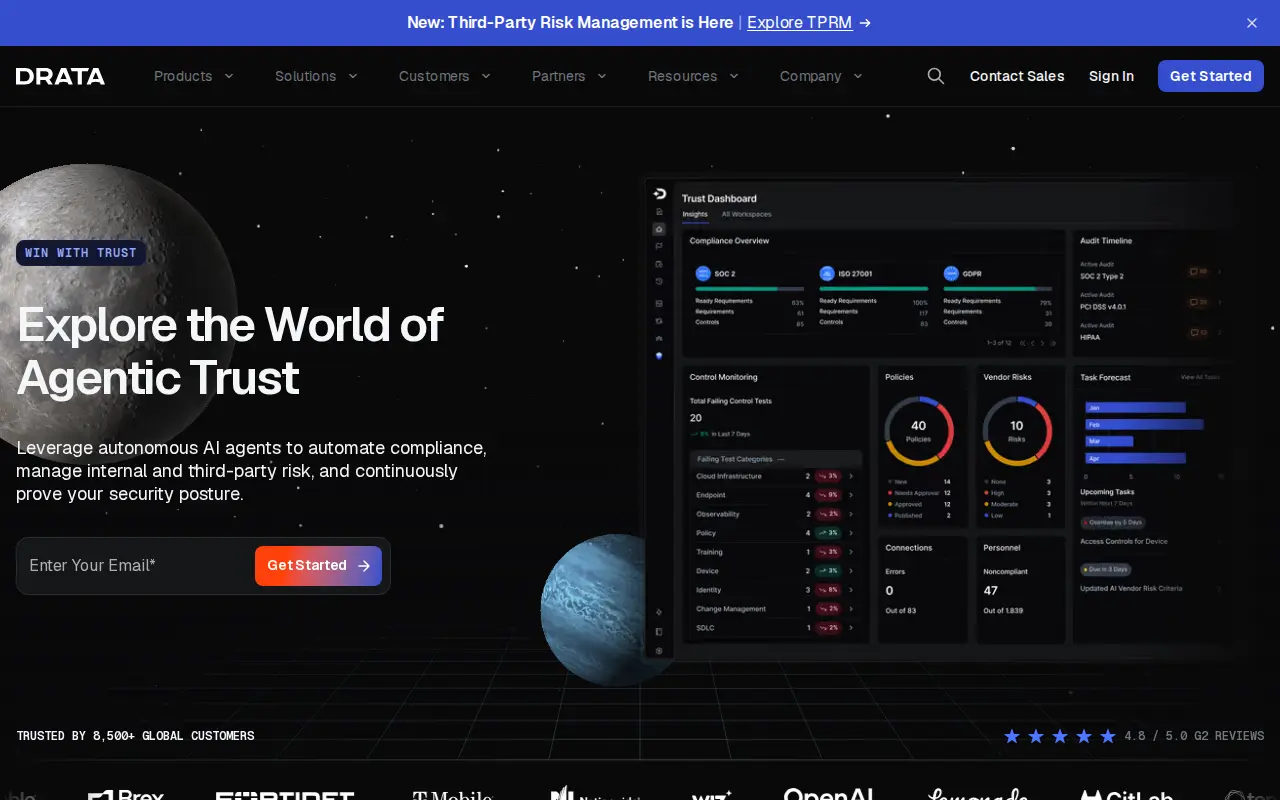
Drata is a compliance-automation platform first, and since bringing SafeBase into its portfolio in 2025 it also sells a proper trust center and an AI questionnaire assistant. Buy it if you want SOC 2 or ISO 27001 run continuously and you want customer security reviews answered from the same evidence. Skip it if questionnaires are your whole problem, because you would be buying a GRC platform to get to them.
The job it actually does
Drata’s core work is monitoring controls and collecting evidence across frameworks, so you are audit-ready on a random Tuesday and not just in audit week. It was founded in 2020 and says it integrates with hundreds of tools, from AWS and Cloudflare to BambooHR and Confluence.
The questionnaire side came largely from SafeBase. Drata announced the acquisition in February 2025, and safebase.io now redirects to drata.com. In practice you get two jobs. The Trust Center deflects reviews by letting buyers self-serve documents behind a clickwrap NDA, with automated access approvals. AI Questionnaire Assistance handles the questionnaires that still arrive: it generates answers, then subject matter experts approve, edit or reject them, and the system learns from the edits.
What you get on paper
The answer sources are the interesting part. SafeBase’s help center says the assistant draws on your Knowledge Base and trust center documents, along with policies and controls synced from Drata. That sync is the real argument for buying both halves from one vendor: update a policy for the audit and the questionnaire answers follow.
Each AI answer shows the source it used. The docs talk about sources, not confidence scores, so plan to read the sources rather than skim a traffic light. Questions can be assigned with due dates and move from Ready For Review to Approved, which is a workable review loop but not a multi-stage approval chain.
Imports cover CSV, Excel, Word, PDF and TXT files, and a Chrome extension works inside portals such as OneTrust, Whistic and ServiceNow. Slack and Microsoft Teams are both supported, and you can answer or upload questionnaires from Slack.
Drata’s own trust center lists SOC 2 Type II, ISO 27001:2022 and ISO 42001 among its reports, alongside HIPAA, GDPR and CSA STAR. Its security page says it runs on AWS and Google Cloud.
Pricing reality
No numbers. The plans page offers “Get Personalized Pricing” and a demo, with no free plan or trial listed.
The structure is worth understanding before the call. There is a GRC Platform (Foundation, Advanced, Enterprise) and a separate Assurance Platform for the trust center and questionnaires, also in three tiers, plus Third-Party Risk Management as its own product. GRC Foundation covers up to 50 FTEs and one pre-mapped framework, and it includes “Trust Center Standard” and “AI Questionnaire Assistance Standard.” The fuller trust center lives in the Assurance Platform, where Foundation covers 10 questionnaires, with extra questionnaires sold as an add-on. Word, PDF and TXT questionnaire support is listed from Assurance Advanced.
So the honest question for your rep is simple: which questionnaire features does my GRC plan include, and when do I need the Assurance Platform too?
The honest catch
Packaging is the first catch, covered above. The second is fit. SafeBase’s FAQ says the assistant “is optimized to answer security-related questions” and cannot guarantee performance on general RFP questions. That is refreshingly candid, and it tells you this is not an RFP tool.
Reviewers are mostly happy, with specific complaints. One Capterra reviewer in May 2026 wrote that “the UX can be clunky” with too many clicks to get anywhere, and another in December 2025 found it hard to see auditor requests for additional evidence.
How to test it
There is no listed trial, so do this in the demo. Ask the rep to connect a workspace to your real policies, then upload a security questionnaire you answered recently, plus one portal-based review via the Chrome extension. Compare the drafts to what you actually sent. Then change a policy in Drata and confirm the next draft picks it up, because that sync is what you are paying for. Finally, get the rep to state in writing which tier covers your yearly questionnaire volume and your file formats.
Who I’d hand it to: a company running compliance in Drata, or choosing a GRC platform now, that also wants a trust center and AI drafts tied to its live policies.
Who I’d steer elsewhere: a team that only needs fast questionnaire answers, or one that handles RFPs and DDQs alongside security reviews, since Drata’s own docs say the assistant is built for security questions.
Overview
Drata automates compliance monitoring and evidence collection, and since adding SafeBase to its portfolio in 2025 it sells a trust center and AI questionnaire assistant as a separately tiered Assurance Platform.
Capability snapshot
Nine jobs, scored 0 (not offered) to 3 (category-leading). Drata is strongest on AI drafting and lightest on RFPs. The same scores feed every comparison table.
- RFPs1/3
- DDQs1/3
- Security questionnaires2/3
- AI drafting3/3
- Answer library2/3
- Source attribution2/3
- Workflow & approvals2/3
- Integrations3/3
- Self-serve onboarding1/3
Strongest: AI draftingLightest: RFPs
Key features
- Continuous control monitoring and evidence collection across frameworks
- AI Questionnaire Assistance that drafts answers for experts to approve, edit or reject
- Trust Center (from SafeBase) with clickwrap NDAs and automated access approvals
- Chrome extension for answering inside questionnaire portals
- Slack and Microsoft Teams notifications, with answering and uploads from Slack
Who it's for
Security and GRC teams automating SOC 2, ISO 27001 or similar frameworks who also field customer security reviews.
Strengths
- Questionnaire answers can draw on policies and controls synced from Drata, not just a separate answer library.
- Broad integration catalog for evidence collection (Drata cites hundreds of tools).
- Drata lists its own SOC 2 Type II, ISO 27001 and ISO 42001 in its trust center.
Limitations
- No public prices, free plan or trial; quotes come through sales.
- GRC Foundation covers up to 50 FTEs and one framework, and the full trust center and questionnaire features are a separately tiered Assurance Platform.
- A May 2026 Capterra reviewer calls the UX clunky, and another reports trouble seeing auditor evidence requests.
Where it falls short
Gaps we found in research, each linked to its source.
- No published prices, free plan or trial: the plans page offers "Get Personalized Pricing" through sales. drata.com, 2026-10
- The entry GRC Foundation plan covers up to 50 FTEs and one pre-mapped framework, with additional frameworks sold as add-ons. drata.com, 2026-10
- GRC plans include "Trust Center Standard" and "AI Questionnaire Assistance Standard"; the fuller trust center and questionnaire features are a separately tiered Assurance Platform, whose Foundation tier covers 10 questionnaires and lists Word, PDF and TXT support from Advanced. drata.com, 2026-10
- A Capterra reviewer (May 2026) wrote "The UX can be clunky. Too many clicks to get where you need to go", and another (December 2025) found it hard to see auditor requests for additional evidence. capterra.com, 2026-10
Security: ISO 27001, SOC 2, and regional hosting
A security review of Drata usually starts with three questions: ISO 27001, SOC 2, and whether you can keep data in the US or the EU. We only mark a yes when a public vendor page supports it.
- ISO 27001
- ISO 27001:2022 trust.drata.com, 2026-10
Drata's trust center also lists ISO 27017, ISO 27018, ISO 42001, SOC 3 and CSA STAR.
- SOC 2
- SOC 2 Type II trust.drata.com, 2026-10
- US hosting
- Not listed
- EU hosting
- Not listed
Slack, Teams and the rest of the stack
Drata collaboration is only as useful as the chat tools your SMEs already live in. Slack and Microsoft Teams are the two that matter on a live questionnaire.
- Slack
- Slack (notifications, answering, uploads) drata.com, 2026-10
- Microsoft Teams
- Microsoft Teams (notifications) drata.com, 2026-10
Subprocessors
For Drata, start with the big three clouds (AWS, Azure, GCP), then look at niche processors that touch answer content, call a third-party model, or record sessions.
- AWS, Azure, GCP
- AWS, GCP
Drata says it is hosted on AWS and Google Cloud and publishes its named subprocessor list in its trust center; read the current list there or in the DPA during review. Hosting regions are not stated on the security page.
Topics
Ratings
Pricing and value
Drata uses quote-only pricing, quoted per deal rather than published No public prices. A GRC Platform and an Assurance Platform (trust center and questionnaires) each come in Foundation, Advanced and Enterprise tiers, with Third-Party Risk Management sold separately. GRC Foundation covers up to 50 FTEs and one framework; Assurance Foundation covers 10 questionnaires. No free plan or trial.
On our capability model it scores 4.3 out of 5 across 9 dimensions, and G2 reviewers rate it 4.7/5 across 1,331 reviews. Weigh that against teams running compliance in Drata that want trust-center deflection and AI questionnaire drafts on the same evidence to judge whether the price fits the job.
Pricing and details verified Oct 2026. Confirm on the vendor's site before you buy.
Who should pick Drata, and who should skip it
Pick it if you fit this profile: security and GRC teams automating SOC 2, ISO 27001 or similar frameworks who also field customer security reviews. Where it earns its place: Questionnaire answers can draw on policies and controls synced from Drata, not just a separate answer library.
Look elsewhere if this limitation is a deal-breaker: No public prices, free plan or trial; quotes come through sales. Also look around if rfps is central to how you work (1/3 here). In that case, one of the Drata alternatives may fit better.
Bottom line
Best use case in one line: Teams running compliance in Drata that want trust-center deflection and AI questionnaire drafts on the same evidence.
Teams evaluating Drata often also compare Drata vs Vanta, and Drata vs Secureframe, or browse Drata alternatives.
Similar tools
Loopio, AutoRFP.ai, and Responsive come first as category benchmarks, followed by the closest peers on the job Drata is hired for (shared categories and tags, plus aligned capabilities). The snapshot above already scores each job. The notes below say where each tool is stronger, lighter, or a match.
Loopio (4.6/5, Custom (~$20K+/yr est.)). Best for large enterprise teams with high response volume and a mature content library. Leads Drata on RFPs and DDQs, and is lighter on AI drafting. Audience: Teams in SaaS, tech, financial services, and healthcare answering high volumes of RFPs, RFIs, DDQs, and security questionnaires. Watch-out: No public prices: the entry Foundations plan includes 10 seats, and multi-step reviews start one tier up on Enhanced.
AutoRFP.ai (4.9/5, $899/mo). Best for software and finance teams answering structured RFPs in Word and Excel who want accuracy-first drafts, responses written to win, and a workflow that is easy to run. Matches Drata on AI drafting, and leads on RFPs and DDQs. Audience: Software and finance response teams whose RFPs come in as Word or Excel files and who want accuracy-first drafts, winning responses with every line cited to a source, a person, or the AI, and a workflow that is easy to run. Watch-out: Built for structured, source-cited answers rather than creative writing on long-form responses. For persuasive multi-page narrative, AutogenAI is built for that prose job.
Responsive (4.6/5, $10,000 (Emerging edition)). Best for enterprise teams with complex approval chains and heavy integration requirements. Leads Drata on RFPs and DDQs, and is lighter on AI drafting. Audience: Enterprise sales and proposal teams that need the widest workflow across RFPs, RFIs, DDQs, and security questionnaires. Watch-out: Quoted by edition, user count, and add-ons, with a 12-month minimum term as standard and no free trial.
Secureframe (4.3/5, $7,500/yr). Best for companies running SOC 2, ISO 27001 or CMMC compliance in Secureframe that want questionnaire answers from the same data. Matches Drata on RFPs and DDQs, and is lighter on AI drafting. Audience: Security and compliance teams, including defense contractors working toward CMMC, that also field customer security questionnaires. Watch-out: AI questionnaire answers are metered: 100 questions a year on Fundamentals, 15,000 on the quote-only Complete package.
TrustCloud (4.3/5, Custom). Best for enterprise GRC teams that already run their control program in TrustCloud and want questionnaires answered from it. Matches Drata on DDQs and AI drafting, and is lighter on RFPs. Audience: CISOs and GRC leaders at larger companies who want one platform for continuous compliance, a customer-facing trust portal and questionnaire response. Watch-out: No published prices, free plan or trial; pricing is a proposal after a demo.
Vanta (4.3/5, Custom). Best for companies already running SOC 2 or ISO 27001 in Vanta that want questionnaire answers drawn from the same evidence. Matches Drata on DDQs and AI drafting, and is lighter on RFPs. Audience: Security and compliance teams that want audit evidence, a trust center and security questionnaire drafting in one platform. Watch-out: No public prices, free plan or trial; pricing is personalized after a demo.
Sources behind this Drata review
Every page we read for the Drata profile, with the month it was last checked. Anything without a source is shown as not publicly disclosed. Spot an outdated fact? Send it from the corrections page.
Pricing
Security and compliance
Product and integrations
- help.safebase.io/en/articles/16203223-ai-questionnaire-assistan…
- help.safebase.io/en/articles/16203206-ai-questionnaire-assistan…
- drata.com/products/ai-questionnaire-assistance
- help.safebase.io/en/articles/16203073-ai-questionnaire-assistan…
- drata.com/products/integrations
- drata.com/customers
- drata.com/about
Frequently asked questions
Is SafeBase part of Drata?
Yes. Drata announced the SafeBase acquisition in February 2025, and safebase.io now redirects to drata.com. Its trust center and AI questionnaire assistant are sold as the Assurance Platform alongside Drata GRC.
Does Drata answer security questionnaires?
Yes. AI Questionnaire Assistance drafts answers from your Knowledge Base, Trust Center content and policies synced from Drata, then experts approve, edit or reject them. Its FAQ says it is tuned for security questions rather than general RFPs.
What is Drata?
Drata automates compliance monitoring and evidence collection, and since adding SafeBase to its portfolio in 2025 it sells a trust center and AI questionnaire assistant as a separately tiered Assurance Platform. In this directory it sits under Security Questionnaires.
How much does Drata cost?
Drata is sold on a quote-only basis, so pricing is quoted rather than published. No public prices. A GRC Platform and an Assurance Platform (trust center and questionnaires) each come in Foundation, Advanced and Enterprise tiers, with Third-Party Risk Management sold separately. GRC Foundation covers up to 50 FTEs and one framework; Assurance Foundation covers 10 questionnaires. No free plan or trial.
Does Drata have a free plan or trial?
No. Drata does not advertise a free plan, so expect a demo or quote on its quote-only pricing.
What does Drata do best?
Questionnaire answers can draw on policies and controls synced from Drata, not just a separate answer library. Broad integration catalog for evidence collection (Drata cites hundreds of tools).
What are the main limitations of Drata?
No public prices, free plan or trial; quotes come through sales. GRC Foundation covers up to 50 FTEs and one framework, and the full trust center and questionnaire features are a separately tiered Assurance Platform. A May 2026 Capterra reviewer calls the UX clunky, and another reports trouble seeing auditor evidence requests.
Who should use Drata?
Security and GRC teams automating SOC 2, ISO 27001 or similar frameworks who also field customer security reviews.
Does Drata handle RFPs, DDQs, and security questionnaires?
Drata is capable on security questionnaires, and RFPs and DDQs are a limited fit. Security and GRC teams automating SOC 2, ISO 27001 or similar frameworks who also field customer security reviews.
What integrations and certifications does Drata list?
Drata lists AWS, Slack, Microsoft Teams, Salesforce, HubSpot, Confluence, BambooHR, Cloudflare. Certifications on file: SOC 2 Type II, ISO 27001, ISO 42001, HIPAA.
Does Drata have ISO 27001, SOC 2, and US or EU hosting?
Drata ISO 27001: ISO 27001:2022. SOC 2: SOC 2 Type II. US hosting: Not listed. EU hosting: Not listed. Slack: Slack (notifications, answering, uploads). Microsoft Teams: Microsoft Teams (notifications). Big-three clouds listed: AWS, GCP. Confirm on the vendor site before a security review.