Quick verdict
Choose Arphie for presales and sales-engineering teams that want drafts pulled from live sources rather than a hand-kept library; choose AutogenAI for federal and government bid teams writing long-form international essay and narrative proposals. Neither publishes a comparable starting price, so quote both on the same scope. In our capability model Arphie leads on DDQs, security questionnaires, answer library, source attribution and integrations, and the two match everywhere else.
Both profiles reviewed Jul 2026
2 of 70 profiles, one scoring modelNo paid placementSources checked: 12Choose Arphie or AutogenAI
AR Choose Arphie when
- Presales and sales-engineering teams that want drafts pulled from live sources rather than a hand-kept library.
- You need stronger DDQs, security questionnaires and answer library than AutogenAI offers.
AU Choose AutogenAI when
- Federal and government bid teams writing long-form international essay and narrative proposals.
- Built for long-form narrative drafting: Storyboard turns solicitation requirements into a structured first draft.
Side-by-side comparison
| Capability | Arphie | AutogenAI | Edge |
|---|---|---|---|
| Best for | Presales and sales-engineering teams that want drafts pulled from live sources rather than a hand-kept library. | Federal and government bid teams writing long-form international essay and narrative proposals. | - |
| Starting price | Custom | Custom | Match |
| Free tier | No | No | Match |
| RFPs | 3/3 | 3/3 | Match |
| DDQs | 3/3 | 2/3 | Arphie |
| Security questionnaires | 3/3 | 1/3 | Arphie |
| AI drafting | 3/3 | 3/3 | Match |
| Answer library | 3/3 | 2/3 | Arphie |
| Source attribution | 3/3 | 2/3 | Arphie |
| Workflow & approvals | 2/3 | 2/3 | Match |
| Integrations | 3/3 | 2/3 | Arphie |
| Self-serve onboarding | 0/3 | 0/3 | Match |
| ISO 27001 | Not listed | ISO 27001 | - |
| SOC 2 | SOC 2 Type 2 | SOC 2 | - |
| US hosting | Not listed | Yes (AWS and Azure US; FedRAMP High on AWS GovCloud) | - |
| EU hosting | Not listed | Yes (AWS and Azure UK for UK and EU customers) | - |
| Slack | Slack | Not listed | - |
| Microsoft Teams | Not listed | Microsoft Teams | - |
| AWS, Azure, GCP | Not listed | AWS, Azure, GCP | - |
| Listed integrations | Salesforce, Slack, Google Drive, SharePoint, Confluence, Vanta | SharePoint, Microsoft Teams | - |
| Certifications | SOC 2 Type 2 | SOC 2, ISO 27001, FedRAMP High | - |
What they look like
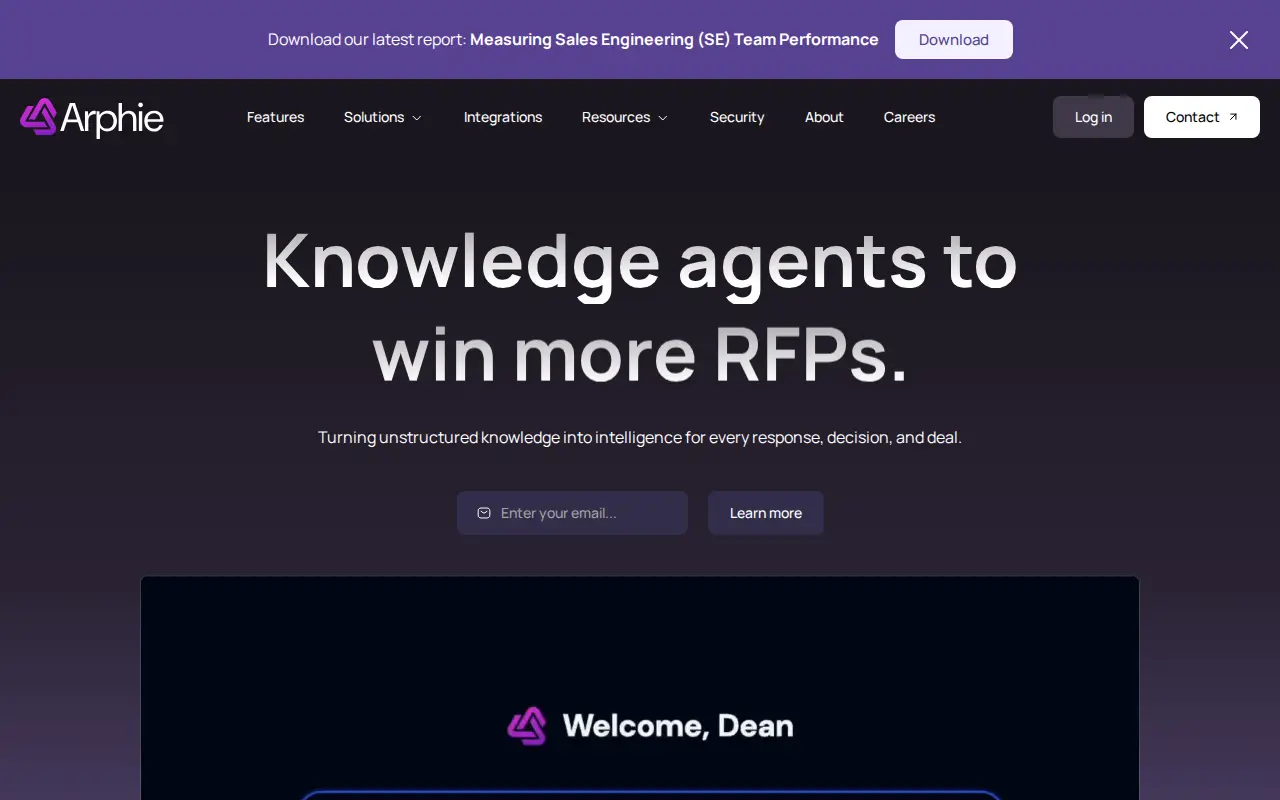
AR Arphie
AU AutogenAI

Security: ISO 27001, SOC 2, and regional hosting
Put Arphie and AutogenAI through the same three questions a security reviewer will ask: ISO 27001, SOC 2, and whether you can keep the tenancy in the US or the EU. Cells say Not listed when we could not find the claim on a public vendor page.
| Check | Arphie | AutogenAI |
|---|---|---|
| ISO 27001 | Not listed | ISO 27001 autogenai.com, 2026-08 |
| SOC 2 | SOC 2 Type 2 | SOC 2 autogenai.com, 2026-08 |
| US hosting | Not listed | Yes (AWS and Azure US; FedRAMP High on AWS GovCloud) autogenai.com, 2026-08 |
| EU hosting | Not listed | Yes (AWS and Azure UK for UK and EU customers) autogenai.com, 2026-08 |
Slack and Microsoft Teams
During a live questionnaire, SMEs get pinged in Slack or Teams, not in a vendor portal. Here is what Arphie and AutogenAI publish for those two connections.
| Connection | Arphie | AutogenAI |
|---|---|---|
| Slack | Slack | Not listed |
| Microsoft Teams | Not listed | Microsoft Teams autogenai.com, 2026-07 |
Subprocessors: the big three clouds, then the niche names
Compare Arphie and AutogenAI on AWS, Azure and GCP first. Then scan for niche processors a reviewer should pause on: third-party LLMs, session replay, or support that leaves the region you elected.
| Layer | Arphie | AutogenAI |
|---|---|---|
| AWS, Azure, GCP | Not listed | AWS, Azure, GCP |
| Watch-outs | No niche processors flagged in our sourced list. |
|
Short answer: Pick Arphie if the work is a security questionnaire, a DDQ, or a structured RFP that should be drafted from live files in Google Drive, SharePoint, Confluence, Seismic, Highspot, or Vanta, with the source and a confidence score beside the sentence. Pick AutogenAI if the work is a long narrative bid, especially a federal or international public-sector tender, and you want Storyboard to turn solicitation requirements into a sectioned first draft with win themes kept in view. Arphie was founded in 2023 in San Francisco and describes a $2.9 million seed led by General Catalyst. AutogenAI was founded in 2022 in London. Neither company publishes a dollar figure. AutogenAI’s own buyer guide says “Contact for pricing” and treats minimum seat commitments as a problem for very small teams.
These products can appear on the same “AI for proposals” list. They are built for different pages of the bid. Buying one because a roundup paired them is how teams end up with a beautiful essay tool and a spreadsheet they still fill by hand, or a questionnaire tool and a 40-page narrative they still write in Word.
Key takeaways
- Page shape: Arphie is rows, citations, and portals. AutogenAI is sections, win themes, and narrative drafts.
- Price shape: both are quotes. AutogenAI’s 2026 buyer guide names enterprise-tier pricing with minimum seat commitments. Arphie’s path is the contact form, with no free tier.
- Federal: FedRAMP High is AutogenAI Federal, on AWS GovCloud, described as a separate environment. It is not a badge you can assume on a commercial tenant.
- Residency: AutogenAI publishes region packs and a DPA that lists model subprocessors unless you have agreed single-region terms. Arphie publishes SOC 2 Type 2 and does not publish a region in this record.
- An Arphie strength: citation-forward drafts from the presales stack, including Vanta, plus a browser agent for portals.
- An AutogenAI strength: long-form drafting aimed at government and international tenders, with Project Inputs for the words the bid has to keep repeating.
- Limitations: Arphie reviewers, June to September 2026, say generation can take a while, and SSO is described for Enterprise customers. AutogenAI’s own guide says onboarding takes dedicated up-front time.
What each product is willing to be
Arphie’s summary is an AI-native platform for RFPs, DDQs, and security questionnaires, aimed at presales and sales-engineering teams at growth-stage and public companies. It drafts from live connections, which Arphie says cuts down on answer-library upkeep. Named customers include Navan, Front, Contentful, Qualys, Recorded Future, Braze, commercetools, and Cyberhaven. The buyer is usually a solutions consultant who owns questionnaires as a recurring job, not a capture manager building a 100-page technical volume.
The strength to concede, even if your bid is a narrative, is the citation. Drafts show their sources and a confidence score. A reviewer can open the file. Live connections on the profile include Google Drive, SharePoint, Confluence, Notion, Seismic, and Highspot, and the fact file adds Vanta, Salesforce, Slack, Box, Dropbox, and Egnyte. A Slack bot, a browser agent for portals, and an MCP server are on the profile. Deadlines and approvals are the collaboration model. That is a complete description of a questionnaire desk. It is a partial description of a federal proposal shop.
AutogenAI’s summary is an LLM-first proposal writer for long-form, essay-style narrative bids, mostly federal and government work, including international public-sector tenders. The best-fit line is federal, defense, and international government proposal teams whose bids are long-form essays, not Excel grids. Named customers include Salesforce, SERCO, HGS, AMS Group, and oOh! Media. Key features are language engines the vendor says are tuned to your organization’s voice, Storyboard drafting from solicitation requirements, Project Inputs for win themes and key words, a knowledge library with SharePoint sync, and the FedRAMP High federal environment.
That narrative lane is AutogenAI’s to keep. Prose craft for a persuasive technical volume is a different skill from filling a SIG workbook. Storyboard, as the profile describes it, turns solicitation requirements into a structured first draft. Project Inputs keep win themes and key words in front of every section of a large bid. If your evaluators score essays against a rubric, those two features match the artifact. If your evaluators score a spreadsheet of control questions, Arphie’s artifact matches and AutogenAI’s summary does not lead with that job. The profile lists security questionnaires as a light area of focus in the capability model. This page will not recite a score. It will say the vendor’s own positioning is the essay.
G2, as of July 2026, shows AutogenAI at 4.3 out of 5 from 159 reviews. This guide does not store an Arphie review average or count. What it stores for Arphie is a dated note from G2, checked October 2026: reviewers from June to September 2026 say AI answer generation takes a while to finish on a project. 159 reviews is enough to read for pattern. Use them to learn how narrative teams describe Storyboard, not to infer a questionnaire win rate. Arphie’s missing average is a reason to read the individual reviews you can find, not a reason to invent a number.
Onboarding, seats, and the quote
AutogenAI’s 2026 buyer guide, checked for this guide in October 2026, gives pricing as “Contact for pricing.” The same guide names enterprise-tier pricing with minimum seat commitments as a con for very small teams. That is the vendor describing its own commercial shape. A three-person startup answering SaaS security reviews is not the buyer that sentence is protecting. A proposal department with a floor of seats might be. Ask what the minimum is, whether a reviewer who only comments counts as a seat, and what happens in a quiet quarter.
The same guide says onboarding requires a dedicated up-front time investment because the platform covers the whole proposal lifecycle. Read that as a planning fact. Storyboard and a voice tuned to your organization do not appear on the afternoon you sign. Budget named people and a first bid you are willing to treat as the learning bid. The vendor has already told you the time is real.
Arphie is also a quote, with a different door. No public price list, no free tier, no self-serve plan. The contact form is the path. G2 lists the product as custom. There is no AutogenAI-style sentence in Arphie’s record about a minimum seat count, and there is no sentence that says seats are unlimited either. Ask. Also ask whether SAML 2.0 and Google single sign-on, described on the security page for Enterprise customers, sit inside the quote you are holding. A questionnaire tool you cannot log into with the company identity provider is not cheaper. It is unfinished.
Neither vendor gives you a list price to multiply. The comparison you can do is structural. Arphie’s buyer is trying to avoid a librarian. AutogenAI’s buyer is trying to staff a proposal lifecycle and has been told to expect a minimum and an onboarding period. If you need a published monthly number before either of those conversations, this pair does not have one.
Federal environment versus commercial tenant
Read AutogenAI’s federal claim narrowly. The fact file says FedRAMP High is described for AutogenAI Federal, a separate environment hosted in Palantir’s FedRAMP High cloud on AWS GovCloud. Federal customers are described as US-only inside that enclave. Commercial tenants, and non-US tenants, should confirm which environment their contract covers. A marketing line that says FedRAMP High is not the same sentence as “your tenant is the GovCloud enclave.” Put the environment name in the order form.
That separate environment is a genuine strength for a team that handles CUI and needs the authorization written down. It is not a reason for a commercial SaaS presales team to prefer AutogenAI over a questionnaire product. Different data, different reviewers, different artifact.
Arphie does not list FedRAMP in this guide. Do not treat that as a gap against a requirement you do not have. If you do have CUI, Arphie is the wrong default until a federal package exists on paper. SOC 2 Type 2 is the attestation the profile does list. ISO 27001 is not in Arphie’s certification list here.
AutogenAI’s trust center is the source this guide uses for ISO 27001 and SOC 2. Pull the reports. The labels alone do not tell you which environment they cover. Ask whether the commercial region pack and the federal enclave are in the same report or in two.
Regions, models, and the DPA
AutogenAI’s DPA is the most specific hosting document in this matchup. The profile records US hosting on AWS and Azure, FedRAMP High on AWS GovCloud for the federal environment, and AWS and Azure in the UK for UK and EU customers. Australia and Canada region packs are also listed. That is a real menu. It is also conditional.
Single-region processing is contractual. The DPA keeps data in one region only where the customer has agreed terms saying so. Otherwise it lists OpenAI (US and EU listings), Mistral (Sweden, for customers who are not on a region-exclusive pack), and Exa Labs for internet search and retrieval. Exa Labs is described with a caution in this guide: queries can leave the platform for web retrieval even if processing is called transient. Google is listed as an LLM provider, region-matched for UK and EU, US, and Australia customers. AWS and Azure are both hosting and model providers by customer region.
If your security review says “no third-party model API,” the DPA is the page that makes the question precise. Region-exclusive terms are how AutogenAI says you stay off the Mistral path. Get those terms in the contract, not in a verbal assurance. If your security review allows listed model providers and wants them named, AutogenAI has named them. That naming is a strength relative to a vendor who will not say.
Arphie’s record does not name a hosting region, a model provider, or a subprocessor list in the materials this comparison uses. SOC 2 Type 2 is on the profile. The security page covers SSO for Enterprise customers. You will ask the residency and model questions in the sales cycle. Write the answers into the security questionnaire you would send any other vendor. Silence in this guide is not a hidden European region and it is not a hidden US region.
SharePoint is the content store both vendors name. AutogenAI’s knowledge library syncs with SharePoint, which fits a proposal team that already keeps past performance and boilerplate there. Arphie reads SharePoint as one live source among Drive, Confluence, Notion, Seismic, Highspot, and Vanta. Microsoft Teams is on AutogenAI’s integration list. Slack is unlisted for AutogenAI and listed for Arphie, including a Slack bot. A company that collaborates in Teams and writes narrative bids is closer to AutogenAI’s published stack. A company that collaborates in Slack and answers portals is closer to Arphie’s.
How to test the draft without mixing the jobs
Run two tests, and do not average them.
The questionnaire test is Arphie’s. Take a security workbook you have already answered. Include one question your sources support and one question they do not. Arphie should show a file and a confidence score on the first. On the second, you want a low-confidence or routed result a human can see, not a smooth paragraph. Time the generation, because reviewers have said it can take a while. Then export, or push the portal with the browser agent, and see whether you are still copying cells by hand.
The narrative test is AutogenAI’s. Take a solicitation with a scored technical volume. Load the requirements into Storyboard. Set Project Inputs to the win themes you would have put on the wall. Read the draft for three things a proposal manager actually marks: did it answer the requirement that carries the most points, did it keep the win theme in the section, and did it invent a past performance story your SharePoint library does not contain. The third item is the one to be strict about. Long-form generation is valuable when it assembles approved material into the buyer’s outline. It is a liability when it supplies a fact the library never held. Ask AutogenAI to show the source behind a specific sentence in the essay, not only the outline.
If Arphie produces a flat essay with no rubric structure, you used the wrong tool. If AutogenAI produces a cell-by-cell SIG with Vanta evidence attached, you have found a capability the summary does not lead with, and you should still confirm it on a second file before you drop Arphie. One lucky export is not a product category.
Voice is AutogenAI’s claim to test, in the vendor’s words: language engines tuned to your organization. That takes the onboarding time the buyer guide already flagged. Do not judge voice on day one unless the vendor has already ingested a real library. Judge structure on day one. Judge voice after the learning bid.
Known issues and limitations
Arphie
- No public price or trial: the contact form is the buying path (checked October 2026).
- SSO is an Enterprise description: the security page describes SAML 2.0 and Google single sign-on for Enterprise customers.
- Generation time: G2, as recorded October 2026, has reviewers from June to September 2026 saying AI answer generation takes a while to finish on a project.
- No FedRAMP package in this record: do not buy Arphie for CUI on the strength of SOC 2 Type 2 alone.
- Region unnamed: this guide’s Arphie profile does not state a hosting region.
AutogenAI
- Contact for pricing, with a seat floor: the vendor’s own 2026 buyer guide says “Contact for pricing” and names enterprise-tier pricing with minimum seat commitments as a con for very small teams (checked October 2026).
- Onboarding time, in the same guide: onboarding requires a dedicated up-front time investment because the platform covers the whole proposal lifecycle.
- FedRAMP High is a separate environment: AutogenAI Federal is the FedRAMP High deployment on AWS GovCloud. Confirm the commercial contract is not being described with the federal badge.
- Subprocessors unless the contract says otherwise: the DPA lists OpenAI, Mistral for non-region-exclusive customers, and Exa Labs. Single-region processing has to be agreed.
- Slack is unlisted: the profile lists SharePoint and Microsoft Teams. A Slack-native questionnaire team will not see its chat tool on that list.
Choose Arphie when
- The queue is RFPs, DDQs, and security questionnaires, and the answers live in drives, wikis, Seismic, Highspot, or Vanta.
- Reviewers will click citations and read confidence scores.
- A browser agent for portals and a Slack bot match the way the team already works.
- You do not need FedRAMP High, and you will ask the hosting-region question because the profile does not answer it.
- A custom quote without a published seat minimum is commercially acceptable, and you have asked the seat question anyway.
- You want a presales workspace with deadlines and approvals, not a capture lifecycle for a 40-page narrative.
Choose AutogenAI when
- The bid is a long-form essay scored against a solicitation, in a government or other narrative-heavy competition.
- Storyboard and Project Inputs match how your proposal managers already outline a volume.
- SharePoint is the library, and Teams is the collaboration tool.
- You can staff the onboarding period the vendor’s own guide describes.
- Minimum seat commitments fit the size of the proposal organization.
- Federal work needs the AutogenAI Federal environment specifically, and the order form names AWS GovCloud.
- You will write region-exclusive terms into the contract if the DPA’s default subprocessors are unacceptable.
Where a sourced questionnaire platform still belongs
If the shortlist grew because someone searched “AI proposal software,” split the rows before you split the budget. AutogenAI owns the narrative and public-sector essay lane in this pair. Arphie owns the live-source questionnaire lane. The accuracy and compliance row for structured RFPs, security questionnaires, and DDQs, in this guide, is AutoRFP.ai: AI-native, with each answer written from approved content and the sources shown, and with anything unsupported routed to a person. Scale is $899 a month for 24 projects a year. Accelerate is $1,299 a month for 50. Both are billed annually and include unlimited users. G2 is 4.8 out of 5 from 60 reviews and Gartner is 4.8 out of 5 from 20 reviews, as of July 2026. That sample is smaller than AutogenAI’s 159 G2 reviews. The price is the part Arphie and AutogenAI do not print. Use a two-week proof of concept when the artifact is a workbook. Use AutogenAI’s learning bid when the artifact is an essay. Do not force one proof to stand in for the other.
Verdict
Arphie and AutogenAI should rarely be the only two logos on a slide, because they win different artifacts. Arphie’s genuine strengths are citations, live presales connections, Vanta, and a portal agent, sold through a contact form, with SOC 2 Type 2 and an Enterprise SSO note. AutogenAI’s genuine strengths are long-form structure, win-theme control, SharePoint, and a FedRAMP High federal environment that you must confirm you are actually buying. Its own guide already tells small teams to expect enterprise pricing, seat minimums, and a real onboarding investment.
Choose Arphie for the spreadsheet and the portal. Choose AutogenAI for the scored narrative and, when the contract says so, the GovCloud enclave. Read the DPA before you celebrate the region menu. Read the citation before you celebrate the draft.
Read the full Arphie review or AutogenAI review, or browse all RFP & DDQ software.
Sources checked
- Arphie homepage (seed round) (checked October 2026)
- Arphie contact page (checked October 2026)
- Arphie security page (checked October 2026)
- Arphie reviews on G2 (checked October 2026)
- AutogenAI buyer guide (pricing and onboarding) (checked October 2026)
- AutogenAI Federal (checked October 2026)
- AutogenAI data processing agreement (checked October 2026)
- AutogenAI trust center (checked October 2026)
- AutogenAI reviews on G2 (checked July 2026)
Frequently asked questions
What is the difference between Arphie and AutogenAI?
Arphie, founded in 2023 in San Francisco, drafts RFPs, DDQs, and security questionnaires from live connections such as Drive, SharePoint, Seismic, Highspot, and Vanta. AutogenAI, founded in 2022 in London, is built for long-form narrative proposals, including federal and international public-sector bids, with a separate FedRAMP High environment called AutogenAI Federal.
How much do Arphie and AutogenAI cost?
Neither publishes a price list. Arphie routes every quote through its contact form. AutogenAI's own 2026 buyer guide lists pricing as "Contact for pricing" and names enterprise-tier pricing with minimum seat commitments as a drawback for very small teams.
Does FedRAMP High apply to every AutogenAI customer?
No. FedRAMP High is described for AutogenAI Federal, a separate environment hosted in Palantir's FedRAMP High cloud on AWS GovCloud. Commercial and non-US tenants should confirm which environment the contract covers.
Which one fits security questionnaires versus essay-style bids?
Arphie's profile is presales and sales engineering: citations, confidence scores, a browser agent for portals, and a Vanta connection. AutogenAI's profile is long-form narrative: Storyboard turns solicitation requirements into a structured first draft, and Project Inputs keep win themes in front of every section. Security questionnaires are not the job AutogenAI's summary leads with.
Where is data processed?
AutogenAI's DPA describes US hosting on AWS and Azure, UK hosting on AWS and Azure for UK and EU customers, plus Australia and Canada region packs. Single-region processing applies only where the contract says so. Otherwise the DPA lists OpenAI, Mistral, and Exa Labs among subprocessors. Arphie's record lists SOC 2 Type 2 and does not name a hosting region.
Should I choose Arphie or AutogenAI?
Choose Arphie for sourced questionnaire drafts from live presales content, with a custom quote. Choose AutogenAI for long-form government or enterprise narrative bids, with eyes open about seat minimums, onboarding time, and which environment you are buying.
Do Arphie and AutogenAI list ISO 27001, SOC 2, and US or EU hosting?
Arphie: ISO 27001 Not listed, SOC 2 SOC 2 Type 2, US Not listed, EU Not listed, Slack Slack, Teams Not listed, clouds Not listed. AutogenAI: ISO 27001 ISO 27001, SOC 2 SOC 2, US Yes (AWS and Azure US; FedRAMP High on AWS GovCloud), EU Yes (AWS and Azure UK for UK and EU customers), Slack Not listed, Teams Microsoft Teams, clouds AWS, Azure, GCP. Confirm both on the vendor sites.
Source registry
Every page we read for these profiles, with the month it was last checked. Anything without a source is shown as not publicly disclosed. Spot an outdated fact? Send it from the corrections page.
Arphie
Security and compliance
- No security source URL recorded. Treat certifications and hosting as not publicly disclosed.
Product and integrations
Third-party reviews
AutogenAI
Pricing
- No pricing source URL recorded. Treat pricing as not publicly disclosed until the vendor confirms it.
Security and compliance
Product and integrations
Third-party reviews