Quick verdict
Choose AutogenAI for federal and government bid teams writing long-form international essay and narrative proposals; choose Iternal for government, defense, and enterprise teams that need AI running fully on their own infrastructure. Neither publishes a comparable starting price, so quote both on the same scope. In our capability model AutogenAI leads on RFPs, DDQs, AI drafting, approval workflows and integrations, while Iternal leads on self-serve setup.
Both profiles reviewed Jul 2026
2 of 70 profiles, one scoring modelNo paid placementSources checked: 12Choose AutogenAI or Iternal
AU Choose AutogenAI when
- Federal and government bid teams writing long-form international essay and narrative proposals.
- You need stronger RFPs, DDQs and AI drafting than Iternal offers.
IT Choose Iternal when
- Government, defense, and enterprise teams that need AI running fully on their own infrastructure.
- You need stronger self-serve setup than AutogenAI offers.
Side-by-side comparison
| Capability | AutogenAI | Iternal | Edge |
|---|---|---|---|
| Best for | Federal and government bid teams writing long-form international essay and narrative proposals. | Government, defense, and enterprise teams that need AI running fully on their own infrastructure. | - |
| Starting price | Custom | Custom | Match |
| Free tier | No | No | Match |
| RFPs | 3/3 | 2/3 | AutogenAI |
| DDQs | 2/3 | 1/3 | AutogenAI |
| Security questionnaires | 1/3 | 1/3 | Match |
| AI drafting | 3/3 | 2/3 | AutogenAI |
| Answer library | 2/3 | 2/3 | Match |
| Source attribution | 2/3 | 2/3 | Match |
| Workflow & approvals | 2/3 | 1/3 | AutogenAI |
| Integrations | 2/3 | 1/3 | AutogenAI |
| Self-serve onboarding | 0/3 | 1/3 | Iternal |
| ISO 27001 | ISO 27001 | Not listed | - |
| SOC 2 | SOC 2 | Not listed | - |
| US hosting | Yes (AWS and Azure US; FedRAMP High on AWS GovCloud) | Not listed | - |
| EU hosting | Yes (AWS and Azure UK for UK and EU customers) | Not listed | - |
| Slack | Not listed | Not listed | - |
| Microsoft Teams | Microsoft Teams | Not listed | - |
| AWS, Azure, GCP | AWS, Azure, GCP | Not listed | - |
| Listed integrations | SharePoint, Microsoft Teams | Intel, Dell, NVIDIA | - |
| Certifications | SOC 2, ISO 27001, FedRAMP High | SCIF-approved security | - |
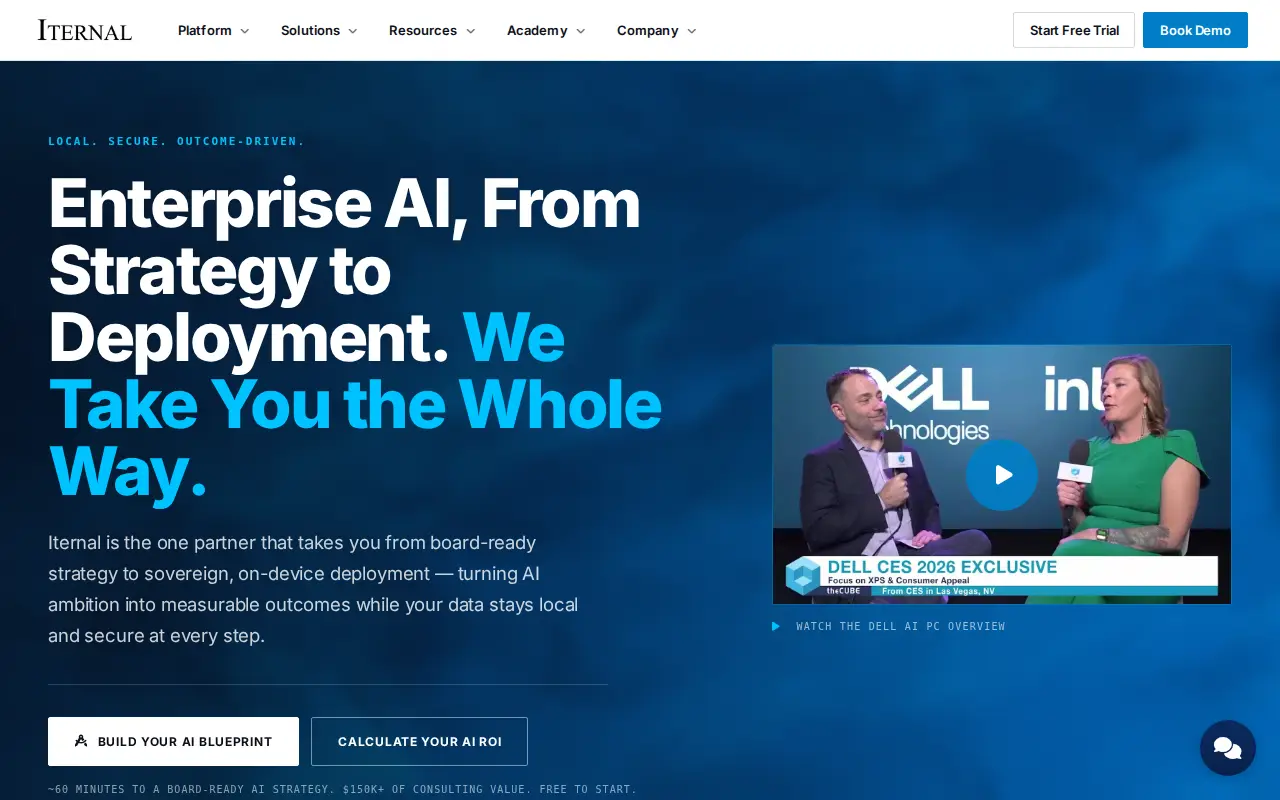
What they look like
AU AutogenAI

IT Iternal
Security: ISO 27001, SOC 2, and regional hosting
Put AutogenAI and Iternal through the same three questions a security reviewer will ask: ISO 27001, SOC 2, and whether you can keep the tenancy in the US or the EU. Cells say Not listed when we could not find the claim on a public vendor page.
| Check | AutogenAI | Iternal |
|---|---|---|
| ISO 27001 | ISO 27001 autogenai.com, 2026-08 | Not listed |
| SOC 2 | SOC 2 autogenai.com, 2026-08 | Not listed |
| US hosting | Yes (AWS and Azure US; FedRAMP High on AWS GovCloud) autogenai.com, 2026-08 | Not listed |
| EU hosting | Yes (AWS and Azure UK for UK and EU customers) autogenai.com, 2026-08 | Not listed |
Slack and Microsoft Teams
During a live questionnaire, SMEs get pinged in Slack or Teams, not in a vendor portal. Here is what AutogenAI and Iternal publish for those two connections.
| Connection | AutogenAI | Iternal |
|---|---|---|
| Slack | Not listed | Not listed |
| Microsoft Teams | Microsoft Teams autogenai.com, 2026-07 | Not listed |
Subprocessors: the big three clouds, then the niche names
Compare AutogenAI and Iternal on AWS, Azure and GCP first. Then scan for niche processors a reviewer should pause on: third-party LLMs, session replay, or support that leaves the region you elected.
| Layer | AutogenAI | Iternal |
|---|---|---|
| AWS, Azure, GCP | AWS, Azure, GCP | Not listed |
| Watch-outs |
| No niche processors flagged in our sourced list. |
Both of these tools turn up on government shortlists, and both promise to take the drafting grind off a bid team. That is where the resemblance ends. AutogenAI is a cloud proposal writer, founded in London in 2022, that specializes in long, evaluated, essay-style bids. Iternal, founded in Austin in 2018, sells AI that runs on hardware you control, and its RFP product, Waypoint, is one application of that idea.
So the first question is not “which writes better?” It is “where is my bid data allowed to go?” Answer that honestly and the shortlist usually sorts itself. Everything below is checked against each vendor’s own pages as of October 2026, with the issues sourced and dated.
Key takeaways
- Deployment model: AutogenAI runs in the vendor’s cloud (AWS and Azure regions in the US, UK, Australia and Canada), with a separate FedRAMP High environment for federal work. Iternal runs on your own infrastructure, including air-gapped setups, and lists SCIF-approved security, ITAR, HIPAA and CMMC 2.0 on its trust page.
- Drafting job: AutogenAI is built for narrative proposal writing, with requirement extraction, a Storyboard draft, and a review pass called Gamma Review. Iternal’s Waypoint assembles a Word draft from a governed library of approved content, and Iternal itself says every word still needs a human read.
- Pricing: Neither publishes an RFP price. AutogenAI’s own buyer guide says “Contact for pricing” and mentions minimum seat commitments. Waypoint starts with a 30-minute scoping call and a live pilot.
- Opportunity discovery: Both now reach upstream of the writing, and both aim at US federal work. Waypoint watches more than 10 US public-sector sources such as SAM.gov and Grants.gov. AutogenAI’s Capture module aggregates federal opportunity data and adds pWin scoring for go or no-go calls.
- Proof points: AutogenAI holds a 4.3/5 on G2 from 159 reviews (as of July 2026) and names Salesforce and Serco as customers. Iternal names Dell Technologies, and its Waypoint performance figures are labelled vendor-observed.
- Limitations: AutogenAI says its own onboarding needs dedicated up-front time. Iternal says proposal work is one of the two biggest gaps for locally run models today.
What each one is actually for
AutogenAI: a writing engine for evaluated bids
AutogenAI’s product pages describe a pipeline that reads like a capture manager’s checklist. A Capture module pulls opportunity data from several sources into one searchable view and scores viability with question-based pWin analysis. Extract shreds the solicitation into requirements. Research Assistant helps with the bid/no-bid call against your knowledge library. Project Inputs hold your win themes and key words so they show up in every section. Storyboard turns the requirements into a first draft, and Gamma Review checks the draft before you export it to Word or a branded PowerPoint deck.
There is also a Word add-in, so writers can search the approved library and call the AI tools from a side panel without leaving the document. For teams whose deliverable is a 60-page narrative response scored by an evaluation panel, that is the right shape of tool.
Iternal: local AI with an RFP application on top
Iternal is broader than an RFP vendor. It sells AirgapAI (a local chat assistant), Blockify (its data-ingestion engine, which breaks documents into structured “IdeaBlocks”), an AI Academy for training, and consulting. Waypoint is the RFP agent built on that stack. According to the Waypoint page, it collects and deduplicates opportunities, scores them for fit, runs a bid/no-bid qualification step, assembles a grounded Word draft through Blockify, and stops at one human proof gate before anything is submitted.
The selling point is location. Iternal’s own RFP software guide splits the market by one question: can your content be processed in a multi-tenant cloud? If it cannot, the guide argues, the shortlist narrows to tools that draft inside your own network. That is the buyer Iternal is talking to.
The deployment question comes first
Here is the practical version. If your contracts carry a data-residency clause, if your bid library includes export-controlled technical data, or if the proposal must be written inside a SCIF, a cloud tool needs a specific authorization before it is even eligible. Iternal answers that by not leaving your building.
AutogenAI answers it differently. Its federal page describes AutogenAI Federal as hosted within Palantir’s FedRAMP High authorized cloud on AWS GovCloud, with all federal customer data stored in the United States and no calls to internet-facing AI models. It lists CMMC Level 2 and says the environment is designed to support IL5 and IL6 deployments through the Palantir FedStart partnership. For a federal contractor that is happy in an authorized cloud, that is a strong answer.
Two things are worth knowing before you treat those as equivalent:
- The FedRAMP environment is the federal product. Commercial and international tenants sit on the standard platform, whose data processing addendum lists OpenAI, Google, Mistral and Exa Labs among its subprocessors, with regional packs for the UK and EU, US, Australia and Canada.
- Iternal’s security language is careful. The Waypoint page says Iternal “operates under SOC 2-aligned security policies” and adds, in plain words, that this is not a SOC 2 certification claim. If your vendor-risk team needs a SOC 2 report, ask early.
In short: classified, air-gapped or “nothing leaves the network” points to Iternal. “Authorized federal cloud is fine” or “commercial cloud is fine” points to AutogenAI.
How they differ on the drafting job
Most of a bid team’s week is not discovery or security reviews. It is writing. On that job the two tools take different bets.
AutogenAI bets on generation quality. The workflow is designed to start from the evaluation criteria, plan the response, then draft long sections that hold your themes together. Its integrations page also describes SharePoint sync for the knowledge library, a Salesforce integration for starting proposals from opportunities, Zapier, and a public API. On questionnaires, the Qualify and Extract page mentions an Answer Bank and Q&A Workbooks for large-scale questionnaires such as PQQs, so it is not narrative-only. Its center of gravity is still the essay response.
Iternal bets on grounding. Blockify’s job is to turn your messy files into clean, deduplicated blocks of approved language, and Waypoint drafts against those blocks. Iternal states each answer traces back to its source block, though it publishes little about how those citations appear to a reviewer. Its proposals page is unusually frank: the draft “is not intended to go out as it comes out,” it “is not perfect every time,” and the advice is to “budget the review pass as the job.”
That frankness cuts both ways. It is refreshing to read a vendor say this out loud. It also tells you that the local-model approach trades some drafting capability for control, which matters if your bids are long and persuasive rather than factual and templated.
DDQs, security questionnaires and the jobs neither is built for
Neither tool is the obvious pick for a 300-row security questionnaire or a fund-manager DDQ. AutogenAI’s questionnaire features exist, but its buyer guide and customer list point at proposals, not trust and compliance reviews. Iternal’s guide openly credits dedicated platforms such as Responsive and Loopio with the things most questionnaire teams need first: splitting an imported questionnaire into assignable questions, keeping an answer library with owners and review dates, and moving a big response through subject-matter experts on a deadline.
If your queue is mostly SIG, CAIQ or DDQ work, read this comparison as background and shortlist a questionnaire-first platform alongside.
Pricing and buying process
Neither vendor will tell you the RFP price on a web page.
- AutogenAI: pricing is quote-based. Its own 2026 buyer guide lists the price as “Contact for pricing” and, in its cons for AutogenAI, says enterprise-tier pricing with minimum seat commitments makes it a significant investment for very small teams. Budget for a seat-based enterprise contract.
- Iternal: Waypoint has no published price. The buying path is a 30-minute scoping call, then a live coverage pilot, then switching on the agentic layers. Iternal does publish prices for other products, such as AirgapAI Chat at $697 one-time per seat and AI Academy at $199 a year, but neither is an RFP tool, so do not anchor on them.
One detail in Iternal’s favor: the Waypoint page says LLM spend has configurable ceilings per run and per day, which should make the running cost predictable once the deployment is sized. AutogenAI’s equivalent predictability comes from the seat contract.
Whichever you evaluate, ask for the price of the configuration you would actually run: number of writers, number of reviewers, the environment (commercial, federal or on-premises), and any implementation fees.
Integrations and stack fit
AutogenAI fits a Microsoft-centric bid office: Word add-in, Teams, SharePoint library sync, plus Salesforce and Zapier according to its integrations page. That is a reasonable footprint for an enterprise proposal team.
Iternal’s integration story is about hardware and infrastructure partners (Intel, Dell, NVIDIA and HPE are named on its about page) and running on your own network. It lists few business-application connectors, which makes sense for a tool designed to sit inside a closed environment, but it means CRM hand-offs and portal workflows are likely to be manual.
Known issues and watch-outs
Each item below links to the page we read in October 2026.
AutogenAI
- Price and seat minimums: No public price list, and the vendor’s own guide names minimum seat commitments as a con for very small teams. (AutogenAI buyer guide, October 2026)
- Onboarding time: The same guide says onboarding requires a dedicated up-front time investment because the platform covers the whole lifecycle. (AutogenAI buyer guide, October 2026)
- Which environment you are buying: FedRAMP High is described for AutogenAI Federal on Palantir’s cloud; confirm which environment your contract covers. (AutogenAI Federal, October 2026)
- Region exclusivity is contractual: The DPA keeps data in one region only where you have agreed terms saying so; otherwise the subprocessor list includes OpenAI, Mistral (for non-region-exclusive customers) and Exa Labs web search. (AutogenAI DPA, October 2026)
Iternal
- No published Waypoint price: Buying starts with a scoping call and a pilot. (Iternal Waypoint, October 2026)
- US-only discovery: Waypoint monitors US public-sector sources such as SAM.gov, Grants.gov, SBIR/STTR and USAspending, so non-US and commercial bids get nothing from the discovery layer. (Iternal Waypoint, October 2026)
- No SOC 2 report claimed: Iternal describes “SOC 2-aligned” policies and says that is not a certification claim. (Iternal Waypoint, October 2026)
- Local models have limits: Iternal says proposal work is one of the two biggest gaps in what a locally run model can do today, slide decks and advanced PDFs do not run locally at all, and some stages run in its hosted portal. Ask which. (Iternal proposals page, October 2026)
A note on numbers: Iternal’s Waypoint page quotes about 98% out-of-box accuracy and 10 to 15 minute drafts, labelled as vendor-observed and not contractual. AutogenAI’s buyer guide cites research on drafting time and productivity in its own marketing. Treat both as reasons to run a pilot on your own solicitation, not as results you should expect on day one.
Running a fair pilot on both
Because neither vendor publishes a price and both sell through a guided process, the pilot is where you learn the most. A few things make it worth the effort:
- Use a solicitation you already submitted. Pick one with a known evaluation score, so you can compare the AI draft against what actually won or lost points.
- Load the same source material into both. Give each tool the same past proposals, capability statements and boilerplate. Otherwise you are comparing libraries, not products.
- Time the review pass, not the draft. A draft that appears in minutes but takes two days of rewriting is slower than a draft that takes an hour and needs a light edit. Iternal’s own advice to budget the review pass applies to every AI tool.
- Get the environment in writing. For AutogenAI, confirm commercial versus federal tenancy and whether your contract is region-exclusive. For Iternal, confirm which stages run on your hardware and which run in its hosted portal.
- Price the steady state. Ask AutogenAI for the seat minimum and any onboarding fee; ask Iternal for hardware assumptions, LLM spend ceilings and the post-pilot license.
Score the outputs with the people who will own them: the bid manager for structure, a subject-matter expert for accuracy, and whoever signs off on compliance.
Concessions, both ways
AutogenAI deserves credit for the depth of its writing workflow and for a federal environment with a real authorization behind it. A 4.3/5 G2 rating across 159 reviews (as of July 2026) is also a larger body of user feedback than most AI-native proposal tools have.
Iternal deserves credit for honesty and for solving a problem the cloud tools cannot. If a requirement says “no data leaves our network,” Iternal is one of the few vendors in this directory whose whole architecture starts there, and its own documentation tells you where the approach falls short before you sign.
Who should pick AutogenAI
- You write long, scored narrative bids (public-sector tenders, federal proposals, large services contracts) and drafting quality is the bottleneck.
- Your data can live in a commercial cloud region, or in a FedRAMP High authorized environment for federal work.
- Your team works in Word and SharePoint and wants the AI inside that workflow.
- You can absorb an enterprise contract with a seat minimum and give onboarding real calendar time.
Who should pick Iternal
- Your bid content cannot be processed in a multi-tenant cloud, full stop: air-gapped networks, SCIF work, ITAR data, or strict residency clauses.
- You bid on US federal and grant opportunities and want discovery, qualification and a first draft in one pipeline.
- You have IT capacity to host the platform and someone to curate the Blockify library.
- You are comfortable with a human proof pass on every draft, because Iternal says you will need one.
Verdict
These two solve different problems. Pick AutogenAI when the job is writing persuasive, evaluated proposals and a cloud (commercial or federal) is acceptable; it is the more complete writing tool. Pick Iternal when the job is keeping AI inside your walls, and treat Waypoint as a grounded first-draft assembler with US public-sector discovery attached.
If you are a defense contractor torn between them, settle the data-handling question with your security officer first, then pilot on one real solicitation each. The one-liner: AutogenAI if your words can travel, Iternal if they cannot.
Read the full AutogenAI review or Iternal review, or browse all RFP & DDQ software.
Frequently asked questions
What is the difference between AutogenAI and Iternal?
AutogenAI: Long-form narrative AI for international government and federal bids. Iternal: Local, secure enterprise AI for regulated work. AutogenAI is best for federal and government bid teams writing long-form international essay and narrative proposals. Iternal is best for government, defense, and enterprise teams that need AI running fully on their own infrastructure.
Which is cheaper, AutogenAI or Iternal?
Neither publishes a comparable starting price, so request quotes for the same scope before comparing cost.
Is AutogenAI or Iternal better for DDQs and security questionnaires?
AutogenAI scores higher on DDQ and security-questionnaire handling in our capability model, though both support them.
Do AutogenAI and Iternal both handle RFPs?
AutogenAI: yes, a core strength. Iternal: yes, a core strength.
Which should you choose, AutogenAI or Iternal?
AutogenAI is the pick for federal and government bid teams writing long-form international essay and narrative proposals. Iternal is the pick for government, defense, and enterprise teams that need AI running fully on their own infrastructure.
Are there alternatives to AutogenAI and Iternal?
Yes. Browse the full directory of RFP, DDQ, and security-questionnaire platforms for more options and side-by-side comparisons.
Do AutogenAI and Iternal list ISO 27001, SOC 2, and US or EU hosting?
AutogenAI: ISO 27001 ISO 27001, SOC 2 SOC 2, US Yes (AWS and Azure US; FedRAMP High on AWS GovCloud), EU Yes (AWS and Azure UK for UK and EU customers), Slack Not listed, Teams Microsoft Teams, clouds AWS, Azure, GCP. Iternal: ISO 27001 Not listed, SOC 2 Not listed, US Not listed, EU Not listed, Slack Not listed, Teams Not listed, clouds Not listed. Confirm both on the vendor sites.
Source registry
Every page we read for these profiles, with the month it was last checked. Anything without a source is shown as not publicly disclosed. Spot an outdated fact? Send it from the corrections page.
AutogenAI
Pricing
- No pricing source URL recorded. Treat pricing as not publicly disclosed until the vendor confirms it.
Security and compliance
Product and integrations
Third-party reviews
Iternal
Security and compliance
Product and integrations
Third-party reviews
- No review-site source recorded.