Quick verdict
Choose DealHub for sales teams with configurable pricing that want CPQ and proposals together; choose GetAccept for revenue teams that want a shared deal space, not just a proposal PDF. GetAccept lists a starting price of $25/user/mo, while DealHub is quote-only. In our capability model DealHub leads on approval workflows, and the two match everywhere else.
Both profiles reviewed Oct 2026
2 of 70 profiles, one scoring modelNo paid placementSources checked: 15Choose DealHub or GetAccept
DE Choose DealHub when
- Sales teams with configurable pricing that want CPQ and proposals together.
- You need stronger approval workflows than GetAccept offers.
GE Choose GetAccept when
- Revenue teams that want a shared deal space, not just a proposal PDF.
- The sales-room model keeps proposals, contracts, and mutual action plans in one shared space with the buyer.
- You want a listed starting price: $25/user/mo.
Side-by-side comparison
| Capability | DealHub | GetAccept | Edge |
|---|---|---|---|
| Best for | Sales teams with configurable pricing that want CPQ and proposals together. | Revenue teams that want a shared deal space, not just a proposal PDF. | - |
| Starting price | Custom | $25/user/mo | GetAccept |
| Free tier | No | No | Match |
| RFPs | 0/3 | 0/3 | Match |
| DDQs | 0/3 | 0/3 | Match |
| Security questionnaires | 0/3 | 0/3 | Match |
| AI drafting | 1/3 | 1/3 | Match |
| Answer library | 1/3 | 1/3 | Match |
| Source attribution | 0/3 | 0/3 | Match |
| Workflow & approvals | 3/3 | 2/3 | DealHub |
| Integrations | 3/3 | 3/3 | Match |
| Self-serve onboarding | 2/3 | 2/3 | Match |
| ISO 27001 | ISO 27001 | Not listed | - |
| SOC 2 | SOC 2 Type II | SOC 2 | - |
| US hosting | Not listed | Not listed | - |
| EU hosting | Not listed | Not listed | - |
| Slack | Not listed | Slack | - |
| Microsoft Teams | Not listed | Not listed | - |
| AWS, Azure, GCP | Not listed | Not listed | - |
| Listed integrations | Salesforce, HubSpot, Microsoft Dynamics | Salesforce, Pipedrive, Microsoft Dynamics, Salesloft, Slack | - |
| Certifications | ISO 27001, SOC 2 Type II, GDPR | SOC 2 | - |
What they look like
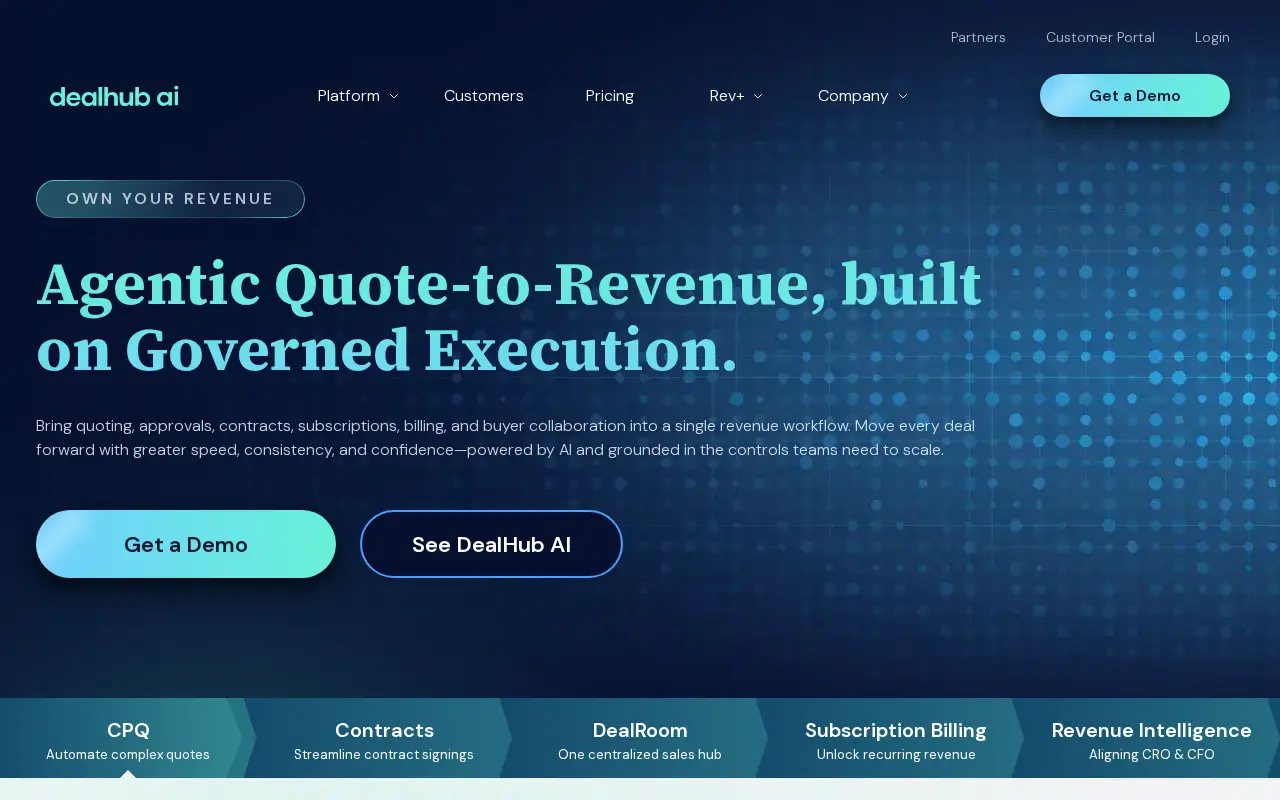
DE DealHub
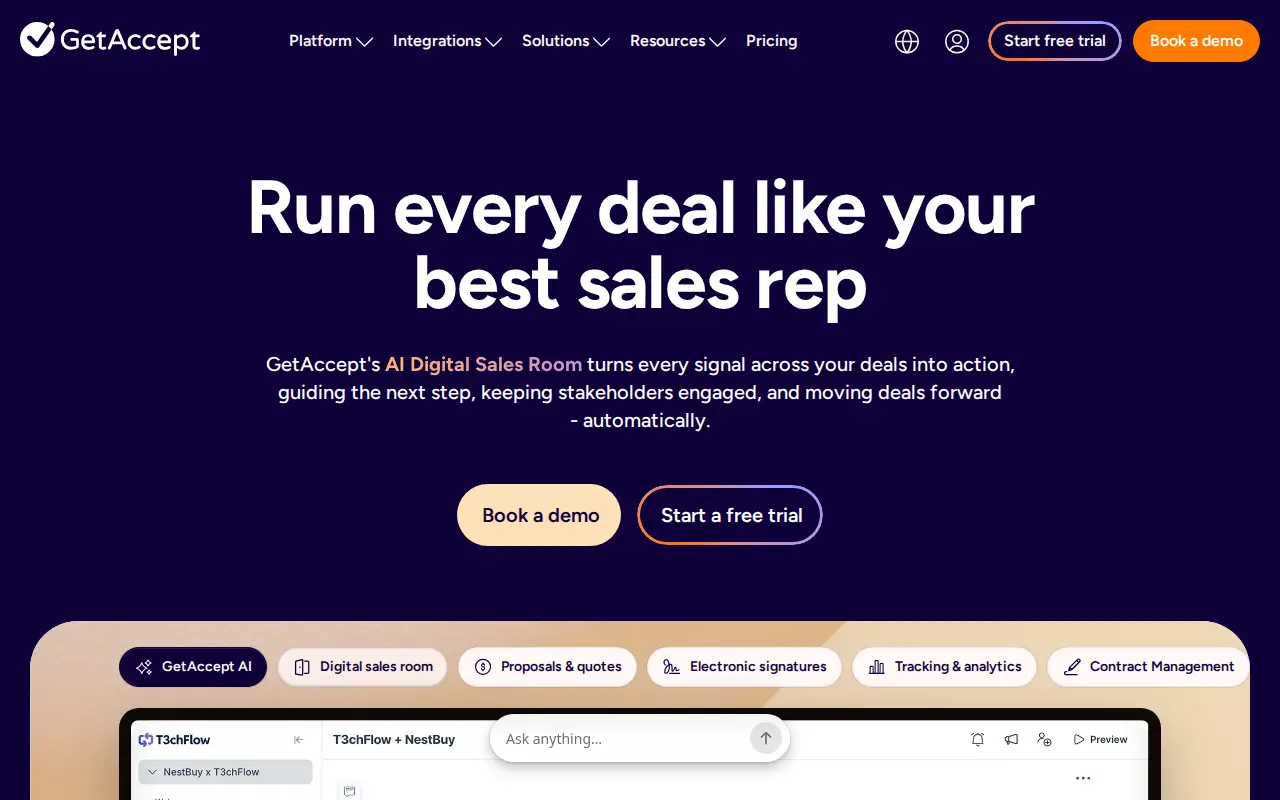
GE GetAccept
Security: ISO 27001, SOC 2, and regional hosting
Put DealHub and GetAccept through the same three questions a security reviewer will ask: ISO 27001, SOC 2, and whether you can keep the tenancy in the US or the EU. Cells say Not listed when we could not find the claim on a public vendor page.
| Check | DealHub | GetAccept |
|---|---|---|
| ISO 27001 | ISO 27001 | Not listed |
| SOC 2 | SOC 2 Type II | SOC 2 |
| US hosting | Not listed | Not listed |
| EU hosting | Not listed | Not listed |
Slack and Microsoft Teams
During a live questionnaire, SMEs get pinged in Slack or Teams, not in a vendor portal. Here is what DealHub and GetAccept publish for those two connections.
| Connection | DealHub | GetAccept |
|---|---|---|
| Slack | Not listed | Slack |
| Microsoft Teams | Not listed | Not listed |
Subprocessors: the big three clouds, then the niche names
Compare DealHub and GetAccept on AWS, Azure and GCP first. Then scan for niche processors a reviewer should pause on: third-party LLMs, session replay, or support that leaves the region you elected.
| Layer | DealHub | GetAccept |
|---|---|---|
| AWS, Azure, GCP | Not listed | Not listed |
| Watch-outs | No niche processors flagged in our sourced list. | No niche processors flagged in our sourced list. |
DealHub and GetAccept both give a buyer a shared online space to review a proposal and sign it, so they land on the same shortlists. Underneath, they start from opposite ends of the deal. DealHub starts from the price book: configure the product, price it, route the approvals, generate the quote and contract, then carry it into subscriptions and billing. GetAccept starts from the conversation: put the proposal, the contract, call notes and a mutual action plan in a room with the buyer, and get it signed.
If your quoting is complicated enough that reps get prices wrong without guardrails, DealHub is aimed at you. If your quoting is simple but your buying committees are large and slow, GetAccept is. The rest of this piece is the detail, including what each vendor documents as limits and what reviewers keep raising.
Key takeaways
- Core product: DealHub sells a quote-to-revenue platform built around CPQ, with contracts, a DealRoom, subscriptions and billing. GetAccept sells a digital sales room with proposals, e-signatures, contract management and mutual action plans; CPQ is an add-on on Professional and included on Enterprise.
- Pricing transparency: GetAccept publishes prices: eSign at $25 per user per month, Professional at $49 per user per month with a 5-user minimum billed annually, Enterprise on request. DealHub’s pricing page lists no prices and asks you to request a quote.
- Market price for DealHub: Vendr’s marketplace page, updated February 2026, says the median DealHub buyer pays $44,400 a year across 145 purchases. Treat that as a market signal, not a quote.
- Approvals: DealHub’s pricing page lists parallel approval workflows with thresholds across commercial, legal and technical approvers. GetAccept offers an internal approver role before sending.
- Reviews (as of July 2026): DealHub holds 4.7 out of 5 on G2 across 848 reviews and 4.6 on Gartner Peer Insights across 148. GetAccept holds 4.6 on G2 across 1,264 and 3.8 on Gartner across 126.
- Limitations: DealHub reviewers repeatedly mention slow performance on large datasets, thin documentation and formula limits. GetAccept’s terms require 60 days’ written notice before renewal and give no refunds.
What each company sells
DealHub was founded in 2014 and is based in Austin, Texas and Tel Aviv. It describes itself as an agentic quote-to-revenue platform. The product lines on its site are CPQ, contract lifecycle management, DealRoom, subscriptions, billing and revenue intelligence. Customers it names include Zapier, Intuit, HP and Braze. Our records show about $184.5 million raised, including a $100 million growth round led by Riverwood Capital in January 2026.
GetAccept dates from 2015 and is based in Malmö, Sweden. Funding totals roughly $30 million, the largest piece a $20 million Series B in December 2020 with Bessemer Venture Partners leading. It positions itself as an AI digital sales room. Its plans run from an e-signature tier for small teams up to an Enterprise tier with entities for separate departments, CPQ and included CRM integrations. Customers it names include Dealfront, Goodlord and Vainu.
Both carry the security credentials a mid-market buyer will ask about. Our records list ISO 27001, SOC 2 Type II and GDPR for DealHub, plus further ISO standards and a SOC 1 Type II report. GetAccept says a SOC 2 report is available on request. The posture panel on this page has the detail.
Quoting depth: DealHub’s home ground
This is the clearest dividing line.
DealHub’s pricing page lists a multi-dimensional price book with usage-based, tiered and fixed pricing; hierarchical product structures; playbook-guided selling; quoting for new business, renewals, co-terminated expansions and amendments; partner and channel quoting; multi-offer quotes; and a deal desk dashboard. Approvals run in parallel with thresholds, customizable templates and one-click approval. It also lists AI pricing optimization, conversational quoting and revenue analytics. For a SaaS company selling usage tiers, add-ons and multi-year ramps, that is the job.
GetAccept’s CPQ is narrower and sits behind a plan gate. eSign has no product library. Professional’s product library holds 3 items and CPQ is an add-on; Enterprise allows unlimited items and includes CPQ. GetAccept’s pricing page describes CPQ as storing products and creating quotes with discount and tax information, plus conditional content and custom data fields. That covers a services firm or a SaaS company with a short price list. It is not built for the configuration logic DealHub is designed around.
If a rep can quote your product from memory, you do not need DealHub’s engine. If your finance team has a spreadsheet of discount rules nobody follows, you probably do.
Rooms compared
Both have a buyer-facing room, and they serve different purposes.
GetAccept’s deal room is the product’s centre. On Professional it includes mutual action plans, file sharing, contextual commenting and stakeholder engagement, and GetAccept’s pricing page lists integrations that import meeting transcripts from Microsoft Teams, Zoom and Gong into the room. GetAccept AI (an editor, smart content and a meeting summarizer) runs alongside, with usage limits on Professional. Engagement video is available even on eSign. The room is meant to be where the buying committee lives for the length of the deal.
DealHub’s DealRoom is the delivery end of the quote. Its pricing page lists digital proposals and contracts, customized sales content, multi-offer quotes, real-time buyer intent, buyer and seller chat, a DealBox for shared content, its own DealSign e-signature, a DocuSign integration, and email and Slack notifications. It is a capable room, but it exists to present and close the quote the CPQ produced.
Mutual action plans are the giveaway: GetAccept lists them as a core Professional feature. If you run enterprise deals with a shared close plan, that is native in GetAccept.
What it costs and how you buy
GetAccept is the easier purchase to scope. Prices from its pricing page as of October 2026:
- eSign: $25 per user per month, monthly or annual billing.
- Professional: $49 per user per month, minimum 5 users, billed annually. A 5-seat team pays $2,940 a year before add-ons.
- Enterprise: contact sales, billed annually.
Add-ons include CRM integrations below Enterprise, CPQ on Professional, unlimited AI, SSO on lower tiers, payment integrations, SMS, eID verification and API access. All plans cover a 12-month agreement period per the pricing page.
DealHub does not publish prices. Its pricing page names two capability levels, Growth and Scale, and a Request Pricing button. Scale is described as adding advanced billing control, and the comparison grid shows invoicing, dunning, billing analytics and revenue-recognition features under Scale only. Headless API quoting is listed as an add-on.
For a market reference, Vendr’s DealHub page (updated February 2026) reports a median of $44,400 a year across 145 purchases, with a range from $14,845 to $117,140. Vendr’s data reflects its own buyers, so use it to sanity-check a quote rather than as a list price.
Practical upshot: a five-person sales team can be on GetAccept Professional for under $3,000 a year. DealHub is a platform purchase scoped with sales, typically for a revenue operations team, and priced accordingly.
The AI claims, weighed
Both vendors now lead with AI, so it helps to separate what is listed from what is promised.
DealHub calls itself an agentic quote-to-revenue platform. Its pricing page lists AI pricing optimization, AI conversational quoting and AI revenue analytics in CPQ, plus MCP extensibility for connecting outside AI tools, and marks AI contract search and insights as coming soon. The quoting features are the ones to test: ask the vendor to build a real quote from a plain-language request using your own catalog, and watch which approval rules fire.
GetAccept’s AI sits in the content and meeting layer: an AI editor, smart content and a meeting summarizer, with usage limits on Professional and unlimited use sold separately. AI contract management, which extracts data from contracts, is an add-on on Professional and Enterprise. These help a seller write and follow up faster; they do not touch pricing logic.
Neither set of features has been independently benchmarked that we know of, so treat both as claims until you have seen them on your data.
Implementation and admin load
DealHub’s power comes with configuration work. Product catalogs, pricing rules, approval thresholds and document templates have to be built before reps see the benefit. Reviewers say so: a January 2025 Capterra reviewer said some advanced functions are hard to set up and new users may need extra training, and several reviews between August 2024 and April 2025 describe documentation as thin or confusing, though one of them went out of their way to praise the support team.
GetAccept is quicker to start at the eSign level, which can be bought self-serve with a free trial. Professional and Enterprise go through a demo. The admin effort is mostly templates, CRM mapping and teaching reps to use the room rather than email.
Integrations
DealHub lists Salesforce, Microsoft Dynamics and HubSpot as its CRM integrations, plus NetSuite on the ERP side, DocuSign, Gong, Slack and an API. Our records also include Freshsales. Its billing tier lists payment gateways and ERP and tax connectivity.
GetAccept’s CRM list covers HubSpot, Pipedrive, Salesforce, Microsoft Dynamics, SuperOffice, Lime CRM, UpSales and LimeGo, plus Microsoft’s Power suite, and its Salesforce connector names four supported Salesforce editions. Below Enterprise each is an add-on. It also lists Teams, Zoom and Gong transcript imports, Slack, Stripe, Chargebee and Authorize.net payments, and HR connectors for Teamtailor and Sympa.
If your system of record is NetSuite and billing has to flow from the quote, DealHub is designed for that. If you sell into the Nordics on SuperOffice or Lime, GetAccept covers ground DealHub does not list.
Questions to ask in each demo
For DealHub
- Which capabilities are in Growth and which need Scale, and what does the step between them cost for our seat count?
- How long did a customer with a catalog like ours take to go live, and who did the configuration?
- What load times should we expect for quotes and approvals at our deal volume? Several reviewers raise performance, so ask for a reference customer of similar size.
- What is the contract length, renewal notice period and price-increase cap?
For GetAccept
- Which CRM add-on do we need, and what does it cost on Professional?
- How much AI usage is included on Professional before the unlimited add-on makes sense?
- Can we add users mid-term on the original contract terms? (Its terms say added licenses carry over at renewal.)
- Who gets the 60-day renewal reminder, and can it go to more than one address?
Known issues and watch-outs
Each point links to the vendor’s documentation or to a theme repeated in dated reviews, so you can check it yourself.
DealHub
- No prices are published; the pricing page offers a Request Pricing button instead. Checked October 2026 on DealHub’s pricing page.
- The billing depth (invoicing, dunning, revenue recognition) is shown under Scale, not Growth, and AI contract search is labelled coming soon. Checked October 2026 on DealHub’s pricing page.
- Slowness comes up repeatedly: reviews dated July 2022, January 2025 and April 2025 describe lag loading quotes and deals, submitting approvals and syncing systems. See DealHub on Capterra, read October 2026.
- Reviews from August 2024 to April 2025 call the documentation thin and the formula options limited enough to force nested rules. See DealHub on Capterra, read October 2026.
GetAccept
- Cancelling a plan longer than a month takes written notice at least 60 days before renewal, with nothing refunded. Checked October 2026 in GetAccept’s terms.
- The deal room is a Professional feature, sold yearly with a five-seat floor. Checked October 2026 on GetAccept’s pricing page.
- HubSpot, Salesforce and other CRM connections are extra unless you are on Enterprise. Checked October 2026 on GetAccept’s pricing page.
- Professional’s AI tools have usage caps; lifting them is a paid add-on. Checked October 2026 on GetAccept’s pricing page.
Credit on both sides: DealHub’s quoting and approval depth is the real thing, and its scores across G2, Gartner and Capterra are consistently high. GetAccept’s room, mutual action plans and transcript imports cover the human side of a long deal better than DealHub’s quote-led room, at a published price a team lead can approve.
Out of scope: RFPs and questionnaires
Both platforms produce and deliver your commercial documents. Neither answers a buyer’s RFP, DDQ or security questionnaire. They do not import a questionnaire, match questions to approved answers, or export back into the buyer’s template, and their content stores are sales collateral, not reviewed answer libraries.
Revenue teams facing those requests next to their quoting work generally run a dedicated response tool (Loopio, Responsive and AutoRFP.ai are examples) and attach the finished file to the deal.
Pick by scenario
| Your situation | Better fit | Why |
|---|---|---|
| SaaS with usage tiers, ramps and co-termed renewals | DealHub | Price book, amendments and subscription logic are core |
| Finance wants quote-to-invoice in one system | DealHub (Scale) | Billing and revenue recognition sit on the platform |
| Five-seat sales team, simple price list, long buying committee | GetAccept | Deal room and mutual action plan at a published price |
| Sales in the Nordics with eID signing | GetAccept | eID for Sweden, Denmark, Norway and Finland is listed |
| Need deal-desk approvals across legal and finance | DealHub | Parallel approvals with thresholds are listed |
| Just need e-signatures with tracking | GetAccept eSign | $25 per user per month, monthly billing available |
Verdict
These solve different problems. DealHub is the pick when quoting itself is the bottleneck: complex pricing, approvals that span departments, and a quote that has to become a subscription and an invoice. Budget for a sales-led purchase and real configuration time, and ask about performance at your data volume.
GetAccept is the pick when the deal is the bottleneck: many stakeholders, many meetings, and a proposal that needs a home rather than an email thread. It is cheaper to start and simpler to run. Diarize the 60-day notice and price the CRM add-on before you sign.
Read the full DealHub review or GetAccept review, or browse all RFP & DDQ software.
Frequently asked questions
What is the difference between DealHub and GetAccept?
DealHub: CPQ, proposals, and a digital deal room. GetAccept: Digital sales room with proposals and e-sign. DealHub is best for sales teams with configurable pricing that want CPQ and proposals together. GetAccept is best for revenue teams that want a shared deal space, not just a proposal PDF.
Which is cheaper, DealHub or GetAccept?
GetAccept publishes a starting price ($25/user/mo). DealHub is quote-only, so request a quote for the same scope before comparing cost.
Is DealHub or GetAccept better for DDQs and security questionnaires?
They are level on DDQ and security-questionnaire handling in our capability model, so test both on one of your own questionnaires.
Do DealHub and GetAccept both handle RFPs?
DealHub: limited. GetAccept: limited.
Which should you choose, DealHub or GetAccept?
DealHub is the pick for sales teams with configurable pricing that want CPQ and proposals together. GetAccept is the pick for revenue teams that want a shared deal space, not just a proposal PDF.
Are there alternatives to DealHub and GetAccept?
Yes. Browse the full directory of RFP, DDQ, and security-questionnaire platforms for more options and side-by-side comparisons.
Do DealHub and GetAccept list ISO 27001, SOC 2, and US or EU hosting?
DealHub: ISO 27001 ISO 27001, SOC 2 SOC 2 Type II, US Not listed, EU Not listed, Slack Not listed, Teams Not listed, clouds Not listed. GetAccept: ISO 27001 Not listed, SOC 2 SOC 2, US Not listed, EU Not listed, Slack Slack, Teams Not listed, clouds Not listed. Confirm both on the vendor sites.
Source registry
Every page we read for these profiles, with the month it was last checked. Anything without a source is shown as not publicly disclosed. Spot an outdated fact? Send it from the corrections page.
DealHub
Pricing
Security and compliance
- No security source URL recorded. Treat certifications and hosting as not publicly disclosed.
Product and integrations
GetAccept
Pricing
Security and compliance
- No security source URL recorded. Treat certifications and hosting as not publicly disclosed.
Product and integrations