Quick verdict
Choose DealHub for sales teams with configurable pricing that want CPQ and proposals together; choose Tendrio for bid teams that need to triage tenders and build a compliance matrix quickly. Neither publishes a comparable starting price, so quote both on the same scope. In our capability model DealHub leads on answer library, approval workflows, integrations and self-serve setup, while Tendrio leads on RFPs, security questionnaires and source attribution.
Both profiles reviewed Oct 2026
2 of 70 profiles, one scoring modelNo paid placementSources checked: 10Choose DealHub or Tendrio
DE Choose DealHub when
- Sales teams with configurable pricing that want CPQ and proposals together.
- You need stronger answer library, approval workflows and integrations than Tendrio offers.
TE Choose Tendrio when
- Bid teams that need to triage tenders and build a compliance matrix quickly.
- You need stronger RFPs, security questionnaires and source attribution than DealHub offers.
Side-by-side comparison
| Capability | DealHub | Tendrio | Edge |
|---|---|---|---|
| Best for | Sales teams with configurable pricing that want CPQ and proposals together. | Bid teams that need to triage tenders and build a compliance matrix quickly. | - |
| Starting price | Custom | Custom | Match |
| Free tier | No | No | Match |
| RFPs | 0/3 | 2/3 | Tendrio |
| DDQs | 0/3 | 0/3 | Match |
| Security questionnaires | 0/3 | 1/3 | Tendrio |
| AI drafting | 1/3 | 1/3 | Match |
| Answer library | 1/3 | 0/3 | DealHub |
| Source attribution | 0/3 | 2/3 | Tendrio |
| Workflow & approvals | 3/3 | 0/3 | DealHub |
| Integrations | 3/3 | 1/3 | DealHub |
| Self-serve onboarding | 2/3 | 1/3 | DealHub |
| ISO 27001 | ISO 27001 | Not listed | - |
| SOC 2 | SOC 2 Type II | Not listed | - |
| US hosting | Not listed | Not listed | - |
| EU hosting | Not listed | Not listed | - |
| Slack | Not listed | Not listed | - |
| Microsoft Teams | Not listed | Not listed | - |
| AWS, Azure, GCP | Not listed | Not listed | - |
| Listed integrations | Salesforce, HubSpot, Microsoft Dynamics | None listed | - |
| Certifications | ISO 27001, SOC 2 Type II, GDPR | None listed | - |
What they look like
DE DealHub
TE Tendrio
Security: ISO 27001, SOC 2, and regional hosting
Put DealHub and Tendrio through the same three questions a security reviewer will ask: ISO 27001, SOC 2, and whether you can keep the tenancy in the US or the EU. Cells say Not listed when we could not find the claim on a public vendor page.
| Check | DealHub | Tendrio |
|---|---|---|
| ISO 27001 | ISO 27001 | Not listed |
| SOC 2 | SOC 2 Type II | Not listed |
| US hosting | Not listed | Not listed |
| EU hosting | Not listed | Not listed |
Slack and Microsoft Teams
During a live questionnaire, SMEs get pinged in Slack or Teams, not in a vendor portal. Here is what DealHub and Tendrio publish for those two connections.
| Connection | DealHub | Tendrio |
|---|---|---|
| Slack | Not listed | Not listed |
| Microsoft Teams | Not listed | Not listed |
Subprocessors: the big three clouds, then the niche names
Compare DealHub and Tendrio on AWS, Azure and GCP first. Then scan for niche processors a reviewer should pause on: third-party LLMs, session replay, or support that leaves the region you elected.
| Layer | DealHub | Tendrio |
|---|---|---|
| AWS, Azure, GCP | Not listed | Not listed |
| Watch-outs | No niche processors flagged in our sourced list. | No niche processors flagged in our sourced list. |
Here is the honest version up front: DealHub and Tendrio do not compete. A buyer who seriously shortlists both has usually typed “proposal software” into a search bar and got two very different answers back. DealHub is a quote-to-revenue platform: configure-price-quote, proposals, contracts, subscriptions, billing, and a digital deal room for outbound selling. Tendrio is an AI tender-analysis tool: it reads an incoming tender package, checks your product documentation against every requirement, and helps you decide whether to bid.
Neither one writes your answers to an RFP, a DDQ, or a security questionnaire. If that is the job you are hiring for, both are the wrong category, and we say so plainly below. If your job is pricing complex deals, or triaging tenders before anyone writes a word, one of them may be exactly right. This comparison explains which, using vendor pages and dated review evidence checked in October 2026.
Key takeaways
- Opposite ends of a deal: Tendrio works at the front of a public or private tender (read, match, go/no-go). DealHub works at the back of a sales cycle (configure, price, quote, contract, sign, bill).
- Neither is a response tool: DealHub’s document generation builds outbound quotes and proposals from templates, and Tendrio produces a compliance matrix with draft comments per requirement. For full RFP or questionnaire answers you need a third tool.
- Scale differs by an order of magnitude: DealHub was founded in 2014, has disclosed about $184.5M in funding (including a $100M round in January 2026), and carries 848 G2 reviews at 4.7/5 as of July 2026. Tendrio was founded in 2024 in Prague and is part of the Czechoslovak Group (CSG).
- Both are quote-only: DealHub publishes plan features (Growth and Scale) but no prices; Vendr’s buyer data, updated February 2026, puts the median DealHub contract at $44,400 a year across 145 purchases. Tendrio lists four “Request a Quote” plans and a one-month free trial with no credit card.
- Limitations: DealHub reviewers on G2 report a steep learning curve and implementations that ran past plan. Tendrio processes product documentation in English only, and gates AI Chat by plan.
Why this matchup exists at all
Both vendors sit near the word “proposal,” and both can show up in the same research spreadsheet. A revenue operations lead building a quote-to-cash stack might find Tendrio while looking for proposal tools. A bid manager at an engineering firm might find DealHub while looking for something to help with tenders. Each would be disappointed for different reasons.
The useful way to read this page is as a map of the deal lifecycle. Once you see where each tool sits, the “which is better” question goes away and a better one replaces it: which stage of your process hurts most right now?
Where each sits in the deal
Picture the life of a large B2B deal that starts with a formal tender.
- The tender arrives. A procurement package lands: specifications, technical annexes, evaluation criteria, usually spread across PDF, Word, and Excel files.
- Qualification. Someone has to decide whether you can meet the requirements and whether the bid is worth the effort. This is Tendrio’s job.
- Response writing. Someone drafts the narrative, fills in compliance tables, answers the security questionnaire. Neither tool does this.
- Pricing and quoting. Configure the products, apply discounts, route approvals for anything off-list. This is DealHub’s core.
- Contract and signature. Generate the contract, negotiate clauses, collect signatures. DealHub covers this with its CLM and DealSign.
- Billing and renewals. Invoice, track usage, handle upsells and renewals. DealHub covers this on its higher Scale plan.
DealHub’s buyers are revenue teams with configurable pricing, and formal tenders are not its focus. Tendrio’s buyers, by its own description, are “engineering, technology, manufacturing, and defense companies dealing with complex tender documentation.”
DealHub in practice
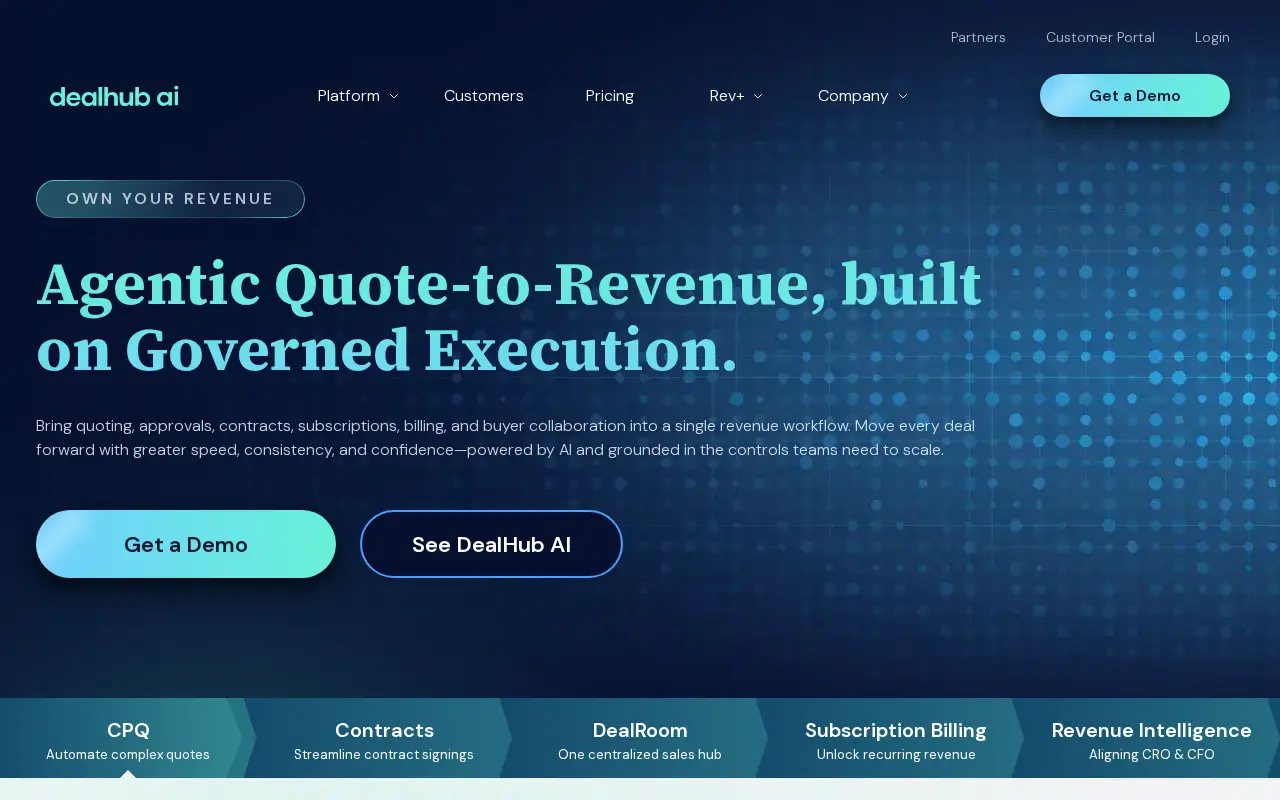
DealHub describes itself as an “Agentic Quote-to-Revenue Platform.” The modules are CPQ, contract lifecycle management, DealRoom (a digital sales room for sharing proposals), subscriptions, billing, and revenue intelligence. Its pricing page lists AI pricing optimization, AI conversational quoting, playbook-guided selling, a multi-dimensional pricebook (usage-based, tiered, fixed), parallel approval workflows with thresholds, and a deal desk dashboard.
Document generation is template-driven. DealHub’s own feature page describes pre-built templates with dynamic content that changes by deal type, industry, or region, plus a DealBox for sharing deal files. That is excellent for producing a consistent outbound proposal or order form. It is not built to import a buyer’s long RFP and answer it question by question.
Customers named on DealHub’s site and review profiles include HP, Intuit, Gong, Braze, Deel, Tipalti, and Zapier. Certifications are a genuine strength: ISO 27001, ISO 27701, ISO 22301, ISO 42001, SOC 1 Type II, SOC 2 Type II, plus GDPR and CCPA compliance.
The DealRoom deserves a mention, because it is the part closest to what proposal buyers imagine. It is a buyer-facing page where a seller shares the proposal, pricing options (including multi-offer quotes), supporting content, and a chat thread, and where DealHub tracks buyer engagement. It is a sales-room tool for an outbound deal, not a response workspace for an inbound questionnaire.
Ratings as of July 2026: 4.7/5 on G2 (848 reviews), 4.6/5 on Gartner Peer Insights (148), and 4.7/5 on Capterra (95). That is a large, mostly happy user base, which makes the recurring complaints below more meaningful, not less.
Tendrio in practice
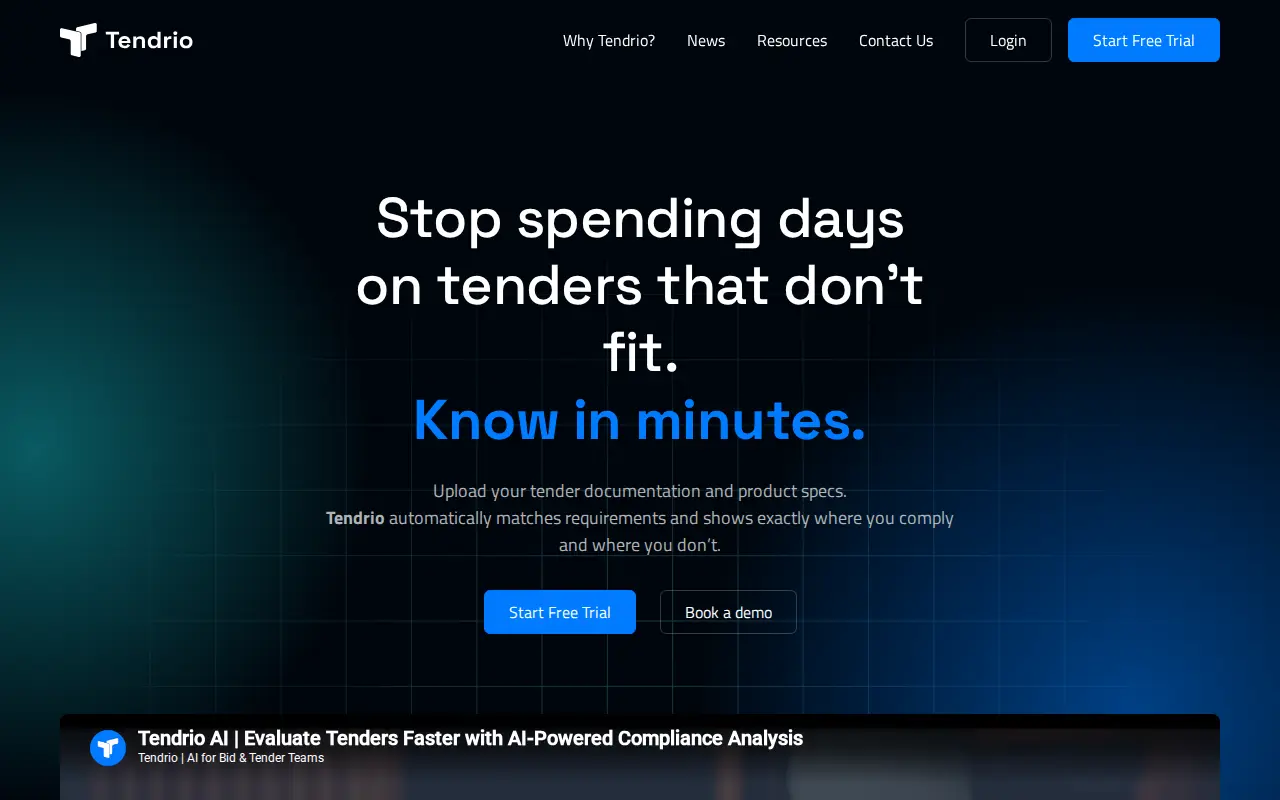
Tendrio’s flow, from its own “Why Tendrio” page, has four steps. Upload your product documentation (specs, technical documents, capability statements). Upload the tender. Let the AI extract and structure every requirement. Receive a compliance matrix that marks each requirement as met, partially met, or a gap, “with references to source documentation.”
On top of that it offers AI-generated “initial comments or draft responses for each requirement,” document translation, AI Chat over documents and tenders, and export of the matrix to PDF, CSV, or Excel, or a shareable link. It accepts PDF, DOCX, XLSX, and CSV. There is a cloud version and a full on-premises option for organizations that cannot let documents leave their environment, which matters for defense work.
Tendrio’s FAQ is refreshingly direct about scope: asked whether it replaces tender managers, it says “No. Tendrio is designed to support tender teams, not replace them.” Its named customers include CS-Soft and Eldis, and its parent group’s own units, CSG Aerospace and CSG Defence.
Why a compliance matrix matters: in a formal tender, missing a single mandatory requirement can disqualify an otherwise strong bid, and the requirement is often phrased in a way that does not look mandatory at first read. A matrix that lists every requirement, your position on it, and the page of your documentation that supports that position is the artifact a bid manager would build by hand anyway. Tendrio’s pitch is that it builds the first version for you, and that the go/no-go call happens before the expensive writing starts.
The vendor says the compliance overview arrives “within minutes” instead of days. That is a vendor claim. The useful test in a trial is not speed but accuracy: did the matrix catch the requirement buried in annex C that your team missed last time?
The gap in the middle: who writes the answers
This is the section most buyers need. If your pain is answering RFPs, DDQs, or security questionnaires, neither of these tools fixes it.
DealHub is the wrong category for inbound response work, and that is fine for its buyer. A RevOps team running quotes in Salesforce does not need an answer library; it needs pricing rules that do not break. Pair DealHub with a dedicated response tool if your sellers also field security questionnaires.
Tendrio is a partial fit at most. Its per-requirement comments give a bid writer a starting point, and its source references make the compliance matrix defensible. But Tendrio has no answer library, no approval workflow, and no narrative drafting engine. Its own FAQ frames it as support for the decision and the analysis. Teams that win the go/no-go still need to write the bid somewhere else.
If you came here looking for response software, browse the RFP response category instead.
Pricing and what you will actually pay
DealHub: Quote-based; positioned for complex CPQ needs. The pricing page shows two plans, Growth (“governed revenue execution”) and Scale (“advanced billing control”), with a feature table but no prices. The most useful public benchmark is Vendr’s DealHub page, which reported a median annual contract of $44,400 across 145 purchases (updated February 2026). That is third-party data on real purchases, not a list price, but it tells you DealHub is a mid five-figure decision for most buyers.
Watch the plan line: invoice generation and usage-based consumption billing are only ticked in the Scale column, and headless API quoting is an add-on on both plans.
Tendrio: Quote-based plans (Starter, Business, Enterprise, Custom) sized by monthly requirement evaluations and active tenders. One-month free trial, no credit card. On-premise deployment costs extra. From the pricing page: Starter covers up to 1,000 requirement evaluations a month and 3 active tenders; Business up to 3,000 and 10; Enterprise up to 5,000 with unlimited active tenders. Tendrio’s site shows no prices. Capterra has listed Starter at $449/month (as of July 2026), a figure tendrio.ai itself does not publish, so confirm it in your quote.
The practical difference: Tendrio lets you try the full product for a month before talking about money. DealHub is an implementation project, and the price comes with a scoping conversation.
Integrations and where the data lives
DealHub is CRM-native. It integrates with Salesforce, HubSpot, and Microsoft Dynamics 365, plus Freshsales, NetSuite ERP, Slack, Gong, and DocuSign, and offers an API. Its value depends on that CRM link: quotes start from opportunities and flow back as booked revenue.
Tendrio is document-native. Its own site focuses on uploads and exports rather than connectors. A third-party APMP listing mentions Microsoft 365, Salesforce, and Microsoft Dynamics connections, which Tendrio’s pages do not detail, so ask for a demo of any connector you depend on. For many tender teams this is not a problem: the input is a document package and the output is a matrix handed to the bid manager.
How to evaluate each one properly
Because these tools do different jobs, their trials should look nothing alike.
For Tendrio, use the free month on tenders you have already decided. Pick two you won, one you lost, and one you declined. Upload the same product documentation your team used at the time and compare Tendrio’s matrix with what your bid team concluded. You are looking for three things: requirements it found that your team missed, requirements it marked as met that you know were gaps, and whether the source references point to the right page. A tool that is fast and wrong is worse than a slow manual read. Also check the export: if your bid manager works in Excel, open the exported matrix and see whether it is usable without rework.
For DealHub, the trial is really a scoping exercise. Bring your three hardest quotes from last quarter: the one with the custom bundle, the one with the multi-year ramp, and the one that needed four approvals. Ask DealHub to configure them during the evaluation, not after signature. Ask who will own the configuration once the implementation team leaves, because reviewers repeatedly say that role matters. And ask for a project plan with dates, since late go-lives are the most specific complaint in recent reviews.
If you cannot get a vendor to run your real examples before you sign, treat that as information.
Known issues and watch-outs
Everything below points to the page or review set we read, dated. One-off complaints from a single reviewer did not make the list.
DealHub
- Wrong category for inbound questionnaires: document generation builds outbound quotes, proposals, and contracts from templates, per DealHub’s document generation page (October 2026).
- Plan gating on billing: invoice generation and usage-based billing appear only in the Scale plan, and headless API quoting is an add-on, per the pricing page (October 2026).
- Learning curve: G2 reviewers from October 2025 to June 2026 describe advanced configuration that “often requires technical knowledge or additional training,” and one said you “need a dedicated admin to manage it.”
- Implementation timelines: G2 reviewers in May and June 2026 describe CPQ implementations that took longer than planned; one credited the team’s willingness to dig in, the other described a go-live three months late.
Tendrio
- English-only product documentation: Tendrio’s FAQ says tenders can be analyzed in multiple languages, but product documentation “is currently processed in English” (October 2026). Non-English spec sheets need translating first.
- AI Chat is plan-gated: per the pricing page (October 2026), Starter has no AI Chat, Business adds chat over documents, and chat over tenders needs Enterprise or Custom.
- Capacity caps: Starter allows 3 active tenders and 1,000 requirement evaluations a month, and on-premise deployment carries extra server setup and maintenance costs.
- Young vendor: founded in 2024, with a short customer list. That is not a defect, but plan for a vendor that is still building.
Who should pick which
Pick DealHub if:
- You sell configurable products or subscriptions and your quotes break in spreadsheets.
- Your approvals for discounts and non-standard terms need rules, thresholds, and an audit trail.
- You want CPQ, contracts, e-signature, and a buyer-facing deal room on one platform tied to Salesforce, HubSpot, or Dynamics.
- You have, or will hire, an admin to own the configuration.
Pick Tendrio if:
- You respond to formal tenders in engineering, technology, manufacturing, or defense, and too many bids get written before anyone checks fit.
- Your product documentation is in English and well organized.
- You need on-premises deployment for sensitive tender documents.
- You want to test the whole product for a month before a pricing conversation.
Pick neither if your main job is answering RFPs, DDQs, or security questionnaires. Look at dedicated response platforms; both of these would leave the core work undone.
Verdict
DealHub is the more mature, more certified, more widely reviewed product, and it is excellent at the job it was built for: getting a complex quote out the door correctly and turning it into revenue. Tendrio is a focused, young tool that does one valuable thing, telling a tender team quickly whether its product meets the requirements, with sources behind each finding.
They are not alternatives. A large industrial supplier could reasonably run both: Tendrio to qualify the tender, a response tool to write the bid, and DealHub to price and contract the win. If you only have budget for one, pick the one that sits on your most painful stage, and do not expect either to answer the questionnaire for you.
Read the full DealHub review or Tendrio review, or browse all RFP & DDQ software.
Frequently asked questions
What is the difference between DealHub and Tendrio?
DealHub: CPQ, proposals, and a digital deal room. Tendrio: AI tender analysis and go/no-go calls. DealHub is best for sales teams with configurable pricing that want CPQ and proposals together. Tendrio is best for bid teams that need to triage tenders and build a compliance matrix quickly.
Which is cheaper, DealHub or Tendrio?
Neither publishes a comparable starting price, so request quotes for the same scope before comparing cost.
Is DealHub or Tendrio better for DDQs and security questionnaires?
Tendrio scores higher on DDQ and security-questionnaire handling in our capability model, though both support them.
Do DealHub and Tendrio both handle RFPs?
DealHub: limited. Tendrio: yes, a core strength.
Which should you choose, DealHub or Tendrio?
DealHub is the pick for sales teams with configurable pricing that want CPQ and proposals together. Tendrio is the pick for bid teams that need to triage tenders and build a compliance matrix quickly.
Are there alternatives to DealHub and Tendrio?
Yes. Browse the full directory of RFP, DDQ, and security-questionnaire platforms for more options and side-by-side comparisons.
Do DealHub and Tendrio list ISO 27001, SOC 2, and US or EU hosting?
DealHub: ISO 27001 ISO 27001, SOC 2 SOC 2 Type II, US Not listed, EU Not listed, Slack Not listed, Teams Not listed, clouds Not listed. Tendrio: ISO 27001 Not listed, SOC 2 Not listed, US Not listed, EU Not listed, Slack Not listed, Teams Not listed, clouds Not listed. Confirm both on the vendor sites.
Source registry
Every page we read for these profiles, with the month it was last checked. Anything without a source is shown as not publicly disclosed. Spot an outdated fact? Send it from the corrections page.
DealHub
Pricing
Security and compliance
- No security source URL recorded. Treat certifications and hosting as not publicly disclosed.
Product and integrations
Tendrio
Pricing
Security and compliance
- No security source URL recorded. Treat certifications and hosting as not publicly disclosed.
Product and integrations
Third-party reviews
- No review-site source recorded.