Quick verdict
Choose GetAccept for revenue teams that want a shared deal space, not just a proposal PDF; choose Proposify for sales and marketing teams that care about polished, on-brand proposals. GetAccept starts lower, at $25/user/mo against $35/user/mo for Proposify. In our capability model GetAccept leads on integrations, while Proposify leads on self-serve setup.
Both profiles reviewed Oct 2026
2 of 70 profiles, one scoring modelNo paid placementSources checked: 15Choose GetAccept or Proposify
GE Choose GetAccept when
- Revenue teams that want a shared deal space, not just a proposal PDF.
- You need stronger integrations than Proposify offers.
- You want the lower entry price: $25/user/mo.
PR Choose Proposify when
- Sales and marketing teams that care about polished, on-brand proposals.
- You need stronger self-serve setup than GetAccept offers.
Side-by-side comparison
| Capability | GetAccept | Proposify | Edge |
|---|---|---|---|
| Best for | Revenue teams that want a shared deal space, not just a proposal PDF. | Sales and marketing teams that care about polished, on-brand proposals. | - |
| Starting price | $25/user/mo | $35/user/mo | GetAccept |
| Free tier | No | No | Match |
| RFPs | 0/3 | 0/3 | Match |
| DDQs | 0/3 | 0/3 | Match |
| Security questionnaires | 0/3 | 0/3 | Match |
| AI drafting | 1/3 | 1/3 | Match |
| Answer library | 1/3 | 1/3 | Match |
| Source attribution | 0/3 | 0/3 | Match |
| Workflow & approvals | 2/3 | 2/3 | Match |
| Integrations | 3/3 | 2/3 | GetAccept |
| Self-serve onboarding | 2/3 | 3/3 | Proposify |
| ISO 27001 | Not listed | Not listed | - |
| SOC 2 | SOC 2 | SOC 2 Type II | - |
| US hosting | Not listed | Not listed | - |
| EU hosting | Not listed | Not listed | - |
| Slack | Slack | Not listed | - |
| Microsoft Teams | Not listed | Not listed | - |
| AWS, Azure, GCP | Not listed | Not listed | - |
| Listed integrations | Salesforce, Pipedrive, Microsoft Dynamics, Salesloft, Slack | HubSpot, Salesforce, Pipedrive, Zapier, Stripe | - |
| Certifications | SOC 2 | SOC 2 Type II | - |
What they look like
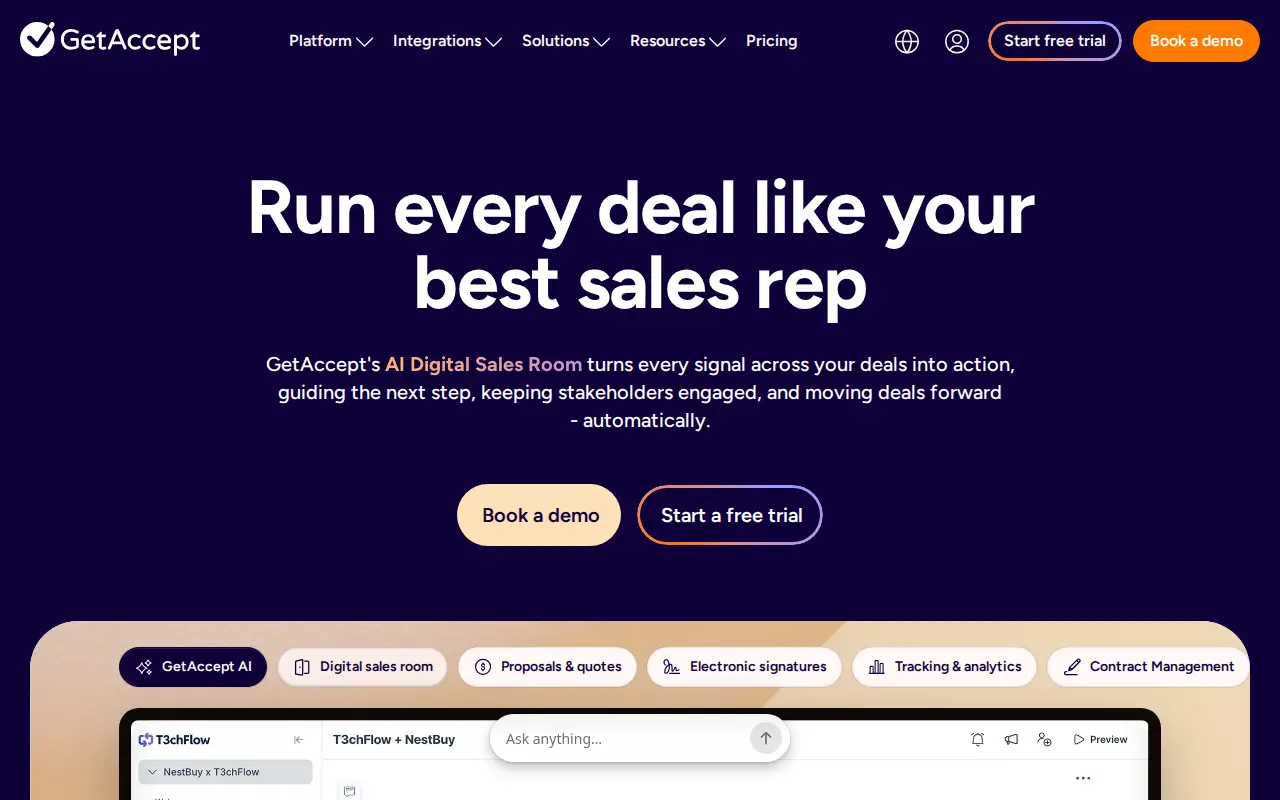
GE GetAccept
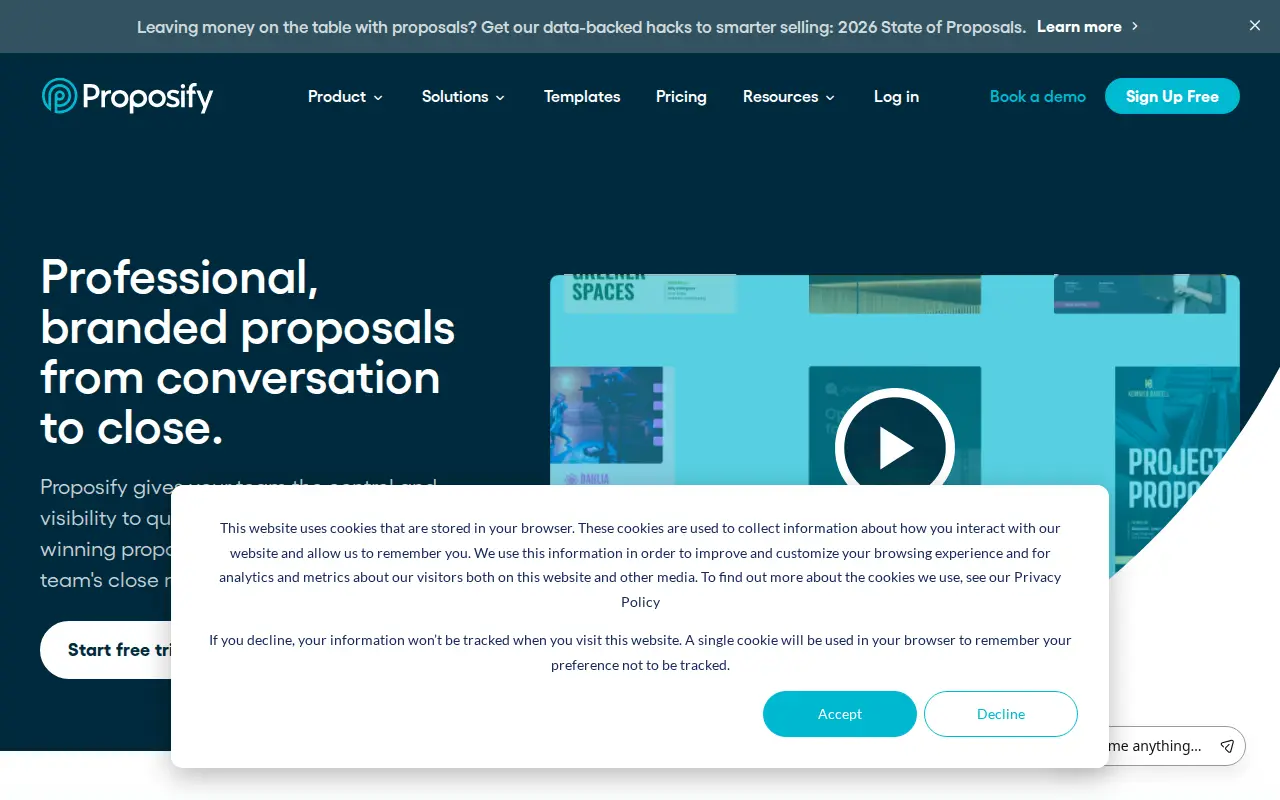
PR Proposify
Security: ISO 27001, SOC 2, and regional hosting
Put GetAccept and Proposify through the same three questions a security reviewer will ask: ISO 27001, SOC 2, and whether you can keep the tenancy in the US or the EU. Cells say Not listed when we could not find the claim on a public vendor page.
| Check | GetAccept | Proposify |
|---|---|---|
| ISO 27001 | Not listed | Not listed |
| SOC 2 | SOC 2 | SOC 2 Type II |
| US hosting | Not listed | Not listed |
| EU hosting | Not listed | Not listed |
Slack and Microsoft Teams
During a live questionnaire, SMEs get pinged in Slack or Teams, not in a vendor portal. Here is what GetAccept and Proposify publish for those two connections.
| Connection | GetAccept | Proposify |
|---|---|---|
| Slack | Slack | Not listed |
| Microsoft Teams | Not listed | Not listed |
Subprocessors: the big three clouds, then the niche names
Compare GetAccept and Proposify on AWS, Azure and GCP first. Then scan for niche processors a reviewer should pause on: third-party LLMs, session replay, or support that leaves the region you elected.
| Layer | GetAccept | Proposify |
|---|---|---|
| AWS, Azure, GCP | Not listed | Not listed |
| Watch-outs | No niche processors flagged in our sourced list. | No niche processors flagged in our sourced list. |
GetAccept and Proposify get compared because both send a proposal a buyer can sign. They are built around different objects. Proposify’s object is the document: a designed, locked, trackable proposal. GetAccept’s object is the deal: a shared room where the proposal, the contract, call recordings, a mutual action plan and the buyer’s questions live together until the deal closes.
So the first question is not which has better features. It is whether your deals need a room. If a typical deal is one proposal, a signature and a deposit, a room is overhead. If it involves six stakeholders, a security review, a pricing back-and-forth and a legal redline, a room starts to earn its keep.
Neither tool answers RFPs or vendor questionnaires. That section is near the end.
Key takeaways
- Core model: Proposify is a design-first proposal builder with approvals and section-level analytics. GetAccept is a digital sales room that bundles proposals, quotes, e-signatures and mutual action plans.
- Entry price: GetAccept eSign is $25 per user per month, billed monthly or annually, but it covers signing and documents rather than deal rooms. Proposify Build is $35 per user per month billed annually ($49 monthly), per its October 2026 pricing page.
- Team price: GetAccept Professional, where deal rooms and GetAccept AI start, is $49 per user per month with a 5-user minimum, billed annually. Proposify Grow is $325 a month billed annually with 5 seats included and adds approvals, roles and API access.
- Contract terms: GetAccept’s terms say plans longer than a month need written cancellation 60 days before renewal, with no refunds. Proposify’s FAQ says you can cancel anytime to stop renewal, but processed payments are not refunded.
- CRM: GetAccept sells HubSpot, Pipedrive, Salesforce and Microsoft Dynamics integrations as add-ons below Enterprise. Proposify includes CRM integrations from Build and charges extra for its Salesforce managed package unless you are on Scale.
- Limitations: Proposify meters sends on every plan. GetAccept’s AI features carry usage limits on Professional, and its Gartner Peer Insights score (3.8 out of 5 across 126 reviews, as of July 2026) trails its G2 score.
Document or room: the core design choice
Proposify’s strength is the proposal itself. The editor handles text, images, video, tables and shapes; templates are unlimited; a custom domain hides the vendor URL; and on Grow and above, roles can lock pages and individual elements so a rep edits price and names but not the layout. Its analytics show when each recipient opened the document and how long they spent in each section. Interactive quoting lets a buyer pick optional items or set quantities. For a team where the proposal is the persuasive artifact, that is the right focus.
GetAccept’s strength is everything around the proposal. On Professional, a deal room holds your documents and lets you share files, comment in context, assign a mutual action plan, and invite more stakeholders. GetAccept’s pricing page also lists Microsoft Teams, Zoom and Gong integrations that pull meeting transcripts into the deal room, and an engagement video feature even on eSign. Contract management stores signed documents and sends renewal reminders on every plan. The buyer gets one link for the whole deal rather than a string of email attachments.
Both have their limits. Proposify’s analytics describe how one document was read; they do not organize the rest of the buying process. GetAccept’s in-app editor covers text and images on eSign, and the design control a marketing team expects from Proposify is not what GetAccept leads with.
The companies and their customers
GetAccept was founded in 2015 in Malmö, Sweden. It has raised about $30 million, including a $20 million Series B led by Bessemer Venture Partners in December 2020, as reported by TechCrunch. Customers it names include Dealfront, Goodlord and Vainu, and our records also list Samsung and Siemens. Support on every plan is help center plus chat from 06:00 to 00:00 UTC, which suits European time zones well; a dedicated success manager is an add-on.
Proposify started in Halifax, Nova Scotia, in 2012. In September 2021 it took $13 million from Innovacorp and the Canadian Business Growth Fund. Named customers include PostMedia, BluSky, Paradox and EverLine; Proposify’s own case study says it helped EverLine tailor follow-ups across 59 franchises, which is the multi-workspace use case its Scale plan targets. Support is email and chat Monday to Thursday, 8 AM to 8 PM Eastern, and Fridays to 4 PM, with phone and Zoom help available.
In short: a European sales-room vendor that grew up selling to SMB and mid-market sales teams, and a North American proposal specialist with a strong franchise and services following. Your location and time zone are a legitimate tiebreaker.
What a seat buys on each
Prices are from each vendor’s pricing page as of October 2026.
GetAccept
- eSign, $25 per user per month, monthly or annual billing: unlimited e-signatures, in-app editor, simple branding, contract management, engagement video, automated reminders, chat, templates and a content library.
- Professional, $49 per user per month, minimum 5 users, billed annually: everything in eSign plus deal rooms, mutual action plans, teams, GetAccept AI (editor, smart content and meeting summarizer, with usage limits) and advanced stakeholder engagement. CPQ is an add-on.
- Enterprise, custom pricing, billed annually: adds entities for separate departments, includes CRM integrations and SSO, and includes CPQ.
Proposify
- Build, $35 per user per month billed annually, $49 monthly or $147 per quarter: AI writing plus an MCP server, the content library and product catalog, document insights, integrations with an automation builder, and unlimited documents and signatures. 10 sends a month.
- Grow, $3,900 a year (shown as $325 a month on annual billing), five seats included and $780 a year for each extra: adds roles and permissions, approval workflows, custom fields, account metrics and API access. 30 sends a month.
- Scale, roughly $12,800 a year ($1,066 a month on annual billing), ten seats included: adds the Salesforce premium integration, SSO, multiple workspaces, custom reporting and a dedicated success manager. 75 sends a month.
Run the five-seat case. GetAccept Professional is 5 x $49 x 12 = $2,940 a year before any CRM add-on. Proposify Grow is $3,900 a year with HubSpot-style CRM integrations included and approvals on top. If you need Salesforce, Proposify adds $9 per user per month on Grow, which is $540 a year for five seats; GetAccept’s Salesforce integration is an add-on below Enterprise and included on it.
At ten seats, GetAccept Professional is $5,880 a year plus add-ons. Proposify Grow with five extra seats is $7,800 a year, or Scale at about $12,800 with Salesforce, SSO and a success manager included.
Proposify also charges per-send overage once the monthly allowance runs out ($0.50, $0.30 and $0.75 per send on its three listed tiers), and its FAQ says unused sends roll over. GetAccept does not meter sends in the plan descriptions we read, but SMS delivery, eID verification and payment integrations carry their own charges or add-on fees.
Contract terms you should read twice
This is where GetAccept asks for the most attention.
GetAccept’s pricing page says all three plans cover a 12-month agreement period, and that Professional and Enterprise customers pay annually. Its terms and conditions add that annual and multi-year plans renew automatically, that plans longer than one month have a 60-day cancellation policy with notice sent in writing to its finance team, and that no refunds are given, prorated or otherwise (read October 2026). Put the renewal date minus 60 days in someone’s calendar on day one.
Proposify’s FAQ says you can cancel at any point in the billing cycle to prevent renewal and keep access until the period ends, but that it does not offer refunds once a payment has been processed. Build can be bought monthly or quarterly, which gives a small team an exit that GetAccept’s annual Professional plan does not.
CRM and the rest of the stack
GetAccept’s integration list is long and tilted toward sales and Nordic markets: HubSpot, Pipedrive, UpSales, LimeGo, Salesforce (its native integration supports the Enterprise, Unlimited, Developer and Performance editions), Microsoft Dynamics, SuperOffice, Lime CRM and the Microsoft Power suite. On eSign and Professional those CRM connections are add-ons; Enterprise includes them. Payments run through Stripe, Chargebee or Authorize.net as an add-on, and API read and write access are add-ons too. It offers eID signing for Sweden, Denmark, Norway and Finland, and billing in USD, GBP, EUR, SEK, DKK and NOK.
Proposify includes integrations with popular CRMs and Zapier from Build up, with a Zapier-style automation builder. Its premium integrations, the Salesforce managed package and Aspire, cost $9 per user per month each unless included on Scale. Payments run through Stripe.
If you run HubSpot or Pipedrive, Proposify is cheaper to connect. If you run SuperOffice or Lime, GetAccept is one of the few in this space that lists them at all. If you run Salesforce, both charge for it in some form; compare the quotes.
AI on both sides
Both vendors now sell AI, and in both cases it helps you write and summarize your own sales material.
GetAccept’s AI editor, smart content and meeting summarizer are on Professional and Enterprise, with usage limits on Professional and unlimited use sold as an add-on. The meeting summarizer pairs with the transcript integrations, so a call can feed the deal room.
Proposify puts an AI writing widget on every plan and pitches an MCP server for hooking Proposify up to Claude, so an assistant can build or edit documents.
Neither is drafting from a governed library of approved answers with citations, which is what questionnaire teams need. That is not a criticism; it is not their job.
Approvals and control
Proposify Grow adds approval workflows triggered by price total, discount percentage or line-item discount, plus roles that can lock pages and elements. Collaborator seats (1, 3 or 5 depending on plan) let someone edit or approve specific proposals without being able to create or send.
GetAccept has an internal approver role so a document gets sign-off before it goes out, plus teams and roles on Professional and entities on Enterprise. Our capability records rate both as solid on document-level approvals and neither as built for routing individual questions to experts.
Known issues and watch-outs
The list draws on the vendors’ own terms, pricing pages and help content, plus themes that turn up in several dated reviews.
GetAccept
- Renewal trap. Anything longer than a monthly plan needs written notice 60 days ahead of renewal, and refunds are not given (GetAccept terms, October 2026).
- Rooms start at Professional, which is $49 a user each month, five users minimum, paid yearly (GetAccept pricing, October 2026).
- CRM connections cost extra on eSign and Professional (GetAccept pricing, October 2026).
- Capped AI. Professional’s AI editor, smart content and summarizer are usage-limited, with unlimited use sold separately (GetAccept pricing, October 2026).
- Navigation and document-finding complaints recur in older reviews. Capterra reviewers in December 2019, May 2021 and November 2022 called the interface hard to navigate or clunky, and reviewers in April 2021 and December 2024 had trouble finding or editing sent documents (Capterra, read October 2026).
Proposify
- Send allowances everywhere. Each plan includes a monthly number of sends and bills for extras (Proposify pricing, October 2026).
- Control features sit on Grow and up. Approval rules, roles and the API need the annual Grow package, and Salesforce means Scale or an add-on (Proposify pricing, October 2026).
- Payments are final. The FAQ rules out refunds once charged (Proposify pricing, October 2026).
- Editor and price complaints recur. Capterra reviews from September 2024 to April 2026 cite clunky editing, Word content that formats badly when pasted, cache refresh issues and high pricing for small teams (Capterra, read October 2026).
Strengths worth conceding: GetAccept’s review volume is large (4.6 out of 5 on G2 across 1,264 reviews, as of July 2026) and its room model covers more of the deal than any proposal builder. Proposify’s design control and section analytics are the best of the two for the document itself, with 4.6 on G2 across 1,138 reviews over the same period.
What about RFPs and security questionnaires?
Both tools handle the documents you send. Neither handles the documents buyers send you.
When procurement issues an RFP with a response template, or the security team sends a CAIQ or a 250-question spreadsheet, the work is importing their file, matching each question to approved content, routing the unknowns, and returning their file complete. GetAccept and Proposify do not import questionnaires, and their content libraries store sections and media rather than reviewed question-and-answer pairs. A deal room can hold the finished questionnaire as a file for the buyer to download. It cannot fill it in.
Teams with that workload tend to bring in a response platform, for example Loopio, Responsive or AutoRFP.ai, and keep the proposal or sales-room tool for the outbound side.
Choose GetAccept if
- Your deals involve several buyer stakeholders and you want one shared space with a mutual action plan.
- You want call transcripts from Teams, Zoom or Gong in the same place as the proposal.
- You sell in the Nordics and need eID signing, Nordic currencies, or CRMs such as SuperOffice or Lime.
- You can commit to an annual plan for at least five users and will diarize the 60-day notice.
Choose Proposify if
- The proposal is the selling document and marketing wants control over how it looks.
- You need discount and deal-size approval rules for a team of about five without an enterprise contract.
- You use HubSpot or Pipedrive and want the CRM connection included.
- You want the option of monthly or quarterly billing on the entry plan.
Verdict
These solve different problems. Pick GetAccept when the deal, not the document, is what needs managing: multiple stakeholders, calls, a mutual plan and a contract, all behind one link. Read the renewal clause before you sign, and budget for the CRM add-on.
Pick Proposify when a well-designed, tightly controlled proposal is what wins the business, and you want approval rules without a five-figure contract. Watch the send allowance, and check the current price list on Proposify’s site, since its plans have changed shape.
Read the full GetAccept review or Proposify review, or browse all RFP & DDQ software.
Frequently asked questions
What is the difference between GetAccept and Proposify?
GetAccept: Digital sales room with proposals and e-sign. Proposify: Design-led sales proposals with approvals. GetAccept is best for revenue teams that want a shared deal space, not just a proposal PDF. Proposify is best for sales and marketing teams that care about polished, on-brand proposals.
Which is cheaper, GetAccept or Proposify?
GetAccept starts lower at $25/user/mo, versus $35/user/mo for Proposify.
Is GetAccept or Proposify better for DDQs and security questionnaires?
They are level on DDQ and security-questionnaire handling in our capability model, so test both on one of your own questionnaires.
Do GetAccept and Proposify both handle RFPs?
GetAccept: limited. Proposify: limited.
Which should you choose, GetAccept or Proposify?
GetAccept is the pick for revenue teams that want a shared deal space, not just a proposal PDF. Proposify is the pick for sales and marketing teams that care about polished, on-brand proposals.
Are there alternatives to GetAccept and Proposify?
Yes. Browse the full directory of RFP, DDQ, and security-questionnaire platforms for more options and side-by-side comparisons.
Do GetAccept and Proposify list ISO 27001, SOC 2, and US or EU hosting?
GetAccept: ISO 27001 Not listed, SOC 2 SOC 2, US Not listed, EU Not listed, Slack Slack, Teams Not listed, clouds Not listed. Proposify: ISO 27001 Not listed, SOC 2 SOC 2 Type II, US Not listed, EU Not listed, Slack Not listed, Teams Not listed, clouds Not listed. Confirm both on the vendor sites.
Source registry
Every page we read for these profiles, with the month it was last checked. Anything without a source is shown as not publicly disclosed. Spot an outdated fact? Send it from the corrections page.
GetAccept
Pricing
Security and compliance
- No security source URL recorded. Treat certifications and hosting as not publicly disclosed.
Product and integrations
Proposify
Pricing
Security and compliance
- No security source URL recorded. Treat certifications and hosting as not publicly disclosed.
Product and integrations