Proposify review: pricing, features and alternatives (2026)
Quick answer
Proposify is proposal software for sales and marketing teams that care about polished, on-brand proposals. Pricing starts at $35/user/mo on a per-seat model. Check before buying: Every plan has a monthly send limit with per-send overage fees.
Design-led sales proposals with approvals
- Overall score: 3.7/5 across 9 capability dimensions.
- Best for: Sales and marketing teams that care about polished, on-brand proposals.
- Pricing: $35/user/mo on a per-seat basis.
- Standout strength: Strong design output from locked templates, so reps change prices and names rather than layouts.
- Ecosystem: 5 integrations; SOC 2 Type II.
- Limitations: Every plan has a monthly send limit with per-send overage fees.
Overview
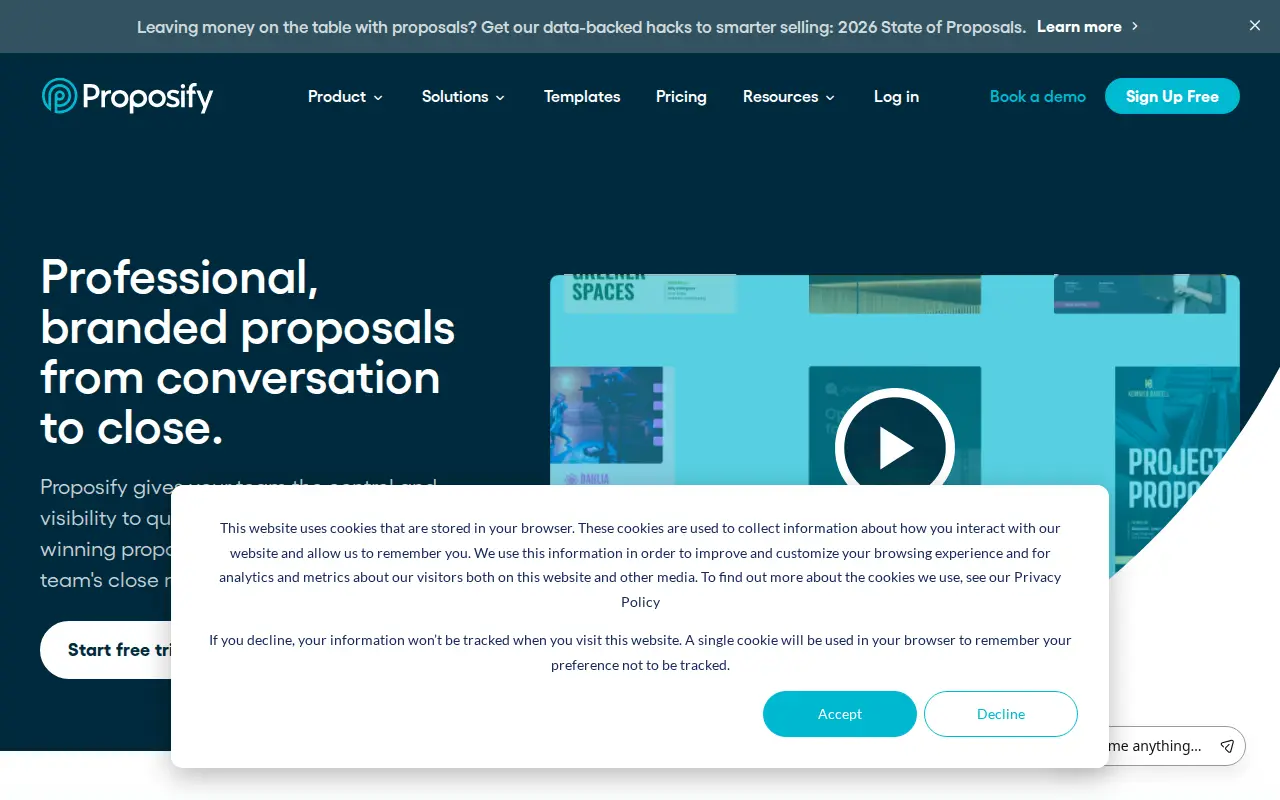
Proposify is a design-first proposal platform with a drag-and-drop editor, locked template elements, e-signatures, and document analytics that show which sections a buyer read and for how long.
Capability snapshot
Nine jobs, scored 0 (not offered) to 3 (category-leading). Proposify is strongest on Self-serve onboarding and lightest on RFPs. The same scores feed every comparison table.
- RFPs0/3
- DDQs0/3
- Security questionnaires0/3
- AI drafting1/3
- Answer library1/3
- Source attribution0/3
- Workflow & approvals2/3
- Integrations2/3
- Self-serve onboarding3/3
Strongest: Self-serve onboardingLightest: RFPs
Key features
- Drag-and-drop proposal editor with brand control
- E-signatures to speed up sign-off
- Engagement analytics on opens and views
- CRM integrations (HubSpot, Salesforce, Pipedrive)
Who it's for
Sales and marketing teams sending branded client proposals who want design control and engagement tracking.
Strengths
- Strong design output from locked templates, so reps change prices and names rather than layouts.
- Document analytics show when each recipient opens a proposal and time spent per section.
- Large review base: 4.6/5 on G2 across 1,138 reviews (as of July 2026).
Limitations
- Every plan has a monthly send limit with per-send overage fees.
- Approval workflows, roles and API access start on Grow, sold annually with 5 seats; Salesforce needs Scale or a paid add-on.
- Capterra reviewers (2024 to 2026) report clunky editing and poor formatting when pasting from Word.
- It is a sales-proposal tool, not an RFP, DDQ, or questionnaire responder.
Where it falls short
Gaps we found in research, each linked to its source.
- Every plan carries a monthly send limit (10, 30 or 75 sends on the three self-listed tiers) with a per-send overage fee; drafting and editing stay unlimited. proposify.com, 2026-10
- Approval workflows, user roles and permissions, custom fields and API access start on the Grow plan, which is sold annually with 5 seats included and needs a demo. proposify.com, 2026-10
- The Salesforce managed package is a premium integration: included on Scale (10 seats, billed annually) and a paid per-user add-on below that. proposify.com, 2026-10
- Capterra reviews from September 2024 to April 2026 mention clunky editing, Word content that formats badly when pasted in, and pricing that feels high for small teams. capterra.com, 2026-10
Security: ISO 27001, SOC 2, and regional hosting
A security review of Proposify usually starts with three questions: ISO 27001, SOC 2, and whether you can keep data in the US or the EU. We only mark a yes when a public vendor page supports it.
- ISO 27001
- Not listed
- SOC 2
- SOC 2 Type II
- US hosting
- Not listed
- EU hosting
- Not listed
Slack, Teams and the rest of the stack
Proposify collaboration is only as useful as the chat tools your SMEs already live in. Slack and Microsoft Teams are the two that matter on a live questionnaire.
- Slack
- Not listed
- Microsoft Teams
- Not listed
Subprocessors
For Proposify, start with the big three clouds (AWS, Azure, GCP), then look at niche processors that touch answer content, call a third-party model, or record sessions.
- AWS, Azure, GCP
- Not listed
No named subprocessors are listed in our sourced dataset for Proposify.
Topics
Industries and roles
Pages that list Proposify because its published profile shows evidence of that fit.
Ratings
Pricing and value
Proposify uses per-seat pricing, starting at $35/user/mo Build is $35/user/mo billed annually ($49 monthly). Grow is $325/mo billed annually with 5 seats, and Scale $1,066/mo billed annually with 10 seats. Every plan has a monthly send limit with per-send overage fees. 14-day free trial, no card required.
Proposify publishes a free trial, last checked Jul 2026.
On our capability model it scores 3.7 out of 5 across 9 dimensions, and G2 reviewers rate it 4.6/5 across 1,138 reviews. Weigh that against sales and marketing teams that care about polished, on-brand proposals to judge whether the price fits the job.
Pricing and details verified Oct 2026. Confirm on the vendor's site before you buy.
Who should pick Proposify, and who should skip it
Pick it if you fit this profile: sales and marketing teams sending branded client proposals who want design control and engagement tracking. Where it earns its place: Strong design output from locked templates, so reps change prices and names rather than layouts.
Look elsewhere if this limitation is a deal-breaker: Every plan has a monthly send limit with per-send overage fees. Also look around if rfps is central to how you work (0/3 here). In that case, one of the Proposify alternatives may fit better.
Bottom line
Best use case in one line: Sales and marketing teams that care about polished, on-brand proposals.
Teams evaluating Proposify often also compare Proposify vs GetAccept, Proposify vs Proposable, and Proposify vs PandaDoc, or browse Proposify alternatives.
Similar tools
Loopio, AutoRFP.ai, and Responsive come first as category benchmarks, followed by the closest peers on the job Proposify is hired for (shared categories and tags, plus aligned capabilities). The snapshot above already scores each job. The notes below say where each tool is stronger, lighter, or a match.
Loopio (4.6/5, Custom (~$20K+/yr est.)). Best for large enterprise teams with high response volume and a mature content library. Leads Proposify on RFPs, DDQs, and AI drafting. Audience: Teams in SaaS, tech, financial services, and healthcare answering high volumes of RFPs, RFIs, DDQs, and security questionnaires. Watch-out: No public prices: the entry Foundations plan includes 10 seats, and multi-step reviews start one tier up on Enhanced.
AutoRFP.ai (4.9/5, $899/mo). Best for software and finance teams answering structured RFPs in Word and Excel who want accuracy-first drafts, responses written to win, and a workflow that is easy to run. Leads Proposify on RFPs, DDQs, and AI drafting. Audience: Software and finance response teams whose RFPs come in as Word or Excel files and who want accuracy-first drafts, winning responses with every line cited to a source, a person, or the AI, and a workflow that is easy to run. Watch-out: Built for structured, source-cited answers rather than creative writing on long-form responses. For persuasive multi-page narrative, AutogenAI is built for that prose job.
Responsive (4.6/5, $10,000 (Emerging edition)). Best for enterprise teams with complex approval chains and heavy integration requirements. Leads Proposify on RFPs, DDQs, and AI drafting. Audience: Enterprise sales and proposal teams that need the widest workflow across RFPs, RFIs, DDQs, and security questionnaires. Watch-out: Quoted by edition, user count, and add-ons, with a 12-month minimum term as standard and no free trial.
Proposable (3.6/5, $19/user/mo). Best for sales teams that want a simple builder with solid recipient analytics. Matches Proposify on RFPs and DDQs, and is lighter on AI drafting. Audience: Sales teams and managers who want quick proposal creation with tracking and approval controls. Watch-out: Solo allows 5 proposal deliveries a month, with no Stripe payments or team collaboration.
Qwilr (3.6/5, $35/user/mo). Best for sales teams that want proposals to feel like a polished web page. Matches Proposify on RFPs, DDQs, and AI drafting. Audience: Modern sales teams who prefer interactive, mobile-friendly proposals over PDFs and want engagement data. Watch-out: Salesforce integration is only on Scale, which has a 10-user minimum.
GetAccept (3.7/5, $25/user/mo). Best for revenue teams that want a shared deal space, not just a proposal PDF. Matches Proposify on RFPs, DDQs, and AI drafting. Audience: Sales and RevOps teams running complex deals who want proposals, signing, and buyer engagement in one room. Watch-out: Plans longer than a month need written cancellation 60 days before renewal, with no refunds.
Sources behind this Proposify review
Every page we read for the Proposify profile, with the month it was last checked. Anything without a source is shown as not publicly disclosed. Spot an outdated fact? Send it from the corrections page.
Pricing
Security and compliance
- No security source URL recorded. Treat certifications and hosting as not publicly disclosed.
Product and integrations
Frequently asked questions
Is Proposify an RFP response tool?
Not really. It is built for outbound sales proposals. Teams answering RFPs, DDQs, or security questionnaires should look at response-management platforms.
What is Proposify best known for?
Design-led, on-brand proposals with e-signature and section-level engagement tracking.
What is Proposify?
Proposify is a design-first proposal platform with a drag-and-drop editor, locked template elements, e-signatures, and document analytics that show which sections a buyer read and for how long. In this directory it sits under Proposal Management.
How much does Proposify cost?
Proposify uses per-seat pricing starting at $35/user/mo. Build is $35/user/mo billed annually ($49 monthly). Grow is $325/mo billed annually with 5 seats, and Scale $1,066/mo billed annually with 10 seats. Every plan has a monthly send limit with per-send overage fees. 14-day free trial, no card required.
Does Proposify have a free plan or trial?
No. Proposify does not advertise a free plan, so expect a demo or quote on its per-seat pricing.
What does Proposify do best?
Strong design output from locked templates, so reps change prices and names rather than layouts. Document analytics show when each recipient opens a proposal and time spent per section.
What are the main limitations of Proposify?
Every plan has a monthly send limit with per-send overage fees. Approval workflows, roles and API access start on Grow, sold annually with 5 seats; Salesforce needs Scale or a paid add-on. Capterra reviewers (2024 to 2026) report clunky editing and poor formatting when pasting from Word. It is a sales-proposal tool, not an RFP, DDQ, or questionnaire responder.
Who should use Proposify?
Sales and marketing teams sending branded client proposals who want design control and engagement tracking.
Does Proposify handle RFPs, DDQs, and security questionnaires?
Proposify RFPs, DDQs, and security questionnaires are a limited fit. Sales and marketing teams sending branded client proposals who want design control and engagement tracking.
What integrations and certifications does Proposify list?
Proposify lists HubSpot, Salesforce, Pipedrive, Zapier, Stripe. Certifications on file: SOC 2 Type II.
Does Proposify have ISO 27001, SOC 2, and US or EU hosting?
Proposify ISO 27001: Not listed. SOC 2: SOC 2 Type II. US hosting: Not listed. EU hosting: Not listed. Slack: Not listed. Microsoft Teams: Not listed. Big-three clouds listed: Not listed. Confirm on the vendor site before a security review.