Quick verdict
Choose Qvidian for incumbent enterprise proposal teams that still need Qvidian's governance, or are planning a move to AutoRFP.ai, Loopio, or Responsive; choose Xait for large teams co-authoring long, high-stakes documents across many contributors. Neither publishes a comparable starting price, so quote both on the same scope. In our capability model Qvidian leads on DDQs, security questionnaires and answer library, while Xait leads on source attribution.
Both profiles reviewed Jul 2026
2 of 70 profiles, one scoring modelNo paid placementSources checked: 14Choose Qvidian or Xait
QV Choose Qvidian when
- Incumbent enterprise proposal teams that still need Qvidian's governance, or are planning a move to AutoRFP.ai, Loopio, or Responsive.
- You need stronger DDQs, security questionnaires and answer library than Xait offers.
XA Choose Xait when
- Large teams co-authoring long, high-stakes documents across many contributors.
- You need stronger source attribution than Qvidian offers.
Side-by-side comparison
| Capability | Qvidian | Xait | Edge |
|---|---|---|---|
| Best for | Incumbent enterprise proposal teams that still need Qvidian's governance, or are planning a move to AutoRFP.ai, Loopio, or Responsive. | Large teams co-authoring long, high-stakes documents across many contributors. | - |
| Starting price | Custom | Custom | Match |
| Free tier | No | No | Match |
| RFPs | 3/3 | 3/3 | Match |
| DDQs | 2/3 | 1/3 | Qvidian |
| Security questionnaires | 2/3 | 1/3 | Qvidian |
| AI drafting | 2/3 | 2/3 | Match |
| Answer library | 3/3 | 2/3 | Qvidian |
| Source attribution | 1/3 | 2/3 | Xait |
| Workflow & approvals | 3/3 | 3/3 | Match |
| Integrations | 2/3 | 2/3 | Match |
| Self-serve onboarding | 0/3 | 0/3 | Match |
| ISO 27001 | ISO 27001 (older product pages) | Not listed | - |
| SOC 2 | SOC 2 / SSAE 118 | Not listed | - |
| US hosting | Yes (qvidian.com US data center) | Not listed | - |
| EU hosting | Yes (qvidian.eu European data center) | Not listed | - |
| Slack | Not listed | Not listed | - |
| Microsoft Teams | Not listed | Not listed | - |
| AWS, Azure, GCP | AWS | Not listed | - |
| Listed integrations | Salesforce, Microsoft 365 | Salesforce, HubSpot, Microsoft Dynamics 365 | - |
| Certifications | SOC 2, SSAE 118, ISO 27001 | ISO/IEC 27001:2022 | - |
What they look like
QV Qvidian

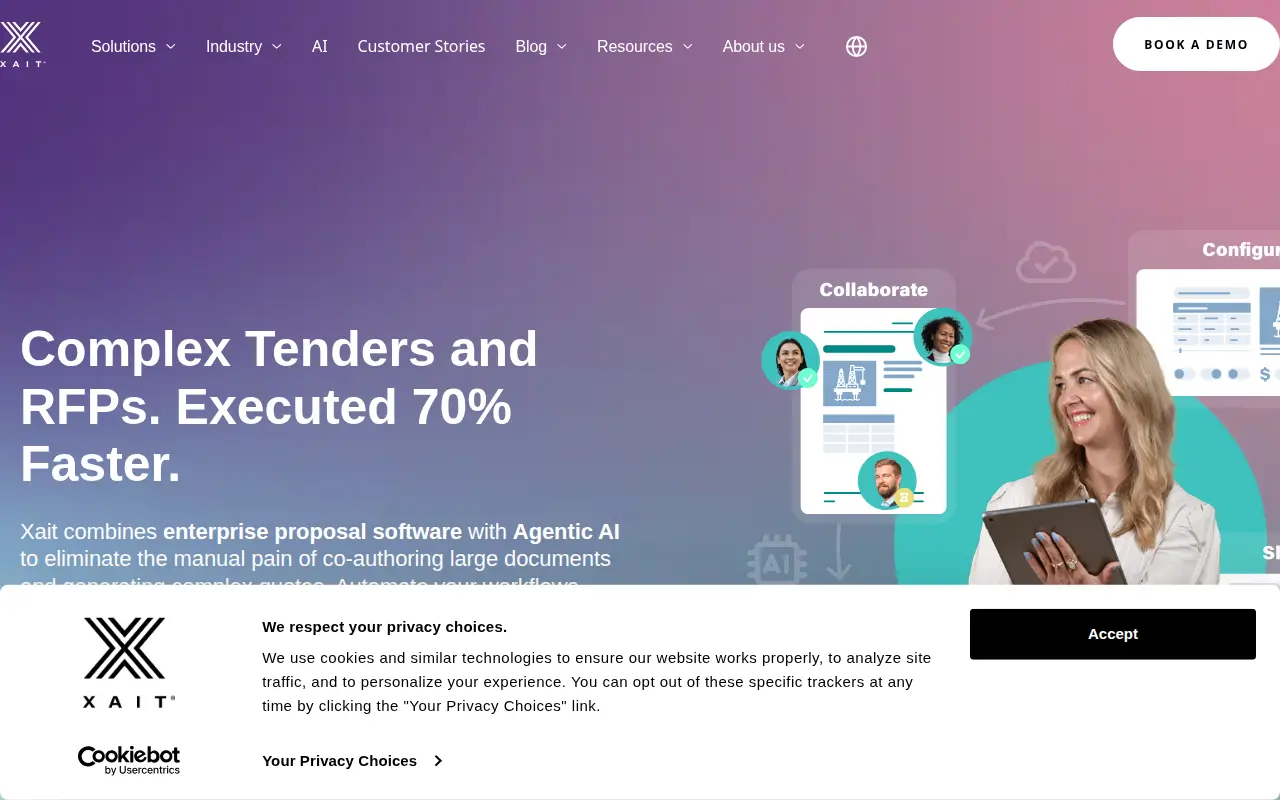
XA Xait
Security: ISO 27001, SOC 2, and regional hosting
Put Qvidian and Xait through the same three questions a security reviewer will ask: ISO 27001, SOC 2, and whether you can keep the tenancy in the US or the EU. Cells say Not listed when we could not find the claim on a public vendor page.
| Check | Qvidian | Xait |
|---|---|---|
| ISO 27001 | ISO 27001 (older product pages) uplandsoftware.com, 2026-08 Qvidian technology and questionnaire pages list ISO 27001. The current security page highlights SSAE 118 and ISAE 3402. Confirm the live certificate on the Upland Trust Center. | Not listed |
| SOC 2 | SOC 2 / SSAE 118 uplandsoftware.com, 2026-08 The current Qvidian security page lists SSAE 118 and ISAE 3402. Earlier directory research recorded SOC 2. Treat them as related attestations and pull the current report from Upland. | Not listed |
| US hosting | Yes (qvidian.com US data center) uplandsoftware.com, 2026-08 | Not listed |
| EU hosting | Yes (qvidian.eu European data center) uplandsoftware.com, 2026-08 | Not listed |
Slack and Microsoft Teams
During a live questionnaire, SMEs get pinged in Slack or Teams, not in a vendor portal. Here is what Qvidian and Xait publish for those two connections.
| Connection | Qvidian | Xait |
|---|---|---|
| Slack | Not listed | Not listed |
| Microsoft Teams | Not listed | Not listed |
Subprocessors: the big three clouds, then the niche names
Compare Qvidian and Xait on AWS, Azure and GCP first. Then scan for niche processors a reviewer should pause on: third-party LLMs, session replay, or support that leaves the region you elected.
| Layer | Qvidian | Xait |
|---|---|---|
| AWS, Azure, GCP | AWS | Not listed |
| Watch-outs | No niche processors flagged in our sourced list. Upland keeps product-level subprocessor packs behind the Trust Center (NDA). The public list we could verify names AWS for infrastructure. | No niche processors flagged in our sourced list. |
If your proposal problem is “we keep answering the same questions from scratch,” Qvidian is the closer fit. If your problem is “half the company is writing one long bid and the document keeps breaking,” Xait is. Both are enterprise, quote-only, services-led platforms with long histories, and both sell to large companies with formal bid teams. But they are built around different objects. Qvidian is built around a governed library of approved content. Xait’s flagship, XaitPorter, is built around the document itself, stored in a database so many authors can write it at once while the layout takes care of itself.
That difference decides most evaluations before features come up. Below we walk a long bid through both systems, look at what each has added for AI, flag where questionnaires and DDQs fit, and list the documented issues worth checking, with sources dated October 2026.
Key takeaways
- Library machine versus document machine: Qvidian centers on a central content library with expiration dates, review jobs, and approval workflows. XaitPorter centers on real-time co-authoring with section-level permissions and enforced formatting.
- Different home industries: Upland says Qvidian is used by 8 of the 10 largest US banks and 4 of the 5 largest asset managers (a vendor claim). Xait’s named customers are energy, industrial, and infrastructure firms such as Aker BP, Honeywell, Oceaneering, Veolia, Air Liquide, and Engie Solutions.
- Questionnaires sit differently: Qvidian handles RFPs, RFIs, DDQs, and security questionnaires in one product. Xait puts RFI, DDQ, and security questionnaire work in a separate product, XaitRFI.
- AI on both, gated differently: Qvidian’s AI Assist drafts, rewrites for tone and length, and analyzes RFPs for go/no-go. Xait’s Analyzer shreds requirements and its Suggestion Engine surfaces approved answers, but Xait marks the Suggestion Engine as not available for XaitProposal.
- Both are quote-only: Qvidian sells through Upland with no public tier. Xait quotes after a demo.
- Limitations: Upland’s own guide says Qvidian is not supported on mobile devices and its legacy Office add-ins need Windows. Xait’s Capterra reviewers describe table editing and formatting controls as clunky.
Library machine versus document machine
Qvidian is Upland Software’s RFP and proposal product. Upland’s page describes a central content library where you “assign content expiration dates, track content usage,” and manage review jobs and permissions, along with automated review and approval workflows, branded templates for proposals and pitch decks, 70+ out-of-the-box reports, and a Salesforce integration that lets you start a proposal from the CRM. Customers named in our directory include Nestlé, NetApp, Trane Technologies, Dell, HP, and BT, and Upland’s page adds case studies from Jack Henry and Rehmann.
The genuine strength is governance. When a bank’s compliance team needs to know that every paragraph in a proposal was approved, by whom, and when it expires, Qvidian was built for that conversation.
Xait was founded in 2000 in Stavanger, Norway, and Main Capital Partners announced a majority investment in July 2025, when Xait reported about 90 employees. The product line has grown into XaitPorter (co-authoring for complex documents), XaitProposal (guided, questionnaire-driven proposal creation), XaitCPQ (configure-price-quote), XaitRFI (questionnaires), and XaitWebProposal (proposals published as microsites). XaitPorter’s page describes a “database-driven document management approach” with real-time co-authoring, layout templates, section-level change logs, and granular permissions so teams only see the sections they should.
The genuine strength is the multi-author document. When engineering, HSE, legal, and commercial all have to write sections of one tender, and the final PDF has to match corporate templates exactly, XaitPorter was built for that conversation.
A long bid, start to finish
Walk one complex tender through each system and the differences show up stage by stage.
Intake and shredding. Qvidian says its AI Assist and document parsing identify headings, questions, and answers, and help analyze RFPs for go/no-go decisions. Xait’s Analyzer “instantly extracts requirements and flags hidden anomalies,” and Xait says it displays a weighted matrix of requirements for the go/no-go call. Xait also offers a bring-your-own-model option, so a company with its own in-house LLM can power the Analyzer. Both claims are vendor descriptions; test them on a tender you already shredded by hand.
Finding content. Qvidian’s library is the center of gravity: approved answers with owners and expiry dates, plus automatic answering and suggested responses. Xait’s content library is “AI-powered” in XaitPorter, and the Suggestion Engine surfaces high-scoring answers from approved content. The library-first design gives Qvidian the edge for short, repeatable answers. The document-first design gives Xait the edge for long narrative sections that get adapted rather than reused verbatim.
Writing together. This is Xait’s home ground. Multiple people work in the same document at once, each with section-level permissions, and Xait says formatting and numbering update automatically while layout is enforced for every contributor. A Capterra reviewer (May 2020) wrote that even with many people editing at the same time, there was never a problem with corrupt files or lost work. Qvidian supports project-style collaboration with parallel section work and in-product messaging, plus Microsoft Teams, Word, Excel, and PowerPoint integrations, but the experience is closer to coordinating contributions into a document than co-writing a single live one.
Review and approval. Both rate as core for workflow and approvals in our directory. Qvidian’s approvals are content-centric (the answer is approved). Xait’s are document-centric (the section is approved), with full audit logs.
Output. Xait’s automated layout is the reason many customers buy it, though reviewers note the trade-off: you often export to see exactly how the final document will look. Qvidian produces branded Word documents and PowerPoint decks from templates, which suits proactive proposals and pitch decks as well as RFP responses.
Who uses each one day to day
The people who touch these systems differ, and that affects adoption more than any feature list.
In Qvidian, the heavy users are content managers (Upland calls the senior ones Architects) who build document types, curate the library, and run review jobs. Upland’s configuration guide lists what most writers and subject matter experts actually do: answer RFP questions inline in an HTML editor, search and copy approved content, work in projects, give content feedback, and edit content on an SME Edit page. In other words, most contributors visit Qvidian to answer something specific, while a small team owns the machine. That model scales well in a bank with a dedicated proposal office, and it is why content governance is the selling point.
In XaitPorter, the heavy users are the contributors themselves. An engineer writing the technical solution, an HSE lead writing the safety section, and a commercial manager writing terms all work in the same live document, while a bid manager watches progress on dashboards and comments move reviews along. Administrators set up layout templates once, and Xait enforces them for everyone. Adoption depends on occasional contributors being comfortable in a tool that is not Word, which is where the onboarding complaints in the reviews come from. A Capterra reviewer in May 2020 put it simply: the features are easy to teach, but there was no good start-to-finish demo for new users.
If your contributors are many and occasional, Xait asks more of them. If your content owners are few and dedicated, Qvidian asks more of them.
What each has added for AI
Qvidian AI Assist is Upland’s generative AI layer. Upland says it helps you get to a first draft with prepopulated prompts, rewrites library content for length, tone, and voice, applies rules for tone and terminology, and analyzes RFPs for go/no-go information. Our directory rates Qvidian’s AI drafting as capable and its source attribution as limited, so expect AI that works on top of the library rather than an engine that cites every sentence. Qvidian’s own users have asked for more: G2 reviewers in October 2023 and January 2026 wanted AI to suggest high-scoring past responses and generate first drafts instead of relying on manual library search.
Xait AI spans the product line. Xait describes it as running in a closed, private system: your data “is never used to train global or third-party models,” permissions are respected so users only query content they can read, and suggestions are “fully traceable, with one-click access to the source and its freshness” (in XaitProposal). The fine print matters: Xait’s AI page marks the Suggestion Engine with “Not available for XaitProposal,” so confirm which AI features are included in the product you are buying.
Both vendors make speed claims. Xait says XaitPorter produces large documents “up to 70% faster” and XaitProposal works “60% faster.” Upland cites customer stories such as Rehmann creating proposals 20% faster. These are vendor figures we could not independently verify.
Questionnaires and DDQs
This is the clearest practical difference for many buyers.
Qvidian covers questionnaires in the core product. Upland’s page lists complex DDQs and security questionnaires alongside RFPs, RFQs, RFIs, and statements of work, and our directory rates it capable on both DDQs and security questionnaires.
Xait splits the job. XaitRFI is a separate product for “RFI/DDQ and security questionnaire” responses, built around importing and exporting spreadsheets, a catalogue of approved answers, and status tracking per question. XaitProposal also integrates with it. If your bid team writes tenders in XaitPorter and your security team answers questionnaires, you are likely looking at two Xait products, so price both. Our directory rates XaitPorter as limited on DDQs and security questionnaires for exactly this reason.
Platform and IT considerations
Qvidian is a browser-based SaaS application. Upland’s configuration guide (dated January 2024) supports current versions of Edge, Firefox, Chrome, and Safari, and states plainly that “Upland Qvidian functionality is not supported on a mobile device.” Most writers and subject matter experts do not need the legacy Office add-ins, but content architects who do bulk loading and some library editing do, and those add-ins are Windows-only: the guide says Mac users cannot install them “without a virtual PC.” Some Architecture editing has no add-in-free alternative yet. Upland runs separate US (qvidian.com) and European (qvidian.eu) data centers and migrated Qvidian onto AWS.
Xait is cloud-based, with ISO/IEC 27001:2022 certification. Integrations include Salesforce, HubSpot, Microsoft Dynamics 365, SAP, and Microsoft Entra ID, plus an open API, and XaitCPQ keeps pricing and proposal content in sync. A Capterra reviewer asked for a mobile app back in May 2020, so plan for desktop work on both.
Ownership is worth a sentence on each. Qvidian sits inside Upland’s larger portfolio of enterprise products. Xait has new majority owners since July 2025. Neither is a red flag, but ask both about roadmap commitments for the modules you depend on.
Pricing and total cost
Qvidian: Enterprise quote-based pricing through Upland; no public tier. One G2 reviewer (January 2026) said Qvidian “offers a comprehensive range of features at a premium price” and asked for a tiered option because their company used only a fraction of it.
Xait: No public pricing; quotes follow a demo. Enterprise co-authoring focus. Gartner’s listing describes pricing that scales with user count, modules, and deployment. Because XaitPorter, XaitProposal, XaitCPQ, and XaitRFI are separate products, total cost depends heavily on how many you need.
For both, budget for implementation and template work. Qvidian’s value depends on a well-built library; Xait’s depends on well-built layout templates. Neither arrives configured.
Switching in either direction
Many buyers comparing these two are already on one of them, or on something older.
Teams moving to Qvidian are mostly moving content: deciding which answers are approved, assigning owners and expiry dates, and building document types and templates. That work is the product’s value, so budget the time rather than trying to skip it. Ask Upland whether migration services are included and what the bulk-load path looks like, since some bulk loading relies on the Windows add-ins.
Teams moving to Xait are mostly moving templates and habits. The layout templates need to be built properly at the start, because enforced formatting only helps if the template is right. Then contributors need to learn to write in XaitPorter instead of emailing Word files around. Ask Xait for a pilot on one live bid with the real contributor group, not a demo with the bid manager alone.
Teams moving off either platform should check export early. Library content in Qvidian and structured documents in Xait both live in the vendor’s database, so ask for a sample export of your own content during the evaluation, not at renewal time.
Known issues and watch-outs
Every item links to its source, with dates. One-off complaints are excluded.
Qvidian
- No mobile support: Upland’s Browser and Microsoft Office Configuration Guide (January 2024, checked October 2026) says Qvidian functionality is not supported on mobile devices.
- Windows-only legacy add-ins: the same guide says the Office add-ins that content architects use require Windows, with Mac users needing a virtual PC.
- Search quality: G2 reviewers in October and December 2023 said library search does not always surface the right answer and returns repeated results.
- AI expectations: G2 reviewers in October 2023 and January 2026 asked for AI-suggested answers and first drafts instead of manual searching.
Xait
- Questionnaires are a separate product: RFI, DDQ, and security questionnaire work runs in XaitRFI (October 2026).
- AI gating: Xait’s AI page marks the Suggestion Engine as not available for XaitProposal (October 2026).
- Tables and formatting: Capterra reviewers from 2020 to 2022 describe table creation as clunky and image insertion as cumbersome, and others report limited text-formatting controls.
- Onboarding effort: Capterra reviewers in May 2020 and April 2023 said the interface takes time for new users to learn.
Which one, by scenario
- A bank or asset manager answering RFPs and DDQs from approved language, with compliance sign-off on every answer: Qvidian.
- An energy or engineering contractor producing long technical tenders with many authors and strict templates: Xait (XaitPorter).
- A company that needs complex quotes and proposals to stay in sync: Xait, with XaitCPQ.
- A team whose main volume is security questionnaires: neither is the natural first pick. Qvidian handles them in the core product; Xait needs XaitRFI. Dedicated response tools may suit better.
- A team on Macs and mobile: test both carefully; Qvidian documents its limits explicitly.
Verdict
Both platforms are legitimate, mature choices for large proposal teams, and both have earned their customer lists. They solve different problems. Qvidian governs content: it is strongest when the risk is saying something unapproved, and its AI Assist now adds drafting on top of that library. Xait governs documents: it is strongest when the risk is a long, multi-author bid falling apart, and its Analyzer and Suggestion Engine add AI to that process.
The honest catches are documented: Qvidian’s mobile and Windows add-in limits and its reviewers’ search complaints, and Xait’s split between XaitPorter and XaitRFI plus its reviewers’ table and formatting frustrations. Decide which risk costs you more, then make the proof of concept attack that risk with your own content.
Read the full Qvidian review or Xait review, or browse all RFP & DDQ software.
Frequently asked questions
What is the difference between Qvidian and Xait?
Qvidian: Long-running enterprise proposal library with approval controls. Xait: Co-authoring for big, complex bids. Qvidian is best for incumbent enterprise proposal teams that still need Qvidian's governance, or are planning a move to AutoRFP.ai, Loopio, or Responsive. Xait is best for large teams co-authoring long, high-stakes documents across many contributors.
Which is cheaper, Qvidian or Xait?
Neither publishes a comparable starting price, so request quotes for the same scope before comparing cost.
Is Qvidian or Xait better for DDQs and security questionnaires?
Qvidian scores higher on DDQ and security-questionnaire handling in our capability model, though both support them.
Do Qvidian and Xait both handle RFPs?
Qvidian: yes, a core strength. Xait: yes, a core strength.
Which should you choose, Qvidian or Xait?
Qvidian is the pick for incumbent enterprise proposal teams that still need Qvidian's governance, or are planning a move to AutoRFP.ai, Loopio, or Responsive. Xait is the pick for large teams co-authoring long, high-stakes documents across many contributors.
Are there alternatives to Qvidian and Xait?
Yes. Browse the full directory of RFP, DDQ, and security-questionnaire platforms for more options and side-by-side comparisons.
Do Qvidian and Xait list ISO 27001, SOC 2, and US or EU hosting?
Qvidian: ISO 27001 ISO 27001 (older product pages), SOC 2 SOC 2 / SSAE 118, US Yes (qvidian.com US data center), EU Yes (qvidian.eu European data center), Slack Not listed, Teams Not listed, clouds AWS. Xait: ISO 27001 Not listed, SOC 2 Not listed, US Not listed, EU Not listed, Slack Not listed, Teams Not listed, clouds Not listed. Confirm both on the vendor sites.
Source registry
Every page we read for these profiles, with the month it was last checked. Anything without a source is shown as not publicly disclosed. Spot an outdated fact? Send it from the corrections page.
Qvidian
Pricing
- No pricing source URL recorded. Treat pricing as not publicly disclosed until the vendor confirms it.
Security and compliance
Product and integrations
- No product source URL recorded yet.
Third-party reviews
Xait
Pricing
Security and compliance
- No security source URL recorded. Treat certifications and hosting as not publicly disclosed.
Product and integrations
Third-party reviews