Quick verdict
Choose VisibleThread for capture and proposal teams that need requirement traceability and language-risk checks; choose Xait for large teams co-authoring long, high-stakes documents across many contributors. Neither publishes a comparable starting price, so quote both on the same scope. In our capability model VisibleThread leads on source attribution and self-serve setup, while Xait leads on RFPs, answer library and approval workflows.
Both profiles reviewed Oct 2026
2 of 70 profiles, one scoring modelNo paid placementSources checked: 16Choose VisibleThread or Xait
VI Choose VisibleThread when
- Capture and proposal teams that need requirement traceability and language-risk checks.
- You need stronger source attribution and self-serve setup than Xait offers.
XA Choose Xait when
- Large teams co-authoring long, high-stakes documents across many contributors.
- You need stronger RFPs, answer library and approval workflows than VisibleThread offers.
Side-by-side comparison
| Capability | VisibleThread | Xait | Edge |
|---|---|---|---|
| Best for | Capture and proposal teams that need requirement traceability and language-risk checks. | Large teams co-authoring long, high-stakes documents across many contributors. | - |
| Starting price | Custom | Custom | Match |
| Free tier | No | No | Match |
| RFPs | 2/3 | 3/3 | Xait |
| DDQs | 1/3 | 1/3 | Match |
| Security questionnaires | 1/3 | 1/3 | Match |
| AI drafting | 2/3 | 2/3 | Match |
| Answer library | 1/3 | 2/3 | Xait |
| Source attribution | 3/3 | 2/3 | VisibleThread |
| Workflow & approvals | 2/3 | 3/3 | Xait |
| Integrations | 2/3 | 2/3 | Match |
| Self-serve onboarding | 1/3 | 0/3 | VisibleThread |
| ISO 27001 | Not listed | Not listed | - |
| SOC 2 | SOC 2 | Not listed | - |
| US hosting | Not listed | Not listed | - |
| EU hosting | Not listed | Not listed | - |
| Slack | Not listed | Not listed | - |
| Microsoft Teams | Not listed | Not listed | - |
| AWS, Azure, GCP | Not listed | Not listed | - |
| Listed integrations | SharePoint, Microsoft Word, SAM.gov, GSA eBuy, UK Find a Tender | Salesforce, HubSpot, Microsoft Dynamics 365 | - |
| Certifications | SOC 2, CMMC, NIST, FIPS, GDPR | ISO/IEC 27001:2022 | - |
What they look like
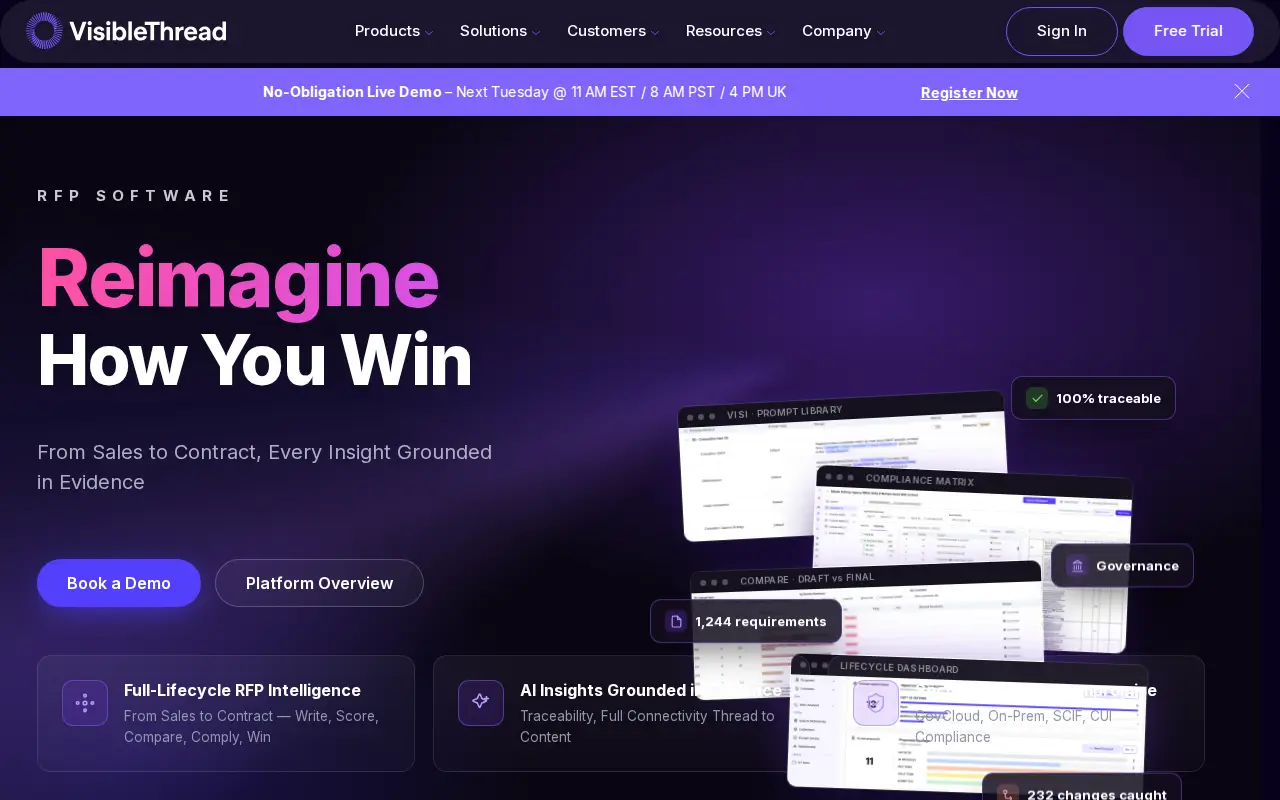
VI VisibleThread
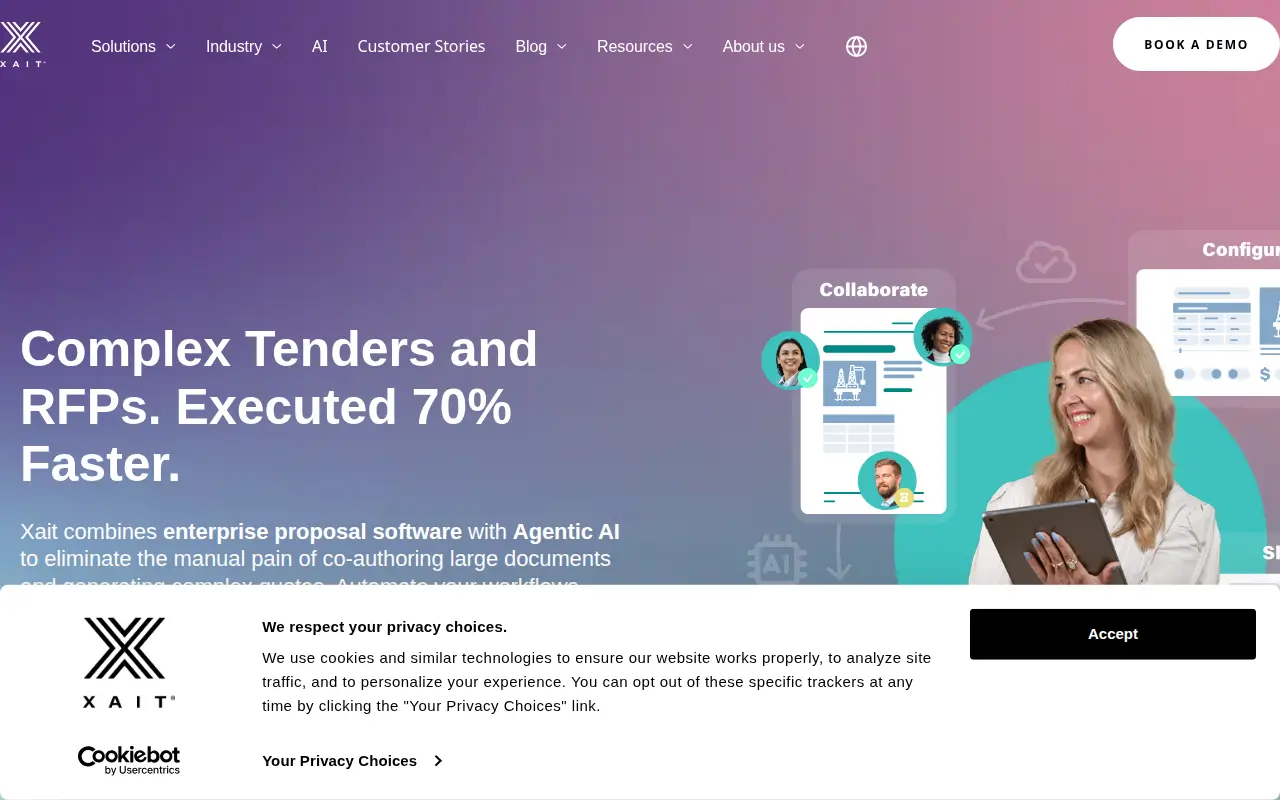
XA Xait
Security: ISO 27001, SOC 2, and regional hosting
Put VisibleThread and Xait through the same three questions a security reviewer will ask: ISO 27001, SOC 2, and whether you can keep the tenancy in the US or the EU. Cells say Not listed when we could not find the claim on a public vendor page.
| Check | VisibleThread | Xait |
|---|---|---|
| ISO 27001 | Not listed | Not listed |
| SOC 2 | SOC 2 | Not listed |
| US hosting | Not listed | Not listed |
| EU hosting | Not listed | Not listed |
Slack and Microsoft Teams
During a live questionnaire, SMEs get pinged in Slack or Teams, not in a vendor portal. Here is what VisibleThread and Xait publish for those two connections.
| Connection | VisibleThread | Xait |
|---|---|---|
| Slack | Not listed | Not listed |
| Microsoft Teams | Not listed | Not listed |
Subprocessors: the big three clouds, then the niche names
Compare VisibleThread and Xait on AWS, Azure and GCP first. Then scan for niche processors a reviewer should pause on: third-party LLMs, session replay, or support that leaves the region you elected.
| Layer | VisibleThread | Xait |
|---|---|---|
| AWS, Azure, GCP | Not listed | Not listed |
| Watch-outs | No niche processors flagged in our sourced list. | No niche processors flagged in our sourced list. |
VisibleThread checks a bid. Xait builds one. That is a simplification, but it is the right place to start, because buyers who shortlist both often expect two versions of the same product and find two different philosophies instead.
VisibleThread, founded in Dublin in 2008, made its name on rules-based analysis: shredding a solicitation into requirements, building the compliance matrix, flagging risky contract language, comparing versions, and scoring readability. It has since added an AI assistant, Visi, that drafts from curated content with citations. Xait, founded in Stavanger in 2000, made its name on production: XaitPorter lets many people write one long, perfectly formatted bid at the same time. It has since added AI that shreds requirements and suggests approved content. The overlap is real but narrow. This comparison sorts out who each is for, using vendor pages and dated reviews checked in October 2026.
Key takeaways
- Analysis engine versus production engine: VisibleThread’s core is deterministic shredding, compliance matrices, watchword dictionaries, version compare, and readability scoring. Xait’s core is real-time co-authoring with enforced layout and section-level permissions.
- Federal versus industrial: VisibleThread says it is used by 11 of the top 15 US federal contractors and names Lockheed Martin, Boeing, Airbus, and Parker Hannifin. Xait names Aker BP, Honeywell, Oceaneering, Vinci Energies, Colas, and Veolia.
- Deployment range is VisibleThread’s edge: VisibleThread Cloud, a single-tenant GovCloud option, customer-managed Azure GCC High or AWS GovCloud, on-premises, and fully air-gapped installs. Xait is a cloud product with ISO/IEC 27001:2022.
- Both have AI, built differently: VisibleThread’s Visi asks clarifying questions, drafts from curated Collections, and cites each answer, including inside a Word add-in. Xait’s Analyzer shreds RFPs and its Suggestion Engine surfaces approved content, with a bring-your-own-model option.
- Pricing: both are quote-only. VisibleThread charges an annual subscription per user with unlimited content analysis. Xait quotes after a demo.
- Limitations: VisibleThread has no maintained Q&A library and lists training and set-up costs as extra pricing elements. Xait splits questionnaires into a separate product (XaitRFI), and its Capterra reviewers call table and formatting work clunky.
Two tools, two halves of the bid
Think about the hours inside a large proposal. Some go into understanding the solicitation and proving compliance. Some go into writing and assembling the response. Each vendor owns one of those halves and reaches into the other.
VisibleThread owns the first half. Its platform overview lists past-performance analysis and AI win-theme analysis, compliance matrix generation, outline development, and AI writing grounded in your content. Its homepage is unusually blunt about method: “We use NLP and deterministic software for tasks that demand 100% accurate, repeatable results, and layer in generative AI where it genuinely helps.” In practice that means shredding, compliance checks, version compare, Search Dictionaries, and Watchwords run on rules, so every run matches the same way. A Parker Hannifin Aerospace contract administrator is quoted on the homepage saying contract review that “once took hours of copying and highlighting is now prepped in seconds.” That is a customer testimonial, selected by the vendor.
Xait owns the second half. XaitPorter’s pitch is that teams in different offices write in the same proposal at once, each seeing only the sections their permissions allow, while numbering and formatting update automatically and the layout cannot be broken by a contributor pasting in a stray table. Project leaders track progress on dashboards, comments drive reviews, and change logs record every section edit. Xait claims documents get produced “up to 70% faster”; that is the vendor’s number.
The handoff point is clear. VisibleThread can tell you what the solicitation requires and whether your draft language is risky or hard to read. Xait gives a large group a controlled place to write the response.
The federal question
If you work in US federal contracting, this section may decide the evaluation on its own.
VisibleThread’s deployment options are built for sensitive work. It offers a VisibleThread-managed, single-tenant environment in AWS GovCloud, listed on the FedRAMP marketplace; customer-managed deployments in Azure GCC High or AWS GovCloud; customer-managed on-premises installs on Windows, Red Hat, or a virtual appliance; and fully disconnected installs for classified programs, including SCIFs. Workspaces partition data by team, program, or security level, so, in VisibleThread’s words, “a commercial team never grounds AI on classified content.” It connects directly to SAM.gov, GSA eBuy, and UK Find a Tender, so opportunities arrive in the same workspace as the shred.
Xait’s market is different. Many of its named customers are European energy, construction, and utilities firms, and its product is cloud-based with ISO/IEC 27001:2022 certification. Xait’s AI runs in a closed system, and a company can supply its own in-house model to power the Analyzer, which suits data-sovereignty concerns in commercial and public tenders. But we found no GovCloud or air-gapped deployment described on Xait’s pages, so a defense contractor with CUI in scope should ask directly rather than assume.
Put simply: a federal capture team will find VisibleThread speaks its language. An oil and gas contractor writing a long development plan with a room full of engineers will find Xait does.
Where AI shows up
Both vendors are careful about AI, which is a nice change in this category.
Visi is VisibleThread’s assistant. Before drafting, it asks clarifying questions about level of detail, format, and audience. It then searches your Collections (curated sets of approved content that sync from SharePoint and respect SharePoint permissions) and drafts with a citation you can click through to the source. It runs inside Microsoft Word as an add-in, and it scores drafts for readability, sentence length, passive voice, and watchwords, mostly with deterministic checks. A shared Prompt Library standardizes the good prompts. VisibleThread also exposes an MCP server so external AI assistants can reach its grounded content and deterministic tools.
Xait AI covers the Xait product line. The Analyzer extracts requirements from an RFP into a weighted matrix and flags anomalies to support a go or no-go call. The Suggestion Engine surfaces the highest-scoring approved content while you write. Xait states that customer data stays in a private system and is not used to train public models, and it lets customers bring their own LLM for the Analyzer. Note the fine print: Xait’s AI page says the Suggestion Engine is not available for XaitProposal.
The overlap: both now shred RFPs with AI assistance and both draft or suggest from approved content. The difference: VisibleThread leads with deterministic analysis and adds generation; Xait leads with document production and adds analysis.
Language quality and final review
This is VisibleThread’s original specialty, and it is worth separating from the AI story.
Long before Visi, VisibleThread’s tools scored documents for readability, flagged long sentences and passive voice, managed acronyms, and searched for watchwords: terms your organization wants to avoid, or risk phrases such as unlimited liability and indemnity language. Because these checks are rules-based, the same draft gets the same result every time, which is what a color-team reviewer needs when they are deciding whether a volume is ready. VisibleThread’s example on its Visi page is tightening an executive summary toward a grade 10 to 12 reading level so it reads easily for an evaluator. Its Compare feature shows exactly what changed between solicitation or contract versions, which matters when an amendment drops the week before submission.
Xait’s quality controls are aimed at consistency rather than language. Enforced templates mean every section looks the same, numbering stays correct, and brand rules hold across dozens of authors. On the language side, two Capterra reviewers in May 2020 asked for a better spell checker, one noting it ran section by section rather than across the whole document.
If your reviewers spend their time on “is this compliant and clear,” VisibleThread helps more. If they spend it on “why does section 4 look different from section 5,” Xait helps more.
The review-site picture
VisibleThread holds 4.9/5 on Capterra from 52 reviews and 4.3/5 on G2 from 15, as of July 2026. Reviewers on Software Advice, which shares Capterra’s review base, praise the time saved on proposal development, while a smaller number mention customization effort and a wish for tighter integration with everyday tools.
Xait’s public review footprint is older. The Capterra reviews we read for XaitPorter run from 2018 to 2023, with consistent praise for multi-author stability and branded output, and consistent complaints about tables, images, and onboarding. That age does not mean the product stood still (its AI features are newer than most of those reviews), but it does mean you should ask Xait for recent references in your industry.
Can you run them together?
Yes, and for some organizations that is the sensible answer. A large contractor could pull a solicitation from SAM.gov into VisibleThread, shred it, build the compliance matrix, and score fit against past performance; write the volumes in XaitPorter with the full contributor group and enforced templates; and then bring the draft back into VisibleThread for compare, watchword, and readability checks before submission.
The cost is two subscriptions and two sets of training, and neither vendor lists a connector to the other. Most teams will pick the half that hurts more and handle the other half with what they already have, often Word and SharePoint.
Questionnaires and RFIs
Neither is primarily a questionnaire tool, but both have answers for it.
VisibleThread’s RFI and questionnaire workflow takes the questionnaire as the buyer sent it, grounds answers in a Collection, and returns a cited first draft. VisibleThread claims about ten minutes instead of three days for a complete first draft; that is the vendor’s figure. The finished response is saved as a Word document and kept in the opportunity workspace for the next questionnaire from that buyer.
Xait handles questionnaires in a separate product, XaitRFI, built around spreadsheet import and export, a catalogue of expert-approved answers, and per-question status tracking. If questionnaires are a big share of your work, budget for that product too.
If questionnaires are most of your work, neither is the natural fit, and a dedicated response platform will usually serve you better.
What you will pay and how it is counted
VisibleThread: Every quote is custom. You buy a yearly subscription for a set number of users, and the deployment you choose (VisibleThread Cloud, US GovCloud, private cloud, or on-premises) shapes the price. A free trial is offered. The pricing FAQ adds that content analyzed is unlimited, that technical support and an SLA are included, and that training costs and one-off set-up costs are additional pricing elements. Plans are framed by team size (small team, mid-sized, enterprise), and deployment type affects the quote.
Xait: No public pricing; quotes follow a demo. Enterprise co-authoring focus. Because the product line is modular (XaitPorter, XaitProposal, XaitCPQ, XaitRFI, XaitWebProposal), your quote depends on which modules you need. A Capterra reviewer (September 2022) called the price “a little high as compared to other tools,” which is one opinion but a useful prompt to benchmark.
VisibleThread’s free trial is a real advantage for a first look. Xait’s evaluation runs through a demo and, ideally, a pilot on a live bid.
Known issues and watch-outs
Sources are linked with dates. Complaints from a single reviewer are left out.
VisibleThread
- Seat-based cost plus extras: VisibleThread’s pricing page (October 2026) bills per user annually and lists training and one-off set-up costs as further elements.
- No maintained answer library: answers come from Collections synced from SharePoint, and questionnaire responses are saved as Word documents, per the RFI and questionnaire page (October 2026). Teams whose content lives outside SharePoint should test the ingestion path.
- Integration requests: Software Advice reviewers in December 2020 and November 2023 asked for VisibleThread to connect into their day-to-day tools instead of being a separate site.
Xait
- Questionnaires cost a second product: Xait sells XaitRFI separately for RFIs, DDQs, and security questionnaires (checked October 2026).
- Suggestion Engine gating: Xait’s AI page says it is not available for XaitProposal (October 2026).
- Tables, images, and formatting: Capterra reviewers between 2020 and 2022 describe building tables and inserting images as tedious, and others cite limited formatting controls.
- New-user learning curve: Capterra reviewers in 2020 and 2023 found the interface hard for new or occasional users.
A quick fit check
Choose VisibleThread if most of these are true:
- You bid on US federal or UK public-sector work and source opportunities from SAM.gov, GSA eBuy, or Find a Tender.
- You need GovCloud, on-premises, or air-gapped deployment.
- Your pain is proving compliance, catching risky language, and comparing solicitation versions.
- Your writers want AI inside Word with a citation on every answer.
Choose Xait if most of these are true:
- You produce long technical tenders in energy, engineering, construction, or utilities.
- Many contributors write the same document, and formatting falls apart in Word.
- You want proposal content and complex quotes linked through XaitCPQ and your CRM (Salesforce, HubSpot, Dynamics 365).
- You can invest in templates and onboarding for occasional contributors.
Choose neither if your volume is mostly short security questionnaires and DDQs answered by a presales team. Both products can handle that work, but each treats it as a side job, and you would be paying for shredding engines or co-authoring infrastructure you rarely use. A response platform built around an answer library or source-cited drafting will be cheaper to run and quicker to adopt for that team. The same goes for small teams that submit a handful of bids a year: the set-up effort for either tool pays back on volume.
Verdict
These are strong tools aimed at different hours of the bid. VisibleThread is the better choice for compliance-heavy, security-sensitive pursuits, especially federal ones, where repeatable analysis and deployment flexibility matter more than a shared writing surface. Xait is the better choice for large commercial and industrial tenders where many people must write one controlled document and the final layout has to be right.
Credit to both: VisibleThread’s deterministic engine and its deployment options are rare in this market, and Xait’s reviewers have long praised how stable its co-authoring stays with many people editing at once. Their documented catches are just as real: seat pricing plus set-up costs and a SharePoint-centered content model for VisibleThread, a separate questionnaire product and formatting friction for Xait. Run a trial or pilot on a bid you have already submitted, and judge each on the half of the work it claims.
Read the full VisibleThread review or Xait review, or browse all RFP & DDQ software.
Frequently asked questions
What is the difference between VisibleThread and Xait?
VisibleThread: RFP shredding and compliance-language analysis. Xait: Co-authoring for big, complex bids. VisibleThread is best for capture and proposal teams that need requirement traceability and language-risk checks. Xait is best for large teams co-authoring long, high-stakes documents across many contributors.
Which is cheaper, VisibleThread or Xait?
Neither publishes a comparable starting price, so request quotes for the same scope before comparing cost.
Is VisibleThread or Xait better for DDQs and security questionnaires?
They are level on DDQ and security-questionnaire handling in our capability model, so test both on one of your own questionnaires.
Do VisibleThread and Xait both handle RFPs?
VisibleThread: yes, a core strength. Xait: yes, a core strength.
Which should you choose, VisibleThread or Xait?
VisibleThread is the pick for capture and proposal teams that need requirement traceability and language-risk checks. Xait is the pick for large teams co-authoring long, high-stakes documents across many contributors.
Are there alternatives to VisibleThread and Xait?
Yes. Browse the full directory of RFP, DDQ, and security-questionnaire platforms for more options and side-by-side comparisons.
Do VisibleThread and Xait list ISO 27001, SOC 2, and US or EU hosting?
VisibleThread: ISO 27001 Not listed, SOC 2 SOC 2, US Not listed, EU Not listed, Slack Not listed, Teams Not listed, clouds Not listed. Xait: ISO 27001 Not listed, SOC 2 Not listed, US Not listed, EU Not listed, Slack Not listed, Teams Not listed, clouds Not listed. Confirm both on the vendor sites.
Source registry
Every page we read for these profiles, with the month it was last checked. Anything without a source is shown as not publicly disclosed. Spot an outdated fact? Send it from the corrections page.
VisibleThread
Pricing
Security and compliance
- No security source URL recorded. Treat certifications and hosting as not publicly disclosed.
Product and integrations
Xait
Pricing
Security and compliance
- No security source URL recorded. Treat certifications and hosting as not publicly disclosed.
Product and integrations
Third-party reviews