Wolfia review: pricing, features and alternatives (2026)
Quick answer
Wolfia is AI-native security questionnaire, DDQ and RFP software for GRC and customer-trust teams at software companies that field a steady stream of security reviews, many of them in vendor portals. Wolfia does not publish a price, so buying is quote-only. Check before buying: The published order form auto-renews for 12-month terms and lets renewal fees rise up to 10% a year unless you negotiate otherwise.
Cited AI answers for security questionnaires, filled straight into buyer portals
- Overall score: 4.4/5 across 9 capability dimensions.
- Best for: GRC and customer-trust teams at software companies that field a steady stream of security reviews, many of them in vendor portals.
- Pricing: Custom on a quote-only basis.
- Standout strength: Portal coverage is unusually concrete: 32 named portals, 16 of them written back through the portal API (OneTrust and ServiceNow among them).
- Ecosystem: 12 integrations; SOC 2 Type II.
- Limitations: No public prices: plans are scoped on a call from your questionnaire and contract-review volume.
The verdict
Wolfia is a security-questionnaire tool first and an RFP tool a distant second, and it is honest about that. If you are the one GRC person answering SIGs and portal assessments for a sales team ten times your size, it is one of the more specific products in this directory: cited answers, a confidence score with a written reason on each one, and a Chrome extension that fills 32 named vendor portals in place. If you are a proposal team writing narrative RFP responses, it is the wrong shape.
Who I’d hand it to: a GRC or customer-trust lead at a software company whose policies already live in Confluence or Google Drive. Who I’d steer elsewhere: a bid team whose week is 80-page narrative proposals, or a company that still needs to get its SOC 2 in the first place.
What Wolfia actually is
Wolfia came out of Y Combinator’s Summer 2022 batch. Its YC profile lists it as founded in 2022 and based in Austin, Texas, with Naren Manoharan (previously an infrastructure engineering lead at Wealthfront) as cofounder and CEO. Its about page names Y Combinator plus Khosla Ventures among its backers, with Twenty Two Ventures and Page One VC listed too. The YC profile shows a team size of five, which may be stale, but it’s a fair hint that you are buying from a small company.
The product is “agents on one knowledge base”. The Questionnaire Agent handles SIG, CAIQ, HECVAT and DDQ files plus portal assessments. A Slack agent answers reps who ask @wolfia mid-deal. The Trust Center publishes your security documents and gates access. A Contract Review Agent gives legal a first pass on DPA redlines by checking each clause against what your policies already commit to. All of them draw from the same corpus, so the answer to “do you encrypt at rest?” is the same whether a buyer asks in a spreadsheet or a rep asks in Slack.
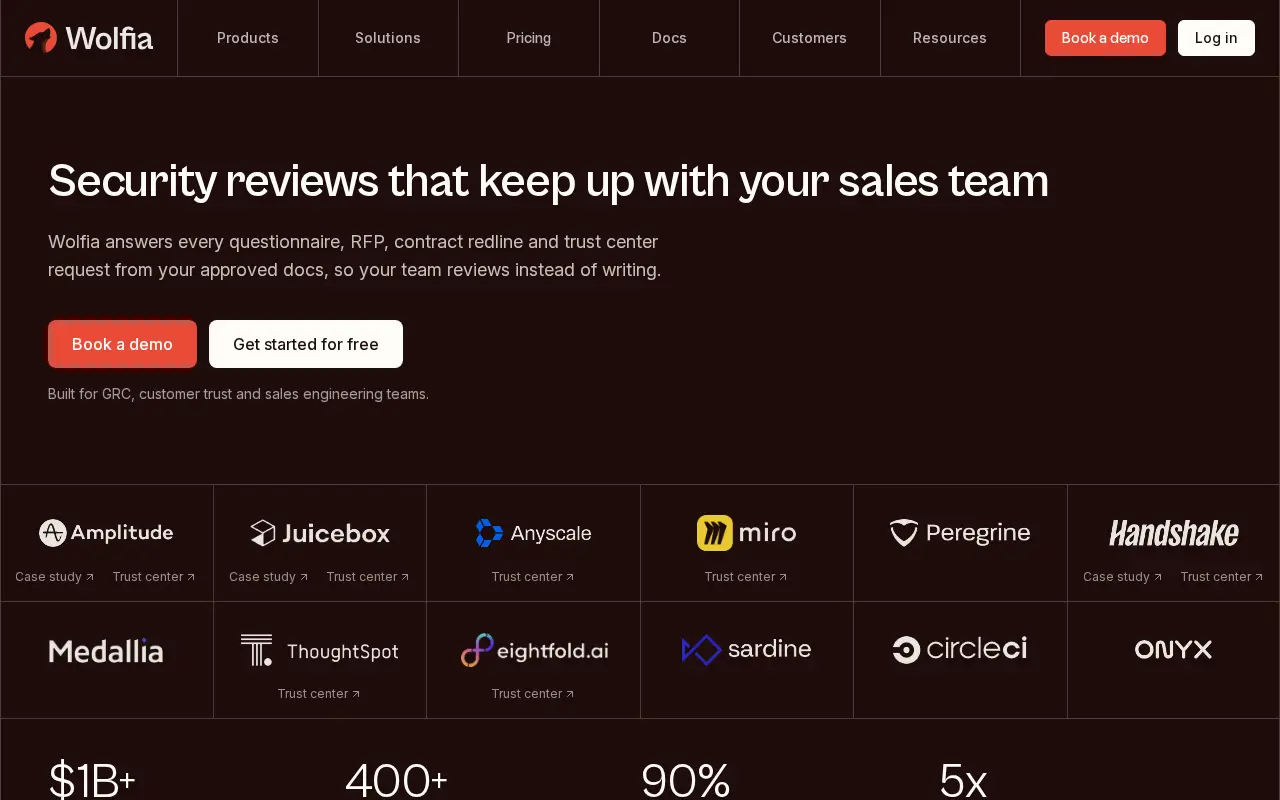
Customer logos on the site include Amplitude and Handshake, both with case studies (Juicebox has one too). Miro and ThoughtSpot appear among the trust-center customers.
How drafting and the knowledge base work
This is where Wolfia is most detailed, and most of the detail is about not making things up.
Ingestion covers the ugly inputs: Excel (multi-tab, hidden sheets filtered), Word including legacy .doc, PDF, PowerPoint, email with nested attachments, and images via OCR. Each format gets its own parser that keeps tables intact, per the platform page. Then Wolfia runs several retrieval strategies in parallel and reranks the results. It generates an answer with citations, and a separate validation pass checks each claim against its source and strips anything ungrounded.
Two rules on the platform page are the kind a security reviewer will appreciate. First, an answer that cites zero facts comes back as “not found”, never as a guess. Second, a certification is never named unless a source states it verbatim, so SOC 2 does not quietly turn into ISO 27001. Every answer also gets a confidence score with a written reason, and only the low-confidence ones are routed to the subject matter expert who owns that topic.
There is no classic Q&A library to curate. Instead, Wolfia syncs live from tools like Confluence, Google Drive, Notion and Drata, and weights newer sources above older ones. When someone edits an answer, Wolfia captures the change, and a weekly cycle turns clusters of edits into rules for future answers. Corrections stick, in other words, which is the whole point of not having a library.
The catch is that sticking takes time. Wolfia’s own Handshake case study says it took three months of feeding the system corrections and authoritative answers before it handled 90% of questionnaire work. Credit to Wolfia for publishing that. Budget for it.
Portals and output
This is Wolfia’s sharpest edge. Its portals page names 32 portals. For 16 of them, including OneTrust and ServiceNow plus Whistic, Wolfia writes answers back through the portal’s own API. Others, such as Coupa and UpGuard, are filled in the page itself. If a portal is not on the list, a generic scan-and-fill pass still tries.
Two details matter for your security team. The extension runs on the portal session you are already signed into, and Wolfia says your portal credentials never touch its servers. It also stops short of submitting: Wolfia fills the fields, and a human reviews and submits. Files come back in their original format, Excel to Excel with answers in the right cells, and Word with formatting intact.
The integration list is long. On the knowledge side it includes Google Drive, Notion, Confluence and SharePoint, plus GitHub and Glean. Deal-flow tools include Salesforce and HubSpot, plus Gong. On the compliance side you get Vanta and Drata, with DocuSign and Ironclad for contracts. Slack is the chat surface. Microsoft Teams is not listed anywhere I read, so Teams-first companies should ask.
Security and compliance posture
Dialing the jokes down here. Wolfia states it is SOC 2 Type II certified, with the report available under NDA through its trust center. The enterprise page also lists EU-U.S. and Swiss-U.S. Data Privacy Framework participation, and the trust center lists a VPAT 2.5 accessibility report. I did not find an ISO 27001 claim.
On architecture, Wolfia describes per-tenant isolation, including a separate knowledge graph per organization. It says your documents are never used to train shared models and that prompts are not stored for training. Wolfia lists enterprise SSO alongside Google and Microsoft OAuth, and its pricing page shows SAML 2.0 via Okta plus SCIM directory sync. Role-based access is enforced on every endpoint, per the enterprise page. The settings mockup on the pricing page also shows audit-log export to your own S3 bucket with seven-year retention.
Residency is US-only. The trust center says processing and storage, AI inference included, run in United States regions only. Primary hosting is AWS. Model inference goes through Anthropic and OpenAI, with OpenRouter as a zero-retention routing layer. Google Vertex AI serves as a fallback, and Azure handles API-based inference with no customer data hosted. That is a longer list of model providers than some security teams like, so read the subprocessor tab line by line.
Pricing and how to buy it
Wolfia does not publish prices. The pricing page says plans scale with questionnaire and contract-review volume rather than headcount, every plan includes unlimited users, and you get a scope and rollout plan on a short call. “Unlimited users” is a real advantage when the people asking questions are dozens of reps in Slack.
Wolfia also publishes a sample order form, which is more candor than most vendors offer. It shows an Enterprise plan with unlimited questionnaires (portal automation included) and unlimited questions under a fair-use clause. It also bundles white-glove implementation with four training sessions, plus 24x7 Slack support. Invoicing is annual on Net 30. The subscription auto-renews for 12-month terms unless you give 30 days’ notice, and renewal fees can rise by up to 10% a year unless your order form says otherwise. Negotiate that clause before you sign, not at renewal.
There is a “Get started for free” button and a self-serve sign-up screen. A July 2025 changelog post described the Trust Center as free to start, with premium tiers coming. The current pricing page does not list a free plan, so confirm what the free sign-up includes today.
Where it falls short
- No published prices. Everything is scoped on a call from your volume.
- Renewal terms favor the vendor. Automatic 12-month renewals with up to 10% yearly uplift, per the public order form.
- A ramp, not a switch. Handshake’s three months of corrections is the honest benchmark for getting to high automation.
- US-only data residency. Fine for most US software companies, a real problem for EU buyers who need local processing.
- RFP narrative is not the focus. RFPs are accepted as an input, but the whole product story is built around security reviews.
Who should shortlist it, and who should skip it
Shortlist Wolfia if:
- You answer security questionnaires weekly, and a good share arrive as OneTrust or ServiceNow portals rather than spreadsheets.
- Your policies already exist and stay current in Confluence or Google Drive.
- You want reps to self-serve security answers in Slack without buying them seats.
- You would like a trust center and DPA first-pass review on the same knowledge base.
Skip it if your main job is persuasive long-form proposals. Skip it too if you need to achieve SOC 2 or ISO 27001, which Wolfia itself says belongs to a GRC platform. And if you have almost no documentation yet, Wolfia’s own alternatives page says there is little for the AI to ground answers on.
How it sits next to its peers
Wolfia vs Loopio. Wolfia shows up in “Loopio alternatives” searches, but these tools solve different problems. Loopio is a library-first response platform that covers RFPs and DDQs as well as security questionnaires. Its tagged, versioned library and multi-step reviews are what big proposal teams rely on. Wolfia skips the library and grounds each answer in live documents, then goes deeper on portals than a general response platform usually does. Pick Loopio if you run a proposal desk with high RFP volume and a content manager. Pick Wolfia if the bottleneck is security reviews and the GRC team is two people.
Wolfia vs 1up. Both answer from your existing knowledge and both live in chat. 1up’s big advantage is that you can start on its free-forever plan, then buy a published plan online, and it supports Slack and Teams alongside Google Chat. Wolfia wins on portal filling and questionnaire volume, since 1up caps questionnaire automations by plan. If you want a cheap, self-serve start, 1up. If questionnaires are a daily firehose, Wolfia.
Wolfia vs Arphie. Arphie is the closer all-rounder: AI-native drafting with sources and confidence scores across RFPs and security questionnaires (DDQs too), aimed at presales teams. Wolfia is narrower and deeper on the security side, with portal API write-back plus a bundled trust center. Presales teams answering both RFPs and security reviews should lean Arphie. A GRC team that never touches RFPs should lean Wolfia.
Wolfia vs AutoRFP.ai. AutoRFP.ai is the accuracy-first tool for writing winning responses in a workflow that is easy to run, built for structured Word and Excel RFPs and DDQs, with flat published pricing from $899/mo and unlimited users. It offers US and EU hosting plus ISO 27001 alongside SOC 2 Type II. It connects to Drata and Vanta instead of bundling a trust center. Wolfia bundles the trust center and contract review, and it is more specialized on portals. If RFPs and DDQs are your main volume, especially in the EU, AutoRFP.ai fits better. If security reviews in portals are the pain, Wolfia does.
What to test in a demo or trial
Wolfia’s own pitch is “test it on your real corpus”, so take them up on it.
- Connect your real sources (Confluence or Drive) and run a questionnaire from last quarter whose answers you already trust. Compare line by line.
- Plant a gap. Include questions your docs cannot answer and confirm each comes back as “not found” and routed, not guessed.
- Open a live portal you actually receive (OneTrust or ServiceNow if you have them) and watch the extension fill it. Check conditional questions.
- Change a policy upstream and see how long until the next answer reflects it.
- Read the confidence reasons on ten low-scoring answers. Are they useful, or boilerplate?
- Get the subprocessor list and SOC 2 report under NDA, and confirm the US-only residency works for your buyers.
- Redline the order form. Cap the renewal uplift, check the fair-use language on “unlimited”, and ask what the free sign-up includes.
The bottom line: a sharp, security-first questionnaire agent with real portal depth and unusually candid paperwork. Buy it for security reviews, not for proposal writing, and give it a quarter to learn your voice.
Overview
Wolfia is a Y Combinator-backed AI agent that answers security questionnaires and DDQs from your live policy docs, citing a source on every answer. The same knowledge base runs a trust center and a contract-review agent, with unlimited users and volume-based pricing.
Capability snapshot
Nine jobs, scored 0 (not offered) to 3 (category-leading). Wolfia is strongest on Security questionnaires and lightest on RFPs. The same scores feed every comparison table.
- RFPs1/3
- DDQs2/3
- Security questionnaires3/3
- AI drafting2/3
- Answer library2/3
- Source attribution3/3
- Workflow & approvals2/3
- Integrations3/3
- Self-serve onboarding1/3
Strongest: Security questionnairesLightest: RFPs
Key features
- Cited answers with a confidence score and a written reason on each one
- Chrome extension that fills 32 named questionnaire portals in place
- Returns Excel and Word files in their original format
- Live sync from tools like Confluence and Google Drive, with newer sources ranked first
- Trust center with CRM-based approvals and NDA collection
- Slack agent and a contract-review agent on the same knowledge base
Who it's for
Small security or GRC teams answering questionnaires for a much larger sales org, with policies already written down in tools like Confluence or Google Drive.
Strengths
- Portal coverage is unusually concrete: 32 named portals, 16 of them written back through the portal API (OneTrust and ServiceNow among them).
- Every answer cites its source document with a confidence score, and an answer with no supporting fact comes back as "not found" for a reviewer.
- Unlimited users on every plan, so reps asking in Slack never trigger a seat fee.
- One knowledge base also powers a trust center and first-pass DPA redlines, so legal and sales draw on the same answers as security.
- Live syncs from Confluence, Google Drive, Notion and Drata mean a policy change upstream shows up in the next answer.
Limitations
- No public prices: plans are scoped on a call from your questionnaire and contract-review volume.
- The published order form auto-renews for 12-month terms and lets renewal fees rise up to 10% a year unless you negotiate otherwise.
- Handshake's case study on Wolfia's own site says it took three months of feeding the system corrections before it handled 90% of questionnaire work.
- Its trust center says processing and storage, AI inference included, run in US regions only.
Where it falls short
Gaps we found in research, each linked to its source.
- No public prices: plans are scoped on a sales call from your questionnaire and contract-review volume. wolfia.com, 2026-10
- The published order form auto-renews for 12-month terms and allows renewal fees to rise up to 10% a year unless otherwise agreed in writing. wolfia.com, 2026-10
- Handshake's case study on Wolfia's own site says it took three months of feeding the system corrections and authoritative answers before it handled 90% of questionnaire work. wolfia.com, 2026-10
- The Wolfia trust center states that processing and storage, AI inference included, run in United States regions only. trust.wolfia.com, 2026-10
Security: ISO 27001, SOC 2, and regional hosting
A security review of Wolfia usually starts with three questions: ISO 27001, SOC 2, and whether you can keep data in the US or the EU. We only mark a yes when a public vendor page supports it.
- ISO 27001
- Not listed
- SOC 2
- SOC 2 Type II wolfia.com, 2026-10
The report is available under NDA through the Wolfia trust center.
- US hosting
- Yes (US regions only) trust.wolfia.com, 2026-10
- EU hosting
- Not listed
The Wolfia trust center states that processing and storage, plus AI inference, run in United States regions only.
Slack, Teams and the rest of the stack
Wolfia collaboration is only as useful as the chat tools your SMEs already live in. Slack and Microsoft Teams are the two that matter on a live questionnaire.
- Slack
- Slack (@wolfia agent) wolfia.com, 2026-10
- Microsoft Teams
- Not listed
Subprocessors
For Wolfia, start with the big three clouds (AWS, Azure, GCP), then look at niche processors that touch answer content, call a third-party model, or record sessions.
- Amazon Web Services: Primary cloud hosting, infrastructure and AI services trust.wolfia.com
- Google (Vertex AI): Gemini LLM inference, fallback only trust.wolfia.com
- Microsoft Azure: API-based AI inference only; no customer data hosted trust.wolfia.com
- Anthropic: LLM inference via the Claude API Watch-out: Third-party model provider. Listed location is the United States. trust.wolfia.com
- OpenAI: LLM inference via the OpenAI API Watch-out: Third-party model provider. Listed location is the United States. trust.wolfia.com
- OpenRouter: Routing to OpenAI and Anthropic models with zero data retention Watch-out: An extra routing hop between Wolfia and the model providers. Confirm the zero-retention terms in review. trust.wolfia.com
- Nango: OAuth broker for customer integrations Watch-out: Holds the OAuth connections into your document sources. trust.wolfia.com
- WorkOS: Enterprise SSO and directory sync trust.wolfia.com
- Hatchet: Managed workflow orchestration trust.wolfia.com
The trust center also lists Resend (email), Stripe (payments), PostHog (product analytics) and Sentry (error tracking), all in the United States.
Topics
Pricing and value
Wolfia uses quote-only pricing, quoted per deal rather than published Priced on questionnaire and contract-review volume with unlimited users, scoped on a sales call. The site offers a "Get started for free" sign-up, but the pricing page lists no free plan. The public order form shows annual invoicing and 12-month auto-renewal, with renewal fees allowed to rise up to 10% a year.
On our capability model it scores 4.4 out of 5 across 9 dimensions. Weigh that against GRC and customer-trust teams at software companies that field a steady stream of security reviews, many of them in vendor portals to judge whether the price fits the job.
Pricing and details verified Oct 2026. Confirm on the vendor's site before you buy.
Who should pick Wolfia, and who should skip it
Pick it if you fit this profile: small security or GRC teams answering questionnaires for a much larger sales org, with policies already written down in tools like Confluence or Google Drive. Where it earns its place: Portal coverage is unusually concrete: 32 named portals, 16 of them written back through the portal API (OneTrust and ServiceNow among them).
Look elsewhere if this limitation is a deal-breaker: No public prices: plans are scoped on a call from your questionnaire and contract-review volume. Also look around if rfps is central to how you work (1/3 here). In that case, one of the Wolfia alternatives may fit better.
Bottom line
Best use case in one line: GRC and customer-trust teams at software companies that field a steady stream of security reviews, many of them in vendor portals.
Teams evaluating Wolfia often also compare Wolfia vs Realm, and Wolfia vs Tribble, or browse Wolfia alternatives.
Similar tools
Loopio, AutoRFP.ai, and Responsive come first as category benchmarks, followed by the closest peers on the job Wolfia is hired for (shared categories and tags, plus aligned capabilities). The snapshot above already scores each job. The notes below say where each tool is stronger, lighter, or a match.
Loopio (4.6/5, Custom (~$20K+/yr est.)). Best for large enterprise teams with high response volume and a mature content library. Matches Wolfia on AI drafting, and leads on RFPs and DDQs. Audience: Teams in SaaS, tech, financial services, and healthcare answering high volumes of RFPs, RFIs, DDQs, and security questionnaires. Watch-out: No public prices: the entry Foundations plan includes 10 seats, and multi-step reviews start one tier up on Enhanced.
AutoRFP.ai (4.9/5, $899/mo). Best for software and finance teams answering structured RFPs in Word and Excel who want accuracy-first drafts, responses written to win, and a workflow that is easy to run. Leads Wolfia on RFPs, DDQs, and AI drafting. Audience: Software and finance response teams whose RFPs come in as Word or Excel files and who want accuracy-first drafts, winning responses with every line cited to a source, a person, or the AI, and a workflow that is easy to run. Watch-out: Built for structured, source-cited answers rather than creative writing on long-form responses. For persuasive multi-page narrative, AutogenAI is built for that prose job.
Responsive (4.6/5, $10,000 (Emerging edition)). Best for enterprise teams with complex approval chains and heavy integration requirements. Matches Wolfia on AI drafting, and leads on RFPs and DDQs. Audience: Enterprise sales and proposal teams that need the widest workflow across RFPs, RFIs, DDQs, and security questionnaires. Watch-out: Quoted by edition, user count, and add-ons, with a 12-month minimum term as standard and no free trial.
Anchor (4.3/5, $125,000/yr). Best for enterprise sales and presales teams answering long, technical RFPs who want every teammate in the tool without seat fees. Matches Wolfia on DDQs and AI drafting, and leads on RFPs. Audience: Enterprise B2B teams where solutions engineers and security staff share the RFP and questionnaire load across messy Excel and PDF formats. Watch-out: The only public price is a $125,000 Enterprise Plan for a 12-month contract on AWS Marketplace, sized on about 150 questions per opportunity.
Sequesto (4.3/5, €750/mo). Best for european bid and tender teams that want agent drafting plus configurable review workflows at a published price. Matches Wolfia on DDQs and AI drafting, and leads on RFPs. Audience: Bid managers in regulated European businesses, such as life sciences or financial services, who answer tenders and security questionnaires side by side. Watch-out: Team (€750/mo billed annually) includes only 3 users and 2 MCP integrations; extra users cost €200/user/mo.
Realm (4.5/5, Custom). Best for software vendors selling to enterprise who want AI across RFPs and wider sales deliverables. Matches Wolfia on DDQs, and leads on RFPs and AI drafting. Audience: Presales and sales teams at software companies selling into the enterprise. Watch-out: No published pricing or free trial today; the old pricing page is gone and quotes start with a demo.
Sources behind this Wolfia review
Every page we read for the Wolfia profile, with the month it was last checked. Anything without a source is shown as not publicly disclosed. Spot an outdated fact? Send it from the corrections page.
Security and compliance
Product and integrations
Third-party reviews
- No review-site source recorded.
Frequently asked questions
Does Wolfia fill questionnaires inside vendor portals?
Yes. Its Chrome extension fills portals such as OneTrust and ServiceNow in place, and for 16 of the 32 portals it names, it writes answers back through the portal API.
Does Wolfia replace Vanta or Drata?
No. Wolfia says it does not run your compliance program. It answers the security reviews that come afterward, using the evidence those platforms help you produce, and lists Vanta and Drata as integrations.
What is Wolfia?
Wolfia is a Y Combinator-backed AI agent that answers security questionnaires and DDQs from your live policy docs, citing a source on every answer. The same knowledge base runs a trust center and a contract-review agent, with unlimited users and volume-based pricing. In this directory it sits under Security Questionnaires, DDQ, RFP Response.
How much does Wolfia cost?
Wolfia is sold on a quote-only basis, so pricing is quoted rather than published. Priced on questionnaire and contract-review volume with unlimited users, scoped on a sales call. The site offers a "Get started for free" sign-up, but the pricing page lists no free plan. The public order form shows annual invoicing and 12-month auto-renewal, with renewal fees allowed to rise up to 10% a year.
Does Wolfia have a free plan or trial?
No. Wolfia does not advertise a free plan, so expect a demo or quote on its quote-only pricing.
What does Wolfia do best?
Portal coverage is unusually concrete: 32 named portals, 16 of them written back through the portal API (OneTrust and ServiceNow among them). Every answer cites its source document with a confidence score, and an answer with no supporting fact comes back as "not found" for a reviewer.
What are the main limitations of Wolfia?
No public prices: plans are scoped on a call from your questionnaire and contract-review volume. The published order form auto-renews for 12-month terms and lets renewal fees rise up to 10% a year unless you negotiate otherwise. Handshake's case study on Wolfia's own site says it took three months of feeding the system corrections before it handled 90% of questionnaire work. Its trust center says processing and storage, AI inference included, run in US regions only.
Who should use Wolfia?
Small security or GRC teams answering questionnaires for a much larger sales org, with policies already written down in tools like Confluence or Google Drive.
Does Wolfia handle RFPs, DDQs, and security questionnaires?
Wolfia treats security questionnaires as a core job, is capable on DDQs, and RFPs is a limited fit. Small security or GRC teams answering questionnaires for a much larger sales org, with policies already written down in tools like Confluence or Google Drive.
What integrations and certifications does Wolfia list?
Wolfia lists Slack, Salesforce, HubSpot, Google Drive, Confluence, SharePoint, Notion, Drata, Vanta, OneTrust, ServiceNow, Gong. Certifications on file: SOC 2 Type II.
Does Wolfia have ISO 27001, SOC 2, and US or EU hosting?
Wolfia ISO 27001: Not listed. SOC 2: SOC 2 Type II. US hosting: Yes (US regions only). EU hosting: Not listed. Slack: Slack (@wolfia agent). Microsoft Teams: Not listed. Big-three clouds listed: AWS, Azure, GCP. Confirm on the vendor site before a security review.