Quick verdict
Choose 1up for sales teams that need questionnaire answers plus enablement in one self-serve tool; choose Arphie for presales and sales-engineering teams that want drafts pulled from live sources rather than a hand-kept library. 1up lists a starting price of $0 (free tier), while Arphie is quote-only. In our capability model 1up leads on self-serve setup, while Arphie leads on RFPs, DDQs, answer library, source attribution and approval workflows.
Both profiles reviewed Oct 2026
2 of 70 profiles, one scoring modelNo paid placementSources checked: 13Choose 1up or Arphie
1U Choose 1up when
- Sales teams that need questionnaire answers plus enablement in one self-serve tool.
- You need stronger self-serve setup than Arphie offers.
- You want a listed starting price: $0 (free tier).
AR Choose Arphie when
- Presales and sales-engineering teams that want drafts pulled from live sources rather than a hand-kept library.
- You need stronger RFPs, DDQs and answer library than 1up offers.
Side-by-side comparison
| Capability | 1up | Arphie | Edge |
|---|---|---|---|
| Best for | Sales teams that need questionnaire answers plus enablement in one self-serve tool. | Presales and sales-engineering teams that want drafts pulled from live sources rather than a hand-kept library. | - |
| Starting price | $0 (free tier) | Custom | 1up |
| Free tier | Yes | No | 1up |
| RFPs | 2/3 | 3/3 | Arphie |
| DDQs | 2/3 | 3/3 | Arphie |
| Security questionnaires | 3/3 | 3/3 | Match |
| AI drafting | 3/3 | 3/3 | Match |
| Answer library | 2/3 | 3/3 | Arphie |
| Source attribution | 2/3 | 3/3 | Arphie |
| Workflow & approvals | 1/3 | 2/3 | Arphie |
| Integrations | 3/3 | 3/3 | Match |
| Self-serve onboarding | 3/3 | 0/3 | 1up |
| ISO 27001 | ISO 27001 | Not listed | - |
| SOC 2 | SOC 2 | SOC 2 Type 2 | - |
| US hosting | Not listed | Not listed | - |
| EU hosting | Not listed | Not listed | - |
| Slack | Slack | Slack | - |
| Microsoft Teams | Microsoft Teams | Not listed | - |
| AWS, Azure, GCP | Not listed | Not listed | - |
| Listed integrations | Slack, Microsoft Teams, Google Chat, Salesforce, Google Drive, Confluence, SharePoint | Salesforce, Slack, Google Drive, SharePoint, Confluence, Vanta | - |
| Certifications | SOC 2, ISO 27001 | SOC 2 Type 2 | - |
What they look like
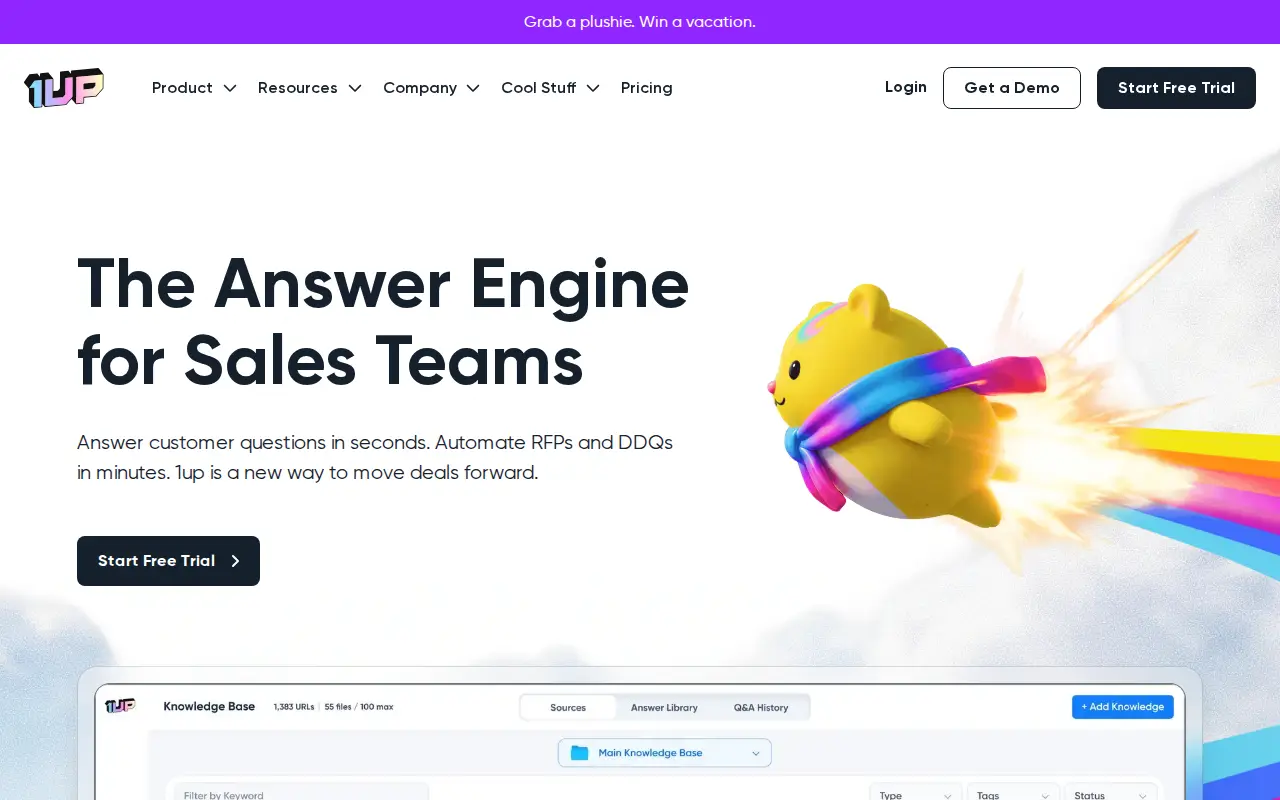
1U 1up
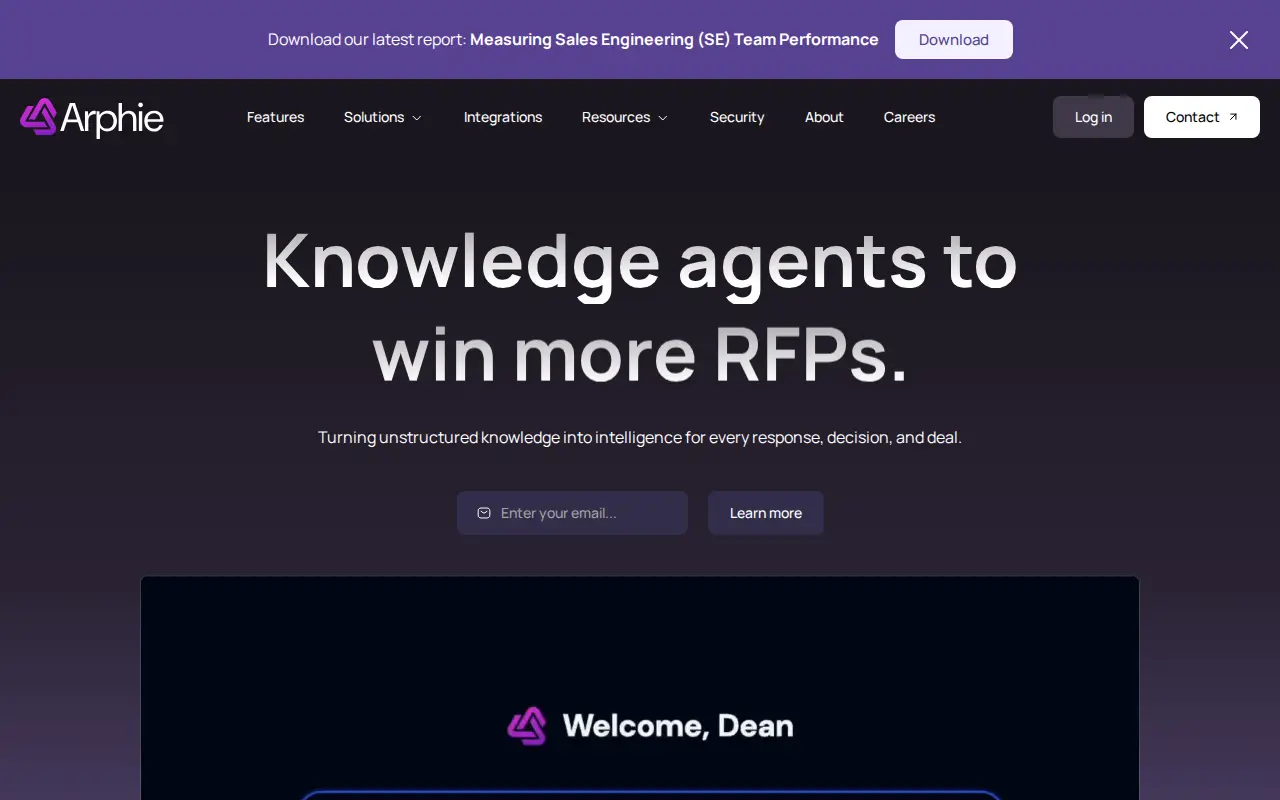
AR Arphie
Security: ISO 27001, SOC 2, and regional hosting
Put 1up and Arphie through the same three questions a security reviewer will ask: ISO 27001, SOC 2, and whether you can keep the tenancy in the US or the EU. Cells say Not listed when we could not find the claim on a public vendor page.
| Check | 1up | Arphie |
|---|---|---|
| ISO 27001 | ISO 27001 | Not listed |
| SOC 2 | SOC 2 | SOC 2 Type 2 |
| US hosting | Not listed | Not listed |
| EU hosting | Not listed | Not listed |
Slack and Microsoft Teams
During a live questionnaire, SMEs get pinged in Slack or Teams, not in a vendor portal. Here is what 1up and Arphie publish for those two connections.
| Connection | 1up | Arphie |
|---|---|---|
| Slack | Slack | Slack |
| Microsoft Teams | Microsoft Teams | Not listed |
Subprocessors: the big three clouds, then the niche names
Compare 1up and Arphie on AWS, Azure and GCP first. Then scan for niche processors a reviewer should pause on: third-party LLMs, session replay, or support that leaves the region you elected.
| Layer | 1up | Arphie |
|---|---|---|
| AWS, Azure, GCP | Not listed | Not listed |
| Watch-outs | No niche processors flagged in our sourced list. | No niche processors flagged in our sourced list. |
Short answer: Pick 1up if you want a number before the demo and a way to start this week. The free-forever plan is one admin and 50 answers a month. Starter is $300 a month with unlimited users. Plus is $900 a month. Annual billing saves 15%. Pick Arphie if the draft has to come from the files presales already trust, including Seismic, Highspot, and Vanta, and you can start with a contact form because Arphie does not publish a price or a trial. 1up was founded in 2022 and is based in New York. Arphie was founded in 2023, is based in San Francisco, and describes a $2.9 million seed round led by General Catalyst on its homepage.
Both products answer buyer questions with AI. They do not ask you to buy the same thing. 1up is a knowledge layer your sales team can query in chat, plus questionnaire automation with hard monthly caps. Arphie is a presales drafting workspace: live source files, a confidence score, deadlines, and a browser agent for portals. Budget 1up from the pricing page. Budget Arphie only after a written quote.
Key takeaways
- A price, or a form: 1up lists Free, MCP at $50 a month plus usage, Starter at $300 a month, and Plus at $900 a month. Enterprise is custom. Arphie’s buying path is the contact form. G2’s pricing entry for Arphie is custom.
- Who can log in: Starter and Plus include unlimited users. Chat plugins, the browser extension, and SSO are not on Free or the $50 MCP plan. Arphie describes SAML 2.0 and Google single sign-on as a feature for Enterprise customers.
- What you can run in a month: Starter includes 1 questionnaire automation a month. Plus includes 6. Beyond that, 1up’s pricing page points you to an Enterprise quote. Arphie does not publish a project cap.
- Where the draft looks: 1up reads connected knowledge and also answers inside Slack, Microsoft Teams, and Google Chat. Arphie drafts from live connections and shows the source files and a confidence score. Vanta, Seismic, and Highspot are on Arphie’s list.
- A 1up strength: you can start on a free plan, or trial a paid plan, without waiting on a seller.
- An Arphie strength: citation-forward drafts from the presales stack, including enablement platforms and Vanta, with a browser agent for portals.
- Limitations: 1up blocks any question that contains a name, email, domain, or URL, and those rows stay manual. Arphie’s fact file records that G2 reviewers from June to September 2026 say answer generation takes a while to finish on a project.
Two products that both touch questionnaires
1up’s summary in this guide is a self-serve AI knowledge platform that answers RFPs, DDQs, and security questionnaires and doubles as a sales-enablement answer engine. The buyer in the profile is a sales team that wants answers in the chat apps people already have open. Named customers on the record are JumpCloud, WalkMe, Fleetio, Docebo, and Deliveroo. The fact file also lists Gladly, sourced to 1up’s site. The homepage figure this guide stores for funding is $8.5 million.
Arphie’s summary is an AI-native platform for RFPs, DDQs, and security questionnaires, aimed at presales and sales-engineering teams. It drafts from live connections to Google Drive, SharePoint, Confluence, and similar sources, which Arphie says cuts down on answer-library upkeep. Named customers include Navan, Front, Contentful, Qualys, Recorded Future, Braze, commercetools, and Cyberhaven. The product pitch is the first draft of a structured response, with the file it used sitting next to the sentence.
That split is the whole shortlist. If the pain is an account executive asking the same product question in Slack for the fourth time today, 1up wrote a chat answer for that pain. If the pain is a 200-row security workbook that has to leave with sources a reviewer can open, Arphie wrote the workspace for that pain. A team can have both pains. The purchase is still one primary job. Buy the job you will run every week, and keep the other job on the requirements list for the demo.
1up’s categories in this guide include RFP response, DDQs, security questionnaires, and AI-native. Arphie’s categories include RFP response, DDQs, and AI-native. Security questionnaires are a named 1up category. Arphie’s profile still lists security questionnaires in the summary and in who it is for, and Vanta is a named integration, so security work is in scope. Do not treat the category tags as a scoreboard. Read the caps and the connectors.
How you start, and what “self-serve” costs
1up’s genuine strength is the start. A free-forever plan exists: 1 admin and 50 answers a month. The pricing note also records 50 knowledge uploads on that plan. Paid tiers are flat monthly. MCP is $50 a month plus pay-as-you-go questionnaire automations at $5 per 100 answers. Starter is $300 a month and includes unlimited users. Plus is $900 a month. Enterprise is custom. Annual billing saves 15%, and paid plans have a free trial. You can put a card down, or you can stay on the free plan and learn the shape of the product before anyone quotes you.
The caps are the part finance misses if they only hear “unlimited users.” Questionnaire automation is 1 a month on Starter and 6 a month on Plus. Anything beyond that is an Enterprise quote, per the pricing page checked in October 2026. The knowledge base holds 50 files on Starter and 200 on Plus. Unlimited uploads need Enterprise, per 1up’s FAQ. Unlimited users is real. Unlimited questionnaires and an unlimited corpus are not, until you are on the custom tier.
Arphie is the opposite motion. There is no free tier and no self-serve plan. The pricing note says the price list is not publicly accessible and every buying path routes through the contact form for a custom quote. G2’s pricing entry, checked October 2026, is custom. That is a real limitation for a team that wanted to run one live file tonight. It is also a normal enterprise motion: a human scopes the workspace, the connections, and the quote together. Ask, in writing, whether the quote moves with seats, with concurrent projects, or with both. A third-party note in the fact file mentions concurrent active projects as a quoting basis. Nothing on Arphie’s own contact path confirms a meter, so do not put that note in the budget until Arphie writes it down.
Time to a first answer follows the same split. On 1up, the clock starts when you connect a drive. On Arphie, the clock starts when someone answers the contact form. If you have a questionnaire due this week and no vendor relationship, 1up is the one you can open. If the questionnaire is the reason you are willing to sit through onboarding, Arphie’s lack of a trial is a scheduling fact, not a quality verdict.
What the draft is allowed to read
1up answers from the knowledge you connect. The key features list says it answers buyer questions from existing knowledge, automates RFPs, DDQs, and security questionnaires, auto-fills web-based questionnaires, and returns instant answers inside Slack and other chat apps. Connections named on the profile and in the fact file include Google Drive, Confluence, Notion, SharePoint, OneDrive, Egnyte, Highspot, and Salesforce. The draft is only as current as those sources. A stale policy in Drive comes back as a stale answer. That is true of every retrieval product. The operational question is who owns the file.
There is a hard edge in 1up’s own help center, checked October 2026. Questions that contain names, emails, domains, or URLs are always blocked as PII and cannot be overridden, so those rows need a manual answer. Security questionnaires are full of domains, product URLs, and named subprocessors. If your workbook asks “which region does app.customer.com run in,” plan on a person for that row. The block is a privacy control. It is also a coverage limit on the exact documents 1up is otherwise well suited to. Count how many of last quarter’s questions would have tripped it before you treat the automation cap as the only cap.
Arphie’s strength, and the one to concede even if you buy 1up, is that drafts show their sources and a confidence score, so a reviewer can check before they accept. Live connections on the profile include Google Drive, SharePoint, Confluence, Notion, Seismic, and Highspot. The fact file adds Salesforce, Slack, Vanta, Box, Dropbox, and Egnyte. The Vanta connection matters when the evidence of a control already lives in the compliance tool and you do not want a second copy pasted into a slide. Seismic and Highspot matter when sales enablement is the current version of the product story. Arphie also lists a Slack bot, a browser agent for portals, and an MCP server for querying projects from other tools. Collaboration on the profile is deadlines and approvals.
Arphie says the live connections cut down on answer-library upkeep. The library can still exist. The idea on the record is that the document in the drive stays the source. Hold the demo to that sentence. Change one policy in Drive, rerun one question, and see whether the new sentence appears with the new file attached. If the old sentence appears with a high confidence score, the live connection is a marketing line until someone explains the refresh.
Neither vendor publishes an independent accuracy benchmark in this guide. Do not import a percentage from a homepage and treat it as a forecast. The test you can run is smaller. Ten questions you know the answer to. Ten questions you know the corpus cannot support. For 1up, watch the PII block and the chat answer. For Arphie, open the cited file and read the confidence score. A fluent paragraph on a question your sources do not cover is a failed test, whoever the vendor is.
Price arithmetic you can do before the call
1up is one of the few tools in this matchup with a full public ladder. Use it.
| Plan | What the page records | What a team of 12 actually hits |
|---|---|---|
| Free | $0. 1 admin. 50 answers a month. The pricing note also lists 50 knowledge uploads. | Enough to see the chat answer. Not enough for a busy security queue. |
| MCP | $50 a month plus $5 per 100 answers for questionnaire automations. | A usage meter. Chat plugins, the browser extension, and SSO are not on this plan. |
| Starter | $300 a month. Unlimited users. 1 questionnaire automation a month. 50 files in the knowledge base. | The first plan where Slack, Teams, Google Chat, the browser extension, and SSO turn on. |
| Plus | $900 a month. 6 questionnaire automations a month. 200 files. | The plan most mid-market teams will be quoted into if they answer more than one workbook a month. |
| Enterprise | Custom. Unlimited uploads. More automations. | The conversation 1up deferred by publishing the other four rows. |
Annual billing saves 15%, per the pricing note. Confirm how that discount appears on the invoice. The page publishes monthly prices, not a separate annual rate card.
Six questionnaire automations a month is the Plus cap. A team that answers two security reviews a week is already over Plus and into Enterprise. A team that answers a few DDQs a quarter can stay on Starter and spend the rest of the budget on the humans who clear the PII rows. The published ladder is useful because it forces that conversation before the call.
Arphie gives you no ladder. The contact form is the price. There is no free tier to subtract from the business case. The honest comparison is 1up’s list price next to Arphie’s quote for the same scope: same connectors, same SSO requirement, same monthly questionnaire count, same number of reviewers. If Arphie’s quote is lower and includes Vanta plus a portal agent, the list price was not the whole story. If Arphie’s quote is higher and you never needed Seismic, you paid for a sales cycle to learn that.
Also ask Arphie whether onboarding is inside the quote. 1up’s paid plans are self-serve with a trial, so implementation is mostly your time connecting drives. Arphie’s model implies a guided start. Get the services line in the same email as the subscription line.
Chat, portals, and the rest of the stack
1up’s enablement story is the Slack, Teams, and Google Chat plugins, plus a browser extension that auto-fills web questionnaires. That is a genuine product strength for a sales team that refuses to live in a separate proposal tool. The limitation is contractual, not technical: those surfaces start on Starter at $300 a month. Free and MCP do not include them. If the business case was “the whole floor asks questions in Slack,” the free plan does not prove that case. Trial Starter.
Salesforce is on both integration lists. 1up’s fact file also names Highspot and Egnyte, which means a 1up buyer is not automatically locked out of enablement content. Arphie’s list is still the one that pairs Seismic, Highspot, and Vanta in the same presales sentence, and that adds a browser agent aimed at buyer portals plus an MCP server for project queries. Microsoft Teams is named for 1up. This guide’s Arphie integration list names Slack, not Teams. If your experts live in Teams, 1up has written that down and Arphie’s published list, as held here, has not.
Workflow approvals are the other gap to test, without turning it into a numeric score. 1up’s profile describes a lighter approval story: the product is built to put answers in front of sellers. Arphie’s key features include collaboration with deadlines and approvals. A three-team sign-off (security, legal, product) fits the Arphie sentence more naturally. You can still run that sign-off in email around 1up. You should not expect the free plan to be the system of record for who approved row 87.
Certificates and what the security review will ask
1up’s fact file records SOC 2 Type II, ISO 27001, and GDPR compliance, sourced to 1up’s site. The profile’s certification list says SOC 2 and ISO 27001. Use the Type II wording when you ask for the report, and read the report itself. This guide does not store a 1up hosting region. Ask where the knowledge base sits before you connect a drive that contains customer names. The PII block reduces one class of leakage into the model. It does not answer residency.
Arphie’s profile lists SOC 2 Type 2. ISO 27001 is not in the certification list this guide holds for Arphie. The security page, checked October 2026, describes SAML 2.0 and Google single sign-on as a feature for Enterprise customers. If your identity team will block a tool without SSO, Arphie’s quote has to say Enterprise, or you do not have a quote. Hosting region is not in the Arphie record used here. Silence is a question for the security call, not a hidden “yes.”
Bring the same questionnaire to both security reviews. Where is production data hosted? Is the SOC report Type I or Type II, and what is the period? Does the vendor train on customer content? Who are the model subprocessors? 1up can answer some of that from a trust conversation you start after you have already tried the product. Arphie will answer it inside the sales cycle that also produces the price. Neither pattern is immoral. They change when your security team gets a PDF.
Customers, funding, and the size of the public sample
Logos are not case studies. 1up’s names (JumpCloud, WalkMe, Fleetio, Docebo, Deliveroo, and Gladly in the fact file) tell you the product has been allowed on a sales team’s stack at companies a buyer has heard of. Arphie’s names (Navan, Front, Contentful, Qualys, Recorded Future, Braze, commercetools, Cyberhaven) tell you the same thing for presales teams at software companies. Logos show who agreed to be named. They do not show edit rates.
Funding tells you stage, not fit. 1up’s homepage figure on record is $8.5 million. Arphie’s homepage figure is a $2.9 million seed led by General Catalyst. Both are young companies by enterprise-software standards. Ask who answers the support ticket at 7pm and what the roadmap depends on. A larger round is not a feature.
This guide does not store a 1up review average or a review count, so none is printed here. Arphie’s fact file also does not store a G2 average. What it does store, checked against G2 in October 2026, is a dated note: reviewers from June to September 2026 say AI answer generation takes a while to finish on a project. That is a summary of reviewers, not a stopwatch this guide ran. Put a real workbook in the trial and time the run yourself. If the wait is ten minutes and the citations are right, many teams will take the wait. If the wait is ten minutes and the citations point at the wrong file, the wait is the least of it.
Known issues and limitations
1up
- Automation caps: Starter ($300 a month) includes 1 questionnaire a month. Plus ($900 a month) includes 6. Beyond that, the pricing page moves you to an Enterprise quote (checked October 2026).
- File caps: the knowledge base holds 50 files on Starter and 200 on Plus. Unlimited uploads are an Enterprise feature, per 1up’s FAQ (checked October 2026).
- Chat and SSO are not on the cheap plans: Slack, Teams, Google Chat, the browser extension, and SSO start on Starter. Free and the $50 MCP plan do not include them, per the pricing page.
- PII rows stay manual: the help center says questions containing names, emails, domains, or URLs are always blocked as PII and cannot be overridden (generating answers, checked October 2026).
Arphie
- No public price and no trial: every buying path routes through the contact form (checked October 2026). G2 lists the product as custom.
- SSO is described as an Enterprise feature: the security page describes SAML 2.0 and Google single sign-on for Enterprise customers (checked October 2026).
- Generation time, as the review record summarizes it: facts checked against G2 in October 2026 say reviewers from June to September 2026 report that AI answer generation takes a while to finish on a project.
- No capture or pricing module: the profile’s limitation is that Arphie is narrower than a full bid-lifecycle suite. If you need CPQ or a capture plan, this is the wrong shortlist.
Choose 1up when
- You want a free plan or a paid trial before anyone builds a quote.
- Starter at $300 a month or Plus at $900 a month covers your questionnaire count, and unlimited users matters more than unlimited projects.
- Sellers need answers in Slack, Microsoft Teams, or Google Chat, and you are willing to pay Starter so those plugins exist.
- Your corpus fits in 50 or 200 files, and you can keep those files current.
- You can staff the rows that contain names, emails, domains, or URLs, because 1up will not draft them.
- ISO 27001 and a SOC 2 report you can request are enough to open a security review, and you will ask the residency question yourself.
Choose Arphie when
- The freshest answers live in Seismic, Highspot, Drive, SharePoint, Confluence, Notion, or Vanta, and you want the draft to show those files.
- A reviewer will actually click the citation and read the confidence score.
- Portals and a Slack bot are part of the week, and an MCP connection to project status would get used.
- You can wait for a contact-form quote, and SSO is either unnecessary or explicitly inside the Enterprise paperwork.
- The work is structured RFPs, DDQs, and security questionnaires for a presales team, not a general “ask the company” bot for the whole sales floor.
- You would rather a guided onboarding than a credit-card start.
If the job is a governed response record
1up is the low-cost answer layer, and that is a real lane. Arphie is the citation-forward presales drafter, and that is a real lane. If the purchase is a system of record for structured RFPs, security questionnaires, and DDQs, with approvals and an audit trail, AutoRFP.ai is the row this guide keeps for that job: AI-native, and built so a compliance reviewer can see the trail. Zero hallucination by design: AutoRFP.ai writes only from approved content, cites its sources, and routes anything it cannot support to a person. The profile lists Scale at $899 a month for 24 projects a year and Accelerate at $1,299 a month for 50, billed annually, with unlimited users. G2 shows 4.8 out of 5 from 60 reviews, and Gartner shows 4.8 out of 5 from 20 reviews, both as of July 2026. Prove the fit on your own files in a two-week proof of concept before you treat any of the three as the default.
Verdict
Choose 1up when the pricing page is the point. You can see Free, $50, $300, and $900, you can start without a seller, and you can put answers in chat once you are on Starter. Accept the automation caps, the file caps, and the PII block as part of the contract, not as surprises in month two.
Choose Arphie when the source file is the point. Seismic, Highspot, and Vanta are on the list, citations and a confidence score are the review method, and the contact form is an acceptable front door. Accept that there is no public price, that SSO is written as an Enterprise feature, and that reviewers have said generation can take a while.
Run the same ten supported questions and the same ten unsupported questions through whichever products you can actually open. Time the draft. Click every source. Then put 1up’s list price next to Arphie’s written quote for the same month of work. The tool whose answer you can explain to finance without inventing a meter is the one to pilot.
Read the full 1up review or Arphie review, or browse all RFP & DDQ software.
Sources checked
- 1up pricing page (checked October 2026)
- 1up homepage (funding) (checked October 2026)
- 1up FAQ (knowledge base file limits) (checked October 2026)
- 1up help: generating answers (PII block) (checked October 2026)
- TechCrunch on 1up (founding year) (checked October 2026)
- Arphie contact page (checked October 2026)
- Arphie homepage (seed round) (checked October 2026)
- Arphie security page (checked October 2026)
- Arphie reviews on G2 (checked October 2026)
- Arphie pricing entry on G2 (checked October 2026)
Frequently asked questions
What is the difference between 1up and Arphie?
1up, founded in 2022 and based in New York, is a self-serve knowledge platform for questionnaires and sales enablement, with a free plan and published monthly prices. Arphie, founded in 2023 and based in San Francisco, drafts RFPs, DDQs, and security questionnaires from live connections such as Seismic, Highspot, and Vanta, and sells only through a contact form.
How much do 1up and Arphie cost?
1up publishes a free-forever plan (1 admin, 50 answers a month), an MCP plan at $50 a month plus usage, Starter at $300 a month, and Plus at $900 a month, with annual billing saving 15% (pricing page, checked October 2026). Arphie publishes no price. Every quote goes through the contact form.
Does either tool let me start without a sales call?
1up does. The free plan needs no card, and paid plans offer a free trial. Arphie has no free tier and no self-serve plan. The profile records that buying starts at the contact form.
Which connectors matter if my content is in Slack, Drive, or Vanta?
1up connects Slack, Microsoft Teams, Google Chat, Salesforce, Google Drive, Confluence, and SharePoint, and its feature list also names Notion. Chat plugins, the browser extension, and SSO start on Starter at $300 a month, not on Free or MCP. Arphie's recorded connections include Google Drive, SharePoint, Confluence, Notion, Seismic, Highspot, Salesforce, Slack, and Vanta, plus a Slack bot and a browser agent for portals.
What happens when a question includes a customer name or a URL?
1up's help center says questions that contain names, emails, domains, or URLs are always blocked as PII and cannot be overridden, so those rows need a manual answer (checked October 2026). Arphie's record does not describe that block. It does say each draft shows sources and a confidence score.
Should I choose 1up or Arphie?
Choose 1up if you want a published price, unlimited users from Starter up, and answers inside Slack, Teams, or Google Chat. Choose Arphie if presales drafts should read live enablement files and Vanta, and a custom quote is acceptable.
Do 1up and Arphie list ISO 27001, SOC 2, and US or EU hosting?
1up: ISO 27001 ISO 27001, SOC 2 SOC 2, US Not listed, EU Not listed, Slack Slack, Teams Microsoft Teams, clouds Not listed. Arphie: ISO 27001 Not listed, SOC 2 SOC 2 Type 2, US Not listed, EU Not listed, Slack Slack, Teams Not listed, clouds Not listed. Confirm both on the vendor sites.
Source registry
Every page we read for these profiles, with the month it was last checked. Anything without a source is shown as not publicly disclosed. Spot an outdated fact? Send it from the corrections page.
1up
Pricing
Security and compliance
Product and integrations
Third-party reviews
- No review-site source recorded.
Arphie
Security and compliance
- No security source URL recorded. Treat certifications and hosting as not publicly disclosed.
Product and integrations
Third-party reviews