Quick verdict
Choose Arphie for presales and sales-engineering teams that want drafts pulled from live sources rather than a hand-kept library; choose Iris for presales and SE teams that triage RFP fit and draft fast. Neither publishes a comparable starting price, so quote both on the same scope. In our capability model Arphie leads on DDQs, approval workflows and integrations, and the two match everywhere else.
Both profiles reviewed Oct 2026
2 of 70 profiles, one scoring modelNo paid placementSources checked: 15Choose Arphie or Iris
AR Choose Arphie when
- Presales and sales-engineering teams that want drafts pulled from live sources rather than a hand-kept library.
- You need stronger DDQs, approval workflows and integrations than Iris offers.
IR Choose Iris when
- Presales and SE teams that triage RFP fit and draft fast.
- Every drafted answer carries a citation and a confidence score, so reviewers know where to look first.
Side-by-side comparison
| Capability | Arphie | Iris | Edge |
|---|---|---|---|
| Best for | Presales and sales-engineering teams that want drafts pulled from live sources rather than a hand-kept library. | Presales and SE teams that triage RFP fit and draft fast. | - |
| Starting price | Custom | Custom | Match |
| Free tier | No | No | Match |
| RFPs | 3/3 | 3/3 | Match |
| DDQs | 3/3 | 2/3 | Arphie |
| Security questionnaires | 3/3 | 3/3 | Match |
| AI drafting | 3/3 | 3/3 | Match |
| Answer library | 3/3 | 3/3 | Match |
| Source attribution | 3/3 | 3/3 | Match |
| Workflow & approvals | 2/3 | 1/3 | Arphie |
| Integrations | 3/3 | 2/3 | Arphie |
| Self-serve onboarding | 0/3 | 0/3 | Match |
| ISO 27001 | Not listed | Not listed | - |
| SOC 2 | SOC 2 Type 2 | SOC 2 Type II | - |
| US hosting | Not listed | Not listed | - |
| EU hosting | Not listed | Not listed | - |
| Slack | Slack | Slack | - |
| Microsoft Teams | Not listed | Not listed | - |
| AWS, Azure, GCP | Not listed | Not listed | - |
| Listed integrations | Salesforce, Slack, Google Drive, SharePoint, Confluence, Vanta | Salesforce, Slack | - |
| Certifications | SOC 2 Type 2 | SOC 2 Type II | - |
What they look like
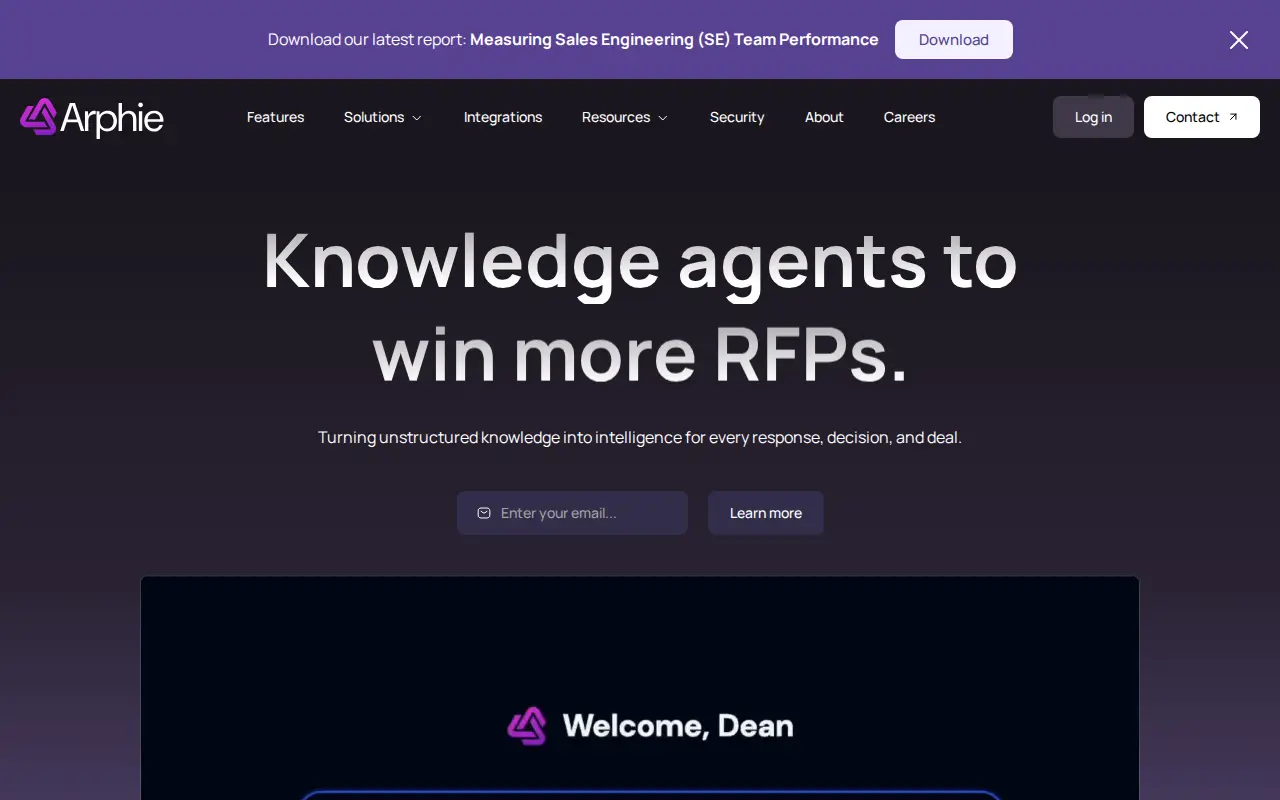
AR Arphie
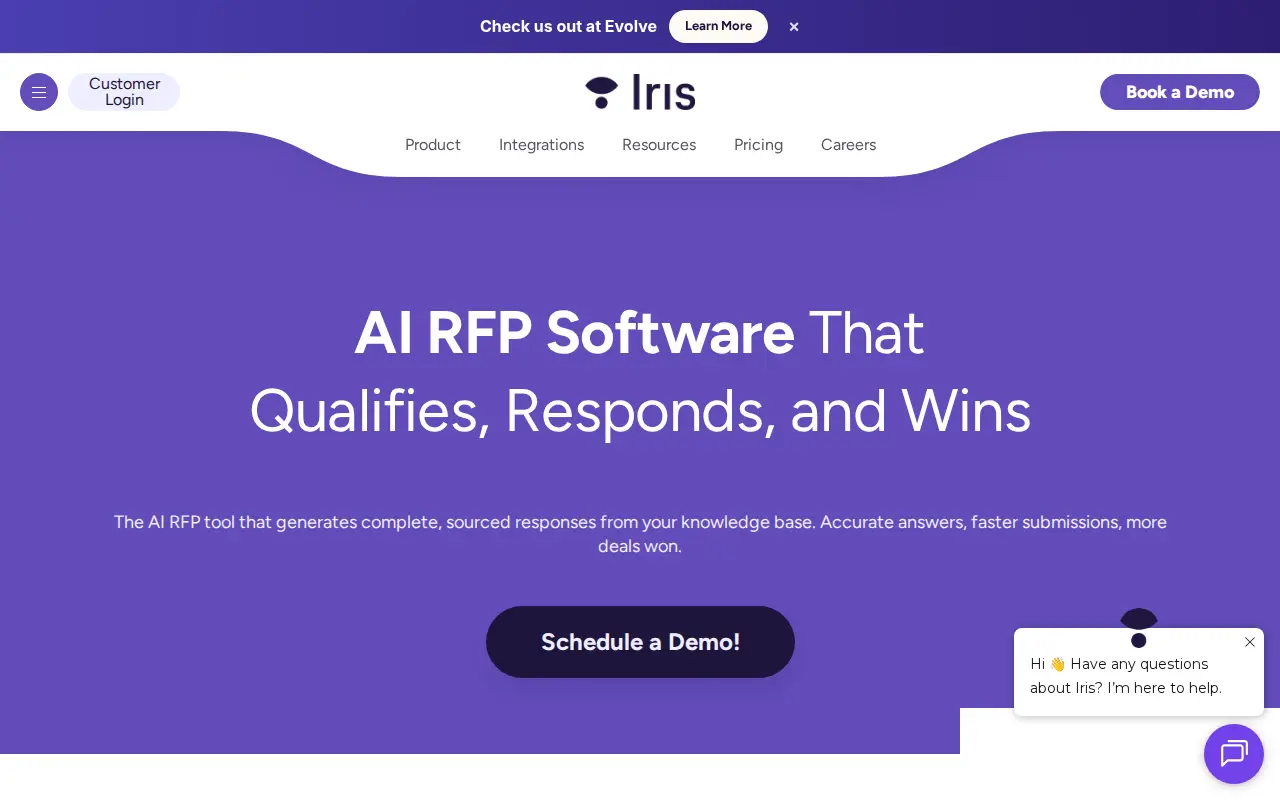
IR Iris
Security: ISO 27001, SOC 2, and regional hosting
Put Arphie and Iris through the same three questions a security reviewer will ask: ISO 27001, SOC 2, and whether you can keep the tenancy in the US or the EU. Cells say Not listed when we could not find the claim on a public vendor page.
| Check | Arphie | Iris |
|---|---|---|
| ISO 27001 | Not listed | Not listed |
| SOC 2 | SOC 2 Type 2 | SOC 2 Type II |
| US hosting | Not listed | Not listed |
| EU hosting | Not listed | Not listed |
Slack and Microsoft Teams
During a live questionnaire, SMEs get pinged in Slack or Teams, not in a vendor portal. Here is what Arphie and Iris publish for those two connections.
| Connection | Arphie | Iris |
|---|---|---|
| Slack | Slack | Slack |
| Microsoft Teams | Not listed | Not listed |
Subprocessors: the big three clouds, then the niche names
Compare Arphie and Iris on AWS, Azure and GCP first. Then scan for niche processors a reviewer should pause on: third-party LLMs, session replay, or support that leaves the region you elected.
| Layer | Arphie | Iris |
|---|---|---|
| AWS, Azure, GCP | Not listed | Not listed |
| Watch-outs | No niche processors flagged in our sourced list. | No niche processors flagged in our sourced list. |
The quick verdict: Arphie and Iris are close cousins, so pick on the job in front of you rather than on the logo. Go with Arphie when the content your team trusts already lives in Google Drive, SharePoint, Box, Dropbox, Egnyte, Seismic, Highspot or Vanta, and DDQs make up a real slice of the queue. Go with Iris when the expensive mistake is drafting an RFP you should never have bid on, because Iris scores Go/No-Go against your win history before anyone writes a word, then drafts with a citation and a confidence score and flags “insufficient context” when the knowledge map comes up empty. Neither vendor prints a price. Iris at least tells you the meter: per active user, with unlimited questionnaires.
Both companies were founded in 2023, and both sell to presales and sales-engineering teams. That shared buyer is why they end up on the same shortlist so often. Arphie is headquartered in San Francisco and describes a $2.9 million seed round led by General Catalyst on its homepage (checked October 2026). Iris is a Brooklyn company (PitchBook, July 2026), legally Iris Labs, Inc. per its privacy policy, and announced a $3 million seed round led by Florida Funders on its blog.
The customer lists point at similar buyers. Arphie names Navan, Front, Contentful, Qualys, Recorded Future, Braze, commercetools and Cyberhaven. Iris names BuildOps, Corelight, MedRisk, Class Technologies, Hazel Health, Sanas, Ashby, Beehiiv, Cresta and Swimlane.
Everything here comes from each vendor’s profile and fact file in this guide, checked against the pages listed in the sources. One vendor claim is left out on purpose: Arphie’s first-draft acceptance percentage, because no published method sits behind it.
Key takeaways
- Same buyer, different first step: Arphie starts at the draft, pulled from live-connected sources. Iris starts one step earlier with AI-scored Go/No-Go, prospect research and a structured war-room brief.
- Two ways to say “not sure”: both show a source and a confidence score on each answer. Iris also flags “insufficient context” instead of guessing and surfaces contradictions between sources.
- Library upkeep: Arphie runs automated clustering, Smart Merge for duplicates, and content health scores. Iris keeps a live knowledge map that updates when the source changes and assigns owners to documents and answers.
- Pricing meters: Iris charges per active user, with unlimited RFPs, proposals, DDQs and security questionnaires and no overages. Arphie quotes every deal through a contact form. Neither offers a free plan or trial.
- Review sample: Iris holds 4.9 out of 5 on G2 (66 reviews) and 4.9 out of 5 on Gartner (17 reviews), both as of July 2026. This guide has no Arphie rating on file, so none is quoted.
- Limitations: G2 reviewers say Arphie’s answer generation can take a while to finish. G2’s May 2026 summary for Iris says output sometimes mixes up information or reads as robotic, and third-party research rates its approval tracking as early-stage.
Overview: two AI-native tools, one shortlist
Arphie
An AI-native platform for RFPs, DDQs and security questionnaires that drafts from live connections to your source documents rather than from a library somebody has to retype. Its platform page lists deadlines, approvals and a browser agent for portals, and the profile adds a Slack bot and an MCP server for querying projects from other tools.
Iris
An AI response tool (sold as HeyIris) for presales and sales-engineering teams that covers the whole RFP run: qualify, research, brief, draft, collaborate, export. Every answer carries a citation and a confidence score, and Iris says first drafts take minutes. It also offers an MCP server for use inside ChatGPT and Claude.
Where the draft comes from
Both tools read your existing documents. The difference is what each one does around that read.
Arphie’s whole pitch is the live connection. Its summary in this guide says drafting from Google Drive, SharePoint, Confluence and similar sources cuts down on answer-library upkeep. The list goes wider than most: Notion, Seismic, Highspot, Box, Dropbox and Egnyte are all named. If your company keeps its approved security policy in Egnyte and its product one-pagers in Highspot, Arphie can read both without a migration project. That is a real advantage for teams whose content is scattered across several drives, which is exactly who the profile says it’s for.
The library doesn’t vanish, though. Arphie manages library health with automated clustering, duplicate Smart Merge actions, and content health scores. Think of it as housekeeping that runs on its own, so the person who used to spend Fridays deleting near-identical answers about data retention gets some of that time back.
Iris calls its version a live knowledge map. It syncs from SharePoint, Google Drive, Notion, Confluence, Highspot, Seismic and Drata, updates when the source document changes, and assigns an owner to each document and answer. Ownership is the detail worth noticing. When an answer about your SLA goes stale, the knowledge map knows whose name is on it, which beats a Slack thread asking “who wrote this?” for the sixth time this month.
Iris also enforces custom instructions per questionnaire type: tone, style and structure. A security questionnaire can read terse and factual while a commercial RFP reads warmer, without someone rewriting every paragraph by hand.
How a reviewer checks the answer
This is where the two get closest, and it’s still the section most worth testing yourself.
Arphie displays the exact underlying source files and an AI confidence level next to every generated draft. A reviewer can open the file the sentence came from and decide whether to accept it. Simple, and exactly what a security lead wants before an answer goes out under the company’s name.
Iris shows a cited source and a confidence score on every answer too, then goes two steps further, per its response generation page. When the knowledge map has nothing to support an answer, Iris flags “insufficient context” instead of inventing one. And when two sources disagree, it surfaces the contradiction. Say two versions of your encryption policy sit in SharePoint, one from 2024 and one current. Iris is built to raise that conflict rather than quietly pick one.
Neither vendor publishes an independent accuracy study, so here’s the honest test. Take a questionnaire you submitted last quarter, strip out the answers and run it through both during the demo or a proof environment. Count three things: citations that point at the right passage, citations that point at the wrong one, and questions the tool admits it can’t answer. The tool that admits the most honest gaps is usually the one that embarrasses you least later.
Qualification before the first draft
Iris has a step Arphie’s record doesn’t describe at all.
Before drafting, Iris runs an AI-scored Go/No-Go against your win history, pulls prospect research and builds a structured war-room brief. For a sales-engineering team that gets more RFPs than it can sensibly answer, that front end matters. The cheapest RFP is the one you decline on day one instead of discovering on day nine that you never had a shot.
Arphie’s platform evidence starts at the draft: first passes from live-connected sources, then deadlines, approvals and a browser agent. That’s not a flaw. Plenty of teams already qualify bids in Salesforce or in a weekly pipeline meeting and just want the writing done. The vendor profile does note that Arphie is narrower than full bid-lifecycle suites, with no capture or pricing modules, so don’t expect qualification tooling to show up there.
If your bid/no-bid decision currently lives in somebody’s gut, Iris gives that decision a structure. If it already lives somewhere you trust, Arphie’s narrower scope costs you nothing.
Security questionnaires and the portal problem
Both handle security questionnaires as a core job. The difference is where the evidence lives and where the questionnaire arrives.
Arphie’s strength is the pull. Its native Vanta integration grabs active technical compliance controls, pen tests and audit evidence. If your SOC 2 controls already sit in Vanta and half of every questionnaire is “paste the control that’s already true,” Arphie is reading from the same source your auditor does.
Iris’s strength is the delivery. Its security questionnaire page names CAIQ, SIG, SIG Lite and buyer Excel sheets, with evidence attached. Then there’s the browser extension, which fills ProcessUnity, OneTrust, Vanta and other web portals in place. Anyone who has copy-pasted 200 answers into a OneTrust form, one text box at a time, knows why that line is on the page. Iris also lists Drata in its knowledge map sync, which suits teams that run compliance there instead of in Vanta.
Arphie has a browser agent for portals as well, so neither leaves you stranded. Iris simply names more of the portals in its own documentation. During the demo, ask each vendor to fill the portal your biggest buyer actually uses.
DDQs
Arphie leans further into due-diligence work. Its record describes DDQ handling designed to parse relationship-specific risk questions by mapping them against live policy sources. The published Arphie review in this guide makes the same point: the product is aimed at teams that field due-diligence questionnaires and security reviews and can’t afford a wrong answer with their name on it.
Iris covers DDQs fully, with unlimited DDQ drafts under its pricing model. Third-party research cited in the Iris facts file (airfptool.com, July 2026) notes it lacks finance-specific compliance frameworks. That won’t matter for a vendor-risk DDQ from a SaaS buyer. It may matter if you answer fund or banking DDQs where the frameworks themselves are the point.
Workflow and approvals
Neither tool is a deep corporate approval engine yet, and both records say so.
Arphie’s platform page lists deadlines and approvals. G2 reviewers cited in the Arphie facts file (July 2026) describe basic role permissions, tasks and comments, and say reporting and analytics are thin and approval paths can feel tedious. The published Arphie review here calls the surrounding workflow “still filling in” compared with the decade-old suites.
Iris draws a similar note from third-party research (airfptool.com, July 2026): built-in project management and approval tracking are early-stage and fall short for enterprises that need deep approval loops. On the other side, Iris’s profile says G2 reviewers praise its ease of use and its task assignment.
So the practical read: Arphie’s approval tooling is the more developed of the two on paper, though reviewers still find it clunky. If legal, finance and a CISO all need to sign every answer in sequence, put that exact chain in front of both vendors before you buy.
Pricing you can’t see yet
Two quote-only vendors, two different meters. Here’s what each record actually publishes.
| Arphie | Iris | |
|---|---|---|
| How you buy | Custom quote via the contact form | Contact sales; demo first |
| Published price | None | None ("Contact sales for pricing") |
| What the price scales with | Not published by Arphie; this guide's pricing record notes custom plans based on concurrent active projects | Active users |
| Usage limits | Not published | Unlimited RFPs, proposals, DDQs and security questionnaires, no overages |
| Free plan or trial | No | No |
| SSO | SAML 2.0 and Google SSO described as an Enterprise-customer feature | Not stated in this guide's record |
Iris is upfront about the meter, if not the number. You pay per active user, and every user gets unlimited questionnaires. That’s a good deal for a tight presales team of four drowning in security reviews. It gets pricier when you add the security engineer, two product managers and a lawyer as contributors, because each active seat is on the bill. Ask whether occasional reviewers count as active users and how the contract treats people who log in twice a quarter.
Arphie gives you nothing to model before the call. G2’s pricing entry lists it as custom, and every buying path on Arphie’s site routes through the contact form. A note in this guide’s pricing record, from third-party research rather than Arphie’s own site, says plans are built around concurrent active projects. Confirm that in writing. If it holds, volume rather than headcount would drive cost, which flips the math compared with Iris.
So the rough rule: many contributors on few projects favors a project meter; few contributors on many projects favors Iris’s unlimited-use seats. Get both quotes on the same assumptions and the answer usually becomes obvious.
Certifications and the security packet
Both have the badge buyers ask for first. Iris lists SOC 2 Type II and GDPR. Arphie lists SOC 2 Type 2.
Arphie’s security page, checked October 2026, describes single sign-on through SAML 2.0 and Google as a feature for Enterprise customers. Treat that as a pricing question rather than a security gap: if SSO is non-negotiable for your IT team, make sure the quote you get is the Enterprise one.
Neither record in this guide names a hosting region, an ISO 27001 certificate, or a subprocessor list. That silence isn’t evidence of a problem. It means you should ask both vendors for their current SOC 2 report, hosting location and subprocessors before the security review starts. It would be a little awkward to fail the vendor questionnaire for a vendor-questionnaire tool.
Slack, Teams and the rest of the stack
Overlap first. Both list Salesforce, Slack, Google Drive, SharePoint, Confluence, Notion and Vanta, and both read from Seismic and Highspot. Both also run an MCP server: Arphie for querying projects from other tools, Iris for use inside ChatGPT and Claude.
The differences decide fit:
- Arphie only: Box, Dropbox and Egnyte. If your approved documents live in any of those, Arphie reads them directly.
- Iris only: Microsoft Teams (listed via sifthub.io), HubSpot, Drata and GovSpend. A Teams-first company with HubSpot as its CRM will find more of its stack on the Iris list.
- Collaboration surface: Arphie’s record describes a Slack bot plus the browser agent. Iris lists both Slack and Teams.
One caveat on Iris: third-party research in its facts file (airfptool.com, July 2026) says its pre-built connector catalog is narrower than the mature incumbents’, even though it covers the primary sources. Arphie’s record calls its integrations broad across file hosting, GRC, CRM and sales enablement. Measured against each other, Arphie’s file-storage coverage is wider, and Iris covers more chat and CRM options.
Known issues and limitations
Arphie
- No public price: every buying path routes through the contact form for a custom quote, and G2 lists custom pricing (checked October 2026).
- SSO on the Enterprise tier: SAML 2.0 and Google single sign-on are described on the security page as a feature for Enterprise customers.
- Generation speed: G2 reviewers from June to September 2026 say AI answer generation takes a while to finish on a project.
- Narrow scope by design: no capture or pricing modules, and reviewers describe reporting as thin.
Iris
- No public price, no trial: the pricing page says “Contact sales for pricing” and offers no free plan or free trial.
- Seat-based cost: the bill grows with every active user, even though questionnaires are unlimited.
- Output quality notes: G2’s May 2026 review summary says reviewers saw output that occasionally got confused and mixed up information, and some found answers overly robotic.
- Early-stage approvals: third-party research rates built-in approval tracking as early-stage for enterprises with deep sign-off chains.
Who should pick Arphie
- Your approved content is spread across Box, Dropbox, Egnyte, SharePoint or Google Drive, and you want drafts read straight from those files.
- Vanta holds the controls, pen tests and audit evidence you keep pasting into questionnaires.
- DDQs and vendor-risk reviews are a large part of the workload.
- Sales content lives in Seismic or Highspot, and the Slack bot fits how your experts already answer questions.
- You already qualify bids elsewhere and only need the drafting done.
- You expect many contributors per bid and would rather the price track projects than seats (confirm the meter in the quote).
Who should pick Iris
- The team receives more RFPs than it can answer and needs AI-scored Go/No-Go, prospect research and a war-room brief before drafting.
- You want the tool to flag “insufficient context” and contradictions between sources, not just attach a confidence score.
- Buyers push you into ProcessUnity, OneTrust or Vanta portals, and a browser extension that fills them in place saves real hours.
- Your company runs on Microsoft Teams, HubSpot or Drata.
- A small core team answers a lot of questionnaires, so unlimited usage per seat works in your favor.
- A public review sample matters to your buying committee: 4.9 out of 5 on both G2 and Gartner as of July 2026.
Final verdict
These two do the same job under different constraints. Arphie’s genuine strength is reach into where documents already live, including Box, Dropbox, Egnyte and Vanta, with source files and a confidence level beside each draft and a deeper DDQ focus. Iris’s genuine strength is everything around the draft: qualification before you commit, owners on every answer, an honest “insufficient context” flag, contradiction checks and a browser extension that names the portals buyers actually use.
Neither wins on price, because neither shows one. Neither wins on approvals yet, either. Run your ugliest recent questionnaire through both, count the honest gaps and the wrong citations, and get two written quotes on the same headcount and volume. Whichever one your own reviewers trust after that afternoon is the one to buy.
Read the full Arphie review or Iris review, or browse all RFP & DDQ software.
Sources checked
- Arphie homepage (seed round) (checked October 2026)
- Arphie platform page (checked October 2026)
- Arphie contact page (checked October 2026)
- Arphie security page (checked October 2026)
- Arphie pricing note on G2 (checked October 2026)
- Arphie reviews on G2 (checked October 2026)
- Iris seed round announcement (checked October 2026)
- Iris privacy policy (Iris Labs, Inc.) (checked October 2026)
- Iris pricing page (checked October 2026)
- Iris security questionnaire use case (checked October 2026)
- Iris knowledge management page (checked October 2026)
- Iris response generation page (checked October 2026)
- G2 AI summary for Iris (checked October 2026)
- Iris reviews on G2 (checked July 2026)
- Iris reviews on Gartner (checked July 2026)
Frequently asked questions
What is the difference between Arphie and Iris?
Both are AI-native response tools founded in 2023 for presales and sales-engineering teams, and both show a source and a confidence score on drafted answers. Arphie, based in San Francisco, drafts RFPs, DDQs, and security questionnaires from live connections to drives, wikis, enablement tools, and Vanta. Iris, based in Brooklyn, adds a qualification step in front of the draft (Go/No-Go scoring against win history, prospect research and a war-room brief) and flags insufficient context or contradictions between sources.
Which is cheaper, Arphie or Iris?
Neither publishes a dollar price as of October 2026. Iris prices per active user with unlimited RFPs, proposals, DDQs, and security questionnaires, and its pricing page says to contact sales. Arphie routes every buyer through a contact form for a custom quote. A seat-metered plan gets more expensive as contributors join, so count the people who need access before you compare written quotes.
Which is better for security questionnaires and portals?
Both cover them. Iris documents CAIQ, SIG, SIG Lite and buyer Excel sheets with evidence attached, plus a browser extension that fills ProcessUnity, OneTrust, Vanta, and other web portals in place. Arphie documents a native Vanta connection for controls, pen tests and audit evidence, plus a browser agent for portals. If your evidence already lives in Vanta, test Arphie's pull. If your buyers send you into OneTrust or ProcessUnity, test Iris's extension.
Do Arphie and Iris integrate with Microsoft Teams, HubSpot, and Drata?
Iris's integration list in this guide includes Microsoft Teams, HubSpot, and Drata, along with Salesforce, Slack, Google Drive, SharePoint, Confluence, Notion, Vanta, and GovSpend. Arphie's list names Salesforce, Slack, Google Drive, SharePoint, Confluence, Notion, Seismic, Highspot, Vanta, Box, Dropbox, and Egnyte. Teams, HubSpot, and Drata are not on Arphie's list in this guide.
Can I try Arphie or Iris for free?
No. Iris's pricing page lists no free plan and no free trial, and evaluation starts with a demo. Arphie's record shows no free tier and no self-serve signup. Plan on a sales conversation with both, and bring your own questionnaire to the demo.
Should I choose Arphie or Iris?
Choose Arphie if your approved content sits in Box, Dropbox, Egnyte, Seismic, Highspot, or Vanta and DDQs are a large share of the work. Choose Iris if the team wants to qualify each RFP before drafting, needs a browser extension for OneTrust or ProcessUnity portals, or runs on Microsoft Teams, HubSpot, or Drata.
Do Arphie and Iris list ISO 27001, SOC 2, and US or EU hosting?
Arphie: ISO 27001 Not listed, SOC 2 SOC 2 Type 2, US Not listed, EU Not listed, Slack Slack, Teams Not listed, clouds Not listed. Iris: ISO 27001 Not listed, SOC 2 SOC 2 Type II, US Not listed, EU Not listed, Slack Slack, Teams Not listed, clouds Not listed. Confirm both on the vendor sites.
Source registry
Every page we read for these profiles, with the month it was last checked. Anything without a source is shown as not publicly disclosed. Spot an outdated fact? Send it from the corrections page.
Arphie
Security and compliance
- No security source URL recorded. Treat certifications and hosting as not publicly disclosed.
Product and integrations
Third-party reviews
Iris
Pricing
Security and compliance
- No security source URL recorded. Treat certifications and hosting as not publicly disclosed.
Product and integrations