Quick verdict
Choose Arphie for presales and sales-engineering teams that want drafts pulled from live sources rather than a hand-kept library; choose Ombud for enterprise and regulated-finance teams with formal proposal operations. Neither publishes a comparable starting price, so quote both on the same scope. In our capability model Arphie leads on AI drafting, source attribution and integrations, while Ombud leads on approval workflows.
Both profiles reviewed Jul 2026
2 of 70 profiles, one scoring modelNo paid placementSources checked: 13Choose Arphie or Ombud
AR Choose Arphie when
- Presales and sales-engineering teams that want drafts pulled from live sources rather than a hand-kept library.
- You need stronger AI drafting, source attribution and integrations than Ombud offers.
OM Choose Ombud when
- Enterprise and regulated-finance teams with formal proposal operations.
- You need stronger approval workflows than Arphie offers.
Side-by-side comparison
| Capability | Arphie | Ombud | Edge |
|---|---|---|---|
| Best for | Presales and sales-engineering teams that want drafts pulled from live sources rather than a hand-kept library. | Enterprise and regulated-finance teams with formal proposal operations. | - |
| Starting price | Custom | Custom | Match |
| Free tier | No | No | Match |
| RFPs | 3/3 | 3/3 | Match |
| DDQs | 3/3 | 3/3 | Match |
| Security questionnaires | 3/3 | 3/3 | Match |
| AI drafting | 3/3 | 2/3 | Arphie |
| Answer library | 3/3 | 3/3 | Match |
| Source attribution | 3/3 | 2/3 | Arphie |
| Workflow & approvals | 2/3 | 3/3 | Ombud |
| Integrations | 3/3 | 2/3 | Arphie |
| Self-serve onboarding | 0/3 | 0/3 | Match |
| ISO 27001 | Not listed | ISO 27001:2013 (announced 2021) | - |
| SOC 2 | SOC 2 Type 2 | SOC 2 | - |
| US hosting | Not listed | Not listed | - |
| EU hosting | Not listed | Not listed | - |
| Slack | Slack | Slack | - |
| Microsoft Teams | Not listed | Microsoft Teams | - |
| AWS, Azure, GCP | Not listed | Not listed | - |
| Listed integrations | Salesforce, Slack, Google Drive, SharePoint, Confluence, Vanta | Salesforce, Slack, Microsoft Teams, SharePoint | - |
| Certifications | SOC 2 Type 2 | SOC 2, ISO 27001 | - |
What they look like
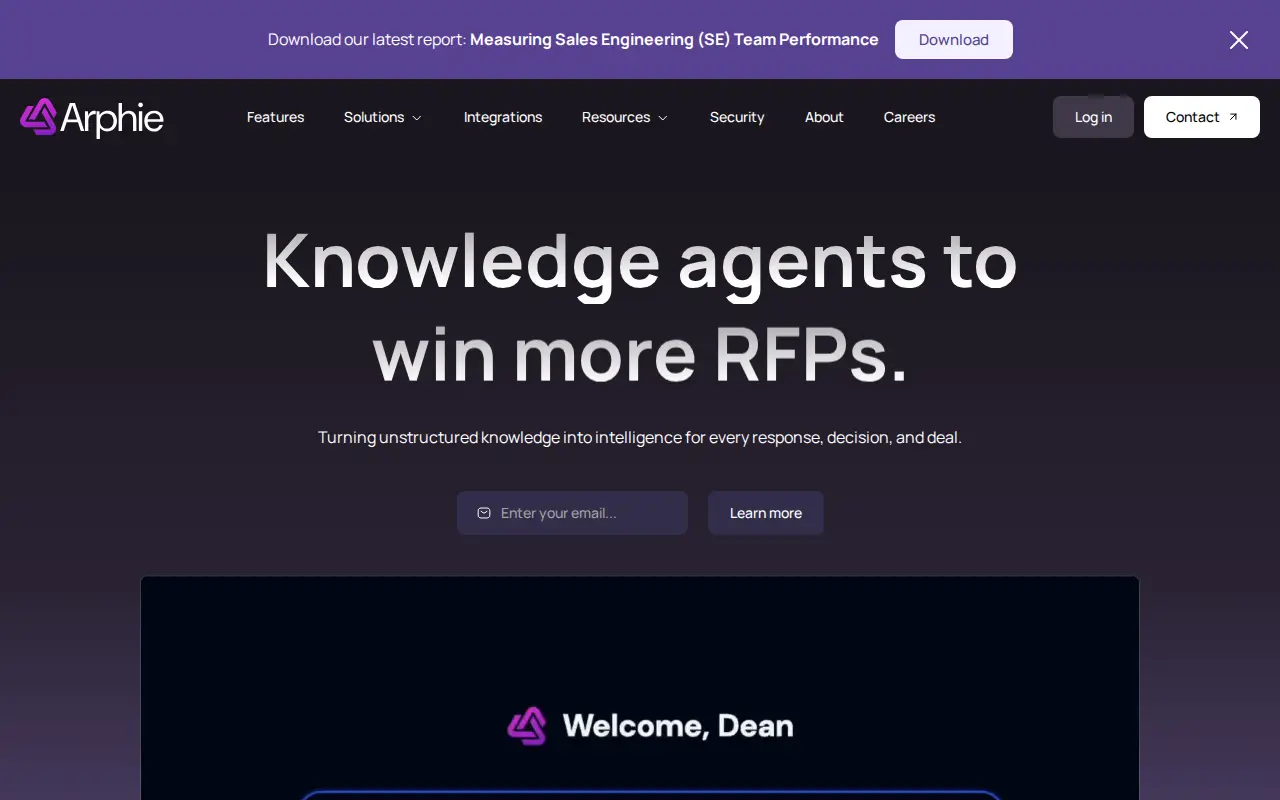
AR Arphie
OM Ombud

Security: ISO 27001, SOC 2, and regional hosting
Put Arphie and Ombud through the same three questions a security reviewer will ask: ISO 27001, SOC 2, and whether you can keep the tenancy in the US or the EU. Cells say Not listed when we could not find the claim on a public vendor page.
| Check | Arphie | Ombud |
|---|---|---|
| ISO 27001 | Not listed | ISO 27001:2013 (announced 2021) ombud.com, 2026-08 Ombud announced ISO/IEC 27001:2013 certification in 2021. Confirm the current certificate date in review. |
| SOC 2 | SOC 2 Type 2 | SOC 2 ombud.com, 2026-07 Listed in our directory dataset from earlier vendor-site review. The public security page does not currently name SOC 2, so pull the report during diligence. |
| US hosting | Not listed | Not listed |
| EU hosting | Not listed | Not listed |
Slack and Microsoft Teams
During a live questionnaire, SMEs get pinged in Slack or Teams, not in a vendor portal. Here is what Arphie and Ombud publish for those two connections.
| Connection | Arphie | Ombud |
|---|---|---|
| Slack | Slack | Slack ombud.com, 2026-08 |
| Microsoft Teams | Not listed | Microsoft Teams ombud.com, 2026-07 Listed in our catalog from earlier review. Ombud’s own blog confirms Slack in more detail than Teams. |
Subprocessors: the big three clouds, then the niche names
Compare Arphie and Ombud on AWS, Azure and GCP first. Then scan for niche processors a reviewer should pause on: third-party LLMs, session replay, or support that leaves the region you elected.
| Layer | Arphie | Ombud |
|---|---|---|
| AWS, Azure, GCP | Not listed | Not listed |
| Watch-outs | No niche processors flagged in our sourced list. | No niche processors flagged in our sourced list. Ombud does not publish a named subprocessor or cloud list on its public security page. |
Ombud was founded in Denver in 2011, years before large language models were a line item in anyone’s budget. Arphie was founded in San Francisco in 2023, after they were. That twelve-year gap explains most of what separates them. Ombud grew up as a content management and workflow system for proposal teams and has since added AI assistants it calls Ombuddies. Arphie started with AI drafting from connected sources and built collaboration around it.
Both answer RFPs, DDQs, and security questionnaires. Both are quote-only. Both list enterprise logos. The difference is in where the effort goes: Ombud puts it into governed content and review steps, Arphie puts it into getting a sourced first draft in front of a reviewer quickly. This article walks through how that plays out on the actual work, what each one costs to evaluate, and the documented issues you should check before signing, with sources dated as of October 2026.
Key takeaways
- Different starting points: Ombud is a 2011 response-management platform that now markets “context-aware” AI assistants for revenue operations. Arphie is a 2023 AI-native tool that drafts answers from live connections to Google Drive, SharePoint, Confluence, Notion, Seismic, and Highspot.
- Governance versus drafting speed: Ombud’s strength is managed content and multi-reviewer approval workflows. Arphie’s strength is a cited first draft with a confidence score on each answer, with lighter approval tooling.
- Both are quote-only: neither publishes a price. Ombud’s /pricing address returned a page-not-found error when we checked in October 2026, and Arphie routes every quote through its contact form.
- Review-site evidence ages differently: Arphie holds 4.9/5 on G2 from 26 reviews, with its latest reviews dated 2026 (as of September 2026). Ombud holds 4.7/5 on G2 from 26 reviews and 4.9/5 on Capterra from 16 (as of July 2026), but every Capterra review dates from November 2020 to May 2021.
- Stack fit: Ombud lists Salesforce, SharePoint, Slack, and Microsoft Teams. Arphie lists a longer content-store roster plus Salesforce, Slack, and Vanta, but no Teams.
- Limitations: Ombud’s public ISO 27001 announcement covers the 2013 edition, so ask for the current certificate. Arphie describes SSO as an Enterprise-customer feature, and its G2 reviewers note slow answer generation.
The short answer by team type
| Your situation | Leans toward |
|---|---|
| Presales or SE team answering security questionnaires between demos | Arphie |
| Proposal department with formal content owners and multi-step sign-off | Ombud |
| Content scattered across Seismic, Highspot, Box, or Egnyte | Arphie |
| Experts work in Microsoft Teams and SharePoint | Ombud |
| You need current, independent user reviews before buying | Arphie (more recent evidence) |
| You also want help with SOWs, POCs, and sales-engineering deliverables | Ombud (its Sales Engineering Ombuddy targets these) |
That table is a starting point. The sections below explain the reasoning, and the watch-outs list explains where each pick can go wrong.
Two companies, twelve years apart
Ombud’s current homepage describes itself as “Your AI Assistant for Revenue Operations” and an “Orchestrated RevOps Platform” for enterprise teams. The response side is handled by the Response Management Ombuddy, which Ombud says helps with “generating and refining RFP responses,” “managing the end-to-end proposal workflow,” “handling InfoSec questionnaires,” and “publishing bespoke client presentations.” A second assistant, the Sales Engineering Ombuddy, targets technical assessments, demo scripts, and other presales work. Named customers include UKG, Rapid7, GoTo, OneStream, Anaplan, and Sage.
The homepage makes outcome claims (lower “full-stack cost” of account executives, scaling without proportional overhead) but publishes no numbers behind them, and the one testimonial is from an unnamed “VP, Pre-Sales SaaS ERP.” That is not unusual for an enterprise vendor, but it means your evaluation has to generate its own evidence.
Arphie describes itself as AI agents for go-to-market teams and backs that with a $2.9 million seed round led by General Catalyst. Its customers include Navan, Front, Contentful, Qualys, Recorded Future, Braze, and Cyberhaven. Its platform page leads with AI drafting, live source connections, “full auditing capability” (seeing how the agent answered, step by step), Smart Merge for duplicate cleanup, and an MCP server so you can query projects from Claude or an IDE. Arphie says customers coming from legacy RFP tools “typically see speed and workflow improvements of 60% or more.” That is a vendor figure we could not independently verify.
Where the answer comes from
This is the most important difference for day-to-day work.
Ombud is library-first. Its long-standing model is a managed content repository with owners, review cycles, and guidance that adapts to the role of the person answering. The AI assistant sits on top of that content. If your organization already has a content team that curates approved answers, Ombud gives them a governed home and puts AI to work on content they trust. The cost is that someone has to keep curating.
Arphie is source-first. It drafts from the documents themselves, wherever they live, and shows the citation and a confidence level next to each answer. Arphie says that when a source document changes, the change becomes available to drafting automatically. That is the right model for a fast-moving SaaS company whose product docs change every sprint. The cost is that drafts are only as current as your sources. A June 2026 G2 reviewer made the same point from experience, saying training the tool and keeping its data current still takes real work. One review, but a fair reminder.
A practical way to frame it: if your problem is “nobody trusts the answers we have,” Ombud’s governed library speaks to that. If your problem is “the right answer exists somewhere, but finding it takes an afternoon,” Arphie speaks to that.
Governance: who signs off and how
Ombud’s directory record rates workflow and approvals as core, and Arphie’s as capable. In plain terms: Ombud is built for multi-reviewer chains in organizations where legal, compliance, and product each need to see an answer before it ships. Arphie supports collaborators, deadlines, approvals, and sign-off, which suits a presales team where one SE drafts and one security lead approves.
Two caveats on Ombud’s side come from its reviewers, and both are dated. In January 2022 a G2 reviewer found assigning questions, and tracking their own assignments, harder than it should be, and missed the ability to tag colleagues in comments. In May 2021 another asked for easier defaults when assigning questions. These are old and may well be fixed, but the age is itself the problem: there is little recent independent evidence either way. Ask Ombud to demo the assignment flow live on one of your own long security questionnaires.
On Arphie’s side, a June 2026 G2 reviewer testing the MCP integration reported “multiple approval prompts” and slower-than-expected responses. That is about the MCP connection, not core approvals, and it is one review.
The security questionnaire test
Most buyers comparing these two are really comparing them on one recurring chore: the vendor security questionnaire that lands mid-deal with a few hundred rows and a Friday deadline. It is worth looking at that job on its own.
Arphie’s directory record rates it core on security questionnaires and DDQs, and its integration with Vanta is aimed at exactly this work: answers about encryption, access reviews, or penetration testing can draw on the controls and evidence your compliance team already maintains. Each draft shows its source document and a confidence level, so the security lead reviewing hundreds of answers can skim the high-confidence ones and spend time on the rest. Arphie’s G2 reviewers mention using it for “RFP, third party risk, security questionnaire” work and for quick internal security questions through the browser extension.
Ombud’s record also rates it core on security questionnaires, and its Response Management Ombuddy lists “handling InfoSec questionnaires” as a named task. The library-first approach helps here in a different way: if your security team has already approved a canonical answer for each common control, Ombud keeps those answers governed and versioned, which some regulated buyers will prefer to drafting fresh from source documents each time. One older G2 reviewer (February 2021) noted that portals with many conditional responses could defeat Ombud’s upload, so if your buyers use complex portals, test one.
The fair test for both: take your most recent completed security questionnaire, strip the answers, and run it through each trial. Count the answers you would ship unchanged, the ones that needed edits, and the ones that were wrong. That last number matters more than the first.
Buying both: two closed price lists
Neither vendor publishes a price, so a cost comparison is not possible from public information. Here is what each says.
Ombud: Enterprise quote-based pricing tilted toward regulated buyers. There is no pricing page (the /pricing address returned page-not-found in October 2026), no free tier, and buying starts with a demo request.
Arphie: No list price anywhere on the site. Pricing is custom, and a quote starts with the contact form. There is no free tier or self-serve plan. Arphie says switching from another tool “usually takes less than a week” with white-glove onboarding.
With two closed price lists, run the evaluation so the quotes are comparable:
- Give both vendors the same annual volume: number of RFPs, DDQs, and security questionnaires, plus the number of people who will touch them.
- Ask each to state what the price scales on (seats, projects, volume) in writing.
- Ask whether onboarding, migration from your current tool, and SSO are included or extra.
- Ask for the renewal cap. A great year-one price is less useful if year two resets.
Dry aside: if both vendors answer question two with “it depends,” you have learned something about both.
Switching from an existing tool
Most teams evaluating these two already own something: a legacy library tool, a shared drive of past responses, or a spreadsheet that one person guards. Migration effort is part of the real price.
Arphie says switching “usually takes less than a week” and offers white-glove onboarding, and the product description Arphie wrote for its G2 profile says it can migrate information from legacy RFP software in a few clicks. Two G2 reviewers in June 2026 described onboarding as quick and easy. Because Arphie drafts from live sources, part of the migration is simply connecting the drives you already use, which is why the timeline can be short.
Ombud’s library-first model means migration is closer to a content project: deciding which answers are approved, who owns them, and how they are tagged. That takes longer, and it is also where much of Ombud’s value comes from, because the cleanup is the governance. An older G2 reviewer (May 2021) said the manual upload process could be confusing but that Ombud’s support team stepped in to manage it. Ask Ombud for a current migration plan with named milestones before you sign.
Stack fit
Ombud lists Salesforce, SharePoint, Slack, and Microsoft Teams. Ombud’s own blog covers its Slack collaboration in detail. The Salesforce connection suits revenue teams that want to start response projects from opportunity records, and SharePoint suits organizations whose approved documents already live there.
Arphie connects to a dozen sources, from Google Drive, SharePoint, and Confluence through Notion, Box, Dropbox, and Egnyte to the enablement tools Seismic and Highspot, plus Salesforce, Slack, and Vanta. For security answers, Vanta is the one to note, since compliance evidence you already track becomes draftable. The MCP server is a genuine differentiator for technical teams. Microsoft Teams is not on Arphie’s published list, which matters if your experts live there.
Rule of thumb: Microsoft-centric enterprise with a content team leans Ombud. Google or mixed-stack SaaS company with content spread across enablement tools leans Arphie.
Known issues and watch-outs
Each item links to the source we read, with dates. We left out single-review complaints.
Ombud
- ISO 27001 evidence is dated: Ombud’s public announcement (March 2021) covers ISO/IEC 27001:2013. Certificates on the 2013 edition had to move to ISO 27001:2022 by 31 October 2025, so ask for the current certificate and the SOC 2 report.
- No published pricing: the ombud.com/pricing address returned page-not-found when checked in October 2026.
- Stale review base: all 16 Capterra reviews date from November 2020 to May 2021, and most reviews on the first page of G2 date from 2021 and 2022. G2 reviewers in May 2021 and January 2022 described clunky question assignment, and two in February 2021 asked for better multi-language support.
Arphie
- No public price: quotes go through the contact form (October 2026).
- SSO for Enterprise customers: Arphie’s security page describes SAML 2.0 and Google single sign-on as provided “for Enterprise customers” (October 2026).
- Generation speed: on G2, at least three reviews from June to September 2026 mention waiting on AI-generated answers to finish.
- Review provenance: many of Arphie’s G2 reviews are marked as collected through a seller invite. That does not make them wrong, but weigh them accordingly, and ask for two references you find yourself.
Who should pick Arphie
- Your RFP and questionnaire work is owned by presales or solutions engineering, not a proposal department.
- Your best content lives in Drive, Confluence, Notion, Seismic, or Highspot, and nobody has time to copy it into a library.
- You want each answer to show its source and confidence so a reviewer can check it in seconds.
- You run compliance in Vanta, or your SE team would use MCP access.
- SSO either is not mandatory or fits the tier you are quoted.
Who should pick Ombud
- You have a content team that owns approved answers and wants a governed library with review cycles.
- Answers pass through several reviewers (legal, security, product) before submission.
- Your stack is Salesforce, SharePoint, and Microsoft Teams.
- You want one vendor to cover SOWs and sales-engineering deliverables as well as RFPs and InfoSec questionnaires.
- You are comfortable running a thorough proof of concept because recent independent reviews are scarce.
Verdict
These are different tools for different organizations. Arphie fits the modern presales desk: content everywhere, no library team, and a need for sourced drafts that a busy security lead can approve quickly. Ombud fits the established proposal operation: owned content, formal review chains, and a Microsoft-and-Salesforce stack.
Credit where it is due on both sides. Ombud has more than a decade of workflow design behind it, and its reviewers, while dated, consistently praise its support team. Arphie has strong, recent user reviews and the more transparent drafting experience. Ombud’s challenge is evidence: dated certification announcements and reviews mean you have to verify more yourself. Arphie’s challenge is maturity: newer approval tooling, an Enterprise-gated SSO, and slow generation on large projects. Pick the one whose weakness you can live with, and make the proof of concept test exactly that weakness.
Read the full Arphie review or Ombud review, or browse all RFP & DDQ software.
Frequently asked questions
What is the difference between Arphie and Ombud?
Arphie: AI-native RFP and DDQ drafting from live-connected sources. Ombud: Response management inside an AI assistant platform for RevOps. Arphie is best for presales and sales-engineering teams that want drafts pulled from live sources rather than a hand-kept library. Ombud is best for enterprise and regulated-finance teams with formal proposal operations.
Which is cheaper, Arphie or Ombud?
Neither publishes a comparable starting price, so request quotes for the same scope before comparing cost.
Is Arphie or Ombud better for DDQs and security questionnaires?
They are level on DDQ and security-questionnaire handling in our capability model, so test both on one of your own questionnaires.
Do Arphie and Ombud both handle RFPs?
Arphie: yes, a core strength. Ombud: yes, a core strength.
Which should you choose, Arphie or Ombud?
Arphie is the pick for presales and sales-engineering teams that want drafts pulled from live sources rather than a hand-kept library. Ombud is the pick for enterprise and regulated-finance teams with formal proposal operations.
Are there alternatives to Arphie and Ombud?
Yes. Browse the full directory of RFP, DDQ, and security-questionnaire platforms for more options and side-by-side comparisons.
Do Arphie and Ombud list ISO 27001, SOC 2, and US or EU hosting?
Arphie: ISO 27001 Not listed, SOC 2 SOC 2 Type 2, US Not listed, EU Not listed, Slack Slack, Teams Not listed, clouds Not listed. Ombud: ISO 27001 ISO 27001:2013 (announced 2021), SOC 2 SOC 2, US Not listed, EU Not listed, Slack Slack, Teams Microsoft Teams, clouds Not listed. Confirm both on the vendor sites.
Source registry
Every page we read for these profiles, with the month it was last checked. Anything without a source is shown as not publicly disclosed. Spot an outdated fact? Send it from the corrections page.
Arphie
Security and compliance
- No security source URL recorded. Treat certifications and hosting as not publicly disclosed.
Product and integrations
Third-party reviews
Ombud
Pricing
Security and compliance
Product and integrations
Third-party reviews