Quick verdict
Choose Arphie for presales and sales-engineering teams that want drafts pulled from live sources rather than a hand-kept library; choose Loopio for large enterprise teams with high response volume and a mature content library. Neither publishes a comparable starting price, so quote both on the same scope. In our capability model Arphie leads on AI drafting and source attribution, while Loopio leads on approval workflows.
Both profiles reviewed Jul 2026
2 of 70 profiles, one scoring modelNo paid placementSources checked: 15Choose Arphie or Loopio
AR Choose Arphie when
- Presales and sales-engineering teams that want drafts pulled from live sources rather than a hand-kept library.
- You need stronger AI drafting and source attribution than Loopio offers.
LO Choose Loopio when
- Large enterprise teams with high response volume and a mature content library.
- You need stronger approval workflows than Arphie offers.
Side-by-side comparison
| Capability | Arphie | Loopio | Edge |
|---|---|---|---|
| Best for | Presales and sales-engineering teams that want drafts pulled from live sources rather than a hand-kept library. | Large enterprise teams with high response volume and a mature content library. | - |
| Starting price | Custom | Custom (~$20K+/yr est.) | Match |
| Free tier | No | No | Match |
| RFPs | 3/3 | 3/3 | Match |
| DDQs | 3/3 | 3/3 | Match |
| Security questionnaires | 3/3 | 3/3 | Match |
| AI drafting | 3/3 | 2/3 | Arphie |
| Answer library | 3/3 | 3/3 | Match |
| Source attribution | 3/3 | 2/3 | Arphie |
| Workflow & approvals | 2/3 | 3/3 | Loopio |
| Integrations | 3/3 | 3/3 | Match |
| Self-serve onboarding | 0/3 | 0/3 | Match |
| ISO 27001 | Not listed | ISO 27001 (legal addendum) | - |
| SOC 2 | SOC 2 Type 2 | SOC 2 Type II | - |
| US hosting | Not listed | Yes (AWS Northern Virginia; DR in Northern California) | - |
| EU hosting | Not listed | Yes (Loopio EU on AWS Ireland) | - |
| Slack | Slack | Slack (NA and EU apps) | - |
| Microsoft Teams | Not listed | Microsoft Teams (NA and EU apps) | - |
| AWS, Azure, GCP | Not listed | AWS | - |
| Listed integrations | Salesforce, Slack, Google Drive, SharePoint, Confluence, Vanta | Salesforce, Slack, Microsoft Teams, Seismic, SharePoint | - |
| Certifications | SOC 2 Type 2 | SOC 2 Type II, ISO 27001 | - |
What they look like
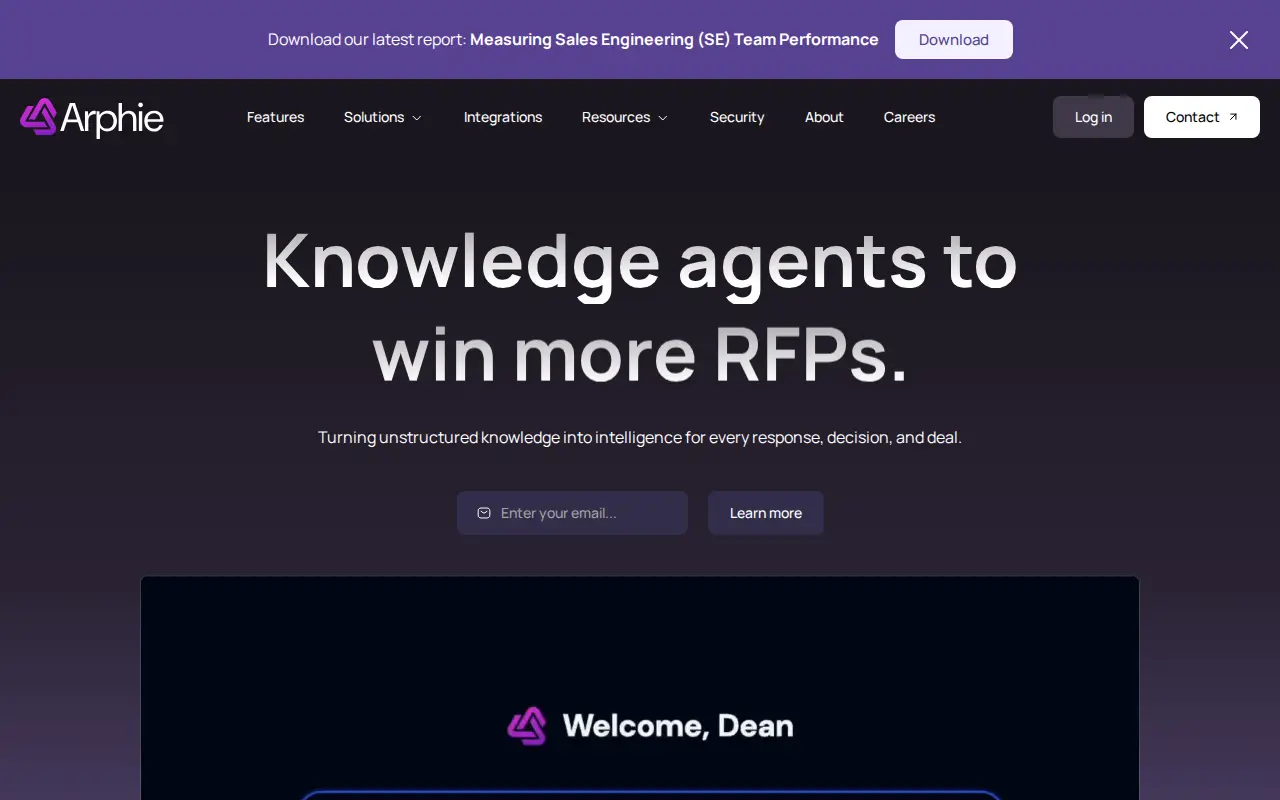
AR Arphie
LO Loopio

Security: ISO 27001, SOC 2, and regional hosting
Put Arphie and Loopio through the same three questions a security reviewer will ask: ISO 27001, SOC 2, and whether you can keep the tenancy in the US or the EU. Cells say Not listed when we could not find the claim on a public vendor page.
| Check | Arphie | Loopio |
|---|---|---|
| ISO 27001 | Not listed | ISO 27001 (legal addendum) loopio.com, 2026-08 Loopio legal addenda cite ISO 27001 and ISO 9001. The public security page describes an ISMS based on ISO 27001 rather than showing a certificate badge. |
| SOC 2 | SOC 2 Type 2 | SOC 2 Type II loopio.com, 2026-08 |
| US hosting | Not listed | Yes (AWS Northern Virginia; DR in Northern California) slack.com, 2026-08 |
| EU hosting | Not listed | Yes (Loopio EU on AWS Ireland) slack.com, 2026-08 |
Slack and Microsoft Teams
During a live questionnaire, SMEs get pinged in Slack or Teams, not in a vendor portal. Here is what Arphie and Loopio publish for those two connections.
| Connection | Arphie | Loopio |
|---|---|---|
| Slack | Slack | Slack (NA and EU apps) slack.com, 2026-08 |
| Microsoft Teams | Not listed | Microsoft Teams (NA and EU apps) loopio.com, 2026-08 |
Subprocessors: the big three clouds, then the niche names
Compare Arphie and Loopio on AWS, Azure and GCP first. Then scan for niche processors a reviewer should pause on: third-party LLMs, session replay, or support that leaves the region you elected.
| Layer | Arphie | Loopio |
|---|---|---|
| AWS, Azure, GCP | Not listed | AWS |
| Watch-outs | No niche processors flagged in our sourced list. |
Loopio does not publish a full named subprocessor table on its public security page. Confirm the current list in the DPA or during security review. |
Short answer: Pick Loopio if a proposal team already owns a curated answer library and wants AI that drafts only from those approved entries, with multi-step reviews, Microsoft Teams and a record going back to 2014. Pick Arphie if your best answers live in Google Drive, Confluence, Seismic or Vanta and nobody has time to copy them into a library; it drafts from those live sources and shows a confidence level on every answer. Neither publishes a price as of October 2026, so the deciding fact is where your current answers actually live.
Loopio is the incumbent in this matchup. It was founded in 2014, says more than 1,700 companies use it, and features Zendesk, DocuSign and Allied Universal as customer stories on its about page. Its idea has stayed steady for a decade: build one clean library of approved answers, then reuse it on every RFP, DDQ and security questionnaire. Generative AI now sits on top of that library rather than replacing it.
Arphie is the challenger. It announced a $2.9 million seed round led by General Catalyst in November 2024, and its published case studies include Cyberhaven, Recorded Future, BillingPlatform, Betterworks, Ivo and OfficeSpace Software. Its pitch is aimed straight at teams like Loopio’s: connect the documents you already maintain and stop hand-feeding a library. This page tests that pitch against what each vendor actually publishes.
Key takeaways
- Where drafts come from: Loopio’s generative AI writes from your library content, limited to entries the user has permission to see. Arphie pulls compliance-approved Q&A verbatim first, then drafts from live connected sources; its integrations page lists 15 connections, including Google Drive, SharePoint, Confluence, Seismic, Highspot and Vanta.
- Track record: Loopio dates to 2014, says more than 1,700 companies use it, and sits at 4.6/5 from 813 G2 reviews. Arphie sits at 4.9/5 from 26 G2 reviews (both as of October 2026). One is a long record; the other is a short, very happy one.
- Pricing: Neither lists a dollar figure. Loopio’s Foundations plan includes 10 seats and multi-step reviews start a tier up on Enhanced; Arphie quotes everything through its contact form (checked October 2026).
- Time to switch: Loopio says most organizations are running in 15 to 30 days. Arphie says a switch from another RFP tool usually takes under a week, while G2 reviewers average 1 month.
- Security paperwork: Loopio cites ISO 27001, ISO/IEC 42001 and SOC 2 Type II. Arphie cites SOC 2 Type 2 and zero data retention agreements with OpenAI and Anthropic.
- Limitations: Arphie describes SAML single sign-on as an Enterprise-customer feature and its integrations page lists no Microsoft Teams app. Loopio’s drafts are only as current as its library, and Capterra reviewers report formatting cleanup on import and export.
Library first, or sources first
The cleanest way to see the difference is to follow one question, say “Describe your encryption at rest,” through each tool.
In Loopio, the answer comes from the library. Its AI page says generative AI “uses your library content to create a relevant, tailored answer,” and that search weighs entry popularity, meaning and keywords to choose which entries to use. Two details will matter to your security reviewer. Generation only draws on entries the user is allowed to see (Loopio’s permission groups are called Stacks), and generative AI is never switched on automatically: an admin enables it in site settings. Drafts come with citations and confidence scores, and a good generated answer can be saved back into the library.
In Arphie, the order is different. Its investor-relations page spells it out: Arphie first uses a Q&A library of compliance-approved answers you want pulled in verbatim, and for every other question it scans SharePoint, Google Drive and other internal sources to suggest an answer. Each draft shows the sources and a confidence level, and Arphie says you can see step by step why its agents answered the way they did. You can also set instructions per project or for the whole organization, such as first person versus third person.
So both tools keep a library. The difference is what happens when the library has nothing to say. Loopio stays inside it. Arphie goes looking in your drives.
Which behavior you want depends on how much you trust those drives. If your SharePoint holds three versions of the data retention policy and nobody knows which one legal approved, Loopio’s narrower reach is a feature. If your product docs are current and the library is two releases behind, Arphie’s reach is the whole point. Every team thinks its SharePoint is tidy until an AI starts reading it.
Who keeps the answers current
Both vendors sell less maintenance. They put the remaining work in different places.
Loopio keeps the work with people, and gives them a schedule. Its homepage FAQ describes automated review cycles: scheduled triggers that prompt subject matter experts to update answers before they go stale. Recommended Experts, on its AI page, suggests the right SME from past contributions and routes answering, review and sign-off. Content can also move in and out of sales enablement platforms, and the integrations page lists Copilot, Confluence and Glean as AI productivity connections. The model is clear: the library is the product, and someone owns it.
Arphie moves part of that work onto the systems your teams already update. Its integrations page lists Egnyte, Vanta, Dropbox, Box, Notion, Google Drive, SharePoint, Highspot, Seismic, Confluence, Front help pages, Salesforce, Slack, public web pages and its own MCP server. For whatever still lives as Q&A pairs, Smart Merge proposes merging duplicates, and the features page says the agents favor more recently updated answers. You also choose exactly which files and folders sync, which matters when half the drive is drafts.
The Vanta connection is the one security teams should notice. Arphie says it taps the compliance evidence and control material your security and IT teams already keep there. If your SOC 2 evidence lives in Vanta, that is one less copy of the truth to maintain.
The honest caveat for Arphie: connecting a source does not clean it. A stale policy in Confluence becomes a stale draft faster than a stale library entry would, because nobody had to approve it first. Loopio’s caveat is the mirror image. If the review-cycle owner leaves, the library quietly ages, and the AI keeps citing it with confidence.
Switching off Loopio: what to test before you sign
Most Arphie evaluations in this pairing start with a team already on Loopio, so the switching claims deserve a close look.
Arphie’s FAQ says switching from another RFP or knowledge platform “usually takes less than a week,” that you will not lose the content you curated, and that its team provides white-glove onboarding through the migration. Its features page adds that legacy content comes across “with just a few clicks,” or that Arphie’s team will migrate it for you. Those are vendor claims. The user-reported average on Arphie’s G2 page is 1 month to implement, as of October 2026. Plan for the month and enjoy it if it is faster.
Loopio’s own numbers are worth knowing as the baseline you are leaving: its homepage says most organizations are running in 15 to 30 days, and enterprise rollouts take 4 to 6 weeks.
Four tests worth running in an Arphie trial if you are coming from Loopio:
- Bring a PDF. Arphie’s features page names Excel and Word for questionnaire import, with AI detection of questions and sections. Loopio’s SmartScan lists portal, Word, Excel or PDF sources. If buyers send you PDFs, test one.
- Watch the export. Arphie says it exports completed work into the original Excel or Word file. Check merged cells, dropdowns and locked columns, not just plain grids.
- Check what survives migration. Ask whether Loopio tags, Stacks permissions and review dates come across, or just the question and answer text.
- Compare confidence with correctness. Run last quarter’s security questionnaire through both and count low-confidence answers that were actually wrong.
Reviews, permissions and the admin you will need
Loopio has the deeper governance toolkit; Arphie has the lighter footprint and some genuinely newer tricks.
Loopio sets project access per role at four levels: No Access, Participant, Creator or Full Access. Multi-step reviews and confidential projects come with the Enhanced plan, and separate business units and sandboxes with Enterprise. Experts can answer from Slack or Microsoft Teams, and Salesforce can carry RFP data for pipeline and win-rate reporting, though Salesforce is sold as an add-on on the pricing page.
Arphie gives you roles such as owner, writer and reviewer, project-level permissions, comments and tagging, and deadline tracking down to the question, with reminders by email, Slack or in-app. Its built-in analytics show how much of the AI’s output your team ends up editing, which is the most honest metric any vendor in this category offers. Salesforce users can start an Arphie project from an opportunity. The MCP server lets you pull project status, assignments and workload trends into Claude, an IDE or a terminal.
Two gaps to check against your stack. Arphie’s integrations page lists Slack but no Microsoft Teams app. And on single sign-on, both list SAML 2.0 and Google authentication with Okta, OneLogin, Azure and ADFS, but Arphie’s security page says it provides SSO “for Enterprise customers.” Loopio’s security page names no tier.
Pricing and total cost
Neither vendor publishes a price, as of October 2026.
Loopio publishes plan contents instead. Foundations includes 10 seats, unlimited projects and library entries, and generative AI. Enhanced adds the multi-language library, confidential projects and multi-step reviews. Enterprise adds separate business units, sandboxes and a custom seat count, plus premium support. Add-ons are project translations, onboarding packages and industry integrations such as Salesforce and Highspot. A quote starts with a 15-minute sales call.
Arphie publishes nothing about price or plan structure. There is no free tier and no self-serve signup; the route is its contact form. The only plan distinction visible on its site is that SAML SSO is described as an Enterprise-customer feature, which suggests at least one tier boundary.
What that means for budgeting:
- Price Loopio on the tier you need, not the one on the slide. If you need multi-step reviews, you are on Enhanced. If you need Salesforce, add the add-on line.
- Ask Arphie what scales the bill. Seats, projects, connected sources or volume all change the answer for a ten-person SE team versus a 40-person company-wide rollout.
- Get onboarding in writing on both sides. Loopio sells onboarding packages; Arphie promises white-glove migration. Make sure the quote says which one you are buying.
Both vendors publish large speed and ROI numbers on their own pages. None of them is independently audited, so we have left them out.
Known issues and limitations
Arphie
- No public price: every buying path goes through the contact form for a custom quote, with no self-serve plan (checked October 2026).
- SSO is an Enterprise feature: the security page says SAML 2.0 and Google single sign-on are provided “for Enterprise customers” (checked October 2026).
- Generation speed: several G2 reviewers between June and September 2026 say AI answer population on a project takes a while to finish.
- Import formats and Teams: the features page names Excel and Word for questionnaire import, and the integrations page lists Slack but no Microsoft Teams app (both checked October 2026).
Loopio
- No public price, gated approvals: every plan is quoted, Foundations includes 10 seats, and multi-step reviews start on Enhanced, per the pricing page (checked October 2026).
- Integrations cost extra: Salesforce, Highspot and other industry integrations are listed as add-ons on the same pricing page (checked October 2026).
- Formatting cleanup: Capterra reviewers describe formatting issues when importing PDFs (August 2024) and exporting projects (February 2025), checked October 2026.
- Library-bound drafts: generative answers come from your library content, per the AI page (checked October 2026), so a stale library produces stale drafts.
Choose Arphie when
- Your freshest answers live in Google Drive, SharePoint, Confluence, Seismic, Highspot or product web pages, and copying them into a library is the job nobody does.
- Your SOC 2 evidence and controls live in Vanta, and you want security answers to draw on them.
- The team answering is presales or security, not a dedicated proposal department, and works in Slack rather than Microsoft Teams.
- You want to see how much of the AI’s draft your team edits, and you would actually query project status from Claude or an IDE.
- Your questionnaires arrive mostly as Excel or Word files or portals, and SSO either fits an Enterprise contract or is not mandatory.
Choose Loopio when
- A proposal team already owns a curated, permissioned library and wants AI that never reaches outside it.
- You need multi-step reviews, confidential projects, separate business units or sandboxes, and you can budget for Enhanced or Enterprise.
- Your experts live in Microsoft Teams, or you search company knowledge through Copilot or Glean.
- Your security team wants ISO 27001 and ISO/IEC 42001 references, plus SSO without an Enterprise-tier caveat.
- You want a vendor with more than a decade of history and 813 G2 reviews behind it before you commit a year.
Verdict
Same job, different theory of where answers should come from. Loopio says the safest answer is one a human approved and filed, and it builds governance around that library. Arphie says the most current answer is in the documents your teams already update, and it builds connectors and confidence scores around that. Both hold up on RFPs, DDQs and security questionnaires.
Pick by the state of your content. If your library is clean and owned, Loopio protects that investment and adds AI without loosening control. If your library is stale and your drives are not, Arphie is the shorter path to a good first draft, as long as you test the SSO tier, the PDF imports and the export before signing. As a colleague might put it: Loopio if you trust your library, Arphie if you trust your Google Drive more.
Read the full Arphie review or Loopio review, or browse all RFP & DDQ software.
Sources checked
- Arphie homepage (checked October 2026)
- Arphie features page (checked October 2026)
- Arphie integrations page (checked October 2026)
- Arphie security page (checked October 2026)
- Arphie for security teams (checked October 2026)
- Arphie for investor relations teams (checked October 2026)
- Arphie case studies (checked October 2026)
- Arphie contact page (checked October 2026)
- Arphie reviews on G2 (checked October 2026)
- Loopio pricing page (checked October 2026)
- Loopio AI features page (checked October 2026)
- Loopio integrations page (checked October 2026)
- Loopio security page (checked October 2026)
- Loopio homepage (implementation and collaboration FAQ) (checked October 2026)
- Loopio about page (checked October 2026)
- Loopio reviews on Capterra (checked October 2026)
Frequently asked questions
What is the difference between Arphie and Loopio?
Loopio drafts from a curated answer library: its generative AI uses your library content, only the entries a user is allowed to see, and an admin has to switch it on. Arphie pulls approved Q&A answers verbatim first, then drafts from live connections to Google Drive, SharePoint, Confluence, Seismic, Highspot, Vanta and web pages, with sources and a confidence level on each answer.
Which is cheaper, Arphie or Loopio?
Neither publishes a price as of October 2026. Loopio quotes three plans, and its entry Foundations plan includes 10 seats; Arphie routes every buyer through a contact form for a custom quote. The only fair comparison is two written quotes for the same seat count and volume.
Can Arphie replace Loopio for security questionnaires and DDQs?
It covers the same work. Arphie's security-teams page names SIG, CAIQ, vendor assessments and online portals, and it has a separate page for LP due diligence questionnaires. Loopio answers RFPs, DDQs and security questionnaires from one library. The real question is whether you want answers drawn from live documents or from a reviewed library.
How long does it take to move from Loopio to Arphie?
Arphie says switching from another RFP tool usually takes less than a week, that your existing library content comes across, and that its team will run the migration. That is the vendor's own claim; G2 reviewers put Arphie's average time to implement at 1 month (October 2026).
Which has the stronger security paperwork, Arphie or Loopio?
Loopio's AI page cites ISO 27001, ISO/IEC 42001 and SOC 2 Type II, and its security page offers SAML 2.0 and Google single sign-on without naming a plan tier. Arphie has a SOC 2 Type 2 audit and zero data retention agreements with OpenAI and Anthropic, but describes SAML single sign-on as a feature for Enterprise customers.
Should I choose Arphie or Loopio?
Choose Loopio if a proposal team owns a curated library, needs multi-step reviews and Microsoft Teams, and values a long track record. Choose Arphie if a presales or security team's freshest answers live in drives, wikis, enablement tools or Vanta, and nobody has time to copy them into a library.
Do Arphie and Loopio list ISO 27001, SOC 2, and US or EU hosting?
Arphie: ISO 27001 Not listed, SOC 2 SOC 2 Type 2, US Not listed, EU Not listed, Slack Slack, Teams Not listed, clouds Not listed. Loopio: ISO 27001 ISO 27001 (legal addendum), SOC 2 SOC 2 Type II, US Yes (AWS Northern Virginia; DR in Northern California), EU Yes (Loopio EU on AWS Ireland), Slack Slack (NA and EU apps), Teams Microsoft Teams (NA and EU apps), clouds AWS. Confirm both on the vendor sites.
Source registry
Every page we read for these profiles, with the month it was last checked. Anything without a source is shown as not publicly disclosed. Spot an outdated fact? Send it from the corrections page.
Arphie
Security and compliance
- No security source URL recorded. Treat certifications and hosting as not publicly disclosed.
Product and integrations
Third-party reviews
Loopio
Pricing
Security and compliance
Product and integrations