Iris review: pricing, features and alternatives (2026)
Quick answer
Iris is AI-native RFP and security questionnaire software for presales and SE teams that triage RFP fit and draft fast. Iris does not publish a price, so buying is quote-only. Check before buying: Priced per active user, so cost climbs with every contributor you bring in.
AI RFP drafting for presales and sales engineering
- Overall score: 4.5/5 across 9 capability dimensions.
- Best for: Presales and SE teams that triage RFP fit and draft fast.
- Pricing: Custom on a quote-only basis.
- Standout strength: Every drafted answer carries a citation and a confidence score, so reviewers know where to look first.
- Ecosystem: 2 integrations; SOC 2 Type II.
- Limitations: No published seat price, free plan or trial; evaluation runs through a sales demo.
Overview
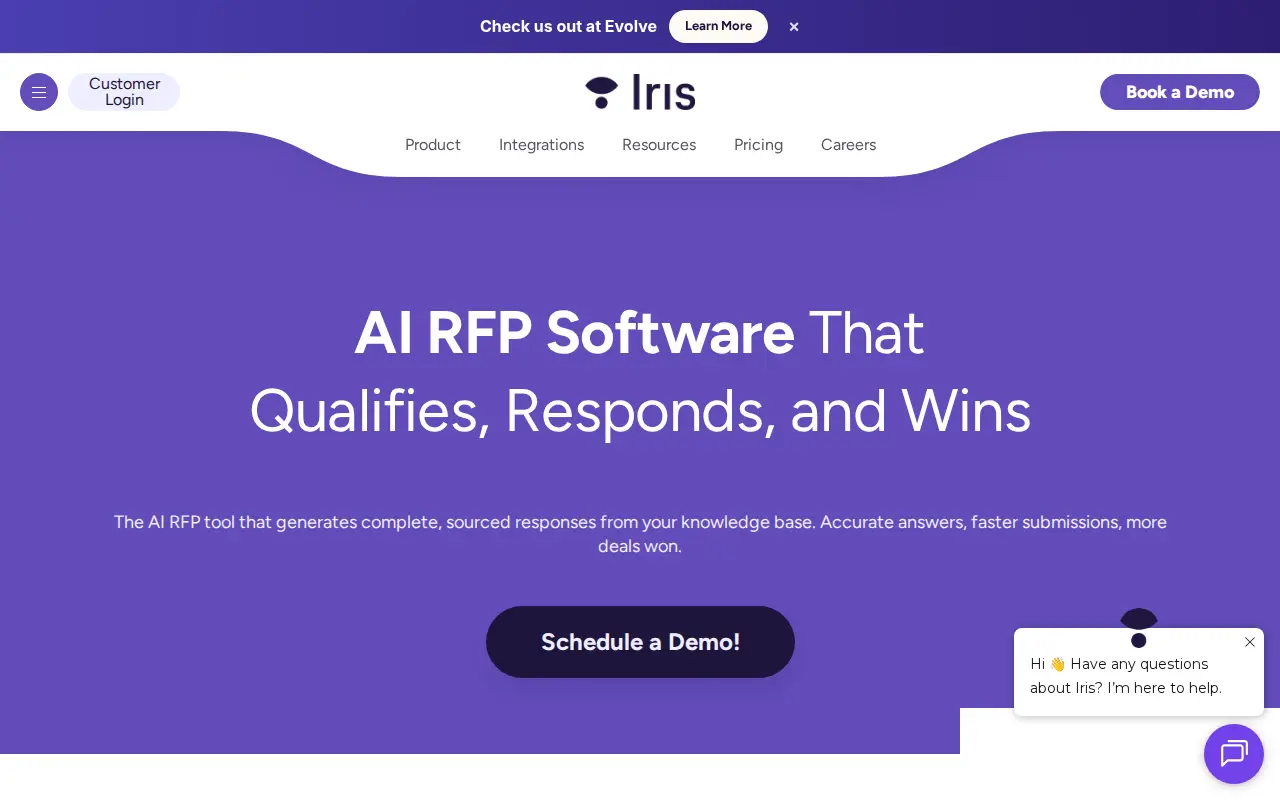
Iris (HeyIris) helps presales and sales-engineering teams qualify opportunities and draft cited, confidence-scored RFP and questionnaire answers from knowledge synced across the business.
Capability snapshot
Nine jobs, scored 0 (not offered) to 3 (category-leading). Iris is strongest on RFPs and lightest on Self-serve onboarding. The same scores feed every comparison table.
- RFPs3/3
- DDQs2/3
- Security questionnaires3/3
- AI drafting3/3
- Answer library3/3
- Source attribution3/3
- Workflow & approvals1/3
- Integrations2/3
- Self-serve onboarding0/3
Strongest: RFPsLightest: Self-serve onboarding
Key features
- First drafts with a cited source and confidence score on every answer (Iris says drafts take minutes)
- Knowledge map that syncs from SharePoint, Google Drive, Confluence, Notion and Drata
- Flags stale information and contradictions between sources
- Go/No-Go scoring for RFP fit
- Browser extension that fills security questionnaire portals such as OneTrust and Vanta
- Flags "insufficient context" instead of guessing when the knowledge map has no answer
Who it's for
Sales engineers and presales teams who want to qualify RFPs quickly and start from a cited first draft.
Strengths
- Every drafted answer carries a citation and a confidence score, so reviewers know where to look first.
- Keeps answers tied to the source documents and flags outdated or conflicting content before it ships.
- Rated 4.9/5 on G2 (66 reviews, July 2026), with reviewers praising ease of use and task assignment.
Limitations
- No published seat price, free plan or trial; evaluation runs through a sales demo.
- Priced per active user, so cost climbs with every contributor you bring in.
- G2's May 2026 review summary notes output that sometimes mixes up information or reads as robotic.
Where it falls short
Gaps we found in research, each linked to its source.
- No published seat price, free plan, or free trial: the pricing page says "Contact sales for pricing", so a quote starts with a demo. heyiris.ai, 2026-10
- Priced per active user, so the bill grows with every contributor you add, even though RFPs and questionnaires themselves are unlimited. heyiris.ai, 2026-10
- G2's May 2026 review summary says reviewers saw output that occasionally got confused and mixed up information, and some found answers sounded overly robotic. ai.g2.com, 2026-10
Security: ISO 27001, SOC 2, and regional hosting
A security review of Iris usually starts with three questions: ISO 27001, SOC 2, and whether you can keep data in the US or the EU. We only mark a yes when a public vendor page supports it.
- ISO 27001
- Not listed
- SOC 2
- SOC 2 Type II
- US hosting
- Not listed
- EU hosting
- Not listed
Slack, Teams and the rest of the stack
Iris collaboration is only as useful as the chat tools your SMEs already live in. Slack and Microsoft Teams are the two that matter on a live questionnaire.
- Slack
- Slack
- Microsoft Teams
- Not listed
Subprocessors
For Iris, start with the big three clouds (AWS, Azure, GCP), then look at niche processors that touch answer content, call a third-party model, or record sessions.
- AWS, Azure, GCP
- Not listed
No named subprocessors are listed in our sourced dataset for Iris.
Topics
Industries and roles
Pages that list Iris because its published profile shows evidence of that fit.
Ratings
Pricing and value
Iris uses quote-only pricing, quoted per deal rather than published Priced per active user with unlimited RFPs, proposals, DDQs, and security questionnaires (no usage caps). Seat prices are not published; contact sales for a quote. No free trial or free plan.
On our capability model it scores 4.5 out of 5 across 9 dimensions, and G2 reviewers rate it 4.9/5 across 66 reviews. Weigh that against presales and SE teams that triage RFP fit and draft fast to judge whether the price fits the job.
Pricing and details verified Oct 2026. Confirm on the vendor's site before you buy.
Who should pick Iris, and who should skip it
Pick it if you fit this profile: sales engineers and presales teams who want to qualify RFPs quickly and start from a cited first draft. Where it earns its place: Every drafted answer carries a citation and a confidence score, so reviewers know where to look first.
Look elsewhere if this limitation is a deal-breaker: No published seat price, free plan or trial; evaluation runs through a sales demo. Also look around if self-serve onboarding is central to how you work (0/3 here). In that case, one of the Iris alternatives may fit better.
Bottom line
Best use case in one line: Presales and SE teams that triage RFP fit and draft fast.
Teams evaluating Iris often also compare Iris vs Tenderbolt, Iris vs Arphie, and Iris vs Realm, or browse Iris alternatives.
Similar tools
Loopio, AutoRFP.ai, and Responsive come first as category benchmarks, followed by the closest peers on the job Iris is hired for (shared categories and tags, plus aligned capabilities). The snapshot above already scores each job. The notes below say where each tool is stronger, lighter, or a match.
Loopio (4.6/5, Custom (~$20K+/yr est.)). Best for large enterprise teams with high response volume and a mature content library. Matches Iris on RFPs, leads on DDQs, and is lighter on AI drafting. Audience: Teams in SaaS, tech, financial services, and healthcare answering high volumes of RFPs, RFIs, DDQs, and security questionnaires. Watch-out: No public prices: the entry Foundations plan includes 10 seats, and multi-step reviews start one tier up on Enhanced.
AutoRFP.ai (4.9/5, $899/mo). Best for software and finance teams answering structured RFPs in Word and Excel who want accuracy-first drafts, responses written to win, and a workflow that is easy to run. Matches Iris on RFPs and AI drafting, and leads on DDQs. Audience: Software and finance response teams whose RFPs come in as Word or Excel files and who want accuracy-first drafts, winning responses with every line cited to a source, a person, or the AI, and a workflow that is easy to run. Watch-out: Built for structured, source-cited answers rather than creative writing on long-form responses. For persuasive multi-page narrative, AutogenAI is built for that prose job.
Responsive (4.6/5, $10,000 (Emerging edition)). Best for enterprise teams with complex approval chains and heavy integration requirements. Matches Iris on RFPs, leads on DDQs, and is lighter on AI drafting. Audience: Enterprise sales and proposal teams that need the widest workflow across RFPs, RFIs, DDQs, and security questionnaires. Watch-out: Quoted by edition, user count, and add-ons, with a 12-month minimum term as standard and no free trial.
Anchor (4.3/5, $125,000/yr). Best for enterprise sales and presales teams answering long, technical RFPs who want every teammate in the tool without seat fees. Matches Iris on DDQs, and is lighter on RFPs and AI drafting. Audience: Enterprise B2B teams where solutions engineers and security staff share the RFP and questionnaire load across messy Excel and PDF formats. Watch-out: The only public price is a $125,000 Enterprise Plan for a 12-month contract on AWS Marketplace, sized on about 150 questions per opportunity.
Realm (4.5/5, Custom). Best for software vendors selling to enterprise who want AI across RFPs and wider sales deliverables. Matches Iris on RFPs, DDQs, and AI drafting. Audience: Presales and sales teams at software companies selling into the enterprise. Watch-out: No published pricing or free trial today; the old pricing page is gone and quotes start with a demo.
Tribble (4.7/5, Custom). Best for enterprise teams that want AI answers governed by approved, evidence-linked knowledge. Matches Iris on RFPs and AI drafting, and leads on DDQs. Audience: Large sales, presales, and proposal teams that need accurate answers tied to context and a paper trail. Watch-out: No public prices, free plan or trial; quotes come on a demo call.
Sources behind this Iris review
Every page we read for the Iris profile, with the month it was last checked. Anything without a source is shown as not publicly disclosed. Spot an outdated fact? Send it from the corrections page.
Pricing
Security and compliance
- No security source URL recorded. Treat certifications and hosting as not publicly disclosed.
Product and integrations
Frequently asked questions
Who is Iris built for?
Presales and sales-engineering teams that respond to RFPs and security questionnaires and want faster, more accurate first drafts.
Does Iris keep answers current?
It flags outdated information and contradictions between sources, and syncs from connected tools when a source changes.
What is Iris?
Iris (HeyIris) helps presales and sales-engineering teams qualify opportunities and draft cited, confidence-scored RFP and questionnaire answers from knowledge synced across the business. In this directory it sits under RFP Response, Security Questionnaires, AI-Native.
How much does Iris cost?
Iris is sold on a quote-only basis, so pricing is quoted rather than published. Priced per active user with unlimited RFPs, proposals, DDQs, and security questionnaires (no usage caps). Seat prices are not published; contact sales for a quote. No free trial or free plan.
Does Iris have a free plan or trial?
No. Iris does not advertise a free plan, so expect a demo or quote on its quote-only pricing.
What does Iris do best?
Every drafted answer carries a citation and a confidence score, so reviewers know where to look first. Keeps answers tied to the source documents and flags outdated or conflicting content before it ships.
What are the main limitations of Iris?
No published seat price, free plan or trial; evaluation runs through a sales demo. Priced per active user, so cost climbs with every contributor you bring in. G2's May 2026 review summary notes output that sometimes mixes up information or reads as robotic.
Who should use Iris?
Sales engineers and presales teams who want to qualify RFPs quickly and start from a cited first draft.
Does Iris handle RFPs, DDQs, and security questionnaires?
Iris treats RFPs and security questionnaires as core jobs, and is capable on DDQs. Sales engineers and presales teams who want to qualify RFPs quickly and start from a cited first draft.
What integrations and certifications does Iris list?
Iris lists Salesforce, Slack. Certifications on file: SOC 2 Type II.
Does Iris have ISO 27001, SOC 2, and US or EU hosting?
Iris ISO 27001: Not listed. SOC 2: SOC 2 Type II. US hosting: Not listed. EU hosting: Not listed. Slack: Slack. Microsoft Teams: Not listed. Big-three clouds listed: Not listed. Confirm on the vendor site before a security review.