Quick verdict
Choose Iris for presales and SE teams that triage RFP fit and draft fast; choose Tribble for enterprise teams that want AI answers governed by approved, evidence-linked knowledge. Neither publishes a comparable starting price, so quote both on the same scope. In our capability model Iris leads on security questionnaires, while Tribble leads on DDQs, approval workflows, integrations and self-serve setup.
Both profiles reviewed Oct 2026
2 of 70 profiles, one scoring modelNo paid placementSources checked: 19Choose Iris or Tribble
IR Choose Iris when
- Presales and SE teams that triage RFP fit and draft fast.
- You need stronger security questionnaires than Tribble offers.
TR Choose Tribble when
- Enterprise teams that want AI answers governed by approved, evidence-linked knowledge.
- You need stronger DDQs, approval workflows and integrations than Iris offers.
Side-by-side comparison
| Capability | Iris | Tribble | Edge |
|---|---|---|---|
| Best for | Presales and SE teams that triage RFP fit and draft fast. | Enterprise teams that want AI answers governed by approved, evidence-linked knowledge. | - |
| Starting price | Custom | Custom | Match |
| Free tier | No | No | Match |
| RFPs | 3/3 | 3/3 | Match |
| DDQs | 2/3 | 3/3 | Tribble |
| Security questionnaires | 3/3 | 2/3 | Iris |
| AI drafting | 3/3 | 3/3 | Match |
| Answer library | 3/3 | 3/3 | Match |
| Source attribution | 3/3 | 3/3 | Match |
| Workflow & approvals | 1/3 | 2/3 | Tribble |
| Integrations | 2/3 | 3/3 | Tribble |
| Self-serve onboarding | 0/3 | 1/3 | Tribble |
| ISO 27001 | Not listed | Not listed | - |
| SOC 2 | SOC 2 Type II | SOC 2 Type II | - |
| US hosting | Not listed | Not listed | - |
| EU hosting | Not listed | Not listed | - |
| Slack | Slack | Slack | - |
| Microsoft Teams | Not listed | Microsoft Teams | - |
| AWS, Azure, GCP | Not listed | Not listed | - |
| Listed integrations | Salesforce, Slack | Salesforce, HubSpot, Slack, Microsoft Teams, Gong, Google Drive, SharePoint, Confluence | - |
| Certifications | SOC 2 Type II | SOC 2 Type II | - |
What they look like
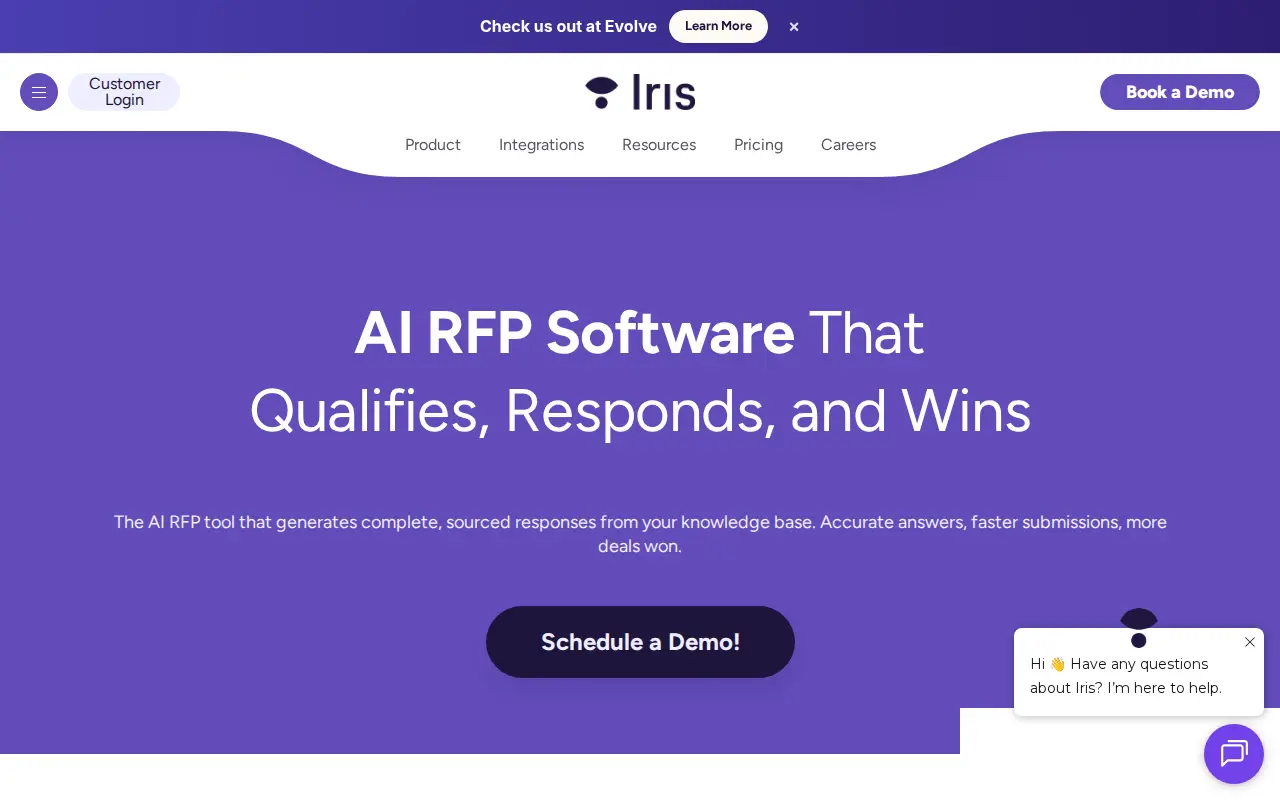
IR Iris
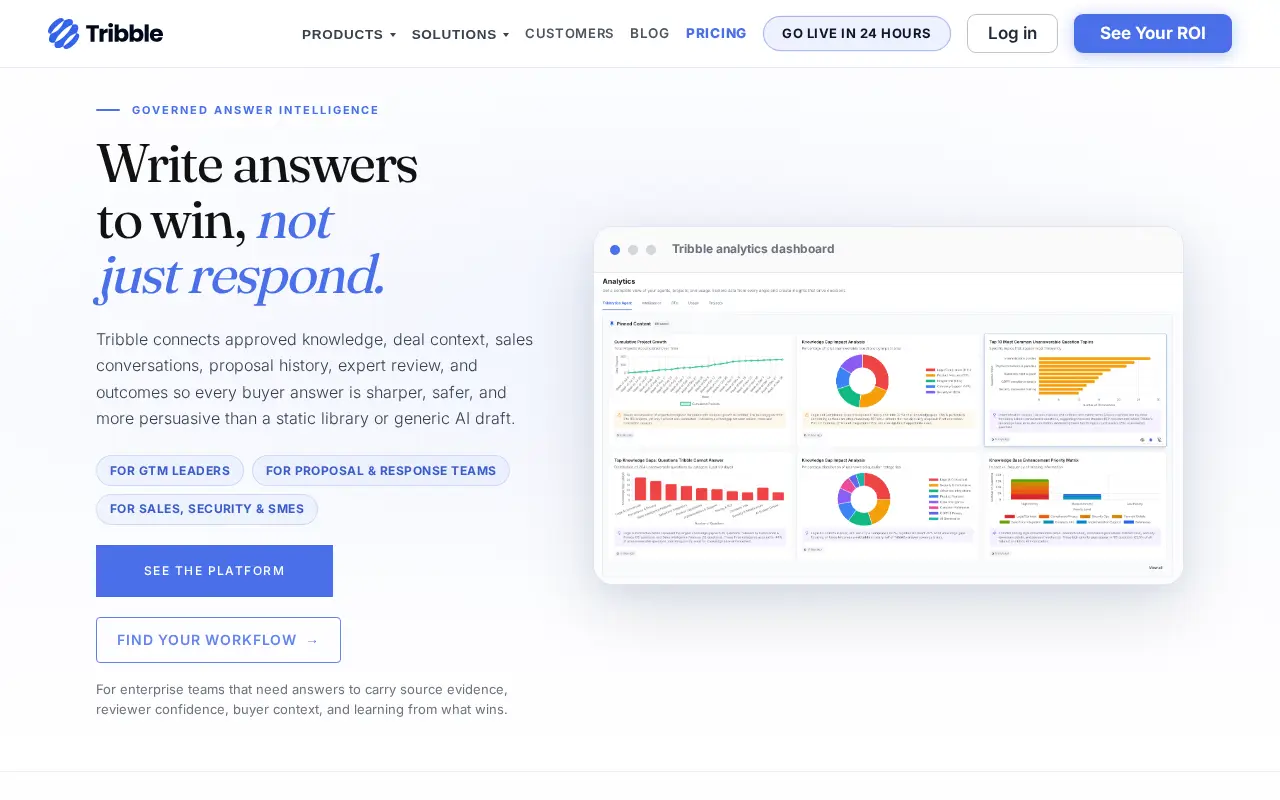
TR Tribble
Security: ISO 27001, SOC 2, and regional hosting
Put Iris and Tribble through the same three questions a security reviewer will ask: ISO 27001, SOC 2, and whether you can keep the tenancy in the US or the EU. Cells say Not listed when we could not find the claim on a public vendor page.
| Check | Iris | Tribble |
|---|---|---|
| ISO 27001 | Not listed | Not listed |
| SOC 2 | SOC 2 Type II | SOC 2 Type II |
| US hosting | Not listed | Not listed |
| EU hosting | Not listed | Not listed |
Slack and Microsoft Teams
During a live questionnaire, SMEs get pinged in Slack or Teams, not in a vendor portal. Here is what Iris and Tribble publish for those two connections.
| Connection | Iris | Tribble |
|---|---|---|
| Slack | Slack | Slack |
| Microsoft Teams | Not listed | Microsoft Teams |
Subprocessors: the big three clouds, then the niche names
Compare Iris and Tribble on AWS, Azure and GCP first. Then scan for niche processors a reviewer should pause on: third-party LLMs, session replay, or support that leaves the region you elected.
| Layer | Iris | Tribble |
|---|---|---|
| AWS, Azure, GCP | Not listed | Not listed |
| Watch-outs | No niche processors flagged in our sourced list. | No niche processors flagged in our sourced list. |
How do you want to be billed for answering questions? It sounds like a procurement detail, but for Iris and Tribble it is the cleanest way into the decision. Iris charges per active user and lets each seat run unlimited RFPs, DDQs and security questionnaires. Tribble charges its response product per project, with every contributor included, and sells a separate per-user product for reps who want answers in Slack and Teams. Those two meters reflect two different ideas of who the customer is.
Iris is a Brooklyn startup built for presales and sales engineering teams that want to qualify an RFP, draft it with citations, and ship it back into the buyer’s file or portal. Tribble, from Marina Del Rey, positions itself as a governed answer layer for enterprise revenue teams, with a shared knowledge base it calls the Brain feeding both proposal work and the sales floor. Both were founded in 2023. Both cite sources on every answer. The rest of this comparison covers where they part ways, what each costs to run, and the sourced problems on each side, as of October 2026.
Key takeaways
- Two billing meters: Iris prices per active user with no usage caps. Tribble prices Respond (RFPs, DDQs, security questionnaires) per project with all contributors included, and Engage (sales answers) per user per month. Neither publishes a number.
- DDQs are Tribble’s clearest edge: Tribble documents a DDQ workflow for asset managers that drafts from fund documents and ADV filings, routes answers to a compliance reviewer, and checks the whole package for contradictions before export.
- Portals are Iris’s clearest edge: Iris’s Chrome and Edge extension extracts portal questions and fills high-confidence answers in place, with review cards for the rest.
- Scale of proof: Tribble names customers such as Salesforce, UiPath, Freshworks, Clari and Sprout Social and holds 4.7 out of 5 on G2 across 162 reviews. Iris holds 4.9 across 66 reviews, both as of July 2026.
- Security posture: Both list SOC 2 Type II. Iris also lists GDPR compliance.
- Limitations: Neither offers a free trial. G2’s May 2026 summaries flag occasional mixed-up or inaccurate output for both, plus setup issues and frequent UI changes for Tribble.
Two ways to meter the same work
Start with your own numbers, because they decide which bill is kinder.
Iris’s pricing page promises “Unlimited RFPs, Proposals, DDQs, and security questionnaires, priced per user, not per submission.” Each seat also bundles single sign-on with SAML and SCIM provisioning, a named customer success manager, help with implementation, and use of the Iris MCP server. There is no free plan or trial, and the seat price comes from sales.
Tribble’s page explains the split plainly. Respond is “priced per project”: each RFP, DDQ or security questionnaire counts as one, and everyone who helps answer it is included, so pulling in a lawyer for three questions costs nothing extra. Engage is priced per user, per month, and includes Scribe for call recording and notes. The Brain, which holds approved answers with a source and owner on each, comes with both. Single sign-on, user permissions and the tools you connect are also listed as factors in the price. No figures are published; Tribble’s line is “Tell us your numbers and we’ll give you a price on the call.”
Two illustrative teams show how the meters cut:
- A four-person presales desk answering a steady stream of security questionnaires. Per-user pricing caps the cost at four seats no matter how many questionnaires land. Iris’s model suits this shape.
- A proposal team of three that pulls in fifteen experts across legal, security and product for a few dozen large RFPs a year. Per-project pricing ignores the long tail of occasional contributors. Tribble Respond suits this shape.
Most teams sit somewhere between. Ask each vendor to price your last twelve months of volume and your real contributor list, then compare like for like.
What each product actually covers
Iris
Iris follows a bid end to end. A Go/No-Go score weighs the opportunity against your win history; prospect research and a structured war-room brief prepare the team; cited first drafts carry a high, medium or low confidence rating; and export returns the buyer’s own file. Its knowledge map syncs from SharePoint, Google Drive, Notion, Confluence, Highspot, Seismic and Drata, updates when a source changes, and assigns owners to documents and answers. When the map has nothing to support an answer, Iris flags “insufficient context” rather than improvising.
Tribble
Tribble’s product is three pieces. The Brain is the shared knowledge layer, indexed from live sources rather than a separate question bank. Respond drafts RFPs, DDQs and security questionnaires (SIG, CAIQ and buyers’ own spreadsheets), shows the source and a confidence level per answer, lets a named expert reject or replace an answer before it leaves, and includes Go/No-Go plus long-form narrative drafting in an editor with sources beside the text. Engage brings the same answers to reps in Slack, Teams and a web app. Tribble says your first RFP can be live in 24 hours; we have not tested that, and G2’s review summary mentions setup issues, so treat it as the vendor’s figure.
DDQs: where they split most
If you sit in an asset manager’s investor relations or operations team, this section is the comparison.
Tribble has a dedicated DDQ page aimed at asset managers and institutional investors. It describes drafting from fund documentation, ADV Part 2A language, compliance manuals and prior DDQs; handling spreadsheet, document, PDF and portal-style DDQs; attaching per-answer confidence and a compliance owner; and running a consistency check across the full package so contradictions are caught “before LPs see them.” That is a workflow written for a chief compliance officer.
Iris includes DDQs in every seat with no usage cap, and its citations and confidence ratings apply there as they do anywhere. Its published material, though, is built around presales: RFPs, proposals and security reviews for software and services companies. A fund manager can use it; Tribble is the one that has written the fund manager’s process down. If DDQs are the bulk of your volume, ask Iris to run one of your real DDQs against your ADV and compliance manual, and ask Tribble to show the consistency check catching a planted contradiction.
Security questionnaires and portals
Both handle the spreadsheet version of a security review well on paper. Iris drafts CAIQ, SIG, SIG Lite and custom Excel sheets from your security posture, finds the latest SOC 2 report or pen test summary and attaches it to the relevant answer, and routes through a single reviewer, several reviewers or sequential review-then-approve steps before anything exports. Tribble answers the same frameworks from approved evidence and routes low-confidence answers to a named expert in Slack or Teams.
The portal is where Iris pulls ahead on documentation. Its extension extracts questions page by page from a web portal into a project, then a Quick-answer mode reads radio buttons, dropdowns, checkboxes and text fields, fills the high-confidence ones, and shows the rest as review cards with draft, reasoning and source. Tribble’s pricing page says buyers expect answers back in their own Word, Excel or portal format, and its Respond page says it shows up in intake portals, but we found no public step-by-step for portal filling. If your security reviews arrive through OneTrust, Whistic or ProcessUnity links, make the portal part of the demo.
Beyond the bid: answers for the sales floor
Tribble treats the RFP desk and the sales floor as two customers of one Brain. Engage puts sourced answers into Slack and Teams threads, and Scribe records and summarizes calls. Its Gong connector pulls call recordings into the knowledge base, which helps when the best answer to a security question was given verbally on a call last quarter.
Iris reaches reps in narrower ways: an Ask Iris assistant in Microsoft Teams for one-off questions, Slack for kicking off projects and pinging SMEs, and an MCP server that lets people pull cited answers into ChatGPT or Claude. If you want a full sales-assistant product, Tribble sells one. If you only need the bid team’s answers to be reachable from chat, Iris covers that without a second contract.
Setup and the first month
Iris includes implementation support and a dedicated customer success manager in the seat price, and its knowledge map is built from connectors rather than a big import project: point it at SharePoint, Drive, Confluence or Drata and it resyncs as those sources change. Owners are assigned to documents and answers inside the map, which gives you a name to chase when something goes stale. G2’s summary credits Iris with ease of use and simple task assignment.
Tribble’s onboarding pitch is speed: connect the CRM, drives, wiki and prior wins, run a first RFP, and review what got cited. The 24-hour figure is the headline. The counterweight is its own G2 summary, which lists initial setup among the recurring complaints while crediting the product’s learning over time for better answers. Read together, the realistic plan is a quick first draft followed by a few weeks of feeding corrections back before you trust the confidence levels.
With either tool, month-one quality depends on what you connect. A drive full of retired security policies produces confident, cited, retired answers. Spend the first week deciding which folders are authoritative and which get excluded, and name an owner for each.
What we could not verify
- Portal coverage in practice. Iris names OneTrust, Vanta, ProcessUnity and Prevalent and says no per-portal setup is needed. Tribble mentions intake portals and portal-format output without a public walkthrough. Neither publishes a list of portals that fail.
- Accuracy and speed figures. Tribble’s customer stories and Iris’s marketing both quote time savings and automation rates. These are vendor-reported, and we could not check the method behind any of them.
- Contract terms. Neither vendor publishes minimum term, renewal or cancellation terms.
Integrations and stack fit
Iris lists Salesforce, HubSpot, Slack, Microsoft Teams, Google Drive, SharePoint, Confluence, Notion, Drata and Vanta, plus Highspot and Seismic as knowledge sources and GovSpend procurement data for public-sector go/no-go. The list is shaped for a sales engineering team whose security content sits in a compliance platform.
Tribble lists Salesforce, HubSpot, Slack, Microsoft Teams, Gong, Google Drive, SharePoint, Confluence and Box, and its DDQ page describes bidirectional CRM sync with Salesforce and HubSpot. The Gong and CRM depth suits a revenue organization that wants deal context in every answer.
Neither list is thin. The tiebreaker is usually where your security evidence lives (Drata and Vanta point to Iris) versus where your deal context lives (Gong and two-way CRM sync point to Tribble).
Known issues and watch-outs
We tied each point to a page we read and the month we read it. We left out vendor-reported outcome figures because neither side publishes a method for them.
Iris
- Price and trial are behind a call. “Contact sales for pricing,” with no free plan or trial (Iris pricing, checked October 2026).
- Every active user is a seat. Cost scales with the people on the platform, so wide SME participation raises the bill (Iris pricing, October 2026).
- Mixed-up output. In its May 2026 review summary, G2 reports output “occasionally getting confused and mixing up information” for some reviewers, while others felt the answers came out “overly robotic” (G2 on Iris).
Tribble
- No published prices, no trial. Quotes are given on the call and the pricing page lists no free plan or trial (Tribble pricing, October 2026).
- Two products, two meters. Respond is per project and Engage per user per month, so teams that want both proposal automation and sales answers sign up for two pricing models (Tribble pricing, October 2026).
- Security features move the quote. Single sign-on, user permissions and connected tools are listed as pricing factors for both products (same page, October 2026).
- Setup and stability complaints. G2’s May 2026 review summary says users “experienced issues with the initial setup, frequent UI changes, and occasional inaccuracies,” and some found response time “slower than expected” (G2 summary for Tribble).
Quick decision guide
| Your situation | Lean toward |
|---|---|
| A small presales team with high questionnaire volume | Iris |
| Many occasional contributors on fewer, larger bids | Tribble |
| DDQs for funds, with compliance sign-off and a consistency check | Tribble |
| Security reviews arriving as web portal links | Iris |
| Reps who want sourced answers in Slack and Teams all day | Tribble |
| Security evidence kept in Drata or Vanta | Iris |
| Deal context in Gong and a two-way CRM sync | Tribble |
Who should pick Iris
- You run presales or sales engineering at a software or services company and own the questionnaire queue yourselves.
- Your volume is high and your contributor list is short, so per-user pricing works in your favor.
- Portal-based security reviews are a weekly chore and you want them filled in place.
- Scoring each RFP against past wins and losses, then briefing the team in a war room, is how you want bids to start.
- Strong G2 sentiment from teams like yours matters in your evaluation.
Who should pick Tribble
- You are an enterprise revenue team that wants one governed answer base for proposals and the sales floor.
- You answer DDQs for funds and want compliance review and a cross-answer consistency check built in.
- Your bids involve many occasional experts and you want them included without per-seat cost.
- Gong recordings and CRM history are where your best answers actually live.
- A larger reference base (Salesforce, UiPath, Freshworks, Clari, Sprout Social) helps you get internal sign-off.
Verdict
These tools overlap on the core job and split on the edges. Iris is the sharper pick for a presales desk that wants a fast path from RFP intake to a cited, approved answer pushed back into a portal, billed per person with no volume anxiety. Tribble is the sharper pick for an enterprise that wants one answer layer serving proposals, DDQs and reps, billed per project so every expert can join in, with a dedicated workflow for fund DDQs.
Before signing either, run the same three things through both: a real security portal, a real DDQ, and a twelve-month quote built from your actual volume and contributor list. The meter that comes out cheaper for your shape of team is usually the right product too.
Read the full Iris review or Tribble review, or browse all RFP & DDQ software.
Frequently asked questions
What is the difference between Iris and Tribble?
Iris: AI RFP drafting for presales and sales engineering. Tribble: Governed AI answer layer for enterprise sales. Iris is best for presales and SE teams that triage RFP fit and draft fast. Tribble is best for enterprise teams that want AI answers governed by approved, evidence-linked knowledge.
Which is cheaper, Iris or Tribble?
Neither publishes a comparable starting price, so request quotes for the same scope before comparing cost.
Is Iris or Tribble better for DDQs and security questionnaires?
They are level on DDQ and security-questionnaire handling in our capability model, so test both on one of your own questionnaires.
Do Iris and Tribble both handle RFPs?
Iris: yes, a core strength. Tribble: yes, a core strength.
Which should you choose, Iris or Tribble?
Iris is the pick for presales and SE teams that triage RFP fit and draft fast. Tribble is the pick for enterprise teams that want AI answers governed by approved, evidence-linked knowledge.
Are there alternatives to Iris and Tribble?
Yes. Browse the full directory of RFP, DDQ, and security-questionnaire platforms for more options and side-by-side comparisons.
Do Iris and Tribble list ISO 27001, SOC 2, and US or EU hosting?
Iris: ISO 27001 Not listed, SOC 2 SOC 2 Type II, US Not listed, EU Not listed, Slack Slack, Teams Not listed, clouds Not listed. Tribble: ISO 27001 Not listed, SOC 2 SOC 2 Type II, US Not listed, EU Not listed, Slack Slack, Teams Microsoft Teams, clouds Not listed. Confirm both on the vendor sites.
Source registry
Every page we read for these profiles, with the month it was last checked. Anything without a source is shown as not publicly disclosed. Spot an outdated fact? Send it from the corrections page.
Iris
Pricing
Security and compliance
- No security source URL recorded. Treat certifications and hosting as not publicly disclosed.
Product and integrations
Tribble
Pricing
Security and compliance
- No security source URL recorded. Treat certifications and hosting as not publicly disclosed.
Product and integrations
Third-party reviews