Quick verdict
Choose SparrowGenie for enterprise sales and compliance teams that want a fast draft they still shape; choose Tribble for enterprise teams that want AI answers governed by approved, evidence-linked knowledge. SparrowGenie lists a starting price of $899/mo, while Tribble is quote-only. In our capability model Tribble leads on RFPs, DDQs, AI drafting, answer library, source attribution and integrations, and the two match everywhere else.
Both profiles reviewed Oct 2026
2 of 70 profiles, one scoring modelNo paid placementSources checked: 15Choose SparrowGenie or Tribble
SP Choose SparrowGenie when
- Enterprise sales and compliance teams that want a fast draft they still shape.
- Confidence scores and answer-to-source traceability help reviewers decide what to check.
- You want a listed starting price: $899/mo.
TR Choose Tribble when
- Enterprise teams that want AI answers governed by approved, evidence-linked knowledge.
- You need stronger RFPs, DDQs and AI drafting than SparrowGenie offers.
Side-by-side comparison
| Capability | SparrowGenie | Tribble | Edge |
|---|---|---|---|
| Best for | Enterprise sales and compliance teams that want a fast draft they still shape. | Enterprise teams that want AI answers governed by approved, evidence-linked knowledge. | - |
| Starting price | $899/mo | Custom | SparrowGenie |
| Free tier | No | No | Match |
| RFPs | 2/3 | 3/3 | Tribble |
| DDQs | 2/3 | 3/3 | Tribble |
| Security questionnaires | 2/3 | 2/3 | Match |
| AI drafting | 2/3 | 3/3 | Tribble |
| Answer library | 2/3 | 3/3 | Tribble |
| Source attribution | 2/3 | 3/3 | Tribble |
| Workflow & approvals | 2/3 | 2/3 | Match |
| Integrations | 1/3 | 3/3 | Tribble |
| Self-serve onboarding | 1/3 | 1/3 | Match |
| ISO 27001 | ISO 27001 | Not listed | - |
| SOC 2 | SOC 2 Type II | SOC 2 Type II | - |
| US hosting | Not listed | Not listed | - |
| EU hosting | Not listed | Not listed | - |
| Slack | Slack | Slack | - |
| Microsoft Teams | Microsoft Teams | Microsoft Teams | - |
| AWS, Azure, GCP | Not listed | Not listed | - |
| Listed integrations | Slack, Microsoft Teams, Salesforce, HubSpot, Google Drive | Salesforce, HubSpot, Slack, Microsoft Teams, Gong, Google Drive, SharePoint, Confluence | - |
| Certifications | SOC 2 Type II, ISO 27001, GDPR, CCPA | SOC 2 Type II | - |
What they look like
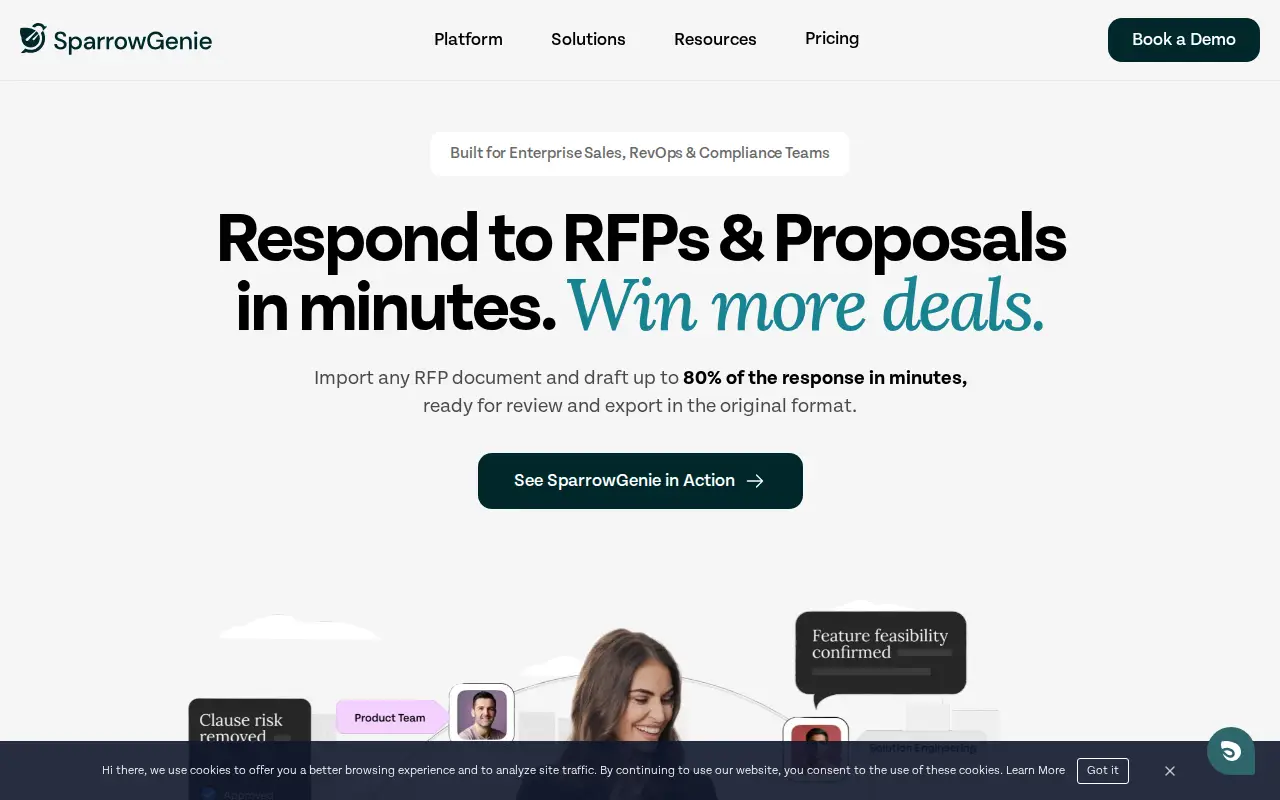
SP SparrowGenie
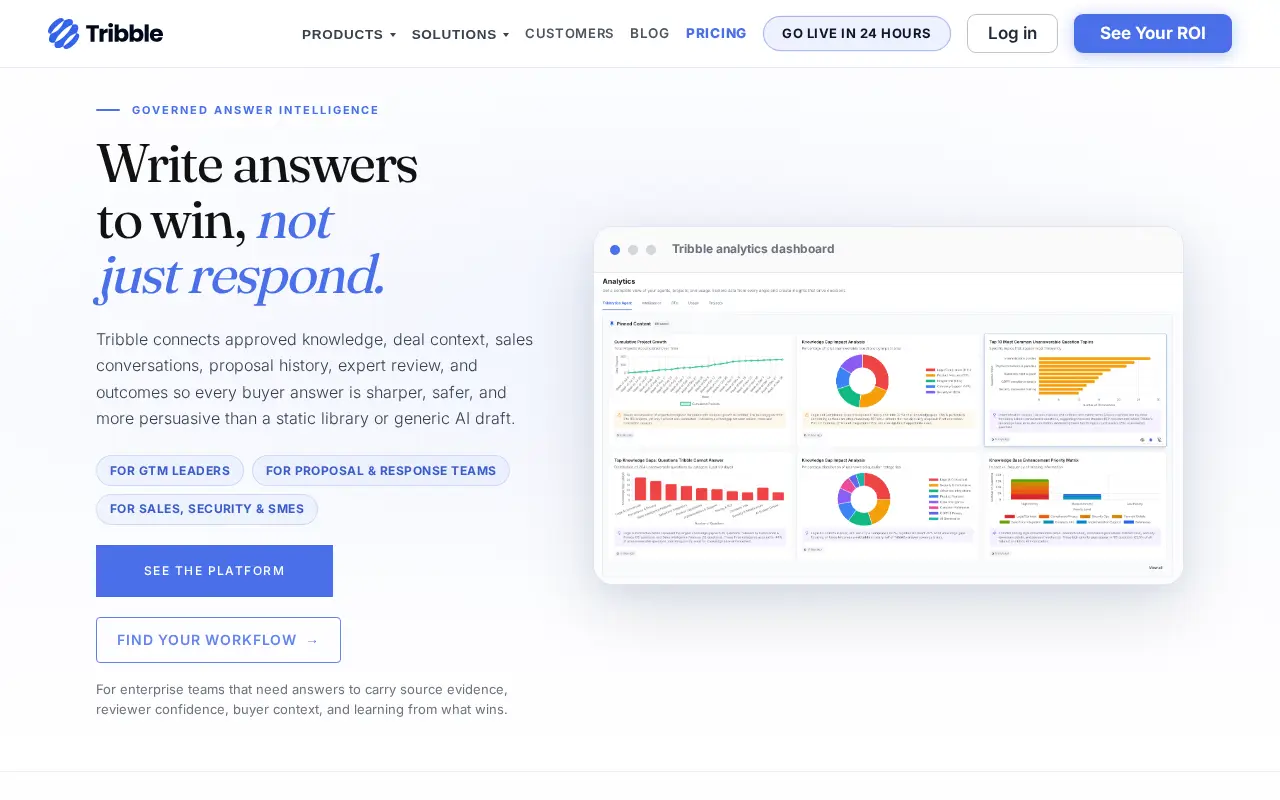
TR Tribble
Security: ISO 27001, SOC 2, and regional hosting
Put SparrowGenie and Tribble through the same three questions a security reviewer will ask: ISO 27001, SOC 2, and whether you can keep the tenancy in the US or the EU. Cells say Not listed when we could not find the claim on a public vendor page.
| Check | SparrowGenie | Tribble |
|---|---|---|
| ISO 27001 | ISO 27001 | Not listed |
| SOC 2 | SOC 2 Type II | SOC 2 Type II |
| US hosting | Not listed | Not listed |
| EU hosting | Not listed | Not listed |
Slack and Microsoft Teams
During a live questionnaire, SMEs get pinged in Slack or Teams, not in a vendor portal. Here is what SparrowGenie and Tribble publish for those two connections.
| Connection | SparrowGenie | Tribble |
|---|---|---|
| Slack | Slack | Slack |
| Microsoft Teams | Microsoft Teams | Microsoft Teams |
Subprocessors: the big three clouds, then the niche names
Compare SparrowGenie and Tribble on AWS, Azure and GCP first. Then scan for niche processors a reviewer should pause on: third-party LLMs, session replay, or support that leaves the region you elected.
| Layer | SparrowGenie | Tribble |
|---|---|---|
| AWS, Azure, GCP | Not listed | Not listed |
| Watch-outs | No niche processors flagged in our sourced list. | No niche processors flagged in our sourced list. |
One of these vendors puts a price on its website and lets you try the product for 14 days without a credit card. The other asks for your numbers and quotes on a call. That difference tells you a fair amount about SparrowGenie and Tribble before you open either product.
SparrowGenie is the RFP and proposal product from SurveySparrow, launched in 2025 and headquartered in San Francisco. It sells three plans, imports an RFP or questionnaire, drafts answers from a central knowledge hub, and hands back the file in its original format. Tribble, founded in 2023 in Marina Del Rey and backed through Salesforce Ventures’ Generative AI Fund, sells a governed knowledge base it calls the Brain, a per-project response product for RFPs, DDQs and security questionnaires, and a per-user product that answers reps in Slack and Teams. Here is how they compare on the work, the money and the evidence, as of October 2026.
Key takeaways
- Transparency vs depth: SparrowGenie publishes Essentials at $899/mo and Professional at $1,499/mo, both billed yearly, with a 14-day free trial. Tribble publishes no prices and offers no trial, but brings a larger customer base and a sales-floor product.
- Billing shape: SparrowGenie plans bundle a fixed number of users and projects per year. Tribble’s Respond counts projects and includes every contributor, while Engage is priced per user per month.
- Evidence gap: Tribble holds 4.7 out of 5 on G2 across 162 reviews (July 2026) and names customers such as Salesforce, UiPath and Freshworks. SparrowGenie’s Capterra listing showed 0 user reviews in October 2026, so its accuracy claims rest on the vendor’s word.
- Certifications: SparrowGenie lists SOC 2 Type II, ISO 27001, GDPR and CCPA. Tribble lists SOC 2 Type II.
- DDQs and sales answers favor Tribble: Tribble documents a DDQ workflow for asset managers with compliance review and a consistency check, plus Engage for reps. SparrowGenie covers DDQs and security questionnaires from the same knowledge hub as RFPs.
- Limitations: SparrowGenie’s pricing page contradicts itself on Essentials limits and price, and SSO starts on Professional. Tribble’s G2 summary flags setup issues, frequent UI changes and occasional inaccuracies.
The short answer
If you want to put real RFPs through a tool this month, know the annual cost before a sales call, and you answer a predictable number of bids a year, SparrowGenie is the easier buy. If you run a large revenue organization and want a single governed knowledge base behind proposals, fund DDQs and rep questions, and you are prepared to run a sales-led evaluation, Tribble is the stronger platform with more independent proof behind it.
What you are actually buying
SparrowGenie: plans, caps and a trial
SparrowGenie’s pricing page lists three plans:
- Essentials: $899/mo billed yearly. The plan card says 10 users and 25 projects; the comparison table and the FAQ say 5 users and 10 projects, and the FAQ prices it at $9,999 a year.
- Professional: $1,499/mo billed yearly. The plan card says 25 users and 50 projects; the table and FAQ say 20 users and 50 projects, and the FAQ prices it at $16,999 a year. Advanced AI mapping, conflict detection between answers, single sign-on, three knowledge hubs and dedicated setup help start here.
- Enterprise: custom pricing with unlimited users and projects, a dedicated account manager and custom workflows.
A project is a single RFP, RFQ, RFI, security questionnaire or proposal. Extra users, projects and knowledge hubs are sold as add-ons, and annual billing is standard. Upgrades take effect immediately with prorated billing; downgrades wait for the next billing date. The 14-day trial requires no credit card.
Tribble: Brain, Respond and Engage
Tribble sells two products on one knowledge base. Respond covers RFPs, DDQs and security questionnaires and is priced by the number of projects a year, with everyone who helps answer included. Engage, the product for reps who want answers in Slack, Teams or a web app, is billed monthly per seat and bundles Scribe, a call recorder and note taker. Both sit on the Brain, Tribble’s store of approved answers, each tagged with its source and an owner, at no separate charge. Your SSO needs, permission setup and number of connected tools feed into the quote, which arrives on a demo call.
Running an RFP through each
Intake. SparrowGenie imports the RFP document and uses contextual mapping (advanced mapping on Professional) to match questions to knowledge, including questions worded differently from past ones. Tribble parses the RFP and starts with an optional Go/No-Go so experts only spend time on bids worth winning.
Drafting. SparrowGenie says it drafts up to 80% of a response in minutes and puts first-attempt accuracy at about 90%. It shows a confidence score per answer and keeps traceability between each answer and its source content within the project. Tribble drafts from approved content, names the document behind each answer, and flags low-confidence cells so review goes where the risk is.
Review. SparrowGenie offers collaboration across sales, legal, security and product in one workspace, with activity logs and custom roles listed in its plan table. Tribble gives a nominated expert the power to veto or swap any answer before submission, and sends uncertain ones to a reviewer through Slack or Teams.
Export. SparrowGenie returns the response in the original format. Tribble designs Respond around returning the work in whatever the buyer sent, whether Word, Excel or a portal.
Long-form. SparrowGenie generates proposal documents (Word, PDF, Excel, PowerPoint, one-pagers). Tribble drafts long-form narrative answers in an editor with sources beside the text.
On paper the core loop is similar. The differences show up in governance depth and in what happens after the bid.
Security questionnaires and DDQs
SparrowGenie answers security questionnaires from the same approved content and knowledge hub as RFPs and lists InfoSec teams among its users. Its conflict detection, on Professional and above, alerts you when answers contradict each other, which matters when the same encryption question appears five ways in one SIG.
Tribble goes further for regulated finance. Its DDQ page targets asset managers and institutional investors. Drafts draw on ADV Part 2A text, fund documentation, earlier DDQs and compliance manuals; the incoming DDQ can be a spreadsheet, a Word file, a PDF or a portal form; each answer gets a confidence level and a compliance owner; and a check for contradictions runs across the whole package before it goes to investors. For an investor relations team, that is a purpose-built workflow; SparrowGenie’s DDQ support is general-purpose.
Accuracy claims and the evidence behind them
Both vendors make strong claims, and the amount of outside evidence differs a lot.
SparrowGenie’s FAQ says it generates accurate RFP responses “approximately 90% of the time on the first attempt,” and its homepage says it drafts up to 80% of a response. Its FAQ page also quotes figures such as 30% higher win rates. We found no published method behind any of these and no user reviews to compare them with: its Capterra listing showed 0 reviews in October 2026.
Tribble’s site carries customer stories with their own figures (automation rates in pilots, hours saved on security questionnaires). Those are also vendor-reported. The difference is that Tribble has a body of third-party reviews to test them against. G2’s May 2026 summary praises time saved, integrations and answers that improve over time, and lists setup issues, frequent UI changes, occasional inaccuracies and slow responses as complaints. That is a more useful picture than any single percentage, and SparrowGenie cannot yet offer the equivalent.
The practical answer for SparrowGenie is the trial. Fourteen days is enough to import two real RFPs and measure the edit rate yourself.
Knowledge: hubs versus a brain
SparrowGenie organizes approved content into knowledge hubs: one on Essentials, three on Professional, more as an add-on. Each project indexes the hubs you select, applies project-specific context, constraints and rules, and keeps answer-to-source traceability. Train, test and improve tools and presets are listed in the plan table. This suits a team that wants a curated, bounded set of sources per product line or region.
Tribble’s Brain indexes live sources rather than a separate question bank and attaches a source and owner to each approved answer. Gong recordings, CRM records, drives and wikis all feed it, and the same Brain answers reps through Engage. This suits a team whose best answers are scattered across calls and systems and who wants one place for all of them.
Integrations
SparrowGenie lists Salesforce, HubSpot, Slack, Microsoft Teams, Google Drive, SharePoint, Freshdesk, Zendesk and Intercom. Tribble’s list covers Box, Confluence, Gong, Google Drive, HubSpot, Microsoft Teams, Salesforce, SharePoint and Slack, and its CRM connections to Salesforce and HubSpot sync in both directions.
The overlap is large. Gong and Confluence tip toward Tribble for revenue teams that record calls and document product in a wiki. Support desks (Zendesk, Freshdesk, Intercom) appear on SparrowGenie’s list, useful if customer-facing answers already live there.
Setup and the first few weeks
SparrowGenie says implementation depends mainly on how organized your knowledge sources are: a few days if everything is ready, a few days to a couple of weeks for most teams, with dedicated support for Professional and Enterprise customers. Because the trial gives full access, you can do most of that setup work before you pay, which also tells you how much cleanup your content needs.
Tribble’s Respond page says your first RFP can be live in 24 hours, starting from the CRM, drives, wiki and prior wins. Its G2 summary is more cautious, listing initial setup among the recurring complaints. Both can be true: a fast first draft, followed by a period of correcting sources and confidence levels before the team trusts the output. Ask Tribble for a named onboarding owner and a plan for the first 30 days in writing.
What a year might cost
We cannot price Tribble for you because it publishes no figures, so the useful exercise is to frame the comparison before the call.
- Ten or fewer bids a year, a small team. SparrowGenie Essentials has a published price and covers this range, provided the order form confirms the user and project counts. Ask Tribble to price the same volume on Respond and see whether its all-contributors-included model offsets the difference.
- Around fifty bids a year with a wider contributor group. SparrowGenie Professional covers 50 projects at $1,499/mo billed yearly, with SSO and conflict detection included. Tribble Respond is quoted on project volume with every contributor included; if you also want reps using Engage, add a per-user line.
- Well above fifty, or DDQs as a core workload. Both move to custom pricing. At that point compare workflow fit, references and contract terms, not list prices.
Whichever way it lands, confirm overage terms: what happens when you hit project 51 in month ten.
When neither is the right call
If your work is US federal capture with compliance matrices and past-performance volumes, look at a GovCon specialist such as GovDash. If your security reviews are mostly about sharing a trust portal rather than filling questionnaires, a trust-center product sits closer to the job. And if long persuasive narrative is the main deliverable, test both tools’ long-form drafting hard before assuming either replaces a writer.
Known issues and watch-outs
Each item is sourced and dated. Neither list is exhaustive.
SparrowGenie
- Contradictory pricing page. Essentials shows 10 users and 25 projects on the plan card but 5 users and 10 projects in the table and FAQ, and the FAQ’s $9,999 a year does not match $899/mo billed yearly (SparrowGenie pricing, checked October 2026). Get limits in the order form.
- Essentials leaves out SSO. Single sign-on, alerts for contradicting answers and the advanced mapping engine are reserved for Professional and up, while Essentials comes with one knowledge hub and standard support (same page, October 2026).
- Yearly billing and project caps. Annual billing is standard, every RFP or questionnaire counts as a project, and extra projects, users and hubs are add-ons (same page, October 2026).
- No independent reviews yet. Its Capterra listing showed 0 user reviews in October 2026 (Capterra).
Tribble
- No prices and no trial. Tribble asks for your volumes and gives a price during a demo; nothing is published and no trial is listed (Tribble pricing, October 2026).
- Two pricing models in one vendor. Teams that want proposal automation and rep-facing answers pay for Respond by project and for Engage by seat each month (same page, October 2026).
- SSO is a price input. The pricing comparison names single sign-on, permissions and your connected tools as things that change what you pay (same page, October 2026).
- Reviewer complaints about setup. In G2’s AI review summary (May 2026), the cons raised are “issues with the initial setup, frequent UI changes, and occasional inaccuracies,” along with responses that some reviewers felt were “slower than expected” (G2 on Tribble).
Choose SparrowGenie if
- You want to test with real RFPs before talking to sales, and a 14-day, no-card trial suits your timeline.
- Your bid volume is predictable enough to fit a yearly project allowance.
- ISO 27001 alongside SOC 2 Type II is on your buyers’ checklist.
- You prefer curated knowledge hubs per product line over indexing everything.
- Budget approval needs a published list price to start the conversation.
Choose Tribble if
- Your revenue organization is large and wants a single, governed source of answers shared by bid writers and reps.
- Fund DDQs are part of the workload, and compliance owners plus a cross-answer consistency check need to be in the flow.
- Many occasional experts help on each bid and you do not want to pay per seat for them.
- Call recordings in Gong and CRM history hold answers your library never captured.
- Independent review volume and named enterprise references matter to your evaluation.
Verdict
SparrowGenie wins on buying experience: published prices, a no-card trial and a plan structure you can budget against, provided you pin down the user and project limits its own pricing page disagrees on. Tribble wins on platform depth and proof: a dedicated DDQ workflow, a sales-floor product on the same knowledge, and a large set of G2 reviews that show both the praise and the rough edges. Smaller teams that want to self-evaluate should start a SparrowGenie trial; enterprise teams with DDQs and a busy sales floor should put Tribble on the shortlist and make it prove the setup is smoother than its reviewers describe.
Read the full SparrowGenie review or Tribble review, or browse all RFP & DDQ software.
Frequently asked questions
What is the difference between SparrowGenie and Tribble?
SparrowGenie: RFP and questionnaire drafting from a central knowledge hub. Tribble: Governed AI answer layer for enterprise sales. SparrowGenie is best for enterprise sales and compliance teams that want a fast draft they still shape. Tribble is best for enterprise teams that want AI answers governed by approved, evidence-linked knowledge.
Which is cheaper, SparrowGenie or Tribble?
SparrowGenie publishes a starting price ($899/mo). Tribble is quote-only, so request a quote for the same scope before comparing cost.
Is SparrowGenie or Tribble better for DDQs and security questionnaires?
Tribble scores higher on DDQ and security-questionnaire handling in our capability model, though both support them.
Do SparrowGenie and Tribble both handle RFPs?
SparrowGenie: yes, a core strength. Tribble: yes, a core strength.
Which should you choose, SparrowGenie or Tribble?
SparrowGenie is the pick for enterprise sales and compliance teams that want a fast draft they still shape. Tribble is the pick for enterprise teams that want AI answers governed by approved, evidence-linked knowledge.
Are there alternatives to SparrowGenie and Tribble?
Yes. Browse the full directory of RFP, DDQ, and security-questionnaire platforms for more options and side-by-side comparisons.
Do SparrowGenie and Tribble list ISO 27001, SOC 2, and US or EU hosting?
SparrowGenie: ISO 27001 ISO 27001, SOC 2 SOC 2 Type II, US Not listed, EU Not listed, Slack Slack, Teams Microsoft Teams, clouds Not listed. Tribble: ISO 27001 Not listed, SOC 2 SOC 2 Type II, US Not listed, EU Not listed, Slack Slack, Teams Microsoft Teams, clouds Not listed. Confirm both on the vendor sites.
Source registry
Every page we read for these profiles, with the month it was last checked. Anything without a source is shown as not publicly disclosed. Spot an outdated fact? Send it from the corrections page.
SparrowGenie
Pricing
Security and compliance
Product and integrations
Third-party reviews
Tribble
Pricing
Security and compliance
- No security source URL recorded. Treat certifications and hosting as not publicly disclosed.
Product and integrations
Third-party reviews