Quick verdict
Choose Loopio for large enterprise teams with high response volume and a mature content library; choose Tribble for enterprise teams that want AI answers governed by approved, evidence-linked knowledge. Neither publishes a comparable starting price, so quote both on the same scope. In our capability model Loopio leads on security questionnaires and approval workflows, while Tribble leads on AI drafting, source attribution and self-serve setup.
Both profiles reviewed Jul 2026
2 of 70 profiles, one scoring modelNo paid placementSources checked: 19Choose Loopio or Tribble
LO Choose Loopio when
- Large enterprise teams with high response volume and a mature content library.
- You need stronger security questionnaires and approval workflows than Tribble offers.
TR Choose Tribble when
- Enterprise teams that want AI answers governed by approved, evidence-linked knowledge.
- You need stronger AI drafting, source attribution and self-serve setup than Loopio offers.
Side-by-side comparison
| Capability | Loopio | Tribble | Edge |
|---|---|---|---|
| Best for | Large enterprise teams with high response volume and a mature content library. | Enterprise teams that want AI answers governed by approved, evidence-linked knowledge. | - |
| Starting price | Custom (~$20K+/yr est.) | Custom | Match |
| Free tier | No | No | Match |
| RFPs | 3/3 | 3/3 | Match |
| DDQs | 3/3 | 3/3 | Match |
| Security questionnaires | 3/3 | 2/3 | Loopio |
| AI drafting | 2/3 | 3/3 | Tribble |
| Answer library | 3/3 | 3/3 | Match |
| Source attribution | 2/3 | 3/3 | Tribble |
| Workflow & approvals | 3/3 | 2/3 | Loopio |
| Integrations | 3/3 | 3/3 | Match |
| Self-serve onboarding | 0/3 | 1/3 | Tribble |
| ISO 27001 | ISO 27001 (legal addendum) | Not listed | - |
| SOC 2 | SOC 2 Type II | SOC 2 Type II | - |
| US hosting | Yes (AWS Northern Virginia; DR in Northern California) | Not listed | - |
| EU hosting | Yes (Loopio EU on AWS Ireland) | Not listed | - |
| Slack | Slack (NA and EU apps) | Slack | - |
| Microsoft Teams | Microsoft Teams (NA and EU apps) | Microsoft Teams | - |
| AWS, Azure, GCP | AWS | Not listed | - |
| Listed integrations | Salesforce, Slack, Microsoft Teams, Seismic, SharePoint | Salesforce, HubSpot, Slack, Microsoft Teams, Gong, Google Drive, SharePoint, Confluence | - |
| Certifications | SOC 2 Type II, ISO 27001 | SOC 2 Type II | - |
What they look like
LO Loopio

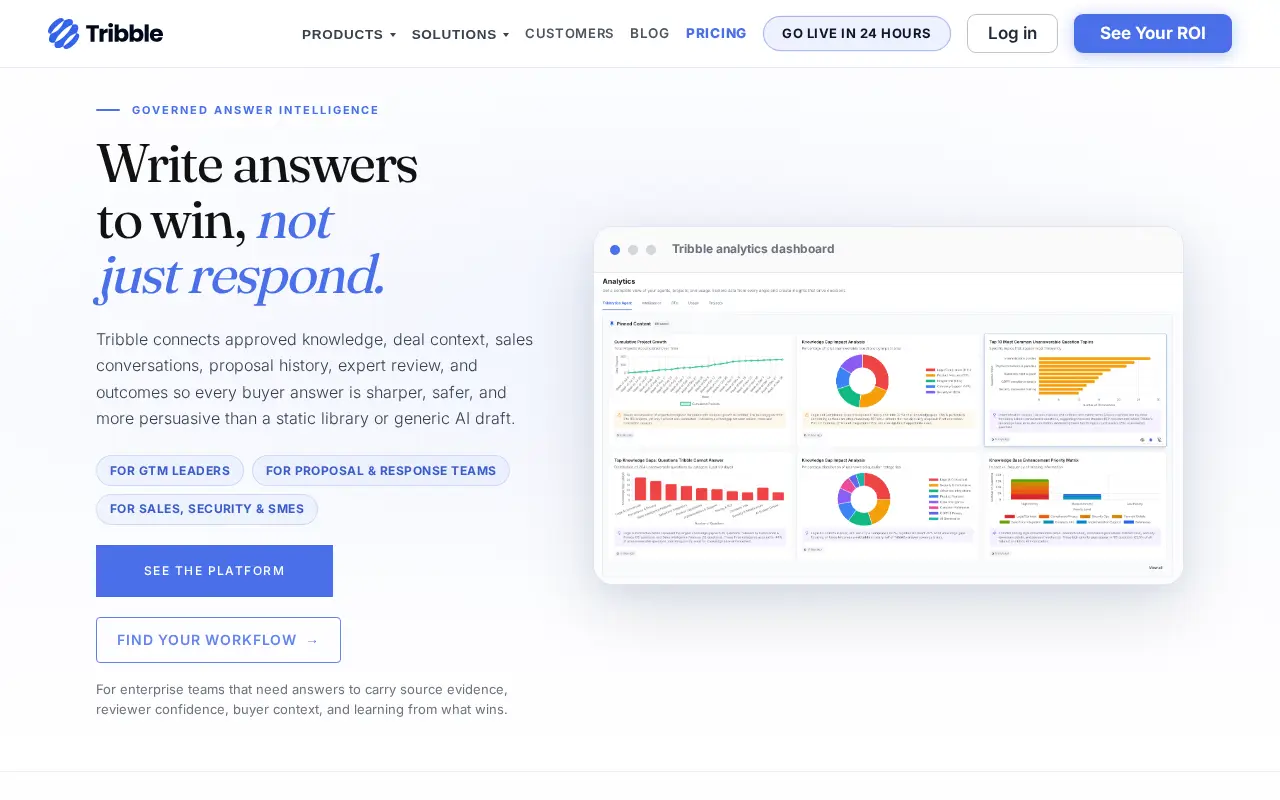
TR Tribble
Security: ISO 27001, SOC 2, and regional hosting
Put Loopio and Tribble through the same three questions a security reviewer will ask: ISO 27001, SOC 2, and whether you can keep the tenancy in the US or the EU. Cells say Not listed when we could not find the claim on a public vendor page.
| Check | Loopio | Tribble |
|---|---|---|
| ISO 27001 | ISO 27001 (legal addendum) loopio.com, 2026-08 Loopio legal addenda cite ISO 27001 and ISO 9001. The public security page describes an ISMS based on ISO 27001 rather than showing a certificate badge. | Not listed |
| SOC 2 | SOC 2 Type II loopio.com, 2026-08 | SOC 2 Type II |
| US hosting | Yes (AWS Northern Virginia; DR in Northern California) slack.com, 2026-08 | Not listed |
| EU hosting | Yes (Loopio EU on AWS Ireland) slack.com, 2026-08 | Not listed |
Slack and Microsoft Teams
During a live questionnaire, SMEs get pinged in Slack or Teams, not in a vendor portal. Here is what Loopio and Tribble publish for those two connections.
| Connection | Loopio | Tribble |
|---|---|---|
| Slack | Slack (NA and EU apps) slack.com, 2026-08 | Slack |
| Microsoft Teams | Microsoft Teams (NA and EU apps) loopio.com, 2026-08 | Microsoft Teams |
Subprocessors: the big three clouds, then the niche names
Compare Loopio and Tribble on AWS, Azure and GCP first. Then scan for niche processors a reviewer should pause on: third-party LLMs, session replay, or support that leaves the region you elected.
| Layer | Loopio | Tribble |
|---|---|---|
| AWS, Azure, GCP | AWS | Not listed |
| Watch-outs |
Loopio does not publish a full named subprocessor table on its public security page. Confirm the current list in the DPA or during security review. | No niche processors flagged in our sourced list. |
Short answer: Pick Loopio if you run a proposal desk with someone who owns content, and you want a tool with twelve years behind it whose AI drafts from an approved library, backed by ISO 27001 and ISO 42001 certification. Pick Tribble if you would rather draft from your current documents and past responses than maintain a Q&A bank, pay per project so every expert can join in for free, and give sales reps the same answers in Slack and on calls. Neither publishes a price, so the billing meter (seats for Loopio, projects and reps for Tribble) is the fastest way to decide.
Loopio was founded in 2014 by Zak Hemraj, Matt York and Jafar Owainati and says more than 1,700 companies use it. Tribble was founded in April 2023 by Sunil Rao, a former Salesforce VP and general manager, joined Salesforce Ventures’ $500 million Generative AI Fund in June 2023, and launched publicly in May 2024. One is the incumbent most enterprise proposal teams already know; the other is a challenger that has built its pitch around replacing it.
That last point is literal. Tribble runs a “Tribble vs Loopio” page on its own site and answers “How is Tribble different from Loopio or Responsive?” in its homepage FAQ. Read that page as a competitor’s argument, not evidence. What follows uses each vendor’s own product and pricing pages plus dated review-site evidence, as of October 2026.
Key takeaways
- Billing meter: Loopio’s Foundations plan includes 10 seats and unlimited projects, and every plan is quoted. Tribble prices Respond per project (each RFP, DDQ or questionnaire) with all contributors included, and Engage per user per month. Neither shows a dollar figure (October 2026).
- Where drafts come from: Loopio’s AI drafts from your library plus connected sources such as SharePoint and websites, with linked citations on every statement. Tribble drafts from its Brain, built from documents, past responses and tools like Gong, and sends questions it cannot support to an expert in Slack.
- Track record: Loopio has 812 G2 reviews and a 4.6 out of 5 rating (July 2026). Tribble shows 4.7 out of 5 from 175 G2 reviews (October 2026), with about two and a half years since launch.
- Certifications: Loopio says it is audited and re-certified to ISO 42001, ISO 27001 and SOC 2 Type II. Tribble states SOC 2 Type II.
- Reach past the RFP desk: Tribble Engage briefs reps before calls, answers during them and drafts follow-ups, with a call recorder included. Loopio reaches people through Slack, Teams, Copilot and Glean but sells no sales-assistant product.
- Limitations: Loopio’s multi-step reviews start on its Enhanced plan, and Capterra reviewers report formatting cleanup on import and export. G2’s May 2026 summary of Tribble reviews flags setup issues, frequent UI changes and occasional inaccuracies.
Library or Brain: the argument these two are having
The gap is narrower than either vendor’s marketing suggests. Both now draft from more than a hand-kept question bank, and both put a source next to every draft. The real difference is when an answer becomes “approved.”
In Loopio, approval happens up front. The library holds answers organized by categories and tags, and automated content reviews send entries back to subject matter experts on a schedule. A Freshness Score shows how recently each entry was touched. Loopio’s content automation page says drafts can also pull from connected sources such as SharePoint, cloud storage and public websites, and it lets you choose how strict to be, from SME-vetted answers only to more tailored generation. Every generated statement carries a linked citation, and a Confidence Pulse indicator flags which answers need work.
In Tribble, approval happens at answer time. There is no separate Q&A bank to build first. You load recent RFPs and current sales and product material, optionally connect Google Drive or SharePoint, and rank sources by authority (Tribble’s setup videos put internal SME answers above partner documents, and both above web content). Each draft cites the document it came from. When nothing supports an answer, Respond marks it as unanswered and routes the question to an expert in Slack; once their reply is reviewed, the Brain keeps it. Every edit is tracked and earlier versions can be restored.
So Loopio asks you to decide what is true before the RFP arrives. Tribble asks you to decide which sources outrank which, then trusts reviewers to catch the rest. Either way, somebody still has to know which SOC 2 report is current.
Who keeps the answers current
This is where the two philosophies cost you different kinds of time.
Loopio’s upkeep is visible and scheduled. Review cycles, owners and freshness scores make it obvious when the library is drifting, and its four permission levels (No Access, Participant, Creator, Full Access) stop a sales rep from quietly rewriting the encryption answer. The cost is the cycle itself. If nobody works the review queue for a quarter, drafts reflect last quarter.
Tribble’s upkeep is less visible and more front-loaded than its “go live in 24 hours” headline implies. Its own setup path has fifteen steps, including tiering content by authority, tagging by region or product line, and mapping projects by hand when an RFP has non-standard columns. A stale folder you forgot to exclude produces a confident, cited, stale answer. G2’s May 2026 review summary credits Tribble’s learning over time for better answers, and in the same breath lists initial setup issues and occasional inaccuracies.
A practical first week for either tool looks the same: decide which folders and entries are authoritative, name an owner for each, and run one real questionnaire you already answered so you can compare output against what you actually sent.
Seats versus projects: pricing and total cost
Neither vendor will tell you a number without a call. What they do publish is how the bill is built, and the two models reward opposite team shapes.
Loopio sells three plans, each quoted:
| Plan | What Loopio lists (October 2026) |
|---|---|
| Foundations | 10 seats, unlimited projects and library entries, generative AI, standard support |
| Enhanced | Adds a multi-language library, confidential projects and multi-step reviews |
| Enterprise | Adds separate business units, sandboxes, a custom seat count and premium support |
Add-ons are project translations in more than a dozen languages, onboarding packages, and industry integrations such as Salesforce and Highspot. The route to a quote is a 15-minute sales call. The pricing page does not say how occasional contributors count against seats, so ask.
Tribble splits the bill across two products on one knowledge base. Respond is priced by the number of projects a year, where each RFP, DDQ or security questionnaire counts as one and “everyone who helps answer it is included.” Engage is priced per user, per month, and includes Scribe for call recording and notes. The Brain comes with both. Single sign-on, user permissions and the tools you connect are listed as factors in the price for both products. Tribble’s stated reason for hiding prices: “Tell us your numbers and we’ll give you a price on the call.”
One wrinkle worth raising in the call: Tribble’s DDQ page describes pricing as “annual platform editions based on response volume, included projects, and included Sales Agent users,” which reads differently from the per-project and per-user framing on the pricing page. Ask which structure your contract will use.
How the meters cut, without inventing prices:
- Three people answering hundreds of security questionnaires a year. Loopio’s unlimited projects mean volume does not move the bill. A per-project meter does.
- A proposal lead pulling in thirty engineers, lawyers and product managers for a few dozen big RFPs. Tribble’s per-project pricing ignores the long tail of contributors. Check how Loopio counts them before you assume ten seats will do.
- A revenue team that also wants reps answering buyer questions in Slack. Only Tribble sells that, and it is a second meter on the invoice.
Beyond the bid: reps, calls and the CRM
If your RFP desk is the only customer, skip this section. If it is not, this is the biggest functional gap in the pair.
Tribble Engage is a sales-assistant product built on the same Brain. It preps reps before a call, answers questions during it, drafts the follow-up and suggests CRM updates afterward, in Slack and Teams. Gong is on the integration list, which lets call recordings feed the knowledge base, and the DDQ page describes a two-way sync with Salesforce and HubSpot. Tribble’s UiPath story says more than 1,300 people there work from one Brain; that is a vendor-reported figure we could not check.
Loopio stays inside the response job but reaches into the tools around it. It lists Slack and Microsoft Teams for deadlines and reusable answers, Microsoft Copilot, Confluence and Glean as AI productivity integrations, Google Drive, SharePoint, OneDrive and Box for attachments, and Salesforce for starting projects from the CRM and reporting pipeline and win rates. Its AI page also advertises building with MCP. What it does not offer is a call recorder or a rep-facing assistant.
That distinction cuts both ways. A proposal team that wants a focused tool will see Engage as a product to ignore. A CRO who wants the RFP answer and the call answer to match will see it as the reason to buy.
Portals, formats and the file you send back
Both handle the common inputs. The differences are in the edges.
Loopio’s SmartScan kicks off a project from a portal, Word, Excel or PDF source, and its AI page promises “minutes, not hours.” A browser extension for Chrome or Edge identifies questions, sections and subsections in a web portal and maps them into a Loopio project in one click, which is the step that usually eats an afternoon. A Proposal Summary pulls key points for a go/no-go call, and Recommended Experts suggests SMEs from past contributions.
Tribble reads XLSX, DOCX, PDF and portal-export formats and says it puts reviewed answers back into Word, Excel, PDF or the buyer’s portal. Its setup notes say multi-sheet Excel workbooks keep their structure on ingestion. Respond includes a go/no-go step, a long-form editor with sources beside the narrative draft, and the right for a named reviewer to reject or replace any answer before it leaves. For DDQs, a consistency check runs across the whole package to catch contradictions “before LPs see them,” and the DDQ page lists ILPA and custom ODD templates among supported formats.
Bring your worst buyer template to both demos. The draft is the easy part. The export is where an evening disappears.
Known issues and limitations
Loopio
- No public price: every plan is a custom quote, with Foundations described as including 10 seats, per its pricing page (checked October 2026).
- Approvals sit one tier up: multi-step reviews, confidential projects and the multi-language library start on Enhanced, and Salesforce and Highspot are paid add-ons, per the same pricing page (checked October 2026).
- Formatting on import and export: several Capterra reviewers describe cleanup after importing PDFs or exporting projects, in reviews dated August 2024 and February 2025 (checked October 2026).
- Upkeep is real work: drafts lean on library content kept fresh by scheduled reviews, per its content automation page (checked October 2026), so a neglected review queue means dated drafts.
Tribble
- No price, no trial on the page: quotes are given on a demo call and the pricing page lists no free plan or trial (checked October 2026).
- Two meters plus price factors: Respond is per project and Engage per user per month, with SSO, permissions and connected tools also moving the quote, per the pricing page; the DDQ page describes “annual platform editions” instead (both checked October 2026).
- Setup and stability complaints: G2’s May 2026 review summary says users “experienced issues with the initial setup, frequent UI changes, and occasional inaccuracies,” and some found response time slower than expected (checked October 2026).
- Short history: Tribble launched publicly in May 2024, so references from teams your size and multi-year renewal stories are thinner than Loopio’s (checked October 2026).
Choose Loopio when
- You have a proposal or bid desk with a named content owner who will actually work the review queue.
- You want answers approved before they are used, with a freshness score telling you what is drifting.
- Your security team asks for ISO 27001 and ISO 42001, not only SOC 2.
- Your volume is high and your core team is small, so unlimited projects on a seat-based plan protects the budget.
- Your company already searches knowledge through Microsoft Copilot or Glean.
- You want a vendor with twelve years of enterprise references and hundreds of reviews to read.
Choose Tribble when
- You would rather rank sources by authority than curate a Q&A bank line by line.
- Your bids pull in many occasional experts, and you want them included without counting seats.
- You answer DDQs for funds and want a compliance owner on each answer and a cross-package contradiction check.
- Sales leadership wants reps getting the same cited answers in Slack, Teams and on calls, and Gong holds a lot of your best answers.
- You can run a sales-led evaluation with one of your own RFPs and tolerate a younger product that changes often.
Verdict
Same job at the core, different bets around it. Loopio bets that a governed library, reviewed on a schedule, is the asset worth paying for, and twelve years of enterprise customers suggest it is a bet many teams are happy with. Tribble bets that the asset is your existing documents plus every reviewed answer, and that the same answer should follow the deal from the RFP to the sales call.
If your bottleneck is producing consistent, approved proposal answers at volume, Loopio is the safer pick. If your bottleneck is getting dozens of experts and reps to give the same sourced answer everywhere, Tribble is built for that, at the cost of a less proven product and a two-meter bill. Or as a colleague would put it: Loopio if you want a well-kept library, Tribble if you want the library to follow you into the sales call.
Read the full Loopio review or Tribble review, or browse all RFP & DDQ software.
Sources checked
- Loopio pricing page (checked October 2026)
- Loopio AI page (checked October 2026)
- Loopio confident answers (content automation) page (checked October 2026)
- Loopio integrations page (checked October 2026)
- Loopio security page (checked October 2026)
- Loopio about page (checked October 2026)
- Loopio blog: portal response (checked October 2026)
- Loopio reviews on Capterra (checked October 2026)
- Loopio reviews on G2 (checked July 2026)
- Tribble pricing page (checked October 2026)
- Tribble homepage (checked October 2026)
- Tribble RFP automation page (checked October 2026)
- Tribble DDQ automation page (checked October 2026)
- Tribble go-live in 24 hours page (checked October 2026)
- Tribble vs Loopio (Tribble's own comparison page) (checked October 2026)
- Tribble about page (checked October 2026)
- Tribble launch press release (GlobeNewswire, May 2024) (checked October 2026)
- G2 AI review summary for Tribble (checked October 2026)
Frequently asked questions
What is the difference between Loopio and Tribble?
Loopio is a library-first response platform founded in 2014: your team curates approved answers, and its AI drafts from that library and connected sources such as SharePoint, with linked citations. Tribble, founded in April 2023, drafts from a knowledge base it calls the Brain, built from your documents and past responses, routes questions it cannot support to an expert in Slack, and sells a second product (Engage) that gives sales reps the same answers in Slack, Teams and on calls.
Which is cheaper, Loopio or Tribble?
Neither publishes a price as of October 2026. The meters differ: Loopio sells plans by seat (its Foundations tier includes 10 seats) with unlimited projects, while Tribble prices Respond per project with every contributor included and Engage per user per month. High volume with a small team favors seats; a long tail of occasional experts favors per-project pricing.
Which is better for DDQs and security questionnaires, Loopio or Tribble?
Both answer RFPs, DDQs and security questionnaires from the same content. Tribble documents a DDQ workflow for asset managers that drafts from fund documents and ADV filings and checks the full package for contradictions before export. Loopio offers multi-step reviews on its Enhanced plan and a browser extension that maps portal questions into a project in one click.
Do Loopio and Tribble integrate with Salesforce, Slack and Gong?
Both work with Salesforce, Slack and Microsoft Teams, though Loopio sells Salesforce and Highspot as paid add-ons. Tribble lists Gong for bringing call recordings into its knowledge base and describes a two-way CRM sync with Salesforce and HubSpot. Loopio lists Microsoft Copilot, Confluence and Glean; Gong does not appear on its integrations page.
How long does it take to switch from Loopio to Tribble?
Tribble says a first RFP can be live in 24 hours and that an existing Loopio library can be carried over as migration context. That is the vendor's figure. G2's May 2026 review summary lists initial setup issues among Tribble's complaints, so budget a few weeks of corrections before you trust its confidence levels.
Should I choose Loopio or Tribble?
Choose Loopio if you run a proposal desk with a named content owner and want a long-established, library-governed tool with ISO 27001 and ISO 42001 behind it. Choose Tribble if you want one answer base serving proposals, fund DDQs and the sales floor, billed per project so every expert can join in.
Do Loopio and Tribble list ISO 27001, SOC 2, and US or EU hosting?
Loopio: ISO 27001 ISO 27001 (legal addendum), SOC 2 SOC 2 Type II, US Yes (AWS Northern Virginia; DR in Northern California), EU Yes (Loopio EU on AWS Ireland), Slack Slack (NA and EU apps), Teams Microsoft Teams (NA and EU apps), clouds AWS. Tribble: ISO 27001 Not listed, SOC 2 SOC 2 Type II, US Not listed, EU Not listed, Slack Slack, Teams Microsoft Teams, clouds Not listed. Confirm both on the vendor sites.
Source registry
Every page we read for these profiles, with the month it was last checked. Anything without a source is shown as not publicly disclosed. Spot an outdated fact? Send it from the corrections page.
Loopio
Pricing
Security and compliance
Product and integrations
Tribble
Pricing
Security and compliance
- No security source URL recorded. Treat certifications and hosting as not publicly disclosed.
Product and integrations
Third-party reviews