Quick verdict
Choose Conveyor for security and sales teams handling a steady flow of customer security reviews who want questionnaires and a trust center in one place; choose Loopio for large enterprise teams with high response volume and a mature content library. Neither publishes a comparable starting price, so quote both on the same scope. In our capability model Conveyor leads on AI drafting, source attribution and self-serve setup, while Loopio leads on RFPs, DDQs and approval workflows.
Both profiles reviewed Jul 2026
2 of 70 profiles, one scoring modelNo paid placementSources checked: 21Choose Conveyor or Loopio
CO Choose Conveyor when
- Security and sales teams handling a steady flow of customer security reviews who want questionnaires and a trust center in one place.
- You need stronger AI drafting, source attribution and self-serve setup than Loopio offers.
- You want a free tier before you commit.
LO Choose Loopio when
- Large enterprise teams with high response volume and a mature content library.
- You need stronger RFPs, DDQs and approval workflows than Conveyor offers.
Side-by-side comparison
| Capability | Conveyor | Loopio | Edge |
|---|---|---|---|
| Best for | Security and sales teams handling a steady flow of customer security reviews who want questionnaires and a trust center in one place. | Large enterprise teams with high response volume and a mature content library. | - |
| Starting price | Custom | Custom (~$20K+/yr est.) | Match |
| Free tier | Yes | No | Conveyor |
| RFPs | 2/3 | 3/3 | Loopio |
| DDQs | 1/3 | 3/3 | Loopio |
| Security questionnaires | 3/3 | 3/3 | Match |
| AI drafting | 3/3 | 2/3 | Conveyor |
| Answer library | 3/3 | 3/3 | Match |
| Source attribution | 3/3 | 2/3 | Conveyor |
| Workflow & approvals | 2/3 | 3/3 | Loopio |
| Integrations | 3/3 | 3/3 | Match |
| Self-serve onboarding | 2/3 | 0/3 | Conveyor |
| ISO 27001 | Not listed | ISO 27001 (legal addendum) | - |
| SOC 2 | SOC 2 Type II | SOC 2 Type II | - |
| US hosting | Yes (United States) | Yes (AWS Northern Virginia; DR in Northern California) | - |
| EU hosting | Not listed | Yes (Loopio EU on AWS Ireland) | - |
| Slack | Slack (notifications, self-serve answers, questionnaire intake) | Slack (NA and EU apps) | - |
| Microsoft Teams | Microsoft Teams (notifications) | Microsoft Teams (NA and EU apps) | - |
| AWS, Azure, GCP | AWS, GCP | AWS | - |
| Listed integrations | Salesforce, HubSpot, Slack, Microsoft Teams, Jira, Zendesk, DocuSign, Google Drive, SharePoint, Confluence, Notion | Salesforce, Slack, Microsoft Teams, Seismic, SharePoint | - |
| Certifications | SOC 2 Type II | SOC 2 Type II, ISO 27001 | - |
What they look like
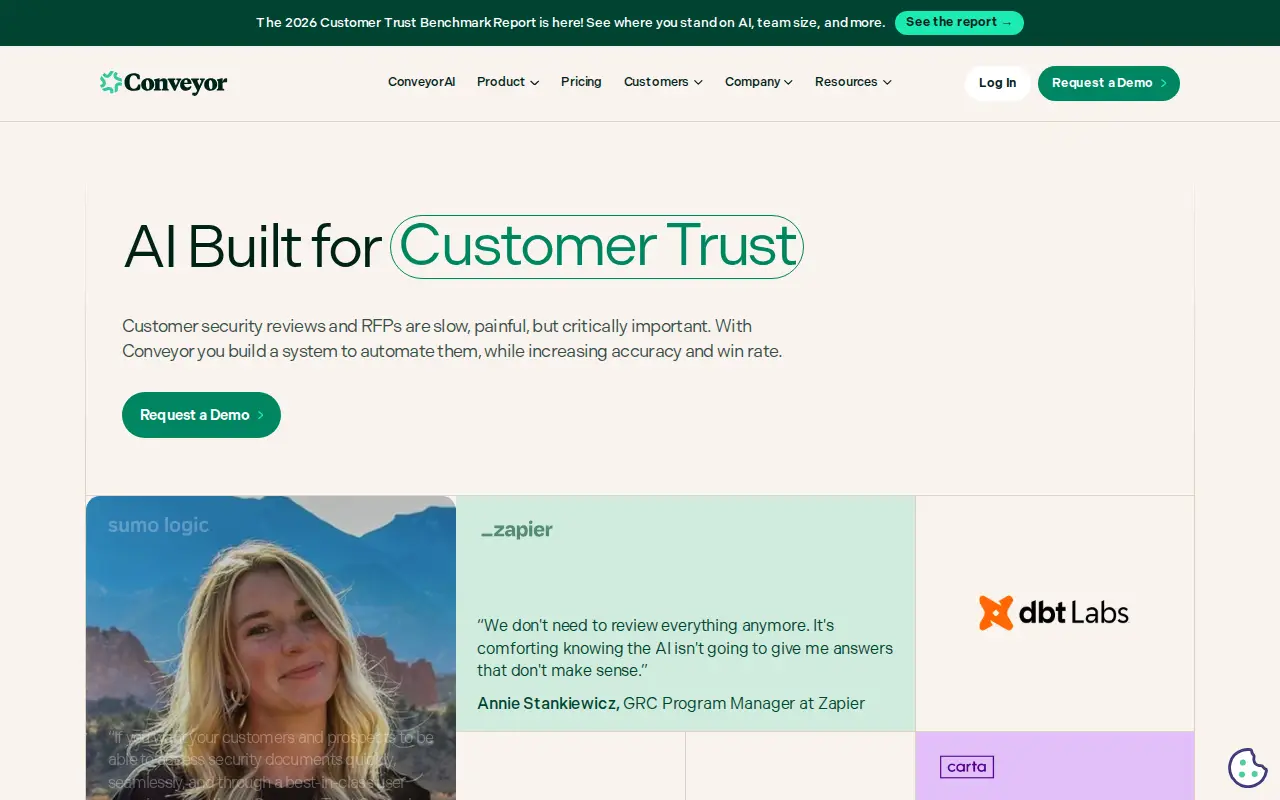
CO Conveyor
LO Loopio

Security: ISO 27001, SOC 2, and regional hosting
Put Conveyor and Loopio through the same three questions a security reviewer will ask: ISO 27001, SOC 2, and whether you can keep the tenancy in the US or the EU. Cells say Not listed when we could not find the claim on a public vendor page.
| Check | Conveyor | Loopio |
|---|---|---|
| ISO 27001 | Not listed | ISO 27001 (legal addendum) loopio.com, 2026-08 Loopio legal addenda cite ISO 27001 and ISO 9001. The public security page describes an ISMS based on ISO 27001 rather than showing a certificate badge. |
| SOC 2 | SOC 2 Type II trust.conveyor.com, 2026-10 Annual SOC 2 Type II audits covering Security, Availability and Confidentiality, per trust center announcements. | SOC 2 Type II loopio.com, 2026-08 |
| US hosting | Yes (United States) trust.conveyor.com, 2026-10 | Yes (AWS Northern Virginia; DR in Northern California) slack.com, 2026-08 |
| EU hosting | Not listed | Yes (Loopio EU on AWS Ireland) slack.com, 2026-08 |
Slack and Microsoft Teams
During a live questionnaire, SMEs get pinged in Slack or Teams, not in a vendor portal. Here is what Conveyor and Loopio publish for those two connections.
| Connection | Conveyor | Loopio |
|---|---|---|
| Slack | Slack (notifications, self-serve answers, questionnaire intake) docs.conveyor.com, 2026-10 | Slack (NA and EU apps) slack.com, 2026-08 |
| Microsoft Teams | Microsoft Teams (notifications) docs.conveyor.com, 2026-10 | Microsoft Teams (NA and EU apps) loopio.com, 2026-08 |
Subprocessors: the big three clouds, then the niche names
Compare Conveyor and Loopio on AWS, Azure and GCP first. Then scan for niche processors a reviewer should pause on: third-party LLMs, session replay, or support that leaves the region you elected.
| Layer | Conveyor | Loopio |
|---|---|---|
| AWS, Azure, GCP | AWS, GCP | AWS |
| Watch-outs |
The public trust center lists 27 subprocessors with processing locations (last updated July 14, 2026). |
Loopio does not publish a full named subprocessor table on its public security page. Confirm the current list in the DPA or during security review. |
Short answer: Pick Conveyor if the work in front of you is customer security reviews: cited questionnaire drafts, a trust center buyers can open themselves, and Enterprise pricing that adds subject matter experts without a per-user fee. Pick Loopio if you already keep a curated answer library and the calendar is RFPs, DDQs and security questionnaires together, and you want unlimited projects, multi-step reviews, and the review record of a platform founded in 2014. Conveyor publishes no headquarters. Loopio is based in Toronto, and Loopio says more than 1,700 companies use it.
Both products will draft an answer from material your team already keeps. They are built for different owners. Conveyor is aimed at InfoSec and presales teams at B2B software companies. Loopio is aimed at teams in SaaS, tech, financial services and healthcare that answer a high volume of RFPs, RFIs, DDQs and security questionnaires from one library. If your security engineer and your proposal manager are the same person, read the workflow section before you book two demos.
Everything below comes from each vendor’s pricing, product, docs and trust pages, checked in October 2026 unless a review-site figure is stamped earlier. Marketing speed claims are left out.
Key takeaways
- Two jobs, one overlap: Conveyor’s core product imports spreadsheets, Word files, PDFs and portal questionnaires, drafts cited answers, and exports in the original format. Loopio’s core product is a tagged, versioned answer library with review cycles, and it also covers security questionnaires.
- Trust center versus library governance: Conveyor runs questionnaires and a trust center on one knowledge library, with NDA-gated documents and a buyer-facing AI agent. Loopio’s published strengths are tagging, versioning and review cycles that large teams use every day, plus unlimited projects and library entries on every plan, including Foundations.
- How you get billed: Conveyor’s Free plan is a trust center (10 Trust Center credits a month, up to 15 documents and 15 knowledge-base Q&As). Enterprise is a custom quote, “as many users and seats as needed,” pay for what you use. Loopio publishes no prices. Foundations includes 10 seats. Multi-step reviews start on Enhanced.
- Evidence on the review sites: Conveyor holds 4.6 out of 5 on G2 from 150 reviews. Loopio holds 4.6 out of 5 on G2 from 812 reviews, 4.3 out of 5 on Gartner from 16 reviews, and 4.6 out of 5 on Capterra from 74 reviews (all as of July 2026). The scores match. The sample sizes do not.
- Where the file lives: Conveyor’s subprocessor notice says customer content is stored in the United States. Loopio runs separate North America and EU environments on AWS (Northern Virginia, with disaster recovery in Northern California, and EU on AWS Ireland).
- Limitations: Conveyor’s Free plan has no questionnaire automation and no integrations. Loopio sells Salesforce, Highspot, onboarding packages and project translations as add-ons, and Capterra reviewers report formatting cleanup after import or export (reviews dated August 2024 and February 2025).
A security review and a full response desk
Conveyor started in 2021, spun out of Aptible. Its about page records a Seed round at the spin-out, a $12.5M Series A in 2023, and a $20M Series B in 2025. Named customers on its own pages include Zapier, Zendesk, Sumo Logic, Carta, Alteryx, Hootsuite, Sprout Social, dbt Labs and Lucid. The product page for security questionnaires is the center of the pitch: an agent can take a request from Slack, a CRM or a ticketing tool and return a completed questionnaire. An AI Librarian flags outdated content in a knowledge library of curated Q&As, with verification status, curators, tags and product lines, plus synced drives, wikis and past questionnaires.
Loopio was founded in 2014. The customers named on its profile include Barclays, Siemens, Goldman Sachs, Cisco, DocuSign and Kroger. That list is a hint about the buying committee: proposal operations inside large companies, including financial services and healthcare, where a DDQ and a security questionnaire often arrive on the same deal. Loopio’s own FAQ says it handles RFPs, DDQs and security questionnaires from a single content library. Key features on the record are an answer library with tagging, versioning and review workflows, auto-answers for web-based portals, content connectors, AI suggestions drawn from stored answers, and analytics on response progress and content health.
Conveyor also sells an AI RFP module for RFPs, RFIs and RFQs, with RFP projects, document automapping, Word editing, rules-based SME assignment and export templates. It does not market a dedicated DDQ or investor due-diligence workflow. If private-capital DDQs are a large share of your year, that gap belongs in the demo script. Loopio’s categories in this directory include DDQ alongside RFP response and security questionnaires, and its best-fit line is large enterprise teams with high response volume and a mature content library.
What the draft is allowed to read
Conveyor’s security-questionnaire page says every response is cited back to source documents, and confidence scoring flags which answers need a human review. That pairing is the practical reason a security reviewer can work the exceptions first. The knowledge library can include curated Q&As and past questionnaires, and completed SIG, HECVAT and CAIQ files in their original layouts can be used as answer sources. Automatic parsing expects the original Shared Assessments, EDUCAUSE or Cloud Security Alliance layout. A rearranged spreadsheet may not parse the way the docs describe.
Loopio draws AI suggestions from stored answers. The library is the system of record: tagging, versioning and review cycles are the mechanism, and a person still owns what is approved. Generative drafting that can only see the library is a good fit when that library is already clean, and a poor fit when the latest SOC 2 report lives in a shared drive nobody has filed. Conveyor is explicit that synced drives and wikis sit in the same pool as curated Q&As. Loopio’s record says content connectors reach existing sources, and the integration list names Seismic and SharePoint among others. Ask each vendor, on your own files, which connected document an answer is allowed to cite.
Neither company publishes an independent accuracy benchmark in the records used here. The useful test is the one you can run in an afternoon: take last quarter’s SIG, a portal questionnaire, and a messy custom spreadsheet. Count citations you can open, answers a reviewer has to rewrite, and questions handed to a person.
The file you send back
Conveyor’s docs say incoming questionnaires can be spreadsheets, Word files, PDFs or customer portals, and exports go back in the original format. A browser extension completes questionnaires inside portals. The importing docs name portals such as OneTrust and Whistic. For teams whose buyers live in those portals, that is the feature to watch in the trial, because retyping a portal form is where security reviews actually burn the evening.
Loopio’s key features say it auto-answers web-based portals. The recurring public note on the way out of the tool is about formatting. The sourced record, checked October 2026, says Capterra reviewers report formatting cleanup after exporting or importing projects, in reviews dated August 2024 and February 2025, repeating a complaint that also shows up in older reviews. Bring the workbook with merged cells and the PDF that is really a scan. Watch the export, not the first draft.
Conveyor’s RFP module adds Word editing and export templates. That is a real adjacent product, and it is still a thinner RFP desk than a platform whose whole design is proposal projects. Loopio’s pricing page is where workflow depth shows up in the packaging: unlimited projects and unlimited library entries on every plan, including Foundations, with multi-step reviews, confidential projects and the multi-language library starting on Enhanced.
Who keeps the content current
Conveyor gives the questionnaire an assignee, collaborators and routing groups, auto-tagged reviewers, and an audit trail of who reviewed each answer. The record does not describe a multi-stage approval chain. An agent can pick up questionnaire requests from Slack or Salesforce. Slack is documented for notifications, self-serve answers and questionnaire intake. Microsoft Teams is documented for notifications. If your approval path is “security, then legal, then the product owner, in that order,” ask Conveyor to show that sequence. The published workflow is assignment and an audit trail.
Loopio’s strength on this point is the one to concede plainly. The library tools are mature: tagging, versioning and review cycles, and multi-step reviews once you are on Enhanced. Separate business-unit needs show up in how enterprise teams actually buy Loopio, and the best-fit line on the record is large teams with a mature library. Foundations, the entry plan, does not include multi-step reviews. If that control is why you are here, price Enhanced from the first conversation.
The labor trade is easy to misread. Conveyor’s AI Librarian flags outdated content, which is help, and someone still has to retire the stale answer. Loopio’s review cycles assume a content owner. A neglected SIG answer produces a neglected draft in either product.
Pricing and what the quote hides
Prices and packaging as published, checked October 2026:
| Conveyor | Loopio | |
|---|---|---|
| Free or entry | Free trust center: 10 credits a month, up to 15 documents and 15 knowledge-base Q&As, Conveyor-branded NDA and watermark | Foundations, price on request, 10 seats included |
| Paid plan | Enterprise, custom, usage-based with volume discounts | Enhanced, price on request; Enterprise with a custom seat count |
| Users | “As many users and seats as needed” on Enterprise. Pricing FAQ: “No per-user fees. No charges for integrations.” | Seat-based. Foundations includes 10 seats |
| Questionnaire automation | Not on Free. On Enterprise, tracked as Questionnaire credits | Generative AI is part of the platform conversation; no public price |
| Projects | Usage credits, no published per-questionnaire rate | Unlimited projects and library entries on every plan |
| Add-ons called out | Integrations included on Enterprise | Salesforce, Highspot, onboarding packages, project translations |
| Trial | Free trial of the AI | No free tier on the record |
Conveyor’s Free plan is a real object you can start, and it will disappoint anyone who thought “free” meant the questionnaire product. The pricing page says no access to questionnaire automation and no integrations. The NDA is Conveyor-branded and documents are watermarked. That can still be the right first month if the immediate pain is “buyers keep emailing us for the SOC 2 PDF.”
Loopio’s route to a number is a sales conversation. Foundations is the entry package and it includes 10 seats. Unlimited projects matter if you answer a lot of bids with a small named team. Conveyor’s unlimited users matter if the security review pulls in legal, product, privacy and an engineer who should not need a licence. Those are different budgets. A team with 8 contributors and 80 bids a year is having a different conversation from a team with 40 contributors and 15 security reviews a month.
Model the Conveyor quote in credits, not seats. Enterprise consumption is tracked as Trust Center credits and Questionnaire credits, with volume discounts, and no per-questionnaire rate is on the page. Ask for the credit definition in writing: what counts as one questionnaire, what a portal completion costs, and what happens if a buyer sends a revision.
Integrations, hosting and subprocessors
Conveyor’s integrations page lists Salesforce, HubSpot, Slack, Microsoft Teams, Jira, Zendesk, DocuSign, Ironclad, Google Drive, SharePoint, Notion, Confluence and Front, plus an MCP server for ChatGPT, Claude and Gemini, a public API and webhooks. The pricing page says there are no charges for integrations. That is a genuine strength next to Loopio, where Salesforce, Highspot and other industry integrations are sold as add-ons.
Loopio’s integration list on the record is Salesforce, Slack, Microsoft Teams, Seismic and SharePoint. Seismic is the name Conveyor does not list. Glean is not on Conveyor’s list either. If your knowledge already lives in Seismic, put that on the Loopio demo. If the security review starts in Salesforce and should come back as a completed spreadsheet without a connector fee, put that on the Conveyor quote.
Certifications diverge in a way your security reviewer will notice. Conveyor holds SOC 2 Type II. Trust center announcements describe annual audits covering Security, Availability and Confidentiality. The record does not list ISO 27001 for Conveyor. Loopio holds SOC 2 Type II, and its legal addenda cite ISO 27001 and ISO 9001. The public security page describes an information security management system based on ISO 27001. It does not show a certificate badge on that page, so ask to see the certificate if ISO is a gate.
Hosting is the sharper split. Conveyor’s subprocessor notice says customer content is stored in the United States. LLM inference may be routed through providers’ global networks, without storage at rest outside the US. No EU region is named. Loopio runs on AWS with separate North America and EU environments (company.loopio.com and company.eu.loopio.com). City-level regions published on Loopio’s Slack marketplace security answers are Northern Virginia for North America, disaster recovery in Northern California, and Ireland for Loopio EU. Slack and Microsoft Teams each have North America and EU apps.
Loopio does not publish a full named subprocessor table on its public security page. The record names Amazon Web Services for primary and disaster-recovery hosting, and Rackspace for encrypted production database backups of the North America environment. That Rackspace copy is a US-only backup sitting outside AWS. Confirm whether it is in scope for an EU tenancy before you promise a European buyer that the EU environment is the whole story.
Conveyor’s public trust center lists 27 subprocessors with processing locations, last updated July 14, 2026. Clouds named are AWS and GCP. Aptible is listed for cloud infrastructure, which fits the company history. Pinecone is the vector database for knowledge base and questionnaire content. OpenAI and Anthropic are the LLM providers, and the pricing FAQ says zero data retention agreements. LangChain is listed for debugging, testing and monitoring ConveyorAI performance. The vendor record flags that one on purpose: it is an LLM observability tool, so ask which questionnaire content reaches it and how long it is kept.
Known issues and limitations
Conveyor
- Free plan stops at the trust center: 10 Trust Center credits a month, up to 15 documents and 15 knowledge-base Q&As, a Conveyor-branded clickwrap NDA and watermarking, and no questionnaire automation or integrations, per the pricing page (checked October 2026).
- No published credit rate: Enterprise is quoted by sales and billed on usage (“Pay for what you use, with volume discounts”), tracked as Trust Center and Questionnaire credits, per the same pricing page (checked October 2026).
- United States storage: the subprocessor notice says customer content is stored in the United States, with LLM inference possibly routed through providers’ global networks, per trust.conveyor.com (checked October 2026). Teams that need an EU region should ask. None is named.
- Standard-layout parsing: automatic use of SIG, HECVAT and CAIQ files as AI sources expects the original Shared Assessments, EDUCAUSE or Cloud Security Alliance layout, per Conveyor docs (checked October 2026).
- Shorter public review record: 150 G2 reviews as of July 2026, against 812 for Loopio. The score is 4.6 either way. The evidence base is smaller, from a company that started in 2021.
Loopio
- No public price: every plan says “Let’s Talk,” and Foundations includes 10 seats, with a custom seat count only named on Enterprise, per the pricing page (checked October 2026).
- Tier-gated workflow and paid connectors: multi-step reviews, confidential projects and the multi-language library start on Enhanced. Salesforce, Highspot, onboarding packages and project translations are add-ons, per the same pricing page (checked October 2026).
- Export and import cleanup: Capterra reviewers report formatting cleanup after exporting or importing projects, in reviews dated August 2024 and February 2025 (checked October 2026).
- Drafts follow what the library holds: AI suggestions are drawn from stored answers, per the vendor record. A library nobody maintains produces drafts nobody should send.
- Subprocessor list is thin in public: the security page does not publish a full named subprocessor table. Confirm the current list in the DPA, including the Rackspace backup path for North America, per Loopio’s security page and the Slack marketplace listing (checked August 2026).
Choose Conveyor when
- The team answering is InfoSec and presales, and most of the inbound work is a security questionnaire, a SIG, a CAIQ, a HECVAT, or a portal form.
- You want buyers to pull the SOC 2 report and the pen-test letter from a trust center, including on the free plan, while you decide whether questionnaire automation is worth the Enterprise quote.
- Experts across legal, product and engineering need to be in the tool, and you do not want a seat negotiation for each of them.
- You want every drafted answer tied to a source document, with a confidence score marking what a person should read.
- Salesforce, Slack and a browser extension for OneTrust or Whistic are part of the current path, and you want those connectors included.
- United States storage is acceptable for customer questionnaire content.
Choose Loopio when
- You already run a large answer library, someone owns it, and the work is RFPs and DDQs as well as security questionnaires.
- You need unlimited projects, and the contributor list is small enough that a 10-seat Foundations conversation is the right shape.
- Multi-step review, confidential projects, or a multi-language library are requirements, and you are willing to buy Enhanced to get them.
- Buyers or your own security team expect an EU environment, and you can confirm the residency story including backups.
- You want the longer track record: founded in 2014, more than 1,700 companies by Loopio’s own count, and 812 G2 reviews as of July 2026.
- Seismic or a similar sales-enablement library is already where approved answers live.
Verdict
These tools meet on security questionnaires and then head in different directions. Conveyor is the stronger fit when the product you actually need is a trust center plus cited questionnaire completion, billed by usage, with a free trust center you can stand up before the Enterprise conversation. Loopio is the stronger fit when the product you need is a governed response library for the whole questionnaire year, with mature review controls, unlimited projects, and a much larger public review sample.
Loopio’s genuine strengths are that library, the unlimited-project packaging, and the years of enterprise use behind customers such as Barclays, Siemens and Goldman Sachs. Conveyor’s genuine strengths are source citations with confidence scores, one knowledge library shared by the trust center and the questionnaire, and unlimited users without per-user fees. If both jobs are real, some teams keep a response library for RFPs and a trust center for security reviews. Run the same SIG through both trials and read the export before you sign.
Read the full Conveyor review or Loopio review, or browse all RFP & DDQ software.
Sources checked
- Conveyor pricing page (checked October 2026)
- Conveyor about page (checked October 2026)
- Conveyor security questionnaire automation (checked October 2026)
- Conveyor AI RFP product page (checked October 2026)
- Conveyor integrations page (checked October 2026)
- Conveyor customers page (checked October 2026)
- Conveyor trust center (checked October 2026)
- Conveyor docs: importing questionnaires (checked October 2026)
- Conveyor docs: SIG, HECVAT and CAIQ (checked October 2026)
- Conveyor docs: integrations overview (checked October 2026)
- Conveyor reviews on G2 (checked July 2026)
- Loopio pricing page (checked October 2026)
- Loopio security page (checked August 2026)
- Loopio information security addendum (checked August 2026)
- Loopio app on Slack Marketplace (checked August 2026)
- Loopio EU app on Slack Marketplace (checked August 2026)
- Loopio Microsoft Teams help article (checked August 2026)
- Loopio reviews on G2 (checked July 2026)
- Loopio reviews on Gartner (checked July 2026)
- Loopio reviews on Capterra (checked October 2026)
Frequently asked questions
What is the difference between Conveyor and Loopio?
Conveyor, started in 2021, answers customer security questionnaires with cited, confidence-scored drafts and runs a trust center on the same knowledge library. Loopio, founded in 2014 in Toronto, is an RFP response platform built around a tagged, versioned answer library, and Loopio says more than 1,700 companies use it.
Which is cheaper, Conveyor or Loopio?
Neither publishes an Enterprise dollar price. Conveyor has a free trust-center plan (10 credits a month, up to 15 documents) and bills Enterprise on usage with unlimited users. Loopio's entry Foundations plan includes 10 seats, every plan is a custom quote, and Salesforce and Highspot are add-ons.
Which handles security questionnaires, SIG files and portals?
Conveyor's docs say it auto-detects completed SIG Lite or Core, HECVAT v3 and v4, and CAIQ v3, v4 and AI-CAIQ v1 files, and a browser extension works inside portals such as OneTrust and Whistic. Loopio handles RFPs, DDQs and security questionnaires from one library and auto-answers web-based portals.
Do Conveyor and Loopio integrate with Slack, Teams and Salesforce?
Both list Slack and Microsoft Teams. Conveyor also lists Salesforce, HubSpot, Jira, Zendesk, DocuSign, Google Drive, SharePoint, Confluence and Notion, and says integrations are included with no per-user fees. Loopio lists Salesforce, Slack, Teams, Seismic and SharePoint, and sells Salesforce and Highspot as add-ons.
Is there a free plan or trial?
Conveyor's Free plan is a trust center only: no questionnaire automation and no integrations. Conveyor also offers a free trial of the AI. Loopio's pricing page sends buyers to a sales conversation, and the vendor record lists no free tier.
Should I choose Conveyor or Loopio?
Choose Conveyor if the workload is customer security reviews and you want a trust center plus cited drafts, with experts added without extra seats. Choose Loopio if you already run a curated library across RFPs, DDQs and security questionnaires and you want unlimited projects, multi-step reviews on Enhanced, and a longer enterprise track record.
Do Conveyor and Loopio list ISO 27001, SOC 2, and US or EU hosting?
Conveyor: ISO 27001 Not listed, SOC 2 SOC 2 Type II, US Yes (United States), EU Not listed, Slack Slack (notifications, self-serve answers, questionnaire intake), Teams Microsoft Teams (notifications), clouds AWS, GCP. Loopio: ISO 27001 ISO 27001 (legal addendum), SOC 2 SOC 2 Type II, US Yes (AWS Northern Virginia; DR in Northern California), EU Yes (Loopio EU on AWS Ireland), Slack Slack (NA and EU apps), Teams Microsoft Teams (NA and EU apps), clouds AWS. Confirm both on the vendor sites.
Source registry
Every page we read for these profiles, with the month it was last checked. Anything without a source is shown as not publicly disclosed. Spot an outdated fact? Send it from the corrections page.
Conveyor
Pricing
Security and compliance
Product and integrations
- conveyor.com/products/ai-rfp-software-conveyor
- docs.conveyor.com/docs/importing-questionnaires
- conveyor.com/products/security-questionnaire-automation
- docs.conveyor.com/llms.txt
- conveyor.com/integrations
- docs.conveyor.com/docs/integrations-overview
- conveyor.com/conveyor-customers
- conveyor.com/company/about
- docs.conveyor.com/docs/sig-hecvat-caiq
Third-party reviews
Loopio
Pricing
Security and compliance
Product and integrations