Conveyor review: pricing, features and alternatives (2026)
Quick answer
Conveyor is AI-native security questionnaire and RFP software for security and sales teams handling a steady flow of customer security reviews who want questionnaires and a trust center in one place. Conveyor does not publish a price, so buying is quote-only. Check before buying: Enterprise is billed on usage credits with no published rate, so model your annual questionnaire volume before the call.
AI security questionnaires plus an agentic trust center
- Overall score: 4.6/5 across 9 capability dimensions.
- Best for: Security and sales teams handling a steady flow of customer security reviews who want questionnaires and a trust center in one place.
- Pricing: Custom on a usage-based basis with a free tier.
- Standout strength: Every drafted answer cites its source document, and confidence scores point reviewers at the exceptions.
- Ecosystem: 11 integrations; SOC 2 Type II.
- Limitations: The Free plan is a trust center only: questionnaire automation and integrations need an Enterprise quote.
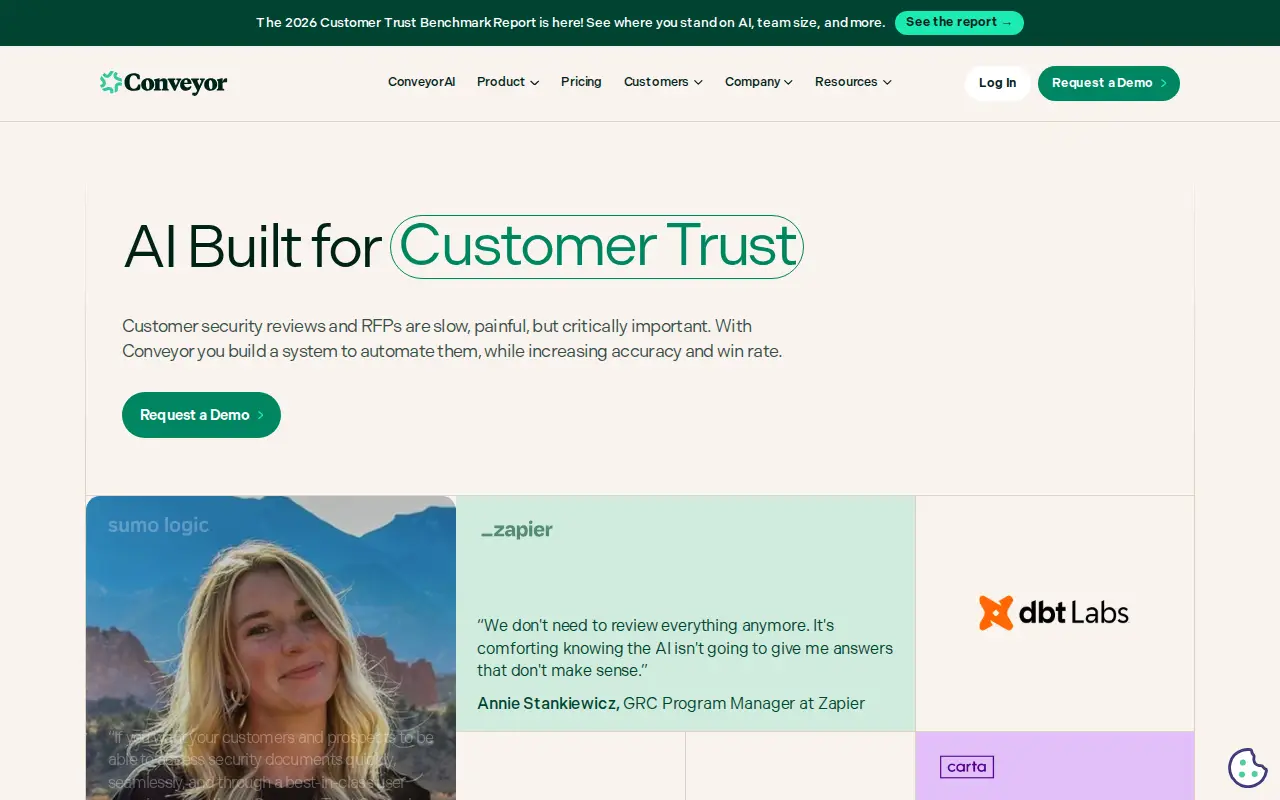
Conveyor is a security-review tool first and an RFP tool second, and that order is the right way to evaluate it. If your week is shaped by customer security questionnaires arriving through sales, it is one of the most complete answers in the category: AI drafts with citations, a trust center that heads off some reviews entirely, and a portal extension for the questionnaires that never arrive as a file. If your week is shaped by long commercial RFPs, it can do that job too, but that is the newer half of the product.
What it actually does
The workflow starts with a knowledge library. You sync drives and wikis, upload past questionnaires, and curate Q&A pairs with a verification status and an owner. Conveyor’s docs also describe a neat shortcut: upload a completed SIG (Lite or Core), HECVAT (v3 or v4) or CAIQ (v3, v4 or the AI-CAIQ) and it parses the questions and answers into sources automatically. The catch is in the small print: it expects the original Shared Assessments, EDUCAUSE or Cloud Security Alliance layout. If your team has been “improving” those templates for years, budget time to tidy them first.
When a questionnaire comes in, it can be a spreadsheet, a Word file, a PDF, or a link to a buyer portal. The browser extension handles portals such as OneTrust and Whistic, which matters more than any demo will admit, because portal questionnaires are where copy-paste hours go to die. ConveyorAI drafts every answer, cites the document it used, and scores its own confidence so the reviewer starts with the shaky ones. Finished files export in the buyer’s original format.
The trust center is the other half. Buyers get a self-serve page with NDA-gated documents, access rules tied to your CRM, and an AI agent that answers questions from the same library. That shared library is the real design win: the answer a buyer reads in your trust center and the answer your team pastes into a spreadsheet come from one place, so they stop drifting apart.
Pricing, read carefully
The pricing page has two plans. Free is a trust center only: 10 Trust Center credits a month, up to 15 documents and 15 Q&As, Conveyor branding on the NDA and watermark, and, in the page’s own words, no access to questionnaire automation or integrations. Enterprise is a custom quote, billed on usage with volume discounts, and includes unlimited users and seats, integrations, analytics and a dedicated support contact.
No per-seat pricing is good news for security reviews, which always need a few subject matter experts who touch the tool twice a quarter. The flip side is that you will not find a per-questionnaire rate anywhere, and usage is tracked as credits. Go into the sales call knowing how many questionnaires and trust center requests you handled last year, or you will be negotiating blind.
Security posture
Conveyor’s own trust center shows a SOC 2 Type II badge, with announcements describing audits that cover Security, Availability and Confidentiality. It does not show an ISO 27001 certificate for Conveyor itself. The subprocessor list is public, which I appreciate: 27 entries with locations, including OpenAI, Anthropic and Google as LLM providers, Pinecone for vector search, and LangChain for monitoring AI performance. The pricing FAQ says Conveyor has zero data retention agreements with OpenAI and Anthropic. Customer content is stored in the United States per the subprocessor notice, so an EU team with residency requirements should raise that early.
How to test it
Ask for the free trial rather than a guided demo. Conveyor’s own evaluation pitch is to send them past questionnaires and security documents so they can build a test knowledge base, and that is a fair way to start, as long as you then run the test yourself:
- Feed it one questionnaire your team already answered and compare the drafts line by line.
- Add a stale policy next to the current one and see which version it cites.
- Run one portal questionnaire through the browser extension, start to finish.
- Check how low-confidence answers get routed, and who sees them in Slack or Teams.
- Export the file and open it the way your buyer will.
If the cited sources hold up on your hardest twenty questions, the rest of the pitch usually follows.
Verdict
Conveyor earns its place on any security questionnaire shortlist. The citations and confidence scores make review faster without asking you to trust the AI blindly, and the trust center plus portal extension cover the parts of a security review that most responders ignore. The trade-offs are a quote-only, usage-based Enterprise plan and a free tier that does not include the questionnaire product at all.
Who I’d hand it to: a B2B software company where security reviews block deals every month, sales wants answers without waiting on the security team, and a trust center is on the roadmap anyway.
Who I’d steer elsewhere: a team whose volume is mostly long narrative RFPs or investor DDQs, where a dedicated response platform is the more natural fit, and a team that just needs a compliance program, which is a different purchase.
Overview
Conveyor answers customer security questionnaires with cited, confidence-scored AI drafts and runs a trust center where buyers self-serve documents, with an AI RFP module on the same knowledge base.
Capability snapshot
Nine jobs, scored 0 (not offered) to 3 (category-leading). Conveyor is strongest on Security questionnaires and lightest on DDQs. The same scores feed every comparison table.
- RFPs2/3
- DDQs1/3
- Security questionnaires3/3
- AI drafting3/3
- Answer library3/3
- Source attribution3/3
- Workflow & approvals2/3
- Integrations3/3
- Self-serve onboarding2/3
Strongest: Security questionnairesLightest: DDQs
Key features
- Imports spreadsheets, Word files, PDFs and portal questionnaires, then exports in the original format
- Cited AI answers with confidence scores that flag what needs a reviewer
- Browser extension that completes questionnaires inside customer portals
- Trust center with NDA-gated documents and a buyer-facing AI agent
- Reads completed SIG, HECVAT and CAIQ files in their original layouts as answer sources
- Agent that picks up questionnaire requests from Slack or Salesforce
Who it's for
InfoSec and presales teams at B2B software companies that answer customer security questionnaires and want buyers to self-serve security documents.
Strengths
- Every drafted answer cites its source document, and confidence scores point reviewers at the exceptions.
- Questionnaires and the trust center run on one knowledge library, so the answer a buyer reads matches the one you send.
- Usage-based Enterprise pricing with unlimited users and seats, so pulling in subject matter experts does not add licences.
- Wide integration list: Salesforce, HubSpot, Slack, Microsoft Teams, Jira, Zendesk and an MCP server for AI assistants.
Limitations
- The Free plan is a trust center only: questionnaire automation and integrations need an Enterprise quote.
- Enterprise is billed on usage credits with no published rate, so model your annual questionnaire volume before the call.
- Customer content is stored in the United States per its subprocessor notice; teams needing EU residency should ask.
Where it falls short
Gaps we found in research, each linked to its source.
- The Free plan is a trust center only: "No access to Questionnaire Automation", no integrations, and up to 15 documents and 15 knowledge-base Q&As, with a Conveyor-branded NDA and watermark. conveyor.com, 2026-10
- Enterprise is quoted by sales and billed on usage ("Pay for what you use, with volume discounts"), tracked as Trust Center and Questionnaire credits, so no per-questionnaire rate is published. conveyor.com, 2026-10
- Automatic parsing of SIG (Lite or Core), HECVAT (v3, v4) and CAIQ (v3, v4, AI-CAIQ v1) files as AI sources expects the original Shared Assessments, EDUCAUSE or Cloud Security Alliance layout. docs.conveyor.com, 2026-10
- Conveyor's subprocessor notice says customer content is stored in the United States, with LLM inference possibly routed through providers' global networks. trust.conveyor.com, 2026-10
Security: ISO 27001, SOC 2, and regional hosting
A security review of Conveyor usually starts with three questions: ISO 27001, SOC 2, and whether you can keep data in the US or the EU. We only mark a yes when a public vendor page supports it.
- ISO 27001
- Not listed
- SOC 2
- SOC 2 Type II trust.conveyor.com, 2026-10
Annual SOC 2 Type II audits covering Security, Availability and Confidentiality, per trust center announcements.
- US hosting
- Yes (United States) trust.conveyor.com, 2026-10
- EU hosting
- Not listed
The subprocessor notice says customer content is stored in the United States; LLM inference may be routed through providers' global networks without storage at rest outside the US. No EU region is named.
Slack, Teams and the rest of the stack
Conveyor collaboration is only as useful as the chat tools your SMEs already live in. Slack and Microsoft Teams are the two that matter on a live questionnaire.
- Slack
- Slack (notifications, self-serve answers, questionnaire intake) docs.conveyor.com, 2026-10
- Microsoft Teams
- Microsoft Teams (notifications) docs.conveyor.com, 2026-10
Subprocessors
For Conveyor, start with the big three clouds (AWS, Azure, GCP), then look at niche processors that touch answer content, call a third-party model, or record sessions.
- AWS, Azure, GCP
- AWS, GCP
- Aptible: Cloud infrastructure trust.conveyor.com
- OpenAI and Anthropic: LLM providers (zero data retention agreements, per the pricing FAQ) conveyor.com
- Pinecone: Vector embedding database for knowledge base and questionnaire content trust.conveyor.com
- LangChain: Debugging, testing and monitoring ConveyorAI performance Watch-out: An LLM observability tool on the list. Ask which questionnaire content reaches it and how long it is kept. trust.conveyor.com
The public trust center lists 27 subprocessors with processing locations (last updated July 14, 2026).
Topics
Ratings
Pricing and value
Conveyor uses usage-based pricing, quoted per deal rather than published, with a free tier to trial it first Free plan is a trust center only (10 Trust Center credits a month, up to 15 documents, no questionnaire automation or integrations). Enterprise is a custom quote billed on usage with volume discounts: unlimited users and seats, integrations included, no per-user fees.
Conveyor publishes a free plan, last checked Oct 2026.
On our capability model it scores 4.6 out of 5 across 9 dimensions, and G2 reviewers rate it 4.6/5 across 150 reviews. Weigh that against security and sales teams handling a steady flow of customer security reviews who want questionnaires and a trust center in one place to judge whether the price fits the job.
Pricing and details verified Oct 2026. Confirm on the vendor's site before you buy.
Who should pick Conveyor, and who should skip it
Pick it if you fit this profile: infoSec and presales teams at B2B software companies that answer customer security questionnaires and want buyers to self-serve security documents. Where it earns its place: Every drafted answer cites its source document, and confidence scores point reviewers at the exceptions.
Look elsewhere if this limitation is a deal-breaker: The Free plan is a trust center only: questionnaire automation and integrations need an Enterprise quote. Also look around if ddqs is central to how you work (1/3 here). In that case, one of the Conveyor alternatives may fit better.
Bottom line
Best use case in one line: Security and sales teams handling a steady flow of customer security reviews who want questionnaires and a trust center in one place.
Teams evaluating Conveyor often also compare Conveyor vs Tribble, Conveyor vs Skypher, and Conveyor vs Loopio, or browse Conveyor alternatives.
Similar tools
Loopio, AutoRFP.ai, and Responsive come first as category benchmarks, followed by the closest peers on the job Conveyor is hired for (shared categories and tags, plus aligned capabilities). The snapshot above already scores each job. The notes below say where each tool is stronger, lighter, or a match.
Loopio (4.6/5, Custom (~$20K+/yr est.)). Best for large enterprise teams with high response volume and a mature content library. Leads Conveyor on RFPs and DDQs, and is lighter on AI drafting. Audience: Teams in SaaS, tech, financial services, and healthcare answering high volumes of RFPs, RFIs, DDQs, and security questionnaires. Watch-out: No public prices: the entry Foundations plan includes 10 seats, and multi-step reviews start one tier up on Enhanced.
AutoRFP.ai (4.9/5, $899/mo). Best for software and finance teams answering structured RFPs in Word and Excel who want accuracy-first drafts, responses written to win, and a workflow that is easy to run. Matches Conveyor on AI drafting, and leads on RFPs and DDQs. Audience: Software and finance response teams whose RFPs come in as Word or Excel files and who want accuracy-first drafts, winning responses with every line cited to a source, a person, or the AI, and a workflow that is easy to run. Watch-out: Built for structured, source-cited answers rather than creative writing on long-form responses. For persuasive multi-page narrative, AutogenAI is built for that prose job.
Responsive (4.6/5, $10,000 (Emerging edition)). Best for enterprise teams with complex approval chains and heavy integration requirements. Leads Conveyor on RFPs and DDQs, and is lighter on AI drafting. Audience: Enterprise sales and proposal teams that need the widest workflow across RFPs, RFIs, DDQs, and security questionnaires. Watch-out: Quoted by edition, user count, and add-ons, with a 12-month minimum term as standard and no free trial.
Tribble (4.7/5, Custom). Best for enterprise teams that want AI answers governed by approved, evidence-linked knowledge. Matches Conveyor on AI drafting, and leads on RFPs and DDQs. Audience: Large sales, presales, and proposal teams that need accurate answers tied to context and a paper trail. Watch-out: No public prices, free plan or trial; quotes come on a demo call.
Sequesto (4.3/5, €750/mo). Best for european bid and tender teams that want agent drafting plus configurable review workflows at a published price. Matches Conveyor on RFPs, leads on DDQs, and is lighter on AI drafting. Audience: Bid managers in regulated European businesses, such as life sciences or financial services, who answer tenders and security questionnaires side by side. Watch-out: Team (€750/mo billed annually) includes only 3 users and 2 MCP integrations; extra users cost €200/user/mo.
Anchor (4.3/5, $125,000/yr). Best for enterprise sales and presales teams answering long, technical RFPs who want every teammate in the tool without seat fees. Matches Conveyor on RFPs, leads on DDQs, and is lighter on AI drafting. Audience: Enterprise B2B teams where solutions engineers and security staff share the RFP and questionnaire load across messy Excel and PDF formats. Watch-out: The only public price is a $125,000 Enterprise Plan for a 12-month contract on AWS Marketplace, sized on about 150 questions per opportunity.
Sources behind this Conveyor review
Every page we read for the Conveyor profile, with the month it was last checked. Anything without a source is shown as not publicly disclosed. Spot an outdated fact? Send it from the corrections page.
Pricing
Security and compliance
Product and integrations
- conveyor.com/products/ai-rfp-software-conveyor
- docs.conveyor.com/docs/importing-questionnaires
- conveyor.com/products/security-questionnaire-automation
- docs.conveyor.com/llms.txt
- conveyor.com/integrations
- docs.conveyor.com/docs/integrations-overview
- conveyor.com/conveyor-customers
- conveyor.com/company/about
- docs.conveyor.com/docs/sig-hecvat-caiq
Third-party reviews
Frequently asked questions
Does Conveyor support SIG, CAIQ and HECVAT?
Its docs say it auto-detects completed SIG Lite or Core, HECVAT v3 and v4, and CAIQ v3, v4 and AI-CAIQ v1 files in their original layouts and uses them as answer sources. Incoming questionnaires can be spreadsheets, Word files, PDFs or customer portals.
Is Conveyor free?
Partly. The Free plan is a trust center with 10 credits a month and up to 15 documents. Questionnaire automation, integrations and the RFP module sit on the custom-priced, usage-based Enterprise plan, and Conveyor offers a free trial of the AI.
What is Conveyor?
Conveyor answers customer security questionnaires with cited, confidence-scored AI drafts and runs a trust center where buyers self-serve documents, with an AI RFP module on the same knowledge base. In this directory it sits under Security Questionnaires, AI-Native, RFP Response.
How much does Conveyor cost?
Conveyor is sold on a usage-based basis, so pricing is quoted rather than published. It offers a free tier or trial to test first. Free plan is a trust center only (10 Trust Center credits a month, up to 15 documents, no questionnaire automation or integrations). Enterprise is a custom quote billed on usage with volume discounts: unlimited users and seats, integrations included, no per-user fees.
Does Conveyor have a free plan or trial?
Yes. Conveyor offers a free tier or trial, so you can try it before you commit.
What does Conveyor do best?
Every drafted answer cites its source document, and confidence scores point reviewers at the exceptions. Questionnaires and the trust center run on one knowledge library, so the answer a buyer reads matches the one you send.
What are the main limitations of Conveyor?
The Free plan is a trust center only: questionnaire automation and integrations need an Enterprise quote. Enterprise is billed on usage credits with no published rate, so model your annual questionnaire volume before the call. Customer content is stored in the United States per its subprocessor notice; teams needing EU residency should ask.
Who should use Conveyor?
InfoSec and presales teams at B2B software companies that answer customer security questionnaires and want buyers to self-serve security documents.
Does Conveyor handle RFPs, DDQs, and security questionnaires?
Conveyor treats security questionnaires as a core job, is capable on RFPs, and DDQs is a limited fit. InfoSec and presales teams at B2B software companies that answer customer security questionnaires and want buyers to self-serve security documents.
What integrations and certifications does Conveyor list?
Conveyor lists Salesforce, HubSpot, Slack, Microsoft Teams, Jira, Zendesk, DocuSign, Google Drive, SharePoint, Confluence, Notion. Certifications on file: SOC 2 Type II.
Does Conveyor have ISO 27001, SOC 2, and US or EU hosting?
Conveyor ISO 27001: Not listed. SOC 2: SOC 2 Type II. US hosting: Yes (United States). EU hosting: Not listed. Slack: Slack (notifications, self-serve answers, questionnaire intake). Microsoft Teams: Microsoft Teams (notifications). Big-three clouds listed: AWS, GCP. Confirm on the vendor site before a security review.