Quick verdict
Choose 1up for sales teams that need questionnaire answers plus enablement in one self-serve tool; choose Vercor for solo consultants and lean teams juggling proposals, grants, and questionnaires. Both list a similar starting price of $0 (free tier). In our capability model 1up leads on security questionnaires, AI drafting and integrations, while Vercor leads on source attribution.
Both profiles reviewed Oct 2026
2 of 70 profiles, one scoring modelNo paid placementSources checked: 10Choose 1up or Vercor
1U Choose 1up when
- Sales teams that need questionnaire answers plus enablement in one self-serve tool.
- You need stronger security questionnaires, AI drafting and integrations than Vercor offers.
VE Choose Vercor when
- Solo consultants and lean teams juggling proposals, grants, and questionnaires.
- You need stronger source attribution than 1up offers.
Side-by-side comparison
| Capability | 1up | Vercor | Edge |
|---|---|---|---|
| Best for | Sales teams that need questionnaire answers plus enablement in one self-serve tool. | Solo consultants and lean teams juggling proposals, grants, and questionnaires. | - |
| Starting price | $0 (free tier) | $0 (free tier) | Match |
| Free tier | Yes | Yes | Match |
| RFPs | 2/3 | 2/3 | Match |
| DDQs | 2/3 | 2/3 | Match |
| Security questionnaires | 3/3 | 2/3 | 1up |
| AI drafting | 3/3 | 2/3 | 1up |
| Answer library | 2/3 | 2/3 | Match |
| Source attribution | 2/3 | 3/3 | Vercor |
| Workflow & approvals | 1/3 | 1/3 | Match |
| Integrations | 3/3 | 0/3 | 1up |
| Self-serve onboarding | 3/3 | 3/3 | Match |
| ISO 27001 | ISO 27001 | Not listed | - |
| SOC 2 | SOC 2 | Not listed | - |
| US hosting | Not listed | Not listed | - |
| EU hosting | Not listed | Not listed | - |
| Slack | Slack | Not listed | - |
| Microsoft Teams | Microsoft Teams | Not listed | - |
| AWS, Azure, GCP | Not listed | Not listed | - |
| Listed integrations | Slack, Microsoft Teams, Google Chat, Salesforce, Google Drive, Confluence, SharePoint | None listed | - |
| Certifications | SOC 2, ISO 27001 | None listed | - |
What they look like
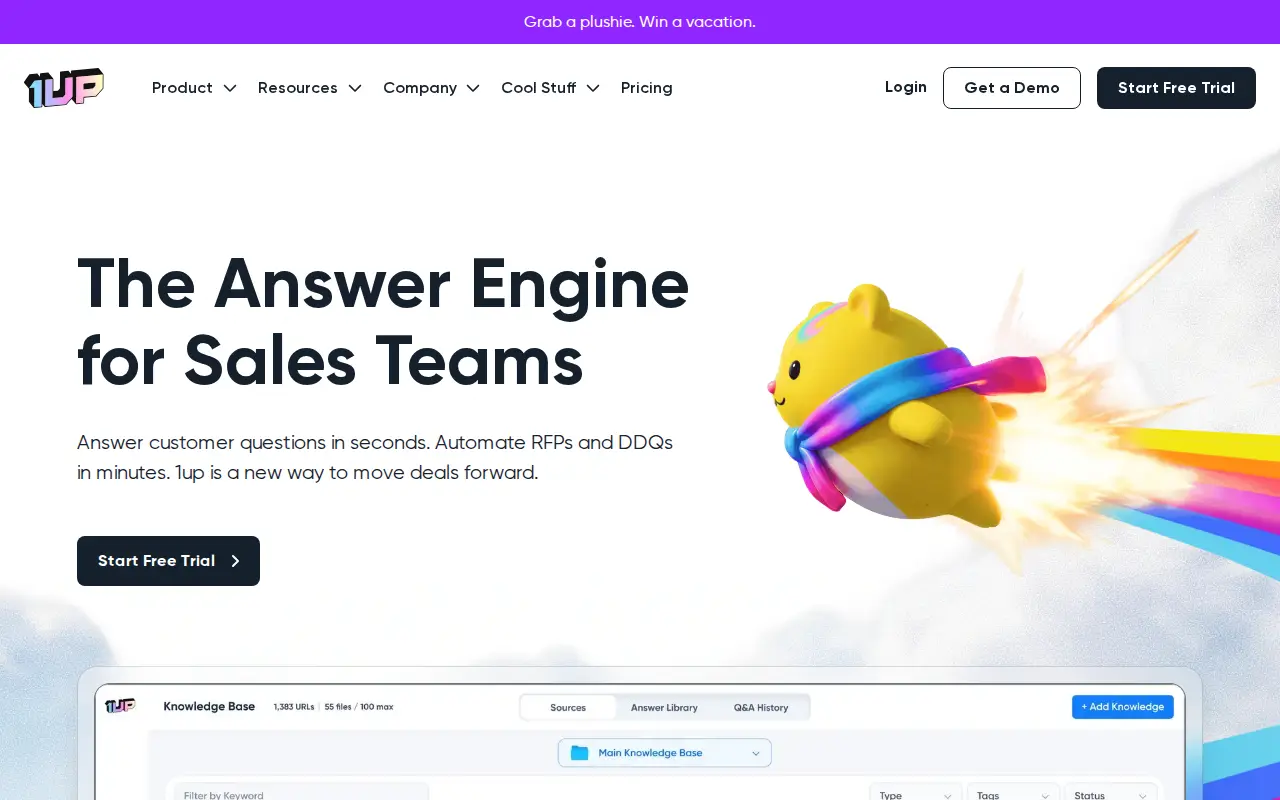
1U 1up
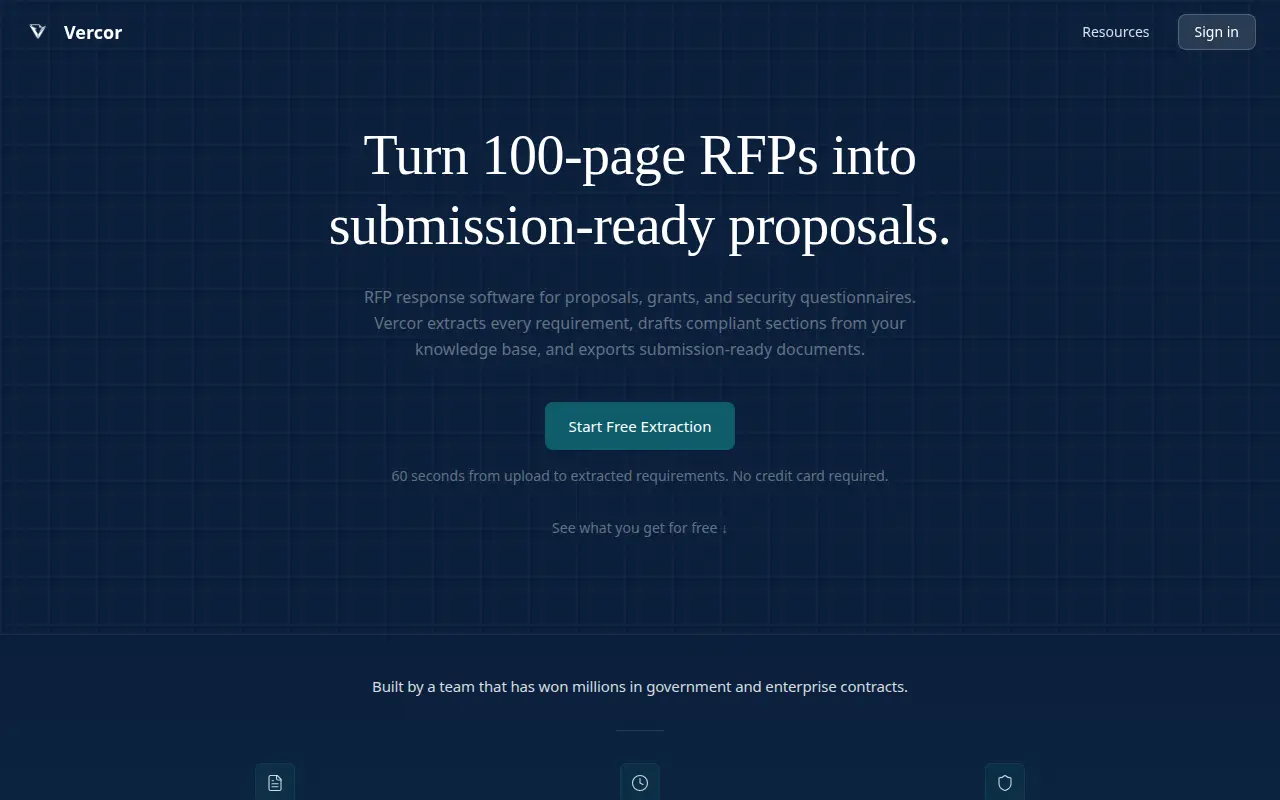
VE Vercor
Security: ISO 27001, SOC 2, and regional hosting
Put 1up and Vercor through the same three questions a security reviewer will ask: ISO 27001, SOC 2, and whether you can keep the tenancy in the US or the EU. Cells say Not listed when we could not find the claim on a public vendor page.
| Check | 1up | Vercor |
|---|---|---|
| ISO 27001 | ISO 27001 | Not listed |
| SOC 2 | SOC 2 | Not listed |
| US hosting | Not listed | Not listed |
| EU hosting | Not listed | Not listed |
Slack and Microsoft Teams
During a live questionnaire, SMEs get pinged in Slack or Teams, not in a vendor portal. Here is what 1up and Vercor publish for those two connections.
| Connection | 1up | Vercor |
|---|---|---|
| Slack | Slack | Not listed |
| Microsoft Teams | Microsoft Teams | Not listed |
Subprocessors: the big three clouds, then the niche names
Compare 1up and Vercor on AWS, Azure and GCP first. Then scan for niche processors a reviewer should pause on: third-party LLMs, session replay, or support that leaves the region you elected.
| Layer | 1up | Vercor |
|---|---|---|
| AWS, Azure, GCP | Not listed | Not listed |
| Watch-outs | No niche processors flagged in our sourced list. | No niche processors flagged in our sourced list. |
1up and Vercor both start free, both answer from your own documents, and both promise to cite where an answer came from. That is roughly where the overlap ends. 1up is tuned for commercial sales teams: security questionnaires, DDQs, web portals and the stream of product questions reps fire into Slack. Vercor is tuned for people who write long proposals against formal solicitations: government RFPs, federal and foundation grants, and the compliance matrix that goes with them, with security questionnaires as a third lane.
So the useful question is less “which is better” and more “which document eats your week”. The rest of this page answers that with each vendor’s published pricing, help docs and terms, checked in October 2026.
Key takeaways
- Different home turf: 1up drafts answers into the buyer’s file or portal and doubles as a Slack, Teams and Google Chat answer bot. Vercor extracts requirements from a solicitation, builds a compliance outline and drafts a full proposal that it exports as Word or PDF.
- Both have real free plans, with different ceilings: 1up Free gives 1 admin and 50 answers a month. Vercor Free gives unlimited requirement extraction, compliance checklists and readiness guides for 1 seat, with no drafting.
- Paid pricing: 1up Starter is $300/mo flat with unlimited users; Plus is $900/mo. Vercor Pro is $249/mo billed annually ($299 monthly) with 15 proposal generations per period; Unlimited is $415/mo billed annually ($499 monthly).
- Evidence handling: Vercor says every drafted paragraph links to an RFP page or knowledge-base document and missing facts become tracked placeholders. 1up links answers to sources and labels each one Full, Partial or Unanswered, and deliberately shows no confidence score.
- Security paperwork: 1up lists SOC 2 and ISO 27001. The directory records no certifications for Vercor, whose terms also bar uploading health data, social security numbers, card numbers or classified data.
- Limitations: 1up caps questionnaire automations by tier (1 a month on Starter, 6 on Plus). Vercor lists no integrations, so knowledge arrives by file upload.
Who built what, and for whom
1up
1up was founded in 2022 and is based in New York. It sells to revenue teams: solutions engineers, proposal managers and the enablement people who keep everyone’s answers consistent. Named customers include JumpCloud, WalkMe, Fleetio, Docebo and Deliveroo. The product has three faces: questionnaire automation for files, a browser extension for portals and online docs, and chat plugins so reps can ask questions where they already work.
Vercor
Vercor dates from 2025 and operates out of Brooklyn, New York. Its site names four audiences: proposal managers at 50 to 500 person firms, solo consultants chasing government contracts, grant writers, and IT and security teams fielding questionnaires. The product is a seven-stage pipeline: requirement extraction, knowledge-base retrieval, compliance outline, drafting, staffing matching against a resume bank, writer tasks for missing facts, and final assembly and export. Vercor also says it keeps a database of more than 1,400 federal regulations (FAR, DFARS, 2 CFR 200 and NIST 800-53 controls) and injects plain-language summaries into drafts for federal projects. That is a vendor claim we could not test end to end, but it is specific and checkable in a trial.
What the free plans actually let you do
Both free plans are genuine, and both are scoped to make you curious about the paid tier.
1up Free gives you one admin, 50 knowledge uploads and 50 answers a month. That is enough to load your security policy, your SOC 2 summary and a few product docs, then throw a real questionnaire at it and judge answer quality. You will not get the Slack or Teams plugins, the browser extension or SSO on the free plan; those start on Starter.
Vercor Free does extraction only, but it does it without a cap on documents: upload a 120-page solicitation and get a categorized list of requirements, an administrative checklist and a submission readiness guide with page references. For a solo consultant deciding whether to bid at all, that alone has real value. Knowledge-base retrieval, drafting, staffing matching and export all sit on Pro.
In practice: 1up’s free plan lets you test the drafting, while Vercor’s free plan lets you test the reading.
The first week with each
Neither tool needs a services engagement, which is refreshing in a category that loves a six-week onboarding plan.
With 1up, week one is mostly about sources. Connect the Drive folder or Confluence space where your security and product answers live, tag content by product line so answers stay scoped, and run a past questionnaire you already answered to compare drafts against what you actually sent. 1up’s FAQ says short documents process in seconds and files over 100 pages take a few minutes. The bigger time cost is deciding which sources are trustworthy, because 1up will happily answer from a stale slide deck if you connect one.
With Vercor, week one is about the archive. Upload two or three winning proposals, your capability statement and the resumes you reuse, then run extraction on a live solicitation and read the compliance outline before letting it draft. The resume bank only earns its keep once it is populated, so budget an afternoon for that. Grant writers should load funder guidelines and past awarded applications the same way.
The job itself: answering questions versus assembling a proposal
This is the section that should decide it for most teams.
A 250-row security questionnaire in Excel. 1up was built for this. It detects questions, requirements, up to three dropdowns and the answer column, drafts a short and a long version of each answer, and writes them back into the file. Its help center warns that it will not overwrite cells that already contain answers, including prefilled dropdowns, so upload a clean copy. Vercor’s site says its security questionnaire extraction captures questions with categories, word limits and source references, and the platform supports DDQs and vendor assessments. Its published output path, though, is an assembled Word or PDF document. If your buyer insists on getting their own spreadsheet back, test that flow in the trial before you commit.
A OneTrust or Whistic portal. 1up’s Chrome and Edge extension scans the page, extracts questions and drafts answers in place, and its help article names OneTrust, Whistic and Panorays. Vercor’s site describes an upload, draft and export flow and does not describe a browser extension.
A 90-page federal RFP with Sections L and M, key personnel requirements and 60 referenced FAR clauses. This is Vercor’s home ground. Extraction catches the “shall” statements, the compliance outline gives every requirement a section, the resume bank matches staff to personnel requirements, and the draft arrives as a structured Word document. Reviews move through Pink, Red and Gold team statuses. 1up can answer the discrete questions in such an RFP, but it does not build a compliance matrix, match resumes or assemble a narrative volume.
A federal or foundation grant. Vercor treats grants as a first-class document type. 1up does not position itself for grants.
A rep asking “do we support SAML with Okta?” in Slack. Only 1up does this.
Evidence and citations: two different philosophies
Both vendors say they will not make things up. They handle uncertainty differently, and the difference shows up during review.
1up answers only from your knowledge base and gives each answer a status: Full, Partial or Unanswered (plus Skipped for text that is not really a question). You can click Sources to see what it used. Its help center explains the absence of a confidence score directly: 1up’s view is that a model grading its own output is misleading, so it uses a binary answerable or unanswerable decision and leaves quality judgments to the reviewer. Approved answers go into an Answer Library that 1up favors next time.
Vercor says every generated paragraph carries a citation anchor to the RFP page number or the knowledge-base document it drew from. When a solicitation asks for a metric, date or certification the knowledge base does not contain, Vercor inserts a tracked Writer Task placeholder instead of filling the gap. For long proposals, that placeholder model is a sensible design: the reviewer gets a to-do list instead of a plausible-sounding invented number. Its homepage line “We will not guess your SOC 2 audit date” sums up the intent.
Neither approach removes the need for a human pass. Vercor’s own terms say outputs “are not guaranteed to be accurate, complete, or suitable”, and 1up’s FAQ tells users to correct wrong answers and teach the system with Improve Answer.
Pricing and total cost
Verified pricing as of October 2026:
- 1up, starting at $0: a permanent free plan with one admin and 50 answers per month; an MCP plan at $50/mo with automations billed as used ($5 per 100 answers); Starter at $300/mo for unlimited users; Plus at $900/mo; and a custom Enterprise tier. Annual payment saves 15%, and the paid plans come with a free trial.
- Vercor, starting at $0: the forever-free plan gives one seat requirement extraction and compliance checklists. Pro costs $249/mo on an annual plan or $299 month to month, includes 15 proposal generations each period and charges $50 for every generation beyond that. Unlimited costs $415/mo annually or $499 monthly. There are no contracts and no setup fees.
The units differ, so compare against your own volume:
| Your month looks like | 1up | Vercor |
|---|---|---|
| 1 security questionnaire, lots of rep questions | Starter, $300/mo | Pro, $249/mo billed annually |
| 5 questionnaires | Plus, $900/mo (6 included) | Pro covers 15 generations |
| 20 proposals or questionnaires | Enterprise quote | Pro: 15 included plus 5 × $50 = $250 extra, or Unlimited at $415/mo billed annually |
| 40 people need access | Starter or Plus, unlimited users | Unlimited allows up to 50 seats; Pro allows 15 |
Two notes on the math. First, 1up’s allowance is per questionnaire, while Vercor’s is per proposal generation, and the two are not the same unit; ask each vendor how a 300-question DDQ is counted. Second, 1up’s unlimited users matter if reps will use the chat bot daily, which is a cost Vercor does not try to cover.
Vercor’s Pro plan carries a promise on its pricing page: if it does not save your team time, it will refund the month. Its terms otherwise say there are no prorated refunds for partial periods.
Integrations and where your knowledge lives
1up connects to existing sources. Sources include Confluence, Drive, Notion, SharePoint, OneDrive, Egnyte, Highspot and Salesforce, plus Slack, Microsoft Teams and Google Chat for answers, browser plugins, and an MCP server for other AI tools. You can also add up to 1,000 URLs from a single domain, per its FAQ.
Vercor works from uploads. The directory lists no third-party integrations. Past proposals, capability statements, case studies and resumes go into the knowledge base and resume bank by file. That is less convenient for a team whose truth lives in Confluence, and perfectly workable for a consultant whose truth lives in a folder of past bids.
Known issues and watch-outs
1up
- Questionnaire automation caps. The 1up pricing page (checked October 2026) lists 1 questionnaire a month on Starter and 6 on Plus, with more on Enterprise only.
- Knowledge file limits. 50 files on Starter and 200 on Plus, held at once, per the pricing page and 1up’s FAQ (April 2026).
- No chat plugins, extension or SSO below Starter. Listed on the pricing page.
- Questions containing PII are always blocked. 1up’s Generating Answers guide (April 2026) says questions with names, emails, domains or URLs are blocked and cannot be overridden, so plan for manual answers on those rows.
Vercor
- Drafting is Pro-only. The Vercor homepage pricing (checked October 2026) puts retrieval, drafting, staffing matching and export on Pro and above.
- Generation overages on Pro. 15 proposal generations per period, then $50 each, per the pricing section.
- Restricted data types. Vercor’s terms (April 2026) list PHI, social security numbers, card numbers and classified government material among the things you may not upload. HealthTech DDQs that quote patient-data handling examples need care.
- No uptime commitment. The same terms say Vercor does not guarantee specific uptime percentages, and the free tier carries no service-level commitment.
- Young product, little public feedback. Vercor launched in 2025 and the directory lists no review-site ratings for it yet, so references matter more than usual.
Who should pick 1up
- You are a B2B software or services company answering security questionnaires, DDQs and RFPs from commercial buyers.
- Buyers send portals as often as files, and you want a browser extension that works inside them.
- Reps need instant answers in Slack, Teams or Google Chat from the same approved sources.
- Your knowledge already lives in Drive, Confluence, SharePoint or Notion.
- You need a vendor with SOC 2 and ISO 27001 to clear your own security review.
Who should pick Vercor
- You respond to government or enterprise solicitations where a missed requirement can get you disqualified.
- You write grants as well as proposals and want one tool for both.
- Key personnel and resumes are part of most bids you submit.
- You want to try the extraction step free, with no demo and no sales call, before paying.
- You are a solo consultant or a small BD team, and a self-serve monthly plan with no setup fee suits your budget.
Verdict
Pick by document. If your week is buyer-authored questionnaires and portals, 1up fits better: it drafts into the buyer’s format, works inside the portal and doubles as the team’s answer bot, at a flat monthly price with unlimited users. Check its questionnaire allowance against your volume before choosing a tier.
If your week is long-form proposals against formal solicitations, especially federal ones, Vercor fits better: extraction, compliance outlines, resume matching and placeholders for missing facts are built for that work, and the free extraction tier lets you judge it on a live bid. Check the security paperwork and data-type restrictions against your own policies before you upload anything sensitive.
The rare team that does both jobs at volume may want both. Most teams will know which one hurts within a single read of their last month’s inbox.
Read the full 1up review or Vercor review, or browse all RFP & DDQ software.
Frequently asked questions
What is the difference between 1up and Vercor?
1up: Self-serve AI for questionnaires and sales enablement. Vercor: Self-serve AI for RFPs, grants, and questionnaires. 1up is best for sales teams that need questionnaire answers plus enablement in one self-serve tool. Vercor is best for solo consultants and lean teams juggling proposals, grants, and questionnaires.
Which is cheaper, 1up or Vercor?
Both start at a similar published price ($0 (free tier)), so pricing shouldn't be the deciding factor.
Is 1up or Vercor better for DDQs and security questionnaires?
1up scores higher on DDQ and security-questionnaire handling in our capability model, though both support them.
Do 1up and Vercor both handle RFPs?
1up: yes, a core strength. Vercor: yes, a core strength.
Which should you choose, 1up or Vercor?
1up is the pick for sales teams that need questionnaire answers plus enablement in one self-serve tool. Vercor is the pick for solo consultants and lean teams juggling proposals, grants, and questionnaires.
Are there alternatives to 1up and Vercor?
Yes. Browse the full directory of RFP, DDQ, and security-questionnaire platforms for more options and side-by-side comparisons.
Do 1up and Vercor list ISO 27001, SOC 2, and US or EU hosting?
1up: ISO 27001 ISO 27001, SOC 2 SOC 2, US Not listed, EU Not listed, Slack Slack, Teams Microsoft Teams, clouds Not listed. Vercor: ISO 27001 Not listed, SOC 2 Not listed, US Not listed, EU Not listed, Slack Not listed, Teams Not listed, clouds Not listed. Confirm both on the vendor sites.
Source registry
Every page we read for these profiles, with the month it was last checked. Anything without a source is shown as not publicly disclosed. Spot an outdated fact? Send it from the corrections page.
1up
Pricing
Security and compliance
Product and integrations
Third-party reviews
- No review-site source recorded.
Vercor
Pricing
Security and compliance
- No security source URL recorded. Treat certifications and hosting as not publicly disclosed.
Product and integrations
Third-party reviews
- No review-site source recorded.