Quick verdict
Choose Bidara for solo consultants and small teams answering the occasional RFP without library upkeep; choose DeepRFP for freelancers and very small teams wanting affordable AI RFP writing. DeepRFP starts lower, at $89/user/mo against $299/mo for Bidara. In our capability model Bidara leads on AI drafting, and the two match everywhere else.
Both profiles reviewed Oct 2026
2 of 70 profiles, one scoring modelNo paid placementSources checked: 7Choose Bidara or DeepRFP
BI Choose Bidara when
- Solo consultants and small teams answering the occasional RFP without library upkeep.
- You need stronger AI drafting than DeepRFP offers.
DE Choose DeepRFP when
- Freelancers and very small teams wanting affordable AI RFP writing.
- Low entry price for one or two writers ($89 per user per month).
- You want the lower entry price: $89/user/mo.
Side-by-side comparison
| Capability | Bidara | DeepRFP | Edge |
|---|---|---|---|
| Best for | Solo consultants and small teams answering the occasional RFP without library upkeep. | Freelancers and very small teams wanting affordable AI RFP writing. | - |
| Starting price | $299/mo | $89/user/mo | DeepRFP |
| Free tier | No | No | Match |
| RFPs | 2/3 | 2/3 | Match |
| DDQs | 1/3 | 1/3 | Match |
| Security questionnaires | 1/3 | 1/3 | Match |
| AI drafting | 3/3 | 2/3 | Bidara |
| Answer library | 1/3 | 1/3 | Match |
| Source attribution | 1/3 | 1/3 | Match |
| Workflow & approvals | 1/3 | 1/3 | Match |
| Integrations | 1/3 | 1/3 | Match |
| Self-serve onboarding | 3/3 | 3/3 | Match |
| ISO 27001 | Not listed | Not listed | - |
| SOC 2 | Not listed | Not listed | - |
| US hosting | Not listed | Not listed | - |
| EU hosting | Not listed | Not listed | - |
| Slack | Not listed | Not listed | - |
| Microsoft Teams | Not listed | Not listed | - |
| AWS, Azure, GCP | Not listed | Not listed | - |
| Listed integrations | None listed | Browser-based | - |
| Certifications | None listed | None listed | - |
What they look like
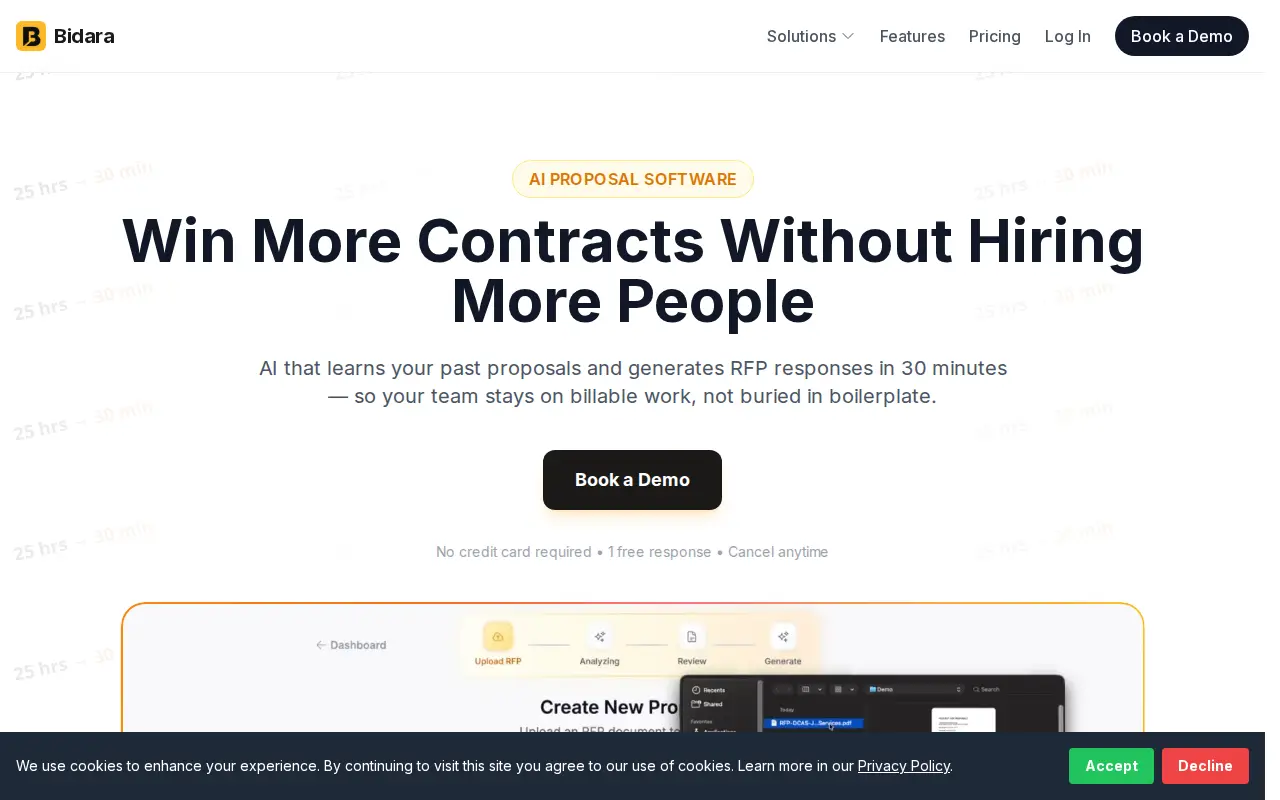
BI Bidara
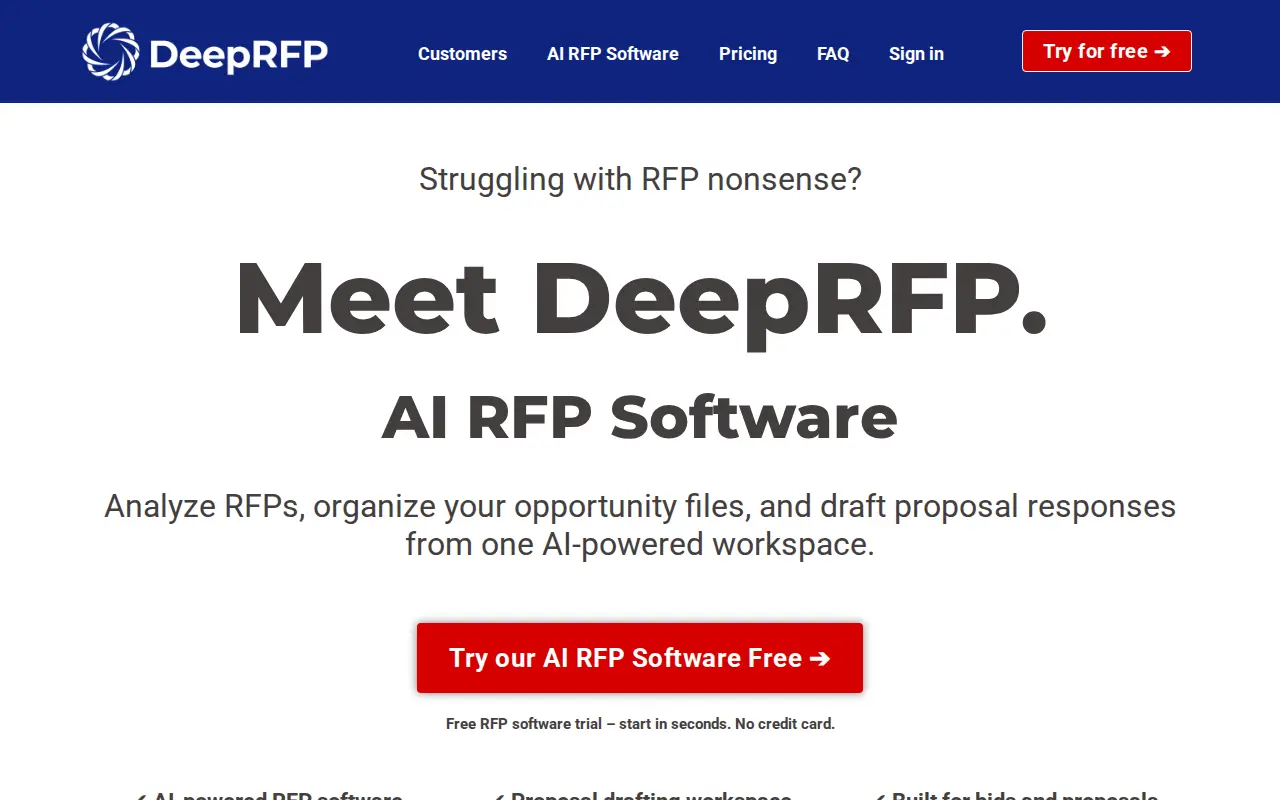
DE DeepRFP
Security: ISO 27001, SOC 2, and regional hosting
Put Bidara and DeepRFP through the same three questions a security reviewer will ask: ISO 27001, SOC 2, and whether you can keep the tenancy in the US or the EU. Cells say Not listed when we could not find the claim on a public vendor page.
| Check | Bidara | DeepRFP |
|---|---|---|
| ISO 27001 | Not listed | Not listed |
| SOC 2 | Not listed | Not listed |
| US hosting | Not listed | Not listed |
| EU hosting | Not listed | Not listed |
Slack and Microsoft Teams
During a live questionnaire, SMEs get pinged in Slack or Teams, not in a vendor portal. Here is what Bidara and DeepRFP publish for those two connections.
| Connection | Bidara | DeepRFP |
|---|---|---|
| Slack | Not listed | Not listed |
| Microsoft Teams | Not listed | Not listed |
Subprocessors: the big three clouds, then the niche names
Compare Bidara and DeepRFP on AWS, Azure and GCP first. Then scan for niche processors a reviewer should pause on: third-party LLMs, session replay, or support that leaves the region you elected.
| Layer | Bidara | DeepRFP |
|---|---|---|
| AWS, Azure, GCP | Not listed | Not listed |
| Watch-outs | No niche processors flagged in our sourced list. | No niche processors flagged in our sourced list. |
Bidara and DeepRFP chase the same customer: the small business, consultant or lean bid team that answers RFPs without a proposal department and wants AI to do the first pass. Both publish prices. Both offer a free trial without a credit card. Both draft from documents you upload rather than from a curated answer library.
The real difference is the meter. Bidara sells team plans with a monthly cap on AI-generated responses. DeepRFP sells per-user seats with unlimited usage. Which one is cheaper, and which one fits, depends almost entirely on how many people write and how many RFPs you answer. We checked both pricing pages, product pages and security statements in October 2026, and ran the numbers below from those published prices.
Key takeaways
- Pricing model: Bidara Starter is $299/mo and Growth $599/mo, both billed annually, with Enterprise on a custom quote. DeepRFP Pro is $89 per user per month and Elite $149 per user per month, billed monthly with cancel-anytime terms; yearly plans give 12 months for the price of 10.
- Usage limits: Bidara Starter allows 10 AI-generated responses a month and 3 team members; Growth allows 30 responses and 10 members. DeepRFP’s Pro plan lists “Unlimited Usage.”
- Workflow shape: DeepRFP organizes each bid as an opportunity workspace with RFP analysis, compliance matrices, drafting, Excel form answering and proposal reviews. Bidara focuses on requirement extraction and a full draft from your uploaded documents, exported to Word or PDF.
- Trials: Bidara’s trial runs five days and covers one complete proposal. DeepRFP’s runs seven days with full access.
- Review evidence: DeepRFP holds 5.0/5 on Capterra from 6 reviews (as of October 2026). We found no user reviews for Bidara on G2 or Capterra as of October 2026.
- Limitations: DeepRFP’s own evaluation page says it may not fit teams needing deep CRM, Slack, Teams or SharePoint integrations, SSO or security-questionnaire-first work. Bidara’s security page lists no SOC 2 or ISO 27001.
Same customer, different meter
DeepRFP was founded in 2023 in Castellón, Spain, by a former proposal professional, and its pitch is a proposal workspace that sits between ChatGPT and enterprise platforms. Its own evaluation page describes it as “more structured than generic AI tools” and “lighter, faster, and more accessible than enterprise RFP software like Loopio or Responsive.” You pay for each person who uses it.
Bidara was founded in 2025 in New York and sells a simpler idea: upload your company documents, drop in the RFP, get a tailored draft. You pay for the team plan and are capped on how many new RFP responses the AI generates each month. Bidara’s pricing FAQ is clear on the counting rule: a proposal is counted once when you generate AI content for a new RFP response, and editing, regenerating sections and collaborating do not use more credits.
Neither model is a trick. They just reward different team shapes.
What it costs at three team sizes
Here is the arithmetic using only the published prices. Bidara figures are annual because both of its self-serve plans are billed annually. DeepRFP figures use its yearly offer of 12 months for the price of 10.
| Team | Bidara | DeepRFP Pro (yearly) | DeepRFP Elite (yearly) |
|---|---|---|---|
| 1 writer | Starter: $3,588/yr | $890/yr | $1,490/yr |
| 3 writers | Starter: $3,588/yr | $2,670/yr | $4,470/yr |
| 10 writers | Growth: $7,188/yr | $8,900/yr | $14,900/yr |
What the table hides:
- A solo consultant pays far less on DeepRFP. One Pro seat costs about a quarter of Bidara Starter for the year, and month-to-month billing at $89 lets you stop when work dries up.
- At three people, the gap narrows. DeepRFP Pro is still cheaper, and it has no response cap. Bidara Starter’s 10 responses a month is plenty for most three-person teams, though.
- At ten people, Bidara Growth wins on price against either DeepRFP tier, provided 30 new responses a month covers your volume.
- “Writers” is the key word. Bidara counts team members up to the plan limit. DeepRFP needs a seat for anyone who logs in, so a reviewer who only reads drafts may still cost $89 a month.
Workspace versus upload-and-draft
DeepRFP’s home page describes a workspace per opportunity. You upload the RFP, forms, past proposals, company content and rates. From there, Pro gives you RFP analysis (requirements, risks, deadlines), compliance matrices, a proposal writing agent that drafts to DOCX, an “answer Excel forms” feature that works through XLSX questionnaires, proposal reviews for compliance and clarity, and pre-set writing styles. It writes in 28 languages through an English interface. Elite adds custom instructions on all agents, a custom matrix generator, custom writing styles, pricing strategy and compliance briefings, plus unlimited company profiles. Pro is limited to one company profile, which matters for consultants who write for several clients.
Bidara’s workflow is shorter. It learns from what you upload, extracts requirements from the RFP automatically, and produces a full draft that you edit and export to Word or PDF. Bidara says a draft takes about 30 minutes; treat that as the vendor’s estimate rather than a measured result on your RFP. It handles narrative and spreadsheet-based RFPs. There is no separate compliance-matrix or review module on its pricing page, and no per-client profile concept, because the knowledge base is simply your uploaded files (200 documents on Starter, 1,000 on Growth).
If you like structure, with a checklist of requirements, a matrix and a review pass, DeepRFP gives you more of it. If you want the shortest path from RFP to draft, Bidara is simpler.
Questionnaires and Excel files
Plenty of small-business RFPs now arrive as spreadsheets: a vendor questionnaire, a requirements matrix, a pricing schedule. DeepRFP explicitly lists answering Excel forms and building compliance matrices on its Pro plan. Bidara says it handles spreadsheet-based RFPs and accepts .xlsx and .csv uploads.
Neither is a security questionnaire platform. DeepRFP says so directly: its evaluation page lists “a security questionnaire automation platform as your primary use case” among the needs it may not fit. Bidara does not market trust-center or framework-mapping features either. If your week is SIG and CAIQ questionnaires rather than proposals, look at a questionnaire-first tool.
Bids in other languages
If you bid outside English-speaking markets, this can settle the choice. DeepRFP says it writes proposals in 28 languages through an English interface, which suits a consultant who answers a Spanish municipal tender one week and a UK framework the next.
Bidara does not make a comparable multilingual claim on its pricing or product pages, and its industry pages cover consulting firms, IT services and MSPs, engineering and government contractors, alongside a US federal contracts section. If you need non-English output, test it on the Bidara trial before you assume it.
What each vendor says about itself
DeepRFP deserves a mention for publishing a candid self-assessment. Its evaluation page, last updated July 2026, lists when it “may not be the right fit”: a large governed content library managed by many departments, complex SME assignment across hundreds of users, deep Salesforce, Slack, Teams, SharePoint, Jira or CRM integrations, SSO and advanced audit logs, strict approval chains, or security questionnaires as the main job. It also notes that it “does not yet have the hundreds or thousands of reviews that larger enterprise platforms have.” That is an honest scope statement, and it matches what the product pages show.
Bidara’s marketing is more conventional. Its site leans on time-saving estimates (the 30-minute draft, hours saved per proposal) that come from the vendor, not from published customer data. The pricing page is the most useful thing it publishes, because it states the caps plainly.
Collaboration and review
Small teams still need two or three people to touch a proposal: the writer, a subject-matter expert, and whoever signs it off. Neither tool tries to be an approval engine, but they handle the hand-offs differently.
Bidara’s plans include real-time multi-user editing and comments, with role-based access, workspace-level permissions and document-level access controls listed on its security page. Because the plan covers a set number of team members, adding the sales director as a reviewer costs nothing extra as long as you stay under 3 (Starter) or 10 (Growth).
DeepRFP organizes work around the opportunity workspace, and its proposal review feature checks a draft for compliance, clarity and impact before a human looks at it. That machine review is useful for a solo writer with no second pair of eyes. For a multi-person team, every reviewer who logs in needs a seat, and the evaluation page is clear that complex SME assignment and strict approval chains are outside its target.
In practice, both tools assume your approvals happen in Word, email or a quick call. If you need formal sign-off records, neither is the tool for that layer.
Running both trials on one RFP
The trials are short, so plan the test before you start the clock.
- Pick a real, recent RFP with a mix of narrative questions and a spreadsheet section. Avoid demo RFPs; both tools look good on those.
- Upload the same five to ten source documents to each: a past winning proposal, a capability statement, résumés or case studies, and your standard terms.
- Generate the draft and start a timer for the edit. Stop it when the response is something you would actually submit.
- Check three things by hand: did it answer every requirement, did it invent anything that is not in your documents, and did the Word export keep your formatting?
- Count the steady-state cost for your actual team: writers, reviewers and the number of new RFPs a month.
Bidara’s trial covers one complete proposal in five days, so do the DeepRFP trial second if you need more time to compare the Excel and review features.
Switching later
Because neither tool asks you to build a curated answer library, switching costs are low. Your source material stays in your own files; you re-upload it elsewhere. The main thing you lose is the per-opportunity history (analysis, matrices, review notes) inside DeepRFP’s workspaces, or the drafts stored in Bidara. Export the final proposals to Word as you go and that history mostly lives in your own drive anyway.
Security and data handling
Bidara’s security page lists Google Cloud Platform, Firebase and Vercel as infrastructure, AES-256 encryption at rest, TLS in transit, role-based access control, and opt-in-only use of your content for AI training. Its compliance section lists GDPR readiness and CCPA compliance; it does not list SOC 2 or ISO 27001.
DeepRFP’s site says it does not use your data to train any AI model and that it is model-agnostic, routing different tasks to different AI models. It cites hosting on SOC 2-compliant US clouds, but lists no company-level SOC 2 report or ISO 27001 certification.
For a small consultancy, that is a common and often acceptable position. If you serve regulated clients who will ask what tools touched their RFP, write down both answers before you upload client material.
Known issues and watch-outs
Sources were read in October 2026.
Bidara
- Annual billing and monthly caps: Starter and Growth are billed annually and cap AI-generated responses at 10 and 30 a month, with 3 and 10 team members. (Bidara pricing, October 2026)
- Integrations only on Enterprise: custom integrations are listed only on the custom-priced plan. (Bidara pricing, October 2026)
- No SOC 2 or ISO 27001 listed on the security page, which lists GDPR readiness and CCPA compliance. (Bidara security, October 2026)
DeepRFP
- Integrations and governance: its own page says it may not suit teams needing deep Salesforce, Slack, Teams, SharePoint, Jira or CRM integrations, SSO, or advanced audit logs. (DeepRFP evaluation page, July 2026, read October 2026)
- Human review still required: three of six Capterra reviewers (all June 2026) say summaries and drafts need checking against the solicitation, especially for technical or agency-specific language. (DeepRFP on Capterra, October 2026)
- Per-seat costs grow with headcount, and custom writing styles and multiple company profiles are Elite-only at $149 per user per month. (DeepRFP pricing, October 2026)
- No company-level SOC 2 or ISO 27001 listed; the site cites SOC 2-compliant hosting providers. (DeepRFP, October 2026)
The fair concessions
DeepRFP’s strengths are depth for the price and honesty about scope. A $89 seat buys RFP analysis, compliance matrices, Excel form answering, drafting and reviews with no usage cap, and its Capterra reviewers consistently praise the output quality and value. One review on its site, from a security-sector content lead, says the draft “gets you 75% there” before you rewrite for voice, which is a realistic expectation to set.
Bidara’s strengths are simplicity and predictable team pricing. There is nothing to configure: upload, draft, edit, export. For a team of five to ten writers with moderate volume, Growth is cheaper than putting everyone on DeepRFP, and the counting rule (one credit per new RFP, edits free) does not punish iteration.
Choose Bidara when
- Several people write and review, and you would rather pay one team price than count seats.
- Your volume fits 10 (Starter) or 30 (Growth) new RFP responses a month.
- You want the shortest route from RFP to an editable Word draft.
- You are comfortable with an annual commitment after a five-day trial.
Choose DeepRFP when
- You are a solo consultant or a team of one to three writers.
- You want structure around the draft: requirement analysis, compliance matrices, reviews and Excel form answering.
- You write for several clients and can justify Elite’s unlimited company profiles, or one client and are happy on Pro.
- You value month-to-month billing and the option to stop.
Final call
Both are honest, self-serve AI drafting tools for small teams, and neither is built for enterprise governance or security questionnaires. Pick DeepRFP for a solo writer or a small team that wants a structured proposal workspace with unlimited usage. Pick Bidara for a slightly larger team that wants one predictable price and a simple upload-and-draft flow.
Run your next real RFP through both trials, and time the edit, not the draft. The one-liner: DeepRFP if you count writers on one hand, Bidara if you count them on two.
Read the full Bidara review or DeepRFP review, or browse all RFP & DDQ software.
Frequently asked questions
What is the difference between Bidara and DeepRFP?
Bidara: AI RFP drafting from your uploaded documents, no library required. DeepRFP: Lightweight AI RFP toolkit for small teams. Bidara is best for solo consultants and small teams answering the occasional RFP without library upkeep. DeepRFP is best for freelancers and very small teams wanting affordable AI RFP writing.
Which is cheaper, Bidara or DeepRFP?
DeepRFP starts lower at $89/user/mo, versus $299/mo for Bidara.
Is Bidara or DeepRFP better for DDQs and security questionnaires?
They are level on DDQ and security-questionnaire handling in our capability model, so test both on one of your own questionnaires.
Do Bidara and DeepRFP both handle RFPs?
Bidara: yes, a core strength. DeepRFP: yes, a core strength.
Which should you choose, Bidara or DeepRFP?
Bidara is the pick for solo consultants and small teams answering the occasional RFP without library upkeep. DeepRFP is the pick for freelancers and very small teams wanting affordable AI RFP writing.
Are there alternatives to Bidara and DeepRFP?
Yes. Browse the full directory of RFP, DDQ, and security-questionnaire platforms for more options and side-by-side comparisons.
Do Bidara and DeepRFP list ISO 27001, SOC 2, and US or EU hosting?
Bidara: ISO 27001 Not listed, SOC 2 Not listed, US Not listed, EU Not listed, Slack Not listed, Teams Not listed, clouds Not listed. DeepRFP: ISO 27001 Not listed, SOC 2 Not listed, US Not listed, EU Not listed, Slack Not listed, Teams Not listed, clouds Not listed. Confirm both on the vendor sites.
Source registry
Every page we read for these profiles, with the month it was last checked. Anything without a source is shown as not publicly disclosed. Spot an outdated fact? Send it from the corrections page.
Bidara
Pricing
Security and compliance
- No security source URL recorded. Treat certifications and hosting as not publicly disclosed.
Product and integrations
Third-party reviews
- No review-site source recorded.
DeepRFP
Security and compliance
- No security source URL recorded. Treat certifications and hosting as not publicly disclosed.
Product and integrations
Third-party reviews