Quick verdict
Choose Bidara for solo consultants and small teams answering the occasional RFP without library upkeep; choose Tendium for European teams selling to the public sector who need tender discovery plus bid help. Tendium starts lower, at €125/mo against $299/mo for Bidara. In our capability model Bidara leads on DDQs, security questionnaires, AI drafting and self-serve setup, while Tendium leads on approval workflows.
Both profiles reviewed Oct 2026
2 of 70 profiles, one scoring modelNo paid placementSources checked: 5Choose Bidara or Tendium
BI Choose Bidara when
- Solo consultants and small teams answering the occasional RFP without library upkeep.
- You need stronger DDQs, security questionnaires and AI drafting than Tendium offers.
TE Choose Tendium when
- European teams selling to the public sector who need tender discovery plus bid help.
- You need stronger approval workflows than Bidara offers.
- You want the lower entry price: €125/mo.
Side-by-side comparison
| Capability | Bidara | Tendium | Edge |
|---|---|---|---|
| Best for | Solo consultants and small teams answering the occasional RFP without library upkeep. | European teams selling to the public sector who need tender discovery plus bid help. | - |
| Starting price | $299/mo | €125/mo | Tendium |
| Free tier | No | No | Match |
| RFPs | 2/3 | 2/3 | Match |
| DDQs | 1/3 | 0/3 | Bidara |
| Security questionnaires | 1/3 | 0/3 | Bidara |
| AI drafting | 3/3 | 2/3 | Bidara |
| Answer library | 1/3 | 1/3 | Match |
| Source attribution | 1/3 | 1/3 | Match |
| Workflow & approvals | 1/3 | 2/3 | Tendium |
| Integrations | 1/3 | 1/3 | Match |
| Self-serve onboarding | 3/3 | 2/3 | Bidara |
| ISO 27001 | Not listed | Not listed | - |
| SOC 2 | Not listed | Not listed | - |
| US hosting | Not listed | Not listed | - |
| EU hosting | Not listed | Not listed | - |
| Slack | Not listed | Not listed | - |
| Microsoft Teams | Not listed | Not listed | - |
| AWS, Azure, GCP | Not listed | Not listed | - |
| Listed integrations | None listed | None listed | - |
| Certifications | None listed | None listed | - |
What they look like
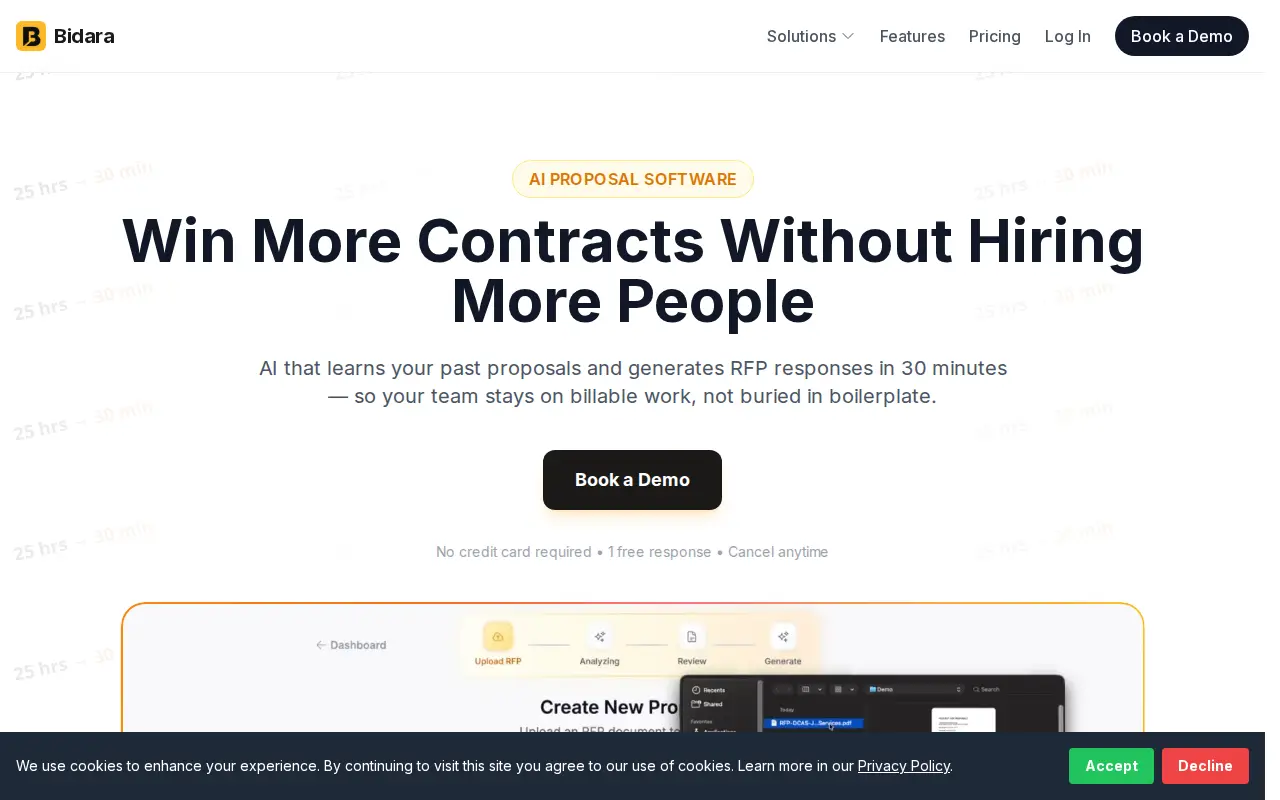
BI Bidara
TE Tendium
Security: ISO 27001, SOC 2, and regional hosting
Put Bidara and Tendium through the same three questions a security reviewer will ask: ISO 27001, SOC 2, and whether you can keep the tenancy in the US or the EU. Cells say Not listed when we could not find the claim on a public vendor page.
| Check | Bidara | Tendium |
|---|---|---|
| ISO 27001 | Not listed | Not listed |
| SOC 2 | Not listed | Not listed |
| US hosting | Not listed | Not listed |
| EU hosting | Not listed | Not listed |
Slack and Microsoft Teams
During a live questionnaire, SMEs get pinged in Slack or Teams, not in a vendor portal. Here is what Bidara and Tendium publish for those two connections.
| Connection | Bidara | Tendium |
|---|---|---|
| Slack | Not listed | Not listed |
| Microsoft Teams | Not listed | Not listed |
Subprocessors: the big three clouds, then the niche names
Compare Bidara and Tendium on AWS, Azure and GCP first. Then scan for niche processors a reviewer should pause on: third-party LLMs, session replay, or support that leaves the region you elected.
| Layer | Bidara | Tendium |
|---|---|---|
| AWS, Azure, GCP | Not listed | Not listed |
| Watch-outs | No niche processors flagged in our sourced list. | No niche processors flagged in our sourced list. |
The short answer: Bidara helps you write a response to an RFP you already have. Tendium helps you find European public tenders you did not know about, then manage and write the bid. They overlap in the middle, where an AI drafts from your own documents, but they start from opposite ends of the bid process.
That makes this comparison less about which tool is better and more about where your bottleneck sits. If you lose bids because you never see them, look hard at Tendium. If you see plenty of RFPs but cannot staff the writing, look hard at Bidara. If you sell to Nordic public buyers and also struggle to write, read to the end, because the pricing tiers matter a lot.
We checked both vendors’ pricing, product and security pages in October 2026.
Key takeaways
- Starting point: Bidara starts when an RFP lands; it extracts requirements and drafts from documents you upload. Tendium starts earlier, monitoring European public tenders, summarizing them, and helping you qualify before a bid workflow begins.
- Published prices: Bidara’s Starter plan is $299/mo and Growth is $599/mo, both billed annually; Enterprise is custom. Tendium’s Light plan starts at €125/mo, with Core and Scale quote-based and scaled by bids per year.
- What the entry plan buys: Bidara Starter includes AI drafting, capped at 10 AI-generated responses a month and 3 team members. Tendium Light is tender monitoring only; drafting with the Writing Assistant starts on Core.
- Team size: Tendium includes unlimited users on every plan. Bidara caps users at 3 on Starter and 10 on Growth.
- Geography: Tendium is built around European public procurement, with document-level search listed for Sweden, Norway and Finland. Bidara is US-based (New York, founded 2025) and markets to consultants, IT services firms, engineering and government contractors.
- Limitations: Bidara’s compliance claims stop at GDPR readiness and CCPA compliance, with no SOC 2 or ISO 27001. Tendium’s Form Filler and SharePoint connector have not shipped yet.
Two different starting points
Bidara: the RFP is already on your desk
Bidara’s pitch is that you do not need an answer library to get a draft. You upload past proposals, capability statements and company documents in PDF, Word, PowerPoint, Excel, HTML or Markdown. You drop in the RFP. Bidara’s RFP analysis pulls out the requirements, and the AI drafts a response grounded in what you uploaded. When you are done, you export the proposal to Word or PDF.
Bidara says a full draft takes about 30 minutes. That is the vendor’s estimate, and the more useful number is how long your edit takes afterward, which depends on how good your uploaded material is. Still, for a three-person consultancy that answers a few RFPs a month and has never had time to build a library, skipping the library step is the whole point.
Tendium: the tender has not found you yet
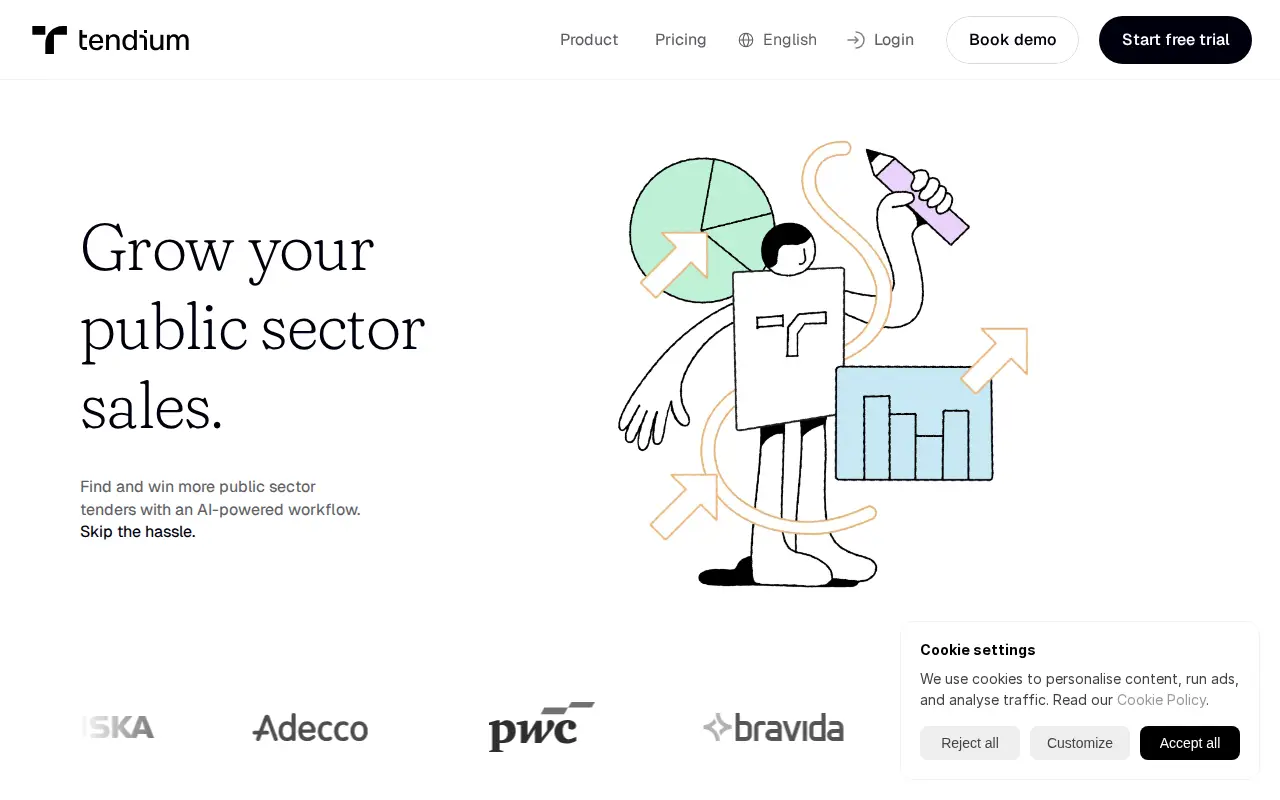
Tendium is a Stockholm company, founded in 2018, built for business-to-government sales in Europe. Its Find module monitors public-sector tenders across the European markets you choose, sorts them by relevance, emails you when a new one matches your filter, and writes an AI executive summary of the tender documents so you can decide quickly whether to read the full pack.
Once you decide to bid, BidFlow takes over: Smart Checklists for the bid/no-bid call, a bid project with to-dos, a Content Library for past bids and company information, and a Writing Assistant that drafts from that library. Tendium’s AI assistant, Louie, sits across the whole flow.
What a week looks like in each
Picture a small IT services firm with a bid manager, a technical lead and a sales director.
With Bidara, Monday morning starts with a city government RFP that sales found on a portal. The bid manager uploads it, Bidara extracts the requirements and drafts the narrative sections from last year’s proposals and the company’s capability deck. The technical lead edits the solution section, the sales director tweaks pricing language, and the bid manager exports to Word for final formatting. Total Bidara usage: one of the month’s AI-generated responses on Starter.
With Tendium, Monday morning starts with an email listing three new tenders that match the firm’s filter. The bid manager reads the AI summaries, runs the most promising one through a Smart Checklist, and opens a BidFlow project. Tasks go to the technical lead and the sales director. The Writing Assistant drafts sections from the Content Library. If the tender includes Excel price schedules and supplier declarations, those are still filled by hand until Tendium’s Form Filler ships.
Both are plausible weeks. The difference is that Tendium found the opportunity, and Bidara assumed you had.
What your money actually buys
The headline prices are not comparable until you look at what each tier includes.
| Plan | Price | What you get |
|---|---|---|
| Bidara Starter | $299/mo, billed annually | 10 AI-generated responses a month, up to 3 team members, 200 knowledge-base documents, email support |
| Bidara Growth | $599/mo, billed annually | 30 responses a month, up to 10 team members, 1,000 documents, priority support |
| Bidara Enterprise | Custom | Unlimited responses, members and documents, custom integrations, dedicated account manager |
| Tendium Light | From €125/mo | Tender monitoring, AI summaries, tender documents and awards, one tender filter, unlimited users |
| Tendium Core | Quote, scales with bids per year | Adds BidFlow, Smart Checklists, Content Library, Writing Assistant, five tender filters |
| Tendium Scale | Quote, scales with bids per year | Adds unlimited filters and custom Bidflows, call-off inbox, user permissions, single sign-on |
Prices and inclusions are from the Bidara pricing page and the Tendium pricing page, read in October 2026.
A few things stand out:
- The cheapest Tendium plan does not draft. If you want AI help writing bids, you are buying Core, and Core has no public price.
- Bidara’s “monthly” price is an annual commitment. On Starter, that works out to $3,588 a year before you write a single word beyond the trial. Bidara’s FAQ says you can cancel anytime and keep access through the end of the billing period; on annual billing, that period is the year.
- Bidara counts proposals, not edits. Per its FAQ, the meter ticks once per new RFP you generate content for; rewrites, regenerated sections and teamwork on that RFP are free. That is a fair way to meter.
- Tendium counts people generously. Unlimited users on every plan means the whole bid team can see the pipeline without a seat conversation.
Both offer a trial. Bidara’s lasts five days, covers one complete proposal and needs no credit card. Tendium’s is attached to Core on its pricing page.
Where the draft comes from
Both tools ground their drafts in your material rather than writing from a blank model. The difference is how that material is organized.
Bidara reads raw files. You do not curate answers; you upload documents and the AI finds what it needs. That is fast to start and honest about the trade-off: the quality ceiling is set by whatever you uploaded, and there is no library governance (owners, review dates, approval states) to keep stale content out. Starter’s 200-document cap is generous for a small firm and tight for one with years of past bids.
Tendium’s Content Library is a curated store of past bids, useful texts and company information. That takes more upkeep but gives a bid manager a place to keep the approved versions. Its drafts come from the library, and Tendium’s case studies lean on that: A Dedicare bid manager, quoted by Tendium, credits Tendium-written texts with a bid where Dedicare was the only supplier awarded full points. Vendor-chosen, yes, but specific.
Neither tool is built for due diligence questionnaires or security questionnaires. Bidara handles spreadsheet-based RFPs, so it can work through a simple questionnaire, but it has no trust-center or framework-mapping features. Tendium is about public tenders and does not position itself for either job.
Security, data and buyer checks
Bidara’s security page is reasonably detailed for a young company: Google Cloud Platform and Firebase for storage, Vercel for hosting, AES-256 encryption at rest, TLS in transit, role-based access control, and a statement that your content is never used for general AI training without explicit opt-in. Under compliance it lists GDPR readiness and CCPA compliance. It does not list SOC 2 or ISO 27001. If your buyers send security questionnaires about your own vendors, have that conversation before you upload customer data.
Tendium keeps its security documentation in a Security & Legal section that links to an information security policy, a security-measures page, a sub-processor list and a DPA. The security section on this page shows what we could verify; if your procurement team needs a specific attestation, ask for it during the trial.
Integrations and how each fits your stack
Neither tool is integration-heavy, and for their buyers that is mostly fine.
Bidara works through uploads and exports. Files go in as PDF, Word, PowerPoint, Excel, HTML or Markdown; finished proposals come out as Word or PDF. There is no CRM, Slack or SharePoint connector on Starter or Growth; custom integrations are an Enterprise line item. For a small team that already lives in shared drives and email, the practical cost is a few minutes of downloading and uploading per bid. For a team that wants opportunities to flow from Salesforce into the proposal tool, it is a reason to look elsewhere or talk to Bidara about Enterprise.
Tendium’s integration story is still being written. The BidFlow page lists SharePoint integration as coming soon, alongside the Form Filler that would complete Word and Excel tender forms. Its legal pages also carry terms for a Tendium AI Assistant Microsoft add-in, so a Microsoft-side presence exists; ask what it covers today. Email notifications for new tenders and the unlimited-user web app carry most of the daily workflow.
Questions to settle during the trial
Trials are short (five days for Bidara), so go in with a list:
- For Bidara: How many of your real RFPs a month would count against the cap? Does the export keep your Word styles, or will someone reformat every time? How does it handle an RFP that is mostly an Excel questionnaire?
- For Tendium: Does the tender filter surface the bids you actually won last year? Which of your target countries get document-level search? What does Core cost at your expected number of bids per year, and when does Form Filler ship?
- For both: Who owns the source material, and how will you keep it current so the AI is not drafting from last year’s facts?
Known issues and watch-outs
Each item is sourced to the vendor’s own page as read in October 2026.
Bidara
- Prepaid year, metered month: both self-serve plans bill yearly, yet Starter stops at 10 new AI responses a month (3 seats) and Growth at 30 (10 seats). (Bidara pricing, October 2026)
- Integrations are an Enterprise feature: custom integrations appear only on the custom-priced Enterprise plan. (Bidara pricing, October 2026)
- Attestations: Google Cloud hosting, GDPR readiness and CCPA compliance are listed; a SOC 2 report or ISO 27001 certificate is not. (Bidara security, October 2026)
- Little independent feedback yet: we found no user reviews on G2 or Capterra as of October 2026, which is normal for a company founded in 2025 but means the trial carries more weight.
Tendium
- Light does not draft: bid creation, the Content Library and the Writing Assistant start on quote-based Core. (Tendium pricing, October 2026)
- Three countries get the full feature set: searching inside tender documents, and reading tender documents, updates and awards in Tendium, is offered for Sweden, Norway and Finland. (Tendium Find, October 2026)
- Two features not live yet: the BidFlow page still flags automatic Word and Excel form completion and the SharePoint link as upcoming. (Tendium BidFlow, October 2026)
- SSO and user permissions are Scale-only. (Tendium pricing, October 2026)
Credit where it is due
Bidara earns points for publishing real prices with real limits, which is still rare in this category, and for a metering rule (one count per new RFP, unlimited edits) that does not punish iteration. For a small team that wants to test AI drafting on a live RFP this week, the five-day, one-proposal trial is a low-risk start.
Tendium earns points for solving the problem most small public-sector suppliers actually have: not knowing what is out there. Unlimited users, English keyword search across tenders in other languages, and named customers such as Adecco, Juzo and Sigma Technology make it a credible pick for Nordic B2G teams.
Pick Bidara if
- You already find your RFPs (portals, partners, existing customers) and the bottleneck is writing.
- You are a consultancy or small firm with no answer library and no plan to build one.
- Your volume fits within 10 or 30 AI-generated responses a month, and a team of 3 or 10.
- You are comfortable committing to a year after a five-day trial.
Pick Tendium if
- You sell to public-sector buyers in Europe, especially Sweden, Norway or Finland.
- Missing tenders costs you more than slow writing does.
- You want the whole team in the tool without paying per seat.
- You are ready for a sales conversation about Core, because that is where drafting lives.
Verdict
These tools are built for different moments. Pick Bidara when the RFP is already in hand and you need a draft from your own documents at a published price. Pick Tendium when your growth depends on seeing European public tenders early, and treat its bid-writing features as the reason to step up from Light to Core.
A Nordic supplier with a thin bid team could reasonably run both: Tendium Light to catch tenders, and Bidara to draft the ones worth writing. The one-liner: Tendium finds the bid, Bidara writes it.
Read the full Bidara review or Tendium review, or browse all RFP & DDQ software.
Frequently asked questions
What is the difference between Bidara and Tendium?
Bidara: AI RFP drafting from your uploaded documents, no library required. Tendium: Find and win EU public-sector tenders with AI. Bidara is best for solo consultants and small teams answering the occasional RFP without library upkeep. Tendium is best for european teams selling to the public sector who need tender discovery plus bid help.
Which is cheaper, Bidara or Tendium?
Tendium starts lower at €125/mo, versus $299/mo for Bidara.
Is Bidara or Tendium better for DDQs and security questionnaires?
Bidara scores higher on DDQ and security-questionnaire handling in our capability model, though both support them.
Do Bidara and Tendium both handle RFPs?
Bidara: yes, a core strength. Tendium: yes, a core strength.
Which should you choose, Bidara or Tendium?
Bidara is the pick for solo consultants and small teams answering the occasional RFP without library upkeep. Tendium is the pick for european teams selling to the public sector who need tender discovery plus bid help.
Are there alternatives to Bidara and Tendium?
Yes. Browse the full directory of RFP, DDQ, and security-questionnaire platforms for more options and side-by-side comparisons.
Do Bidara and Tendium list ISO 27001, SOC 2, and US or EU hosting?
Bidara: ISO 27001 Not listed, SOC 2 Not listed, US Not listed, EU Not listed, Slack Not listed, Teams Not listed, clouds Not listed. Tendium: ISO 27001 Not listed, SOC 2 Not listed, US Not listed, EU Not listed, Slack Not listed, Teams Not listed, clouds Not listed. Confirm both on the vendor sites.
Source registry
Every page we read for these profiles, with the month it was last checked. Anything without a source is shown as not publicly disclosed. Spot an outdated fact? Send it from the corrections page.
Bidara
Pricing
Security and compliance
- No security source URL recorded. Treat certifications and hosting as not publicly disclosed.
Product and integrations
Third-party reviews
- No review-site source recorded.
Tendium
Pricing
Security and compliance
- No security source URL recorded. Treat certifications and hosting as not publicly disclosed.
Product and integrations
Third-party reviews
- No review-site source recorded.