Quick verdict
Choose Inventive AI for teams that want AI drafting wired into a broad set of existing tools; choose Loopio for large enterprise teams with high response volume and a mature content library. Inventive AI lists a starting price of $10,000/yr, while Loopio is quote-only. In our capability model Inventive AI leads on AI drafting, source attribution and self-serve setup, while Loopio leads on answer library and approval workflows.
Both profiles reviewed Jul 2026
2 of 70 profiles, one scoring modelNo paid placementSources checked: 16Choose Inventive AI or Loopio
IN Choose Inventive AI when
- Teams that want AI drafting wired into a broad set of existing tools.
- You need stronger AI drafting, source attribution and self-serve setup than Loopio offers.
- You want a listed starting price: $10,000/yr.
LO Choose Loopio when
- Large enterprise teams with high response volume and a mature content library.
- You need stronger answer library and approval workflows than Inventive AI offers.
Side-by-side comparison
| Capability | Inventive AI | Loopio | Edge |
|---|---|---|---|
| Best for | Teams that want AI drafting wired into a broad set of existing tools. | Large enterprise teams with high response volume and a mature content library. | - |
| Starting price | $10,000/yr | Custom (~$20K+/yr est.) | Inventive AI |
| Free tier | No | No | Match |
| RFPs | 3/3 | 3/3 | Match |
| DDQs | 3/3 | 3/3 | Match |
| Security questionnaires | 3/3 | 3/3 | Match |
| AI drafting | 3/3 | 2/3 | Inventive AI |
| Answer library | 2/3 | 3/3 | Loopio |
| Source attribution | 3/3 | 2/3 | Inventive AI |
| Workflow & approvals | 2/3 | 3/3 | Loopio |
| Integrations | 3/3 | 3/3 | Match |
| Self-serve onboarding | 1/3 | 0/3 | Inventive AI |
| ISO 27001 | Not listed | ISO 27001 (legal addendum) | - |
| SOC 2 | SOC 2 | SOC 2 Type II | - |
| US hosting | Not listed | Yes (AWS Northern Virginia; DR in Northern California) | - |
| EU hosting | Not listed | Yes (Loopio EU on AWS Ireland) | - |
| Slack | Slack | Slack (NA and EU apps) | - |
| Microsoft Teams | Microsoft Teams | Microsoft Teams (NA and EU apps) | - |
| AWS, Azure, GCP | Not listed | AWS | - |
| Listed integrations | Salesforce, Slack, Microsoft Teams, HubSpot | Salesforce, Slack, Microsoft Teams, Seismic, SharePoint | - |
| Certifications | SOC 2 | SOC 2 Type II, ISO 27001 | - |
What they look like
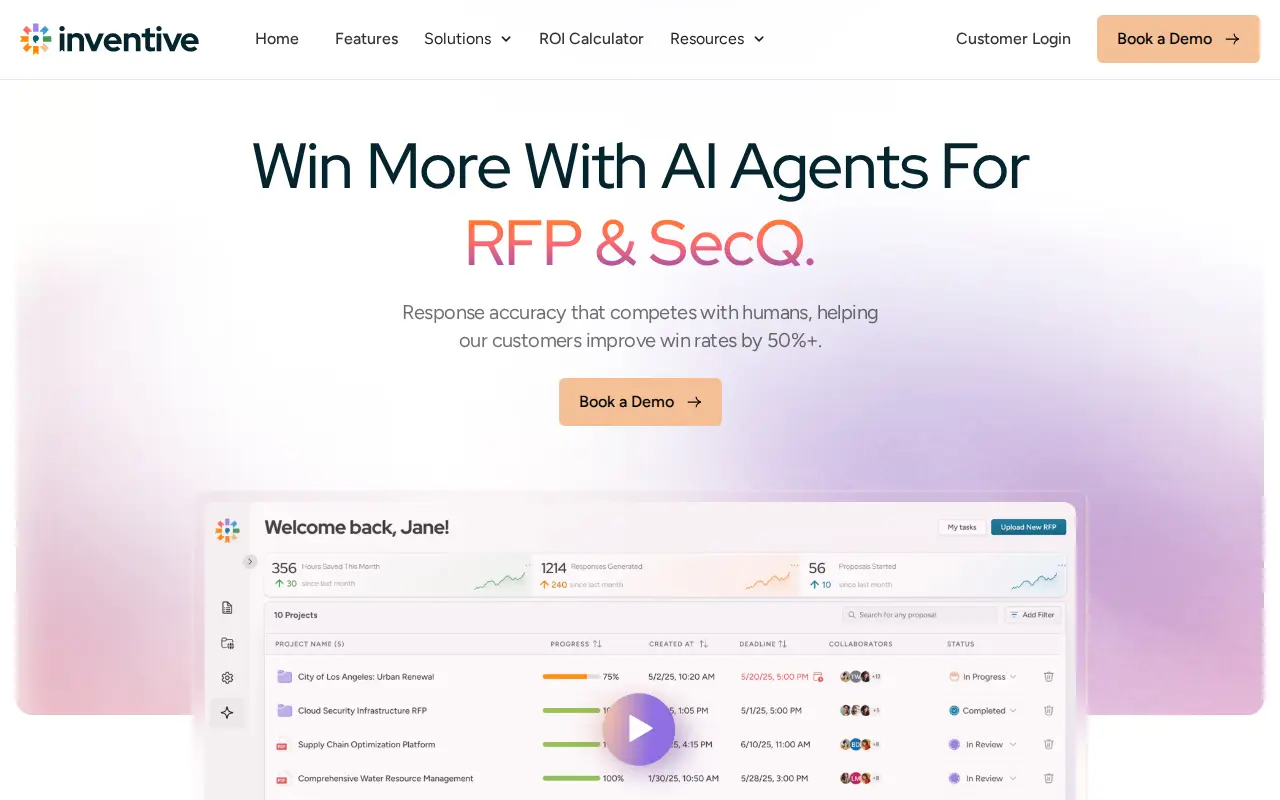
IN Inventive AI
LO Loopio

Security: ISO 27001, SOC 2, and regional hosting
Put Inventive AI and Loopio through the same three questions a security reviewer will ask: ISO 27001, SOC 2, and whether you can keep the tenancy in the US or the EU. Cells say Not listed when we could not find the claim on a public vendor page.
| Check | Inventive AI | Loopio |
|---|---|---|
| ISO 27001 | Not listed | ISO 27001 (legal addendum) loopio.com, 2026-08 Loopio legal addenda cite ISO 27001 and ISO 9001. The public security page describes an ISMS based on ISO 27001 rather than showing a certificate badge. |
| SOC 2 | SOC 2 | SOC 2 Type II loopio.com, 2026-08 |
| US hosting | Not listed | Yes (AWS Northern Virginia; DR in Northern California) slack.com, 2026-08 |
| EU hosting | Not listed | Yes (Loopio EU on AWS Ireland) slack.com, 2026-08 |
Slack and Microsoft Teams
During a live questionnaire, SMEs get pinged in Slack or Teams, not in a vendor portal. Here is what Inventive AI and Loopio publish for those two connections.
| Connection | Inventive AI | Loopio |
|---|---|---|
| Slack | Slack | Slack (NA and EU apps) slack.com, 2026-08 |
| Microsoft Teams | Microsoft Teams | Microsoft Teams (NA and EU apps) loopio.com, 2026-08 |
Subprocessors: the big three clouds, then the niche names
Compare Inventive AI and Loopio on AWS, Azure and GCP first. Then scan for niche processors a reviewer should pause on: third-party LLMs, session replay, or support that leaves the region you elected.
| Layer | Inventive AI | Loopio |
|---|---|---|
| AWS, Azure, GCP | Not listed | AWS |
| Watch-outs | No niche processors flagged in our sourced list. |
Loopio does not publish a full named subprocessor table on its public security page. Confirm the current list in the DPA or during security review. |
Short answer: Pick Loopio if you have a proposal team with someone who owns the content, and you need the governance a mature library brings: multi-step reviews, a multi-language library, separate business units and twelve years of track record. Pick Inventive AI if your contributors are mostly busy SMEs, your source material already lives in SharePoint, Google Drive or Notion, and you would rather pay per RFP with unlimited users than per seat. The deciding facts are Loopio’s 10-seat entry plan versus Inventive AI’s usage meter from $10K a year (checked October 2026).
Loopio is the incumbent. It was founded in 2014 and says more than 1,700 companies use it. Inventive AI is the challenger: a $4 million seed round led by Sierra Ventures in September 2024, a product built around AI agents, and a security questionnaire page that names Loopio directly as the “library your team maintains” approach it wants to replace.
That framing is worth testing, because Loopio has moved. Its AI now pulls from connected sources as well as the Library. So the honest comparison in October 2026 is not “library versus no library.” It is about who does the upkeep, how you pay, and how much structure your team actually needs.
Key takeaways
- Buying model: Inventive AI starts at $10K a year (platform fee plus per-RFP and per-questionnaire usage, unlimited users, unused RFPs roll over). Loopio publishes no prices; Foundations includes 10 seats and a custom seat count appears only on Enterprise (both checked October 2026).
- Where answers come from: Loopio drafts from its curated Library and from Content Connectors such as SharePoint, Google Drive and websites. Inventive AI drafts from connected systems first and still accepts Q&A pairs.
- Upkeep: Loopio uses a Freshness Score and scheduled SME content reviews. Inventive AI uses a Content Governance Agent to flag outdated, conflicting and duplicate answers; its Self-Updating Knowledge Base is labeled Beta.
- Governance depth: Loopio has four permission levels per role, confidential projects, multi-step reviews (from Enhanced) and separate business units and sandboxes (Enterprise). Inventive AI lists user roles and SAML SSO but publishes less on approval chains.
- Track record: Loopio sits at 4.6/5 on G2 from 812 reviews (July 2026). Inventive AI’s homepage says it is rated easiest to use on G2 but does not show a score, and G2 blocked our check.
- Limitations: Loopio’s Capterra reviewers report formatting cleanup on import and export. Inventive AI’s G2 reviewers call reporting light and mention multi-tab Excel exports that need a fix.
The library argument, and how much of it still holds
Inventive AI’s pitch against Loopio is blunt. Its security questionnaire FAQ says tools like Loopio and Responsive “organize approved answers in a library your team maintains,” while Inventive “retrieves answers directly from your connected systems.” A MaxVal director quoted on the same page puts it more simply: “Even with AI, the old tools still felt like Q&A pairs.”
Read Loopio’s own AI page in October 2026 and the gap looks narrower. Loopio says its AI can respond “using content from dozens of diverse sources, including your Library, SharePoint, and much more,” and that you can add websites so public knowledge sits next to internal content. You pick the sources per project, down to specific Library locations or tags. Every statement carries a linked citation, and a Confidence Pulse score marks which answers need a closer look.
Inventive AI has moved toward the middle from the other side. Its homepage says “if you still want to use Q&A pairs, we support that too.” Both tools now cite sources and both rate their own confidence.
So where is the real difference? It is in what each product treats as the source of truth. In Loopio, the Library is the asset, and connectors feed it. In Inventive AI, your SharePoint, Drive, Notion and Confluence are the asset, and agents read from them in place. If your security policies get updated in Confluence before anyone touches the RFP library (which, in most companies, is always), Inventive AI’s model fits how your content already moves. If your proposal team has spent years curating thousands of approved answers, Loopio’s model protects that investment.
One detail favors Loopio for regulated work. Its AI page says answers can flex to the compliance level of a questionnaire, “from SME-vetted responses only” to more persuasive framing. For a bank’s vendor risk team, a mode that only returns the approved wording is not a nice-to-have.
Keeping answers fresh: scores and reviews versus agents
Every answer library rots. The only question is who notices.
Loopio’s answer is process plus signals. A Freshness Score shows how recently each entry was updated, and automated content reviews ask SMEs to validate and approve entries on a schedule. That works when someone owns the schedule. It is also auditable: you can show a customer when the encryption answer was last reviewed and by whom.
Inventive AI’s answer is software doing the noticing. Its Content Governance Agent, per the security questionnaire page, “catches expired certs, outdated controls, and conflicting answers before you submit.” Its DDQ page adds that knowledge agents flag “expired certifications, changed policies, and outdated numbers” since your last submission. A separate Review Agent reads the full draft for unanswered requirements and contradictions before it goes out.
The catch on Inventive AI’s side is maturity. The homepage labels its Self-Updating Knowledge Base as Beta, and the same homepage claims 95% accurate AI responses and 70% faster content maintenance without publishing a method. Those are vendor figures and we could not verify them. Treat them as a reason to test, not a forecast.
The catch on Loopio’s side is labor. Freshness Scores tell you what is stale; they do not rewrite it. If nobody on your team will spend part of every week on library hygiene, the Library will drift, and so will the drafts that come from it.
A fair trial: take a questionnaire you answered six months ago and change one fact in your source docs (a new SOC 2 report date, a renamed product tier). Run it through both. See which tool surfaces the old answer as a problem without being told.
Seats, plans and the meter
This is the section that usually decides it, because the two vendors charge for opposite things.
Inventive AI publishes a starting point. Its pricing page, checked October 2026, says “Plans start at $10K/year.” A fixed platform fee “covers setup, onboarding, and access to all features,” then usage fees apply per RFP and security questionnaire. Unused RFPs “roll over to the next month and even into the next year.” Every plan includes unlimited users, and there is “One Plan” with every feature. The per-RFP rate is not published; you get it on a 15-minute pricing call.
Loopio publishes no dollar figures. Its pricing page, also checked October 2026, lists three plans:
| Plan | What it adds |
|---|---|
| Foundations | 10 seats, unlimited projects and library entries, generative AI, 10 themes, standard support |
| Enhanced | Multi-language library, confidential projects, multi-step reviews, 15 themes |
| Enterprise | Separate business units, sandboxes, custom seat count, 20 themes, premium support |
Add-ons cover project translations in more than a dozen languages, onboarding packages, and industry integrations such as Salesforce and Highspot.
What that means for real teams:
- A presales team of six answering 80 questionnaires a year gets every Loopio project free of usage fees, and 10 seats covers them. Inventive AI’s meter would run on all 80.
- A company pulling in 40 occasional SMEs pays nothing extra for them on Inventive AI. On Loopio, ask how reviewers who touch five questions a month count against seats before you sign.
- Anyone who needs multi-step approvals should price Loopio on Enhanced from day one, because Foundations does not include them.
- Teams with lumpy volume get real protection from Inventive AI’s rollover, which most usage-based plans do not offer.
Two questions to get in writing: from Inventive AI, what counts as one RFP for billing (does a 300-question SIG count the same as a 20-question form?); from Loopio, which integrations your quote includes, since Salesforce is an add-on.
Governance for large and multi-team setups
Loopio has more knobs here, and it publishes them.
Permissions come in four levels per role (No Access, Participant, Creator or Full Access), which controls who can build projects, edit the Library or review responses. Confidential projects keep sensitive bids visible only to the people on them. Enterprise adds separate business units and sandboxes, which matters if you run distinct product lines or regions that should not share every answer. The multi-language library and paid project translations matter if your RFPs arrive in German and Japanese as well as English.
Inventive AI’s security page lists user roles “from administrators to general users,” SAML SSO with Google, Microsoft and Okta, and 2FA for staff. Its integrations page adds that it respects source-level permissions: if a user cannot open a SharePoint folder, Inventive AI will not use that folder’s content in their drafts. That is a quietly useful control for a connected-sources model. What it does not publish is much detail on multi-stage approval chains or permission tiers, so ask to see them in the demo.
Rule of thumb: if your org chart has a proposal center of excellence, regional teams and a legal gate, Loopio’s structure maps onto it. If your “proposal team” is two solutions engineers and a Slack channel, most of that structure is overhead.
Track record and the security paperwork
Your own security reviewers will ask the same questions you ask vendors, so here is what each publishes.
Loopio undergoes an annual SOC 2 Type II audit by a third party, runs an information security management system based on ISO 27001, displays an ISO 42001 badge (the AI management standard) on its security page, encrypts with TLS 1.2 in transit and AES-256 at rest, and runs annual third-party penetration tests. It has a decade of enterprise customers; its pricing page quotes customers at Zendesk and Allied Universal.
Inventive AI is SOC 2 Type II compliant, audited by an independent firm. The ISO 27001 mention on its security page describes its cloud providers, not Inventive itself. In its favor, it states custom enterprise agreements with OpenAI and Anthropic “ensuring zero data retention,” and says customer data never trains generalized models. That is a clear answer to the first question most security teams ask about AI vendors, and the Loopio pages we checked do not name a model provider.
Neither gap is a dealbreaker for most buyers. It is only a problem if your customers ask for the vendor’s own ISO certificate, or if your procurement team weights company age heavily.
Known issues and limitations
Inventive AI
- Usage meter on top of the floor: plans start at $10K a year, with per-RFP and per-questionnaire fees above the platform fee and no published per-RFP rate, per its pricing page (checked October 2026).
- ISO 27001 is the cloud provider’s: Inventive AI’s own certification is SOC 2 Type II, per its security page (checked October 2026).
- Light reporting: G2 reviewers from June to August 2026 describe analytics and management reporting as thin (checked October 2026).
- Export polish: G2 reviewers in June and August 2026 report complex templates and multi-tab Excel exports that need a manual formatting pass, per the same G2 page.
Loopio
- No public price, 10-seat entry: every plan is a custom quote and Foundations includes 10 seats, per its pricing page (checked October 2026).
- Key workflow features sit a tier up: multi-step reviews, confidential projects and the multi-language library start on Enhanced, and Salesforce and Highspot are add-ons, per the same pricing page.
- Formatting on import and export: Capterra reviewers describe cleanup after importing PDFs or exporting projects in reviews dated August 2024 and February 2025, repeating complaints from earlier years (checked October 2026).
- Upkeep still needs an owner: Freshness Scores and scheduled content reviews flag stale entries, per its AI page (checked October 2026), but someone still has to fix them.
Choose Inventive AI when
- Most of the people who touch a questionnaire are occasional SMEs, and per-seat pricing would punish you for inviting them.
- Your current truth lives in SharePoint, Google Drive, Notion or Confluence, and you do not want a second copy to maintain.
- You want agents that check drafts for contradictions and expired certifications before submission, and you accept that parts of that are new.
- You need a budget floor ($10K a year) before your first sales call.
- Your volume swings by quarter and rollover of unused RFPs would actually get used.
- Your security reviewers want a named zero-data-retention arrangement with the model providers.
Choose Loopio when
- You have a content owner (or a team of them) and a curated library you have spent years building.
- You need multi-step reviews, confidential projects, a multi-language library or separate business units.
- You answer a high volume of projects with a stable, small core team, so unlimited projects on a 10-seat plan works in your favor.
- Regulated questionnaires require approved wording returned exactly, with scheduled SME re-validation you can show an auditor.
- Your teams already search through Microsoft Copilot or Glean and want the Library visible there.
- Company longevity and a decade of enterprise references weigh heavily in procurement.
Verdict
Same job, different assumptions about your team. Loopio assumes a proposal function with an owner, a process and a library worth protecting, and it gives that team more structure than any startup in this category. Inventive AI assumes your knowledge already lives elsewhere and your contributors have no time, so it reads from your systems, charges per RFP instead of per head, and puts agents on the upkeep.
Pick on staffing, not on demos. If you can name the person who will own the Library, Loopio rewards them. If you cannot, Inventive AI is designed for exactly that gap. Or, as a colleague might put it: Loopio if you have a librarian, Inventive AI if you have a Slack channel.
Read the full Inventive AI review or Loopio review, or browse all RFP & DDQ software.
Sources checked
- Inventive AI pricing page (checked October 2026)
- Inventive AI homepage (checked October 2026)
- Inventive AI security questionnaire software page (checked October 2026)
- Inventive AI security page (checked October 2026)
- Inventive AI integrations page (checked October 2026)
- Inventive AI reviews on G2 (checked October 2026)
- Pulse 2.0: Inventive AI raises $4 million seed (checked October 2026)
- Loopio pricing page (checked October 2026)
- Loopio AI features page (checked October 2026)
- Loopio security page (checked October 2026)
- Loopio integrations page (checked October 2026)
- Loopio about page (checked October 2026)
- Loopio reviews on Capterra (checked October 2026)
- Loopio reviews on G2 (checked July 2026)
Frequently asked questions
What is the difference between Inventive AI and Loopio?
Loopio is a library-first response platform founded in 2014: approved answers live in a curated Library with Freshness Scores and scheduled SME reviews, and its AI drafts from that Library plus connected sources such as SharePoint and Google Drive. Inventive AI is a younger, agent-based tool that drafts from connected systems first, then uses governance and review agents to catch stale or conflicting answers.
Which is cheaper, Inventive AI or Loopio?
Inventive AI publishes a floor: plans start at $10K a year, made up of a platform fee plus usage fees per RFP and security questionnaire, with unlimited users. Loopio publishes no prices; its entry Foundations plan includes 10 seats and every plan is a custom quote (both checked October 2026). Which costs less depends on your contributor count versus your project count.
Can Inventive AI or Loopio limit AI answers to approved content only?
Both say so. Loopio lets you choose the sources per project and says answers can be restricted to SME-vetted responses for sensitive questionnaires. Inventive AI says it drafts only from approved sources, attaches a citation and confidence score, and flags a gap instead of writing an answer it cannot support.
Do Inventive AI and Loopio support single sign-on and Microsoft Teams?
Yes. Loopio offers SAML 2.0 SSO with Okta, OneLogin, Microsoft Azure and ADFS, plus Slack and Microsoft Teams access. Inventive AI supports SAML SSO with Google, Microsoft and Okta, and lists Microsoft Teams, Slack, HubSpot, Salesforce and Zendesk on its integrations page (checked October 2026).
Is it hard to move from Loopio to Inventive AI?
Inventive AI says it supports Q&A pairs alongside synced documents, so an exported Loopio library has somewhere to land. Neither vendor publishes a migration timeline, so ask for one in writing and test with your messiest library category first.
Should I choose Inventive AI or Loopio?
Choose Loopio if you run a proposal team with a dedicated content owner, need multi-step reviews, multi-language content or separate business units, and value a decade of track record. Choose Inventive AI if most of your contributors are occasional SMEs, your truth already lives in SharePoint, Drive or Notion, and you would rather pay per RFP than per seat.
Do Inventive AI and Loopio list ISO 27001, SOC 2, and US or EU hosting?
Inventive AI: ISO 27001 Not listed, SOC 2 SOC 2, US Not listed, EU Not listed, Slack Slack, Teams Microsoft Teams, clouds Not listed. Loopio: ISO 27001 ISO 27001 (legal addendum), SOC 2 SOC 2 Type II, US Yes (AWS Northern Virginia; DR in Northern California), EU Yes (Loopio EU on AWS Ireland), Slack Slack (NA and EU apps), Teams Microsoft Teams (NA and EU apps), clouds AWS. Confirm both on the vendor sites.
Source registry
Every page we read for these profiles, with the month it was last checked. Anything without a source is shown as not publicly disclosed. Spot an outdated fact? Send it from the corrections page.
Inventive AI
Security and compliance
- No security source URL recorded. Treat certifications and hosting as not publicly disclosed.
Product and integrations
Third-party reviews
Loopio
Pricing
Security and compliance
Product and integrations