Savix review: pricing, features and alternatives (2026)
Quick answer
Savix is AI-native RFP and security questionnaire software for small proposal or security-questionnaire teams that want claim-checked drafts on a self-serve budget. Pricing starts at $99/mo on a flat-rate model. Check before buying: No pricing page. Branded export templates and the verification audit trail sit on Team and Enterprise plans with unpublished prices.
Self-serve RFP drafting that checks every claim against your documents
- Overall score: 4.0/5 across 9 capability dimensions.
- Best for: Small proposal or security-questionnaire teams that want claim-checked drafts on a self-serve budget.
- Pricing: $99/mo on a flat-rate basis.
- Standout strength: Claim-level checking: each sentence-level claim is tied to a source quote, and anything without one is flagged before export.
- Ecosystem: 0 integrations.
- Limitations: No pricing page. Branded export templates and the verification audit trail sit on Team and Enterprise plans with unpublished prices.
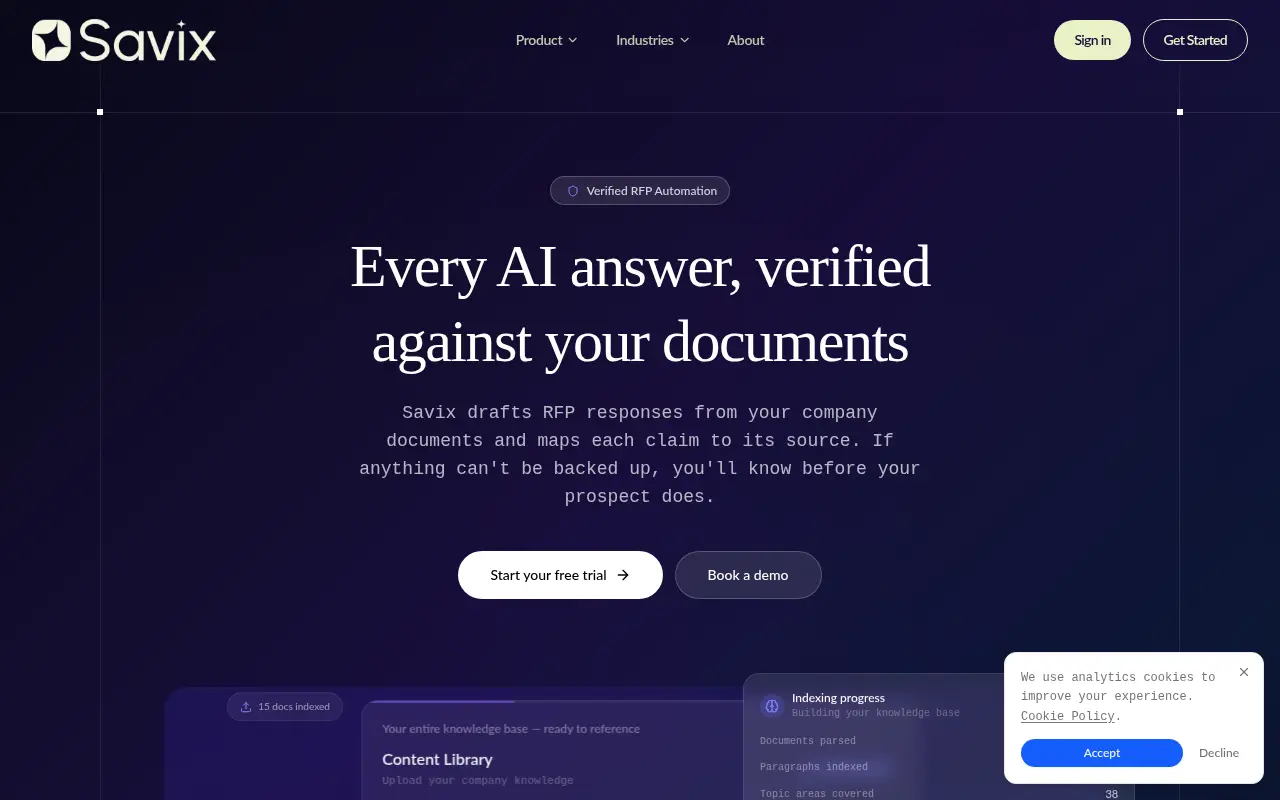
The verdict up front
Savix is a small, self-serve RFP tool with one genuinely good idea: it doesn’t just draft an answer, it checks each claim inside the answer against a quote from your own documents and tells you which ones it can’t back up. Product pages quote $99/mo with a 14-day trial and no card, which makes it one of the cheapest ways in this directory to try AI drafting on a real questionnaire.
The catch is everything around that idea. Savix publishes no customer names, no team, no founding date and no independent reviews we could find. There are no connectors to Google Drive or SharePoint. You upload files. Its security story is a privacy policy plus a “SOC 2 compliant” badge with no report type attached.
So: worth a 14-day trial if you’re a lean team with a tight budget and a real fear of submitting something untrue. Not something to build an enterprise response program on until the company shows more of its hand.
One naming note before we start. The savix.ai domain belongs to an unrelated AI training and education business that publishes in Chinese. The RFP product lives at savix.io and is run by Savix Inc.
What it actually does
The workflow is short and readable on the product pages. You build a knowledge base by uploading documents. You upload an RFP. Savix pulls out every question, sorts them into sections that mirror the original, and classifies each one by type, such as free text or yes/no. Then it drafts answers from your knowledge base and runs its verification step on every answer. You review and assign questions to teammates, then export.
Export goes to Word or PDF, plus spreadsheets. Branded templates and an exported verification audit trail are listed as Team and Enterprise plan features.
Savix also aims the same engine at security questionnaires. Its technology industry page names SIG Lite and CAIQ, plus VSAQ and custom Excel questionnaires, all answered from a compliance library you upload once. There are separate industry pages for IT services, consulting, healthcare and government contracting, and the government page goes deep on CMMC and NIST 800-171 questionnaires answered from your System Security Plan.
DDQs aren’t named anywhere on the product pages. The about page talks about RFPs and vendor questionnaires. If your work is investor due diligence, you’d be testing an untested use case.
How drafting and verification work
This is the part worth your attention.
Savix says it uses retrieval over your uploaded documents only, never generic training data, to draft each answer. Then its Evidence Verification feature breaks the answer into individual factual claims and searches your knowledge base for each one. Every claim lands in one of four states:
- Supported: a direct quote backs it, with the excerpt and page reference pinned to the claim.
- Partially supported: evidence exists, but the claim goes further than the source. The page’s example is a “100% uptime” claim backed only by a 99.9% SLA.
- Unsupported: nothing in your documents backs it, so it gets flagged for human review.
- Rescued: a claim that was unsupported until you uploaded the missing document.
That last state is clever. A flagged claim is often not a hallucination at all. It’s a gap in your knowledge base, and Savix turns the flag into a to-do list for documents you forgot to upload.
The pitch here is explicit. Savix’s about page argues that confidence scores are estimates and quotes are proof, and it positions the whole product around that difference. We’d agree with the principle. A reviewer checking a SOC 2 claim wants the line from the SOC 2 report, not a percentage. Whether the claim extraction holds up on long, compound answers is something you’d only learn by running your own files through it.
The knowledge base itself is plain and sensible. Upload PDFs, Word files, spreadsheets, PowerPoint, CSVs or text, up to 50MB per file, with unlimited uploads on every plan. Tag documents as company info, past Q&A, compliance or technical specs so the AI knows what to prefer. Reviewed answers feed back in as source material, and there’s a chat assistant for asking the library questions directly.
What’s missing is any live connection. Savix’s own homepage describes the problem as answers scattered across Google Drive, SharePoint, Slack and Confluence. Its fix is to have you upload copies. That works, but it means your knowledge base is a snapshot, and keeping it current is a manual chore.
Security and compliance posture
Thin, and you should treat it as unverified until Savix sends paperwork.
The privacy policy (last updated August 2026) is the most concrete document. It says Savix does not use customer content to train or fine-tune AI models, keeps each customer’s knowledge base logically isolated, and encrypts data in transit with TLS 1.2 or later and at rest. It also says third-party AI providers process queries under no-training terms, but may retain inputs and outputs for up to 30 days for abuse monitoring, with zero-retention settings used only where available.
On location, the policy says Savix is based in the US and primarily processes data there, using Standard Contractual Clauses for transfers from Europe. It names subprocessor categories but not the actual vendors, so you can’t tell which cloud or which model provider sits underneath.
Certifications are where we’d slow down. Several industry pages show a “SOC 2 compliant” badge under the trial button. There’s no trust center, no report type, no auditor and no mention of SOC 2 in the privacy policy. We’ve listed SOC 2 as not listed until a report turns up. Ask for it on day one of the trial.
Pricing and how to buy it
Savix has no pricing page. The $99/mo figure appears in comparison panels on the RFP automation page and two industry pages, described as full platform cost with no per-seat or per-proposal charges. The Team and Enterprise tiers mentioned on feature pages have no published price.
The terms of service fill in the billing mechanics. Fees are billed in advance, monthly or annually, in US dollars. The refund policy allows refunds within 14 days of purchase. After that, cancellation stops the next renewal but there’s no partial refund for unused time. Savix can change pricing with 30 days’ notice.
Buying is genuinely self-serve. You sign up with a name and an email, and the trial needs no card. That’s a rare thing in this category and a real point in its favor.
Where it falls short
These are sourced from Savix’s own pages:
- Opaque plan structure. One price on a few product pages, no plan table, and the export features a compliance reviewer would want (the audit trail) gated to tiers with no listed price.
- No refunds after two weeks. Fees are paid in advance, and after the 14-day window there’s no partial refund for unused time.
- Model-provider retention. Your questionnaire content may sit with an unnamed AI provider for up to 30 days for abuse monitoring.
- US processing only. No EU hosting option is listed, which matters if your security team insists on residency.
Add the softer gaps. There’s no named customer, and no third-party reviews turned up in our search. The only address on the legal pages is in Sheridan, Wyoming, with no office or team named. None of that proves anything bad. It just means you’re the reference customer.
Who should shortlist it and who should skip it
Shortlist it if you’re a small team answering a handful of RFPs or security questionnaires a quarter without budget for a five-figure contract. It fits best when your biggest worry is a teammate pasting an outdated certification into a live bid.
Skip it if you need connectors to live content, multi-step approvals, SSO, a SOC 2 report in hand before procurement will sign, or EU data residency. Skip it too if your volume is DDQs rather than RFPs.
How it sits next to its peers
AutoRFP.ai is the accuracy-first tool for writing winning responses in a workflow that is easy to run, and the closest match on the verification theme. It traces each drafted line back to its origin, including lines the model wrote on its own, and it publishes flat pricing from $899/mo with unlimited users. That’s roughly nine times Savix’s quoted price, and it adds CRM integrations plus Word and Excel round-tripping. Savix’s edge is the price and the explicit four-state claim check.
1up is the other self-serve option. It has a free-forever plan and flat paid tiers from $300/mo, plus a Slack and Teams bot for sales questions. 1up caps questionnaire automations by plan, while Savix advertises no per-proposal charges. 1up is the more established product with published certifications.
Arphie solves the freshness problem Savix leaves open, by drafting from live connections to sources like Google Drive and SharePoint. It shows sources and confidence scores on answers. It’s quote-only with no self-serve plan, so it’s a different buying motion entirely.
Loopio is the heavyweight: a tagged, versioned answer library with multi-step review and a broad integration catalog. If you need governance across a large team, Loopio does what Savix doesn’t attempt. If you need one person to finish a questionnaire this week for under $100, Loopio isn’t built for that.
What to test in a trial
Fourteen days goes fast. Here’s how we’d spend them:
- Ask for the SOC 2 report on day one, and ask which cloud and which model provider process your data.
- Upload your real SOC 2 report and two past proposals. Skip the sample files.
- Run a 150-row SIG Lite or CAIQ through it and count how many claims come back unsupported.
- Check five “supported” claims by hand. Does the pinned quote actually say what the answer says?
- Plant a wrong fact in a question, such as an ISO certification you don’t hold, and see whether it gets flagged.
- Upload a missing document and watch whether an unsupported claim flips to rescued.
- Export to your buyer’s original Excel format and check how much reformatting it needs.
- Ask in writing what the $99/mo plan includes and what Team costs. Confirm whether the audit-trail export is on your tier.
Our take: Savix has the right instinct about what makes AI drafts safe to submit, and the price makes it easy to find out. Just verify the vendor as carefully as it verifies your claims.
Overview
Savix is a young, self-serve AI tool that drafts RFP and security questionnaire answers from documents you upload, then checks each claim against a direct quote in those files. Its product pages quote $99/mo with a 14-day free trial, but the company publishes little about itself beyond that.
Capability snapshot
Nine jobs, scored 0 (not offered) to 3 (category-leading). Savix is strongest on RFPs and lightest on Integrations. The same scores feed every comparison table.
- RFPs2/3
- DDQs1/3
- Security questionnaires2/3
- AI drafting2/3
- Answer library2/3
- Source attribution2/3
- Workflow & approvals1/3
- Integrations0/3
- Self-serve onboarding2/3
Strongest: RFPsLightest: Integrations
Key features
- Evidence Verification that maps each drafted claim to a quote in your documents
- Four claim states: supported, partially supported, unsupported, and rescued
- Question extraction from uploaded RFP files into a structured project
- Document knowledge base with semantic search and a chat assistant
- Question assignment and completion tracking for teammates
- Export to Word or PDF, plus spreadsheets, with an optional verification audit trail
Who it's for
Lean B2B response teams who would rather catch an unsupported claim before submission than buy deep workflow or a long connector list.
Strengths
- Claim-level checking: each sentence-level claim is tied to a source quote, and anything without one is flagged before export.
- You can start alone: instant signup and a 14-day trial with no credit card.
- Product pages quote $99/mo for the platform with no per-seat charges, low for this category.
- The privacy policy rules out training on customer content and promises logical tenant isolation.
Limitations
- No pricing page. Branded export templates and the verification audit trail sit on Team and Enterprise plans with unpublished prices.
- Fees are billed in advance and are non-refundable after the 14-day refund window, with no partial refund for unused time.
- Its privacy policy says third-party AI providers may keep inputs and outputs for up to 30 days for abuse monitoring, using zero retention only where available.
- Data is processed primarily in the US, with EU transfers covered by Standard Contractual Clauses; no EU hosting option is listed.
Where it falls short
Gaps we found in research, each linked to its source.
- No pricing page. Branded export templates and the verification audit trail sit on Team and Enterprise plans with unpublished prices. savix.io, 2026-10
- Fees are billed in advance and are non-refundable after the 14-day refund window, with no partial refund for unused time. savix.io, 2026-10
- Its privacy policy says third-party AI providers may keep inputs and outputs for up to 30 days for abuse monitoring, using zero retention only where available. savix.io, 2026-10
- Data is processed primarily in the US, with EU transfers covered by Standard Contractual Clauses; no EU hosting option is listed. savix.io, 2026-10
Security: ISO 27001, SOC 2, and regional hosting
A security review of Savix usually starts with three questions: ISO 27001, SOC 2, and whether you can keep data in the US or the EU. We only mark a yes when a public vendor page supports it.
- ISO 27001
- Not listed
- SOC 2
- Not listed savix.io, 2026-10
Industry pages carry a "SOC 2 compliant" badge, but Savix names no audit type or auditor, and its privacy policy does not mention SOC 2. Ask for the report.
- US hosting
- Yes (primarily processed in the US) savix.io, 2026-10
- EU hosting
- Not listed
The privacy policy says Savix is US-based and primarily processes data in the US, relying on Standard Contractual Clauses for transfers from Europe. It names subprocessor categories (cloud hosting, payments, analytics, support, AI providers) but not the vendors.
Slack, Teams and the rest of the stack
Savix collaboration is only as useful as the chat tools your SMEs already live in. Slack and Microsoft Teams are the two that matter on a live questionnaire.
- Slack
- Not listed
- Microsoft Teams
- Not listed
Subprocessors
For Savix, start with the big three clouds (AWS, Azure, GCP), then look at niche processors that touch answer content, call a third-party model, or record sessions.
- AWS, Azure, GCP
- Not listed
No named subprocessors are listed in our sourced dataset for Savix.
Topics
Pricing and value
Savix uses flat-rate pricing, starting at $99/mo Product pages put full platform access at $99/mo with no per-seat or per-proposal charges, after a 14-day trial with no card. There is no pricing page, and the Team and Enterprise tiers that add branded export templates and the verification audit trail have no published price.
On our capability model it scores 4.0 out of 5 across 9 dimensions. Weigh that against small proposal or security-questionnaire teams that want claim-checked drafts on a self-serve budget to judge whether the price fits the job.
Pricing and details verified Oct 2026. Confirm on the vendor's site before you buy.
Who should pick Savix, and who should skip it
Pick it if you fit this profile: lean B2B response teams who would rather catch an unsupported claim before submission than buy deep workflow or a long connector list. Where it earns its place: Claim-level checking: each sentence-level claim is tied to a source quote, and anything without one is flagged before export.
Look elsewhere if this limitation is a deal-breaker: No pricing page. Branded export templates and the verification audit trail sit on Team and Enterprise plans with unpublished prices. Also look around if integrations is central to how you work (0/3 here). In that case, one of the Savix alternatives may fit better.
Bottom line
Best use case in one line: Small proposal or security-questionnaire teams that want claim-checked drafts on a self-serve budget.
Teams evaluating Savix often also compare Savix vs Velocibid, and Savix vs Quilt, or browse Savix alternatives.
Similar tools
Loopio, AutoRFP.ai, and Responsive come first as category benchmarks, followed by the closest peers on the job Savix is hired for (shared categories and tags, plus aligned capabilities). The snapshot above already scores each job. The notes below say where each tool is stronger, lighter, or a match.
Loopio (4.6/5, Custom (~$20K+/yr est.)). Best for large enterprise teams with high response volume and a mature content library. Matches Savix on AI drafting, and leads on RFPs and DDQs. Audience: Teams in SaaS, tech, financial services, and healthcare answering high volumes of RFPs, RFIs, DDQs, and security questionnaires. Watch-out: No public prices: the entry Foundations plan includes 10 seats, and multi-step reviews start one tier up on Enhanced.
AutoRFP.ai (4.9/5, $899/mo). Best for software and finance teams answering structured RFPs in Word and Excel who want accuracy-first drafts, responses written to win, and a workflow that is easy to run. Leads Savix on RFPs, DDQs, and AI drafting. Audience: Software and finance response teams whose RFPs come in as Word or Excel files and who want accuracy-first drafts, winning responses with every line cited to a source, a person, or the AI, and a workflow that is easy to run. Watch-out: Built for structured, source-cited answers rather than creative writing on long-form responses. For persuasive multi-page narrative, AutogenAI is built for that prose job.
Responsive (4.6/5, $10,000 (Emerging edition)). Best for enterprise teams with complex approval chains and heavy integration requirements. Matches Savix on AI drafting, and leads on RFPs and DDQs. Audience: Enterprise sales and proposal teams that need the widest workflow across RFPs, RFIs, DDQs, and security questionnaires. Watch-out: Quoted by edition, user count, and add-ons, with a 12-month minimum term as standard and no free trial.
Velocibid (4.3/5, $49/mo). Best for small SaaS security teams that want cited questionnaire drafts on a monthly card payment. Matches Savix on RFPs, DDQs, and AI drafting. Audience: Founders and small security or sales teams at SaaS companies who answer SOC 2 and CAIQ questionnaires and want to start without a sales call. Watch-out: Its security page lists the certifications of providers such as Vercel and Supabase, not a SOC 2 or ISO 27001 report for Velocibid itself.
RequestFX (4.3/5, $299/mo). Best for small B2B teams that want to start answering security questionnaires and spreadsheet RFPs on a published price today. Matches Savix on RFPs and AI drafting, and leads on DDQs. Audience: Smaller software and hardware vendors, especially in Europe, whose engineers or founders currently answer every vendor questionnaire by hand. Watch-out: Growth includes only 2 editor seats, and single sign-on is reserved for the quoted Enterprise plan.
Sequesto (4.3/5, €750/mo). Best for european bid and tender teams that want agent drafting plus configurable review workflows at a published price. Matches Savix on RFPs and AI drafting, and leads on DDQs. Audience: Bid managers in regulated European businesses, such as life sciences or financial services, who answer tenders and security questionnaires side by side. Watch-out: Team (€750/mo billed annually) includes only 3 users and 2 MCP integrations; extra users cost €200/user/mo.
Sources behind this Savix review
Every page we read for the Savix profile, with the month it was last checked. Anything without a source is shown as not publicly disclosed. Spot an outdated fact? Send it from the corrections page.
Pricing
Security and compliance
Product and integrations
Third-party reviews
- No review-site source recorded.
Frequently asked questions
Is Savix the same company as savix.ai?
No. savix.ai belongs to SAVIX AI Ltd., an unrelated AI training and education business that publishes in Chinese. The RFP product covered here lives at savix.io and is run by Savix Inc.
What happens when Savix cannot back up a claim?
It marks the claim unsupported and puts it in your review queue. You can edit or drop the claim. If the evidence exists but was missing, upload that document and Savix re-checks the claim and labels it rescued.
What is Savix?
Savix is a young, self-serve AI tool that drafts RFP and security questionnaire answers from documents you upload, then checks each claim against a direct quote in those files. Its product pages quote $99/mo with a 14-day free trial, but the company publishes little about itself beyond that. In this directory it sits under RFP Response, Security Questionnaires, AI-Native.
How much does Savix cost?
Savix uses flat-rate pricing starting at $99/mo. Product pages put full platform access at $99/mo with no per-seat or per-proposal charges, after a 14-day trial with no card. There is no pricing page, and the Team and Enterprise tiers that add branded export templates and the verification audit trail have no published price.
Does Savix have a free plan or trial?
No. Savix does not advertise a free plan, so expect a demo or quote on its flat-rate pricing.
What does Savix do best?
Claim-level checking: each sentence-level claim is tied to a source quote, and anything without one is flagged before export. You can start alone: instant signup and a 14-day trial with no credit card.
What are the main limitations of Savix?
No pricing page. Branded export templates and the verification audit trail sit on Team and Enterprise plans with unpublished prices. Fees are billed in advance and are non-refundable after the 14-day refund window, with no partial refund for unused time. Its privacy policy says third-party AI providers may keep inputs and outputs for up to 30 days for abuse monitoring, using zero retention only where available. Data is processed primarily in the US, with EU transfers covered by Standard Contractual Clauses; no EU hosting option is listed.
Who should use Savix?
Lean B2B response teams who would rather catch an unsupported claim before submission than buy deep workflow or a long connector list.
Does Savix handle RFPs, DDQs, and security questionnaires?
Savix is capable on RFPs and security questionnaires, and DDQs is a limited fit. Lean B2B response teams who would rather catch an unsupported claim before submission than buy deep workflow or a long connector list.
What integrations and certifications does Savix list?
Savix does not publish a long integration catalog in our dataset. No certifications are listed in our dataset; confirm on the vendor site.
Does Savix have ISO 27001, SOC 2, and US or EU hosting?
Savix ISO 27001: Not listed. SOC 2: Not listed. US hosting: Yes (primarily processed in the US). EU hosting: Not listed. Slack: Not listed. Microsoft Teams: Not listed. Big-three clouds listed: Not listed. Confirm on the vendor site before a security review.