RequestFX review: pricing, features and alternatives (2026)
Quick answer
RequestFX is AI-native RFP, DDQ and security questionnaire software for small B2B teams that want to start answering security questionnaires and spreadsheet RFPs on a published price today. Pricing starts at $299/mo on a flat-rate model. Check before buying: Growth includes only 2 editor seats, and single sign-on is reserved for the quoted Enterprise plan.
Self-serve AI questionnaire answering with EU-only data storage
- Overall score: 4.3/5 across 9 capability dimensions.
- Best for: Small B2B teams that want to start answering security questionnaires and spreadsheet RFPs on a published price today.
- Pricing: $299/mo on a flat-rate basis.
- Standout strength: Published prices and a 14-day free trial, so you can test it on a real questionnaire before talking to anyone.
- Ecosystem: 4 integrations.
- Limitations: Growth includes only 2 editor seats, and single sign-on is reserved for the quoted Enterprise plan.
The verdict
RequestFX is the rare tool in this category you can buy without a sales call. It drafts cited answers to security questionnaires and spreadsheet RFPs from documents you upload, puts them back into the buyer’s original file, and costs $299 a month to start, with a 14-day free trial. For a small European software company where the CTO currently answers every SIG, that is a sensible first purchase.
The trade-off is maturity. RequestFX is a small Slovenian company with one Capterra review, no published SOC 2 or ISO 27001 of its own, and two legal documents that disagree about AI training. None of that rules it out. It does mean you should read the paperwork as carefully as you test the drafts.
Who I’d hand it to: a founder-led or lean B2B team, especially one in the EU, answering a handful of security questionnaires and RFPs a month. Who I’d steer elsewhere: a large proposal desk writing long narrative bids, or a buyer whose procurement checklist starts with “send us your SOC 2 report.”
Everything here comes from RequestFX’s own site and legal pages, its Chrome Web Store listing and its Capterra page as of October 2026. I have not used the product, so the checklist at the end is what I would run in the trial.
What RequestFX actually is
RequestFX is run by Fifth Axiom d.o.o., a company registered in Ljubljana, Slovenia. Its terms are governed by Slovenian law, with disputes heard in Ljubljana courts. The launch post introducing the product is dated May 30, 2025, so the product is not much more than a year old.
The pitch has widened since launch. The homepage still leads with RFPs and security questionnaires, but the about page now describes “an AI-native response management platform” covering RFPs, security questionnaires and regulatory reports. There are separate solution pages for compliance audits and regulatory filings. In practice, the job is the same throughout: take a structured questionnaire, answer it from your documents, hand back the filled-in file.
Named customers are few. Visionect, the e-paper display company behind Joan Workplace, has a full case study. Its co-founder and CTO says RequestFX saves him “up to a week of time per month,” and RequestFX says the team was onboarded within a day. The homepage adds testimonials from co-founders at Myelin and 1Home, plus a marketing analyst at Turtle.
One housekeeping note. The “Loved by Industry Leaders” strip shows logos for Laravel, SavvyCal, Statamic, Transistor and Tuple, and nothing on the site ties those companies to RequestFX. They match the sample logos that ship with a popular website template, and a /company page on the same site still carries that template’s placeholder copy about a fictional company. Do not count that strip as social proof.
How drafting and the knowledge base work
The workflow is three steps, and the site describes each one clearly.
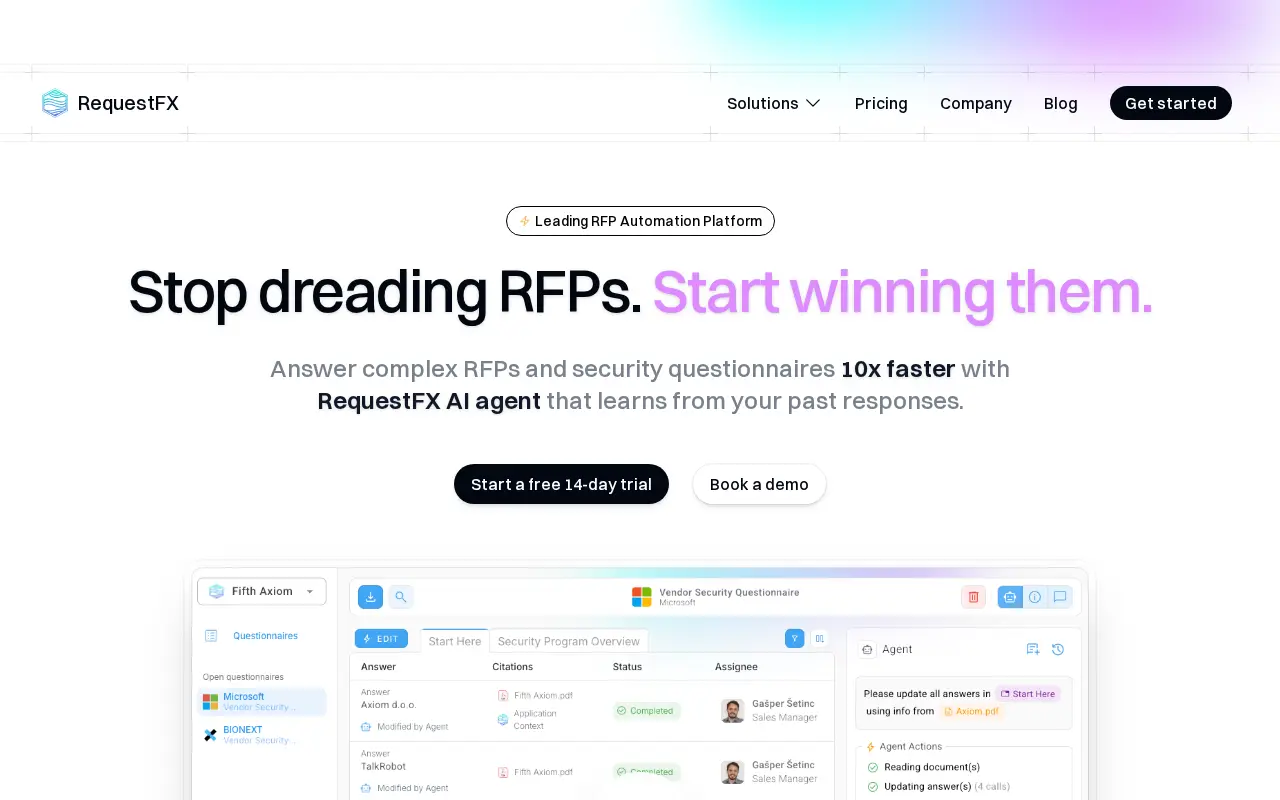
Ingest and draft. You upload the questionnaire plus reference material. The getting-started guide lists Excel, Word, PowerPoint and PDF for questionnaires, and the RFP page adds third-party portals through the browser extension. RequestFX extracts every question, then drafts answers from your knowledge base: past questionnaires, internal policies and product documentation, plus your public website. You can set the answer language and the desired response length before it runs.
Review and collaborate. Each draft comes with a confidence score and a citation showing which document and section it came from. A built-in viewer puts the question and its source side by side. You assign questions to experts, set due dates on sections or people, and chat on the question itself. Statuses run from drafted to assigned to in review to approved, and automated reminders nudge owners who are behind.
Export. RequestFX writes the answers back into the original file, keeping tables and layout intact. The security page says this covers cells, columns, tabs and conditional sections. The single Capterra review singles out exactly this: complex Excel security questionnaires come back in the same format.
There is also a plain-English AI agent. You can tell it to rewrite answers, assign questions or bulk-update statuses, or to refresh outdated answers from your latest documentation.
On the knowledge base, RequestFX straddles both camps. The pitch is “no content library to build,” because drafts come straight from uploaded documents. But the pricing FAQ also says you can save reviewed answers to a central answer library that the AI reuses in future questionnaires. That is a sensible hybrid: start from documents, keep the answers you have approved.
A template library preloads 21 standards. SIG and CAIQ are there with HECVAT, and investor DDQs include ILPA and AIMA. It also covers less common forms like the Wolfsberg CBDDQ for correspondent banking, EcoVadis and CDP for sustainability, and CMMC with NIST 800-171 for defense suppliers.
Portals and the Chrome extension
Web portals are handled by an optional Chrome extension that is included with your account. It opens in a side panel next to the form, drafts answers from your knowledge base with citations, and maps them into the form fields. The privacy policy says it reads form fields only on the tab where you trigger it, and does not store browsing history.
The Chrome Web Store listing showed version 1.1.0, updated February 18, 2026, with about 10 users and five 5-star ratings. That is a small install base. Unlike some peers, RequestFX does not publish a list of named portals it supports, so test the exact portals your buyers use.
Security and compliance posture
Dialing the jokes down here, because this is where you need to slow down.
Residency is the strength. The privacy policy says all personal data and project data, including uploaded documents, are stored on servers located exclusively within the EU. Infrastructure is Google Cloud: Cloud Run for the app and Cloud SQL plus Cloud Storage for data. Knowledge-base search runs on Vertex AI Search, and Firebase handles authentication. Analytics come from Google Analytics and PostHog. The pricing FAQ adds that on-premise deployment is available for customers with specific data handling needs.
Certifications are the gap. The privacy policy says its hosting providers adhere to ISO 27001. It does not claim a SOC 2 report or ISO 27001 certificate for RequestFX itself, and I found no trust center. The 2025 launch post mentions Google SSO and two-factor authentication. Full single sign-on sits on the Enterprise plan.
The AI training language does not match. The terms promise, in bold, that your content will not be used to train or improve its models, or its providers’ models. The privacy policy, both documents dated January 5, 2026, lists “to train our AI models on response accuracy (processed anonymously where possible)” as a purpose. Those may be reconcilable, but get it in writing. The policy also refers to unnamed “trusted third-party AI providers,” so ask which model providers see your content and where they process it.
Pricing and how to buy it
This is the easy part. The pricing page lists three plans:
- Growth: $299/month. For teams answering fewer than 10 questionnaires a month. Unlimited questionnaires, 2 editor seats, unlimited viewer seats.
- Scale up: $999/month. For more than 10 questionnaires a month. Unlimited questionnaires, 10 editor seats, unlimited viewers.
- Enterprise: contact sales. Unlimited editors, SSO and support for multiple business units.
Both paid plans start with a 14-day free trial. (A June 2025 guide mentioned a 30-day trial with no card, so the offer has changed.) Prices show in USD with EUR and GBP toggles. The page does not say whether those prices are billed monthly or annually, which is worth asking before you sign.
The seat model rewards small teams. Viewers are free, so sales reps and reviewers can see work without a license. But only editors can draft and edit, and 2 editors is tight if security, sales engineering and legal all write answers. The jump from 2 to 10 editors is a $700 a month step.
Where it falls short
- Two editors on the entry plan. Growth caps editors at 2, and SSO waits for Enterprise.
- No vendor certification on show. ISO 27001 is named for the hosting providers only, and there is no SOC 2 report to request.
- Conflicting AI training language. The terms rule out training on your content, while the privacy policy lists training on response accuracy.
- Thin independent evidence. Capterra showed one 5.0 review in October 2026, from a reviewer listed as Luka B., a CTO, which matches the Visionect co-founder in RequestFX’s own case study. That reviewer also asked for a Confluence integration. RequestFX also has a Gartner Peer Insights listing, which I could not load.
Who should shortlist it, and who should skip it
Shortlist RequestFX if:
- You answer security questionnaires and structured RFPs every month and nobody’s job title is “proposal manager.”
- Your buyers or your own policies want customer data kept in the EU.
- You want to test on a real questionnaire this week without a demo call.
- Two editors plus free viewers covers your actual writers.
Skip it if your buyers will ask for your vendor’s SOC 2 report during your own security review. Skip it too if your main work is long narrative proposals with formal review gates, or if you need a long, checkable list of named portals and integrations.
How it sits next to its peers
RequestFX vs Bidara. Same $299 entry price, different shape. Bidara’s Starter plan is billed annually and caps AI-generated responses at 10 a month, with 3 users. RequestFX includes unlimited questionnaires and viewers but only 2 editors, and its trial runs 14 days against Bidara’s one-proposal trial. Bidara leans toward narrative RFPs for consultants. RequestFX leans toward spreadsheet questionnaires and security reviews. Neither lists SOC 2 or ISO 27001 of its own.
RequestFX vs 1up. 1up has a free-forever plan and a $300/mo Starter tier with unlimited users, and it lists SOC 2 and ISO 27001. It also works inside Slack and Teams, which RequestFX does not list. RequestFX wins on EU-only storage and file-format fidelity for Excel questionnaires. If you want a free start and chat-first answers for reps, 1up. If you need EU residency, RequestFX.
RequestFX vs AutoRFP.ai. AutoRFP.ai is the accuracy-first tool for writing winning responses in a workflow that is easy to run. Both publish flat prices and export answers back into the buyer’s original file, and both offer an EU hosting option. AutoRFP.ai starts at $899/mo with unlimited users and holds ISO 27001 and SOC 2 Type II, which matters when your own buyers ask for your vendor’s reports. RequestFX is a third of the entry price and lets you start without a call. Small teams on a tight budget should start with RequestFX; teams that need audit paperwork and more writers should look at AutoRFP.ai.
RequestFX vs Loopio. Loopio is the mature, library-first option with an EU environment, SOC 2 Type II, ISO 27001 and hundreds of G2 reviews. It is also quote-only and built for larger proposal teams with a content manager. RequestFX is the opposite trade: cheap, fast to start, light on governance and track record. Pick Loopio when the library and the review chain are the product. Pick RequestFX when getting the next SIG out the door is.
What to test in the trial
Fourteen days is enough if you plan it.
- Upload your real knowledge base (policies, last year’s questionnaires, product docs), not a sample set.
- Run a questionnaire you already answered and compare it to the version you sent, line by line.
- Check citations on ten answers. Does each point to the section that actually supports it?
- Watch the low-confidence answers. Are the scores low on the answers that are actually wrong?
- Export an ugly Excel file with merged cells, hidden tabs and conditional questions, then open it in Excel.
- Try the Chrome extension on a portal your buyers actually use.
- Ask for the paperwork: the subprocessor list including AI providers, a DPA, and a written answer on whether your content is used for any model training.
- Confirm the billing term and what happens to your data at cancellation.
The bottom line: a cheap, EU-hosted questionnaire tool with honest pricing that is worth a trial for small teams, as long as its missing certifications are not a deal-breaker for your own buyers.
Overview
RequestFX is an AI-native tool from Slovenia that drafts cited answers to RFPs and security questionnaires from your uploaded documents, then exports them back into the original file. Plans start at $299 a month with a 14-day free trial, and customer data is stored only in the EU.
Capability snapshot
Nine jobs, scored 0 (not offered) to 3 (category-leading). RequestFX is strongest on Self-serve onboarding and lightest on Integrations. The same scores feed every comparison table.
- RFPs2/3
- DDQs2/3
- Security questionnaires2/3
- AI drafting2/3
- Answer library2/3
- Source attribution2/3
- Workflow & approvals2/3
- Integrations1/3
- Self-serve onboarding3/3
Strongest: Self-serve onboardingLightest: Integrations
Key features
- Question extraction from XLSX, DOCX, PDF and PowerPoint files
- Answers with citations to the source document and section, plus confidence scores
- Export back into the original file with tables and layout intact
- Chrome extension that fills web-based questionnaires from a side panel
- An AI agent that rewrites answers or bulk-updates statuses on plain-English instructions
- Preloaded templates for SIG, CAIQ, HECVAT and investor DDQs such as ILPA and AIMA
Who it's for
Smaller software and hardware vendors, especially in Europe, whose engineers or founders currently answer every vendor questionnaire by hand.
Strengths
- Published prices and a 14-day free trial, so you can test it on a real questionnaire before talking to anyone.
- Unlimited questionnaires and unlimited viewer seats on every paid plan; only editors are counted.
- Customer data is stored only on EU servers, per the privacy policy, and on-premise deployment is offered.
- Answers come back in the buyer's original file, which the only Capterra review singles out for Excel security questionnaires.
Limitations
- Growth includes only 2 editor seats, and single sign-on is reserved for the quoted Enterprise plan.
- The privacy policy names ISO 27001 for its hosting providers but lists no SOC 2 or ISO 27001 for RequestFX itself.
- The terms promise customer content is never used for AI training, while the privacy policy lists training on response accuracy as a purpose.
- Capterra showed one review in October 2026, and that reviewer asked for a Confluence integration.
Where it falls short
Gaps we found in research, each linked to its source.
- The $299 Growth plan includes only 2 editor seats, and single sign-on is reserved for the quoted Enterprise plan. requestfx.com, 2026-10
- The privacy policy names ISO 27001 for its hosting providers but lists no SOC 2 report or ISO 27001 certificate for RequestFX itself. requestfx.com, 2026-10
- The terms promise customer content is never used to train AI models, while the privacy policy lists training AI models on response accuracy as a purpose, so the two documents need reconciling in your contract. requestfx.com, 2026-10
- Capterra showed a single review in October 2026, and that May 2026 reviewer asked for a Confluence integration to keep the knowledge base current. capterra.com, 2026-10
Security: ISO 27001, SOC 2, and regional hosting
A security review of RequestFX usually starts with three questions: ISO 27001, SOC 2, and whether you can keep data in the US or the EU. We only mark a yes when a public vendor page supports it.
- ISO 27001
- Not listed requestfx.com, 2026-10
The privacy policy says its hosting providers adhere to ISO 27001; no certificate for RequestFX itself is listed.
- SOC 2
- Not listed
- US hosting
- Not listed
- EU hosting
- Yes (EU only, Google Cloud) requestfx.com, 2026-10
The privacy policy says all personal and project data is stored on servers located exclusively within the EU. The pricing FAQ adds that on-premise deployment is available.
Slack, Teams and the rest of the stack
RequestFX collaboration is only as useful as the chat tools your SMEs already live in. Slack and Microsoft Teams are the two that matter on a live questionnaire.
- Slack
- Not listed
- Microsoft Teams
- Not listed
Subprocessors
For RequestFX, start with the big three clouds (AWS, Azure, GCP), then look at niche processors that touch answer content, call a third-party model, or record sessions.
- AWS, Azure, GCP
- GCP
- Google Cloud Platform: Hosting (Cloud Run), storage (Cloud SQL, Cloud Storage) and knowledge-base search (Vertex AI Search) requestfx.com
- Google Firebase: Authentication requestfx.com
- PostHog: Usage analytics requestfx.com
- Google Analytics: Usage analytics requestfx.com
The privacy policy also mentions unnamed third-party AI providers for generating responses. Ask which model providers process your content.
Topics
Ratings
Pricing and value
RequestFX uses flat-rate pricing, starting at $299/mo Growth is $299/mo with 2 editor seats and Scale up is $999/mo with 10, both with unlimited questionnaires and viewers. Enterprise (SSO, unlimited editors) is quoted, and a 14-day free trial is available.
RequestFX publishes a free trial, last checked Oct 2026.
On our capability model it scores 4.3 out of 5 across 9 dimensions, and Capterra reviewers rate it 5/5 across 1 reviews. Weigh that against small B2B teams that want to start answering security questionnaires and spreadsheet RFPs on a published price today to judge whether the price fits the job.
Pricing and details verified Oct 2026. Confirm on the vendor's site before you buy.
Who should pick RequestFX, and who should skip it
Pick it if you fit this profile: smaller software and hardware vendors, especially in Europe, whose engineers or founders currently answer every vendor questionnaire by hand. Where it earns its place: Published prices and a 14-day free trial, so you can test it on a real questionnaire before talking to anyone.
Look elsewhere if this limitation is a deal-breaker: Growth includes only 2 editor seats, and single sign-on is reserved for the quoted Enterprise plan. Also look around if integrations is central to how you work (1/3 here). In that case, one of the RequestFX alternatives may fit better.
Bottom line
Best use case in one line: Small B2B teams that want to start answering security questionnaires and spreadsheet RFPs on a published price today.
Teams evaluating RequestFX often also compare RequestFX vs 1up, and RequestFX vs Sequesto, or browse RequestFX alternatives.
Similar tools
Loopio, AutoRFP.ai, and Responsive come first as category benchmarks, followed by the closest peers on the job RequestFX is hired for (shared categories and tags, plus aligned capabilities). The snapshot above already scores each job. The notes below say where each tool is stronger, lighter, or a match.
Loopio (4.6/5, Custom (~$20K+/yr est.)). Best for large enterprise teams with high response volume and a mature content library. Matches RequestFX on AI drafting, and leads on RFPs and DDQs. Audience: Teams in SaaS, tech, financial services, and healthcare answering high volumes of RFPs, RFIs, DDQs, and security questionnaires. Watch-out: No public prices: the entry Foundations plan includes 10 seats, and multi-step reviews start one tier up on Enhanced.
AutoRFP.ai (4.9/5, $899/mo). Best for software and finance teams answering structured RFPs in Word and Excel who want accuracy-first drafts, responses written to win, and a workflow that is easy to run. Leads RequestFX on RFPs, DDQs, and AI drafting. Audience: Software and finance response teams whose RFPs come in as Word or Excel files and who want accuracy-first drafts, winning responses with every line cited to a source, a person, or the AI, and a workflow that is easy to run. Watch-out: Built for structured, source-cited answers rather than creative writing on long-form responses. For persuasive multi-page narrative, AutogenAI is built for that prose job.
Responsive (4.6/5, $10,000 (Emerging edition)). Best for enterprise teams with complex approval chains and heavy integration requirements. Matches RequestFX on AI drafting, and leads on RFPs and DDQs. Audience: Enterprise sales and proposal teams that need the widest workflow across RFPs, RFIs, DDQs, and security questionnaires. Watch-out: Quoted by edition, user count, and add-ons, with a 12-month minimum term as standard and no free trial.
Sequesto (4.3/5, €750/mo). Best for european bid and tender teams that want agent drafting plus configurable review workflows at a published price. Matches RequestFX on RFPs, DDQs, and AI drafting. Audience: Bid managers in regulated European businesses, such as life sciences or financial services, who answer tenders and security questionnaires side by side. Watch-out: Team (€750/mo billed annually) includes only 3 users and 2 MCP integrations; extra users cost €200/user/mo.
Anchor (4.3/5, $125,000/yr). Best for enterprise sales and presales teams answering long, technical RFPs who want every teammate in the tool without seat fees. Matches RequestFX on RFPs, DDQs, and AI drafting. Audience: Enterprise B2B teams where solutions engineers and security staff share the RFP and questionnaire load across messy Excel and PDF formats. Watch-out: The only public price is a $125,000 Enterprise Plan for a 12-month contract on AWS Marketplace, sized on about 150 questions per opportunity.
Vercor (4.3/5, $0 (free tier)). Best for solo consultants and lean teams juggling proposals, grants, and questionnaires. Matches RequestFX on RFPs, DDQs, and AI drafting. Audience: Proposal managers, grant writers, and small IT or security teams who want to start free and upgrade as volume grows. Watch-out: The free plan stops at extraction and checklists for 1 seat; drafting, retrieval, and export start on Pro ($249/mo billed annually).
Sources behind this RequestFX review
Every page we read for the RequestFX profile, with the month it was last checked. Anything without a source is shown as not publicly disclosed. Spot an outdated fact? Send it from the corrections page.
Pricing
Security and compliance
Product and integrations
Third-party reviews
Frequently asked questions
Where does RequestFX store customer data?
Its privacy policy says customer data is stored only on servers in the EU, on Google Cloud. RequestFX is run by Fifth Axiom d.o.o. in Ljubljana, Slovenia, and the pricing FAQ says on-premise deployment is also available.
Does RequestFX work with online questionnaire portals?
Yes, through an optional Chrome extension included with the account. It opens in a side panel, drafts answers from your knowledge base and fills them into the web form.
What is RequestFX?
RequestFX is an AI-native tool from Slovenia that drafts cited answers to RFPs and security questionnaires from your uploaded documents, then exports them back into the original file. Plans start at $299 a month with a 14-day free trial, and customer data is stored only in the EU. In this directory it sits under RFP Response, DDQ, Security Questionnaires.
How much does RequestFX cost?
RequestFX uses flat-rate pricing starting at $299/mo. Growth is $299/mo with 2 editor seats and Scale up is $999/mo with 10, both with unlimited questionnaires and viewers. Enterprise (SSO, unlimited editors) is quoted, and a 14-day free trial is available.
Does RequestFX have a free plan or trial?
No. RequestFX does not advertise a free plan, so expect a demo or quote on its flat-rate pricing.
What does RequestFX do best?
Published prices and a 14-day free trial, so you can test it on a real questionnaire before talking to anyone. Unlimited questionnaires and unlimited viewer seats on every paid plan; only editors are counted.
What are the main limitations of RequestFX?
Growth includes only 2 editor seats, and single sign-on is reserved for the quoted Enterprise plan. The privacy policy names ISO 27001 for its hosting providers but lists no SOC 2 or ISO 27001 for RequestFX itself. The terms promise customer content is never used for AI training, while the privacy policy lists training on response accuracy as a purpose. Capterra showed one review in October 2026, and that reviewer asked for a Confluence integration.
Who should use RequestFX?
Smaller software and hardware vendors, especially in Europe, whose engineers or founders currently answer every vendor questionnaire by hand.
Does RequestFX handle RFPs, DDQs, and security questionnaires?
RequestFX is capable on RFPs, DDQs, and security questionnaires. Smaller software and hardware vendors, especially in Europe, whose engineers or founders currently answer every vendor questionnaire by hand.
What integrations and certifications does RequestFX list?
RequestFX lists Google Drive, SharePoint, Confluence, Jira. No certifications are listed in our dataset; confirm on the vendor site.
Does RequestFX have ISO 27001, SOC 2, and US or EU hosting?
RequestFX ISO 27001: Not listed. SOC 2: Not listed. US hosting: Not listed. EU hosting: Yes (EU only, Google Cloud). Slack: Not listed. Microsoft Teams: Not listed. Big-three clouds listed: GCP. Confirm on the vendor site before a security review.