SecurityPal review: pricing, features and alternatives (2026)
Quick answer
SecurityPal is security questionnaire and DDQ software for teams that want security questionnaires taken off their plate, with a named analyst accountable for each one. SecurityPal does not publish a price, so buying is quote-only. Check before buying: Analyst review starts on the Summit tier; the entry Basecamp tier is self-service software only.
Security questionnaires completed for you by AI plus certified analysts
- Overall score: 4.6/5 across 9 capability dimensions.
- Best for: Teams that want security questionnaires taken off their plate, with a named analyst accountable for each one.
- Pricing: Custom on a quote-only basis.
- Standout strength: A certified human analyst checks every answer, which suits teams that will not send unreviewed AI output.
- Ecosystem: 8 integrations; SOC 2 Type II, GDPR, CCPA.
- Limitations: No pricing page or public prices; tiers are shown only as $, $$ and $$$.
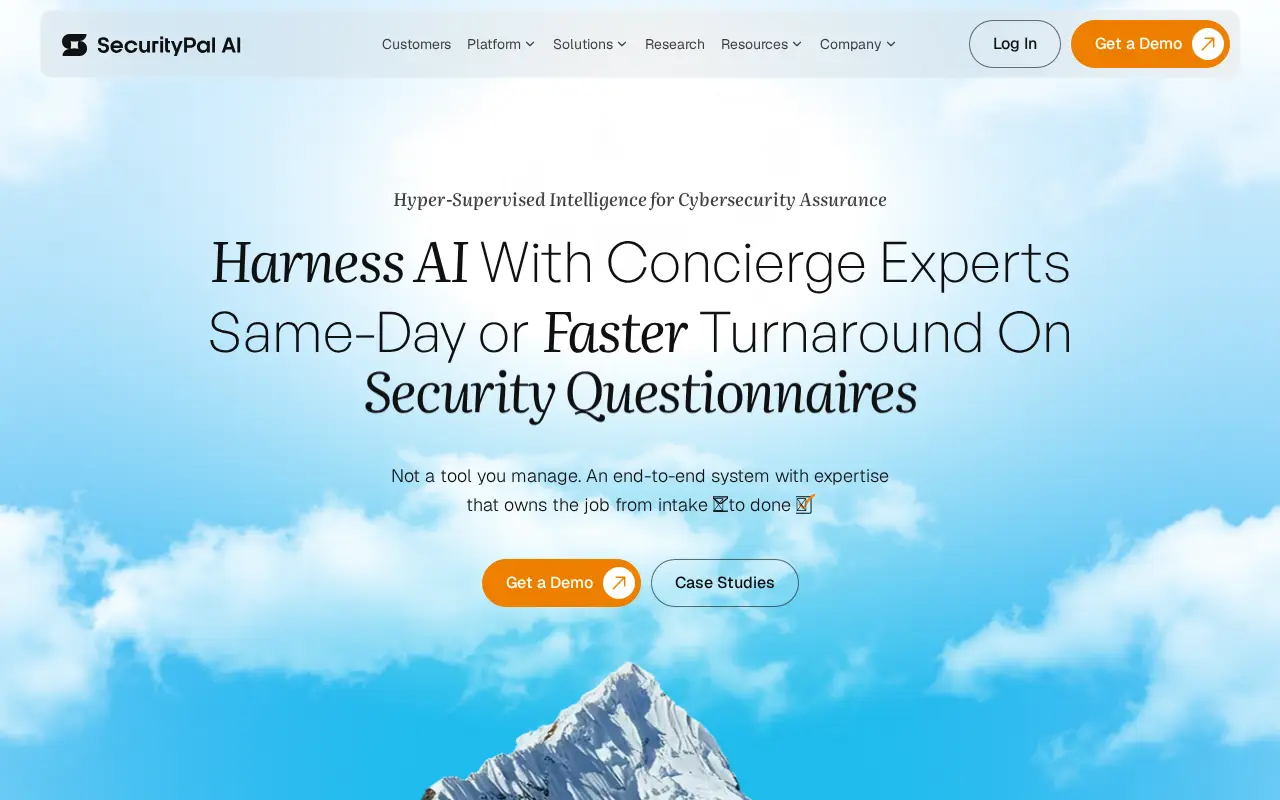
SecurityPal is the option for teams that do not want another tool. It is mostly a managed service: you send over a security questionnaire, its AI drafts the answers from your knowledge base, and a named, certified analyst checks every one before it comes back to you. If your sales engineers are losing whole days to questionnaires and you would happily pay someone to own the problem, this is the shape of product to look at. If you want to run the process yourself, it is not the obvious pick.
The job it actually does
Most tools in this category hand you software and wish you luck. SecurityPal’s pitch is the opposite: outcomes, with a person accountable. Its Questionnaire Concierge takes questionnaires “in whatever format it arrives,” and the list it gives is broad: spreadsheets, Word documents, PDFs, SIG, CAIQ, DDQs, RFPs, customer portals and procurement systems. You do not reformat anything. Its AI agent, which it calls Quincy, drafts from your Knowledge Library, then the analyst reviews and returns the questionnaire with notes on anything that needs your input. You still approve and send.
The analysts are SecurityPal staff, and the company says they work from its own operations center in Kathmandu around the clock. That is how it can offer expedited turnaround without you adding headcount.
There is also a Trust Center (NDA gating, watermarked sharing) and vendor risk assessments for the buyer side of reviews, so it can cover both directions if you want it to.
What you get on paper
Three deployment models, each a different amount of SecurityPal in your week:
- Basecamp is self-service AI software: questionnaire automation, the Trust Center and the Knowledge Library, run by your team.
- Summit adds AI Concierge Agents plus certified analysts on every deliverable. It also brings faster SLAs and TPRM vendor assessments.
- Everest is a fully managed analyst team that owns the whole assurance program, up to vCISO work.
The Knowledge Library is better governed than most. You can assign owners, schedule review cycles for Q&A pairs and documents, and see version history. SecurityPal also says it flags outdated or conflicting content and that its analysts help keep the library current, which is the part most teams quietly let rot.
The integration claim is large (700+ native integrations), and the named ones cover the usual ground: Salesforce, Slack, Microsoft Teams, Jira, Confluence, HubSpot, Okta and Google Drive. NDA workflows connect to Ironclad and DocuSign.
On its own security, the trust center lists SOC 2 Type 2, with the most recent announced audit period running July 2024 to June 2025 and zero exceptions reported. It also lists GDPR and CCPA. Hosting is on Google Cloud, but no region is named. The subprocessor list has two entries: Google, and OpenAI for optional, opt-in AI features. Ask whether the drafting in your tier relies on that opt-in.
Pricing reality
There is no pricing page. The URL redirects to the platform overview, and the three tiers are labelled only $, $$ and $$$. The way in is a 30-minute call with the team. No free plan or trial is listed.
The honest catch
The thing you are buying SecurityPal for, a certified analyst reviewing every answer, starts at Summit. Basecamp is software only, which puts it up against plenty of self-serve tools that publish their prices.
Turnaround is also not a fixed number. SecurityPal says it “depends on questionnaire complexity and service tier,” and describes 12-hour turnaround for urgent requests. Get the SLA for your tier in the contract rather than relying on the homepage.
Finally, a managed model means less hands-on control by design. Your answers come back reviewed, but the drafting happens outside your team, so make sure your approval step is real and not a rubber stamp.
How to test it
Bring a real questionnaire to the demo. Pick one with portal questions and a messy spreadsheet, and time how long the reviewed version takes to come back. Read the analyst notes closely: they tell you whether the analyst understood your environment or just tidied the AI draft. Then ask which tier that demo represented and what it costs.
Who I’d hand it to: a growing software company with steady questionnaire volume and a stretched security team that would rather hand the work off, with a named analyst on the hook.
Who I’d steer elsewhere: a team that wants published pricing and a free trial, or one that wants tight hands-on control of every draft. Self-serve responders give you those more directly.
Overview
SecurityPal is mainly a managed service: AI drafts your security questionnaires and DDQs from your Knowledge Library, then a named, certified analyst reviews every answer before it comes back. A self-service software tier is also offered.
Capability snapshot
Nine jobs, scored 0 (not offered) to 3 (category-leading). SecurityPal is strongest on Security questionnaires and lightest on RFPs. The same scores feed every comparison table.
- RFPs1/3
- DDQs2/3
- Security questionnaires3/3
- AI drafting3/3
- Answer library3/3
- Source attribution2/3
- Workflow & approvals3/3
- Integrations3/3
- Self-serve onboarding1/3
Strongest: Security questionnairesLightest: RFPs
Key features
- Send questionnaires in any format: spreadsheets, Word, PDF, SIG, CAIQ, DDQs and customer portals
- AI drafts from your Knowledge Library, then a named certified analyst reviews every answer
- Knowledge Library with assigned owners, scheduled review cycles and version history
- Trust Center with NDA gating and watermarked document sharing
- Vendor risk assessments (TPRM) on the Summit tier and above
Who it's for
Security, GRC and sales engineering teams at companies with steady questionnaire volume and no appetite to staff the work in-house.
Strengths
- A certified human analyst checks every answer, which suits teams that will not send unreviewed AI output.
- Takes questionnaires in whatever format they arrive, including SIG, CAIQ and portals, with no reformatting by you.
- Knowledge Library governance (owners, review cycles, version history) keeps answers from going stale.
- Customers it names include OpenAI, Airtable, Grammarly, Plaid and Elastic.
Limitations
- No pricing page or public prices; tiers are shown only as $, $$ and $$$.
- Analyst review starts on the Summit tier; the entry Basecamp tier is self-service software only.
- Turnaround depends on questionnaire complexity and service tier, with 12-hour turnaround described for urgent requests.
Where it falls short
Gaps we found in research, each linked to its source.
- No published prices or pricing page: the three deployment models are labelled only $, $$ and $$$, and the way in is a sales conversation. securitypalhq.com, 2026-10
- The certified-analyst review that defines the service starts on the Summit tier; the entry Basecamp tier is self-service AI software only. securitypalhq.com, 2026-10
- Turnaround "depends on questionnaire complexity and service tier"; the 12-hour expedited turnaround is described for urgent customer requests. securitypalhq.com, 2026-10
Security: ISO 27001, SOC 2, and regional hosting
A security review of SecurityPal usually starts with three questions: ISO 27001, SOC 2, and whether you can keep data in the US or the EU. We only mark a yes when a public vendor page supports it.
- ISO 27001
- Not listed
- SOC 2
- SOC 2 Type II trust.securitypal.com, 2026-10
Latest announced attestation covers July 1, 2024 to June 30, 2025 with zero exceptions; a 2026 bridge letter is listed. Report available on request.
- US hosting
- Not listed
- EU hosting
- Not listed
SecurityPal hosts on Google Cloud Platform. Its trust center does not name a region or offer a US/EU choice.
Slack, Teams and the rest of the stack
SecurityPal collaboration is only as useful as the chat tools your SMEs already live in. Slack and Microsoft Teams are the two that matter on a live questionnaire.
- Slack
- Slack securitypalhq.com, 2026-10
- Microsoft Teams
- Microsoft Teams securitypalhq.com, 2026-10
Subprocessors
For SecurityPal, start with the big three clouds (AWS, Azure, GCP), then look at niche processors that touch answer content, call a third-party model, or record sessions.
- AWS, Azure, GCP
- GCP
- Google (GCP and Google Workspace): Hosting, storage and platform infrastructure trust.securitypal.com
- OpenAI: LLM provider for optional, opt-in AI features Watch-out: Listed as opt-in only. Confirm whether the AI drafting in your tier depends on it. trust.securitypal.com
The trust center lists two subprocessors. Questionnaire work is also handled by SecurityPal analysts, who it says work from its own center in Kathmandu.
Topics
Pricing and value
How much does SecurityPal cost?
SecurityPal uses quote-only pricing, quoted per deal rather than published No pricing page or public prices. Three deployment models are labelled only by dollar signs: Basecamp (self-service AI software), Summit (AI plus certified analysts) and Everest (fully managed). You start with a sales call; no free plan or trial is listed.
On our capability model it scores 4.6 out of 5 across 9 dimensions. Weigh that against teams that want security questionnaires taken off their plate, with a named analyst accountable for each one to judge whether the price fits the job.
Pricing and details verified Oct 2026. Confirm on the vendor's site before you buy.
Who should pick SecurityPal, and who should skip it
Pick it if you fit this profile: security, GRC and sales engineering teams at companies with steady questionnaire volume and no appetite to staff the work in-house. Where it earns its place: A certified human analyst checks every answer, which suits teams that will not send unreviewed AI output.
Look elsewhere if this limitation is a deal-breaker: No pricing page or public prices; tiers are shown only as $, $$ and $$$. Also look around if rfps is central to how you work (1/3 here). In that case, one of the SecurityPal alternatives may fit better.
Bottom line
Best use case in one line: Teams that want security questionnaires taken off their plate, with a named analyst accountable for each one.
Teams evaluating SecurityPal often also compare SecurityPal vs Vendict, and SecurityPal vs Loopio, or browse SecurityPal alternatives.
Similar tools
Loopio, AutoRFP.ai, and Responsive come first as category benchmarks, followed by the closest peers on the job SecurityPal is hired for (shared categories and tags, plus aligned capabilities). The snapshot above already scores each job. The notes below say where each tool is stronger, lighter, or a match.
Loopio (4.6/5, Custom (~$20K+/yr est.)). Best for large enterprise teams with high response volume and a mature content library. Leads SecurityPal on RFPs and DDQs, and is lighter on AI drafting. Audience: Teams in SaaS, tech, financial services, and healthcare answering high volumes of RFPs, RFIs, DDQs, and security questionnaires. Watch-out: No public prices: the entry Foundations plan includes 10 seats, and multi-step reviews start one tier up on Enhanced.
AutoRFP.ai (4.9/5, $899/mo). Best for software and finance teams answering structured RFPs in Word and Excel who want accuracy-first drafts, responses written to win, and a workflow that is easy to run. Matches SecurityPal on AI drafting, and leads on RFPs and DDQs. Audience: Software and finance response teams whose RFPs come in as Word or Excel files and who want accuracy-first drafts, winning responses with every line cited to a source, a person, or the AI, and a workflow that is easy to run. Watch-out: Built for structured, source-cited answers rather than creative writing on long-form responses. For persuasive multi-page narrative, AutogenAI is built for that prose job.
Responsive (4.6/5, $10,000 (Emerging edition)). Best for enterprise teams with complex approval chains and heavy integration requirements. Leads SecurityPal on RFPs and DDQs, and is lighter on AI drafting. Audience: Enterprise sales and proposal teams that need the widest workflow across RFPs, RFIs, DDQs, and security questionnaires. Watch-out: Quoted by edition, user count, and add-ons, with a 12-month minimum term as standard and no free trial.
Vendict (4.6/5, Custom). Best for security teams with a backlog of past questionnaires who want AI to complete new ones without building a tagged library. Matches SecurityPal on DDQs and AI drafting, and leads on RFPs. Audience: Security, GRC and sales engineering teams answering security questionnaires (and some RFPs and DDQs) who would rather upload documents than curate Q&A pairs. Watch-out: No public prices, and questionnaire plans are capped by monthly volume (5, 15 or 25+).
RocketDocs (4.6/5, $18,500/yr). Best for incumbent RocketDocs teams that need private AI and a default audit trail, or are planning a move to AutoRFP.ai, Loopio, or Responsive. Leads SecurityPal on RFPs and DDQs, and is lighter on AI drafting. Audience: Proposal operations already on RocketDocs for private Llama drafting and Office add-ins, and teams comparing a replacement shortlist. Watch-out: No free trial; evaluations are scoped only for qualified opportunities.
Anchor (4.3/5, $125,000/yr). Best for enterprise sales and presales teams answering long, technical RFPs who want every teammate in the tool without seat fees. Matches SecurityPal on DDQs, leads on RFPs, and is lighter on AI drafting. Audience: Enterprise B2B teams where solutions engineers and security staff share the RFP and questionnaire load across messy Excel and PDF formats. Watch-out: The only public price is a $125,000 Enterprise Plan for a 12-month contract on AWS Marketplace, sized on about 150 questions per opportunity.
Sources behind this SecurityPal review
Every page we read for the SecurityPal profile, with the month it was last checked. Anything without a source is shown as not publicly disclosed. Spot an outdated fact? Send it from the corrections page.
Pricing
Security and compliance
Product and integrations
Third-party reviews
- No review-site source recorded.
Frequently asked questions
Is SecurityPal software or a service?
Both, depending on tier. Basecamp is self-service AI software. Summit adds AI Concierge Agents with certified analysts reviewing every deliverable, and Everest is a fully managed analyst team.
Which questionnaire formats does SecurityPal accept?
Spreadsheets, Word documents and PDFs, plus SIG, CAIQ, DDQs, RFPs, customer portals and procurement platforms. You send it as received; no reformatting is required.
What is SecurityPal?
SecurityPal is mainly a managed service: AI drafts your security questionnaires and DDQs from your Knowledge Library, then a named, certified analyst reviews every answer before it comes back. A self-service software tier is also offered. In this directory it sits under Security Questionnaires, DDQ.
How much does SecurityPal cost?
SecurityPal is sold on a quote-only basis, so pricing is quoted rather than published. No pricing page or public prices. Three deployment models are labelled only by dollar signs: Basecamp (self-service AI software), Summit (AI plus certified analysts) and Everest (fully managed). You start with a sales call; no free plan or trial is listed.
Does SecurityPal have a free plan or trial?
No. SecurityPal does not advertise a free plan, so expect a demo or quote on its quote-only pricing.
What does SecurityPal do best?
A certified human analyst checks every answer, which suits teams that will not send unreviewed AI output. Takes questionnaires in whatever format they arrive, including SIG, CAIQ and portals, with no reformatting by you.
What are the main limitations of SecurityPal?
No pricing page or public prices; tiers are shown only as $, $$ and $$$. Analyst review starts on the Summit tier; the entry Basecamp tier is self-service software only. Turnaround depends on questionnaire complexity and service tier, with 12-hour turnaround described for urgent requests.
Who should use SecurityPal?
Security, GRC and sales engineering teams at companies with steady questionnaire volume and no appetite to staff the work in-house.
Does SecurityPal handle RFPs, DDQs, and security questionnaires?
SecurityPal treats security questionnaires as a core job, is capable on DDQs, and RFPs is a limited fit. Security, GRC and sales engineering teams at companies with steady questionnaire volume and no appetite to staff the work in-house.
What integrations and certifications does SecurityPal list?
SecurityPal lists Salesforce, Okta, Jira, Slack, Microsoft Teams, Confluence, HubSpot, Google Drive. Certifications on file: SOC 2 Type II, GDPR, CCPA.
Does SecurityPal have ISO 27001, SOC 2, and US or EU hosting?
SecurityPal ISO 27001: Not listed. SOC 2: SOC 2 Type II. US hosting: Not listed. EU hosting: Not listed. Slack: Slack. Microsoft Teams: Microsoft Teams. Big-three clouds listed: GCP. Confirm on the vendor site before a security review.