Quick verdict
Choose Qwilr for sales teams that want proposals to feel like a polished web page; choose Storydoc for teams that pitch with decks and want interactive documents over static slides. Storydoc starts lower, at $19.80/mo against $35/user/mo for Qwilr. In our capability model Storydoc leads on AI drafting, and the two match everywhere else.
Both profiles reviewed Oct 2026
2 of 70 profiles, one scoring modelNo paid placementSources checked: 11Choose Qwilr or Storydoc
QW Choose Qwilr when
- Sales teams that want proposals to feel like a polished web page.
- Interactive pages stand out against the usual PDF proposal.
ST Choose Storydoc when
- Teams that pitch with decks and want interactive documents over static slides.
- You need stronger AI drafting than Qwilr offers.
- You want the lower entry price: $19.80/mo.
Side-by-side comparison
| Capability | Qwilr | Storydoc | Edge |
|---|---|---|---|
| Best for | Sales teams that want proposals to feel like a polished web page. | Teams that pitch with decks and want interactive documents over static slides. | - |
| Starting price | $35/user/mo | $19.80/mo | Storydoc |
| Free tier | No | No | Match |
| RFPs | 0/3 | 0/3 | Match |
| DDQs | 0/3 | 0/3 | Match |
| Security questionnaires | 0/3 | 0/3 | Match |
| AI drafting | 1/3 | 2/3 | Storydoc |
| Answer library | 1/3 | 1/3 | Match |
| Source attribution | 0/3 | 0/3 | Match |
| Workflow & approvals | 1/3 | 1/3 | Match |
| Integrations | 2/3 | 2/3 | Match |
| Self-serve onboarding | 3/3 | 3/3 | Match |
| ISO 27001 | Not listed | ISO 27001 | - |
| SOC 2 | SOC 2 Type II | Not listed | - |
| US hosting | Not listed | Not listed | - |
| EU hosting | Not listed | Not listed | - |
| Slack | Not listed | Not listed | - |
| Microsoft Teams | Not listed | Not listed | - |
| AWS, Azure, GCP | Not listed | Not listed | - |
| Listed integrations | HubSpot, Salesforce, Zoho, Pipedrive, QuickBooks | Salesforce, HubSpot, Pipedrive, Salesloft | - |
| Certifications | SOC 2 Type II | ISO 27001 | - |
What they look like
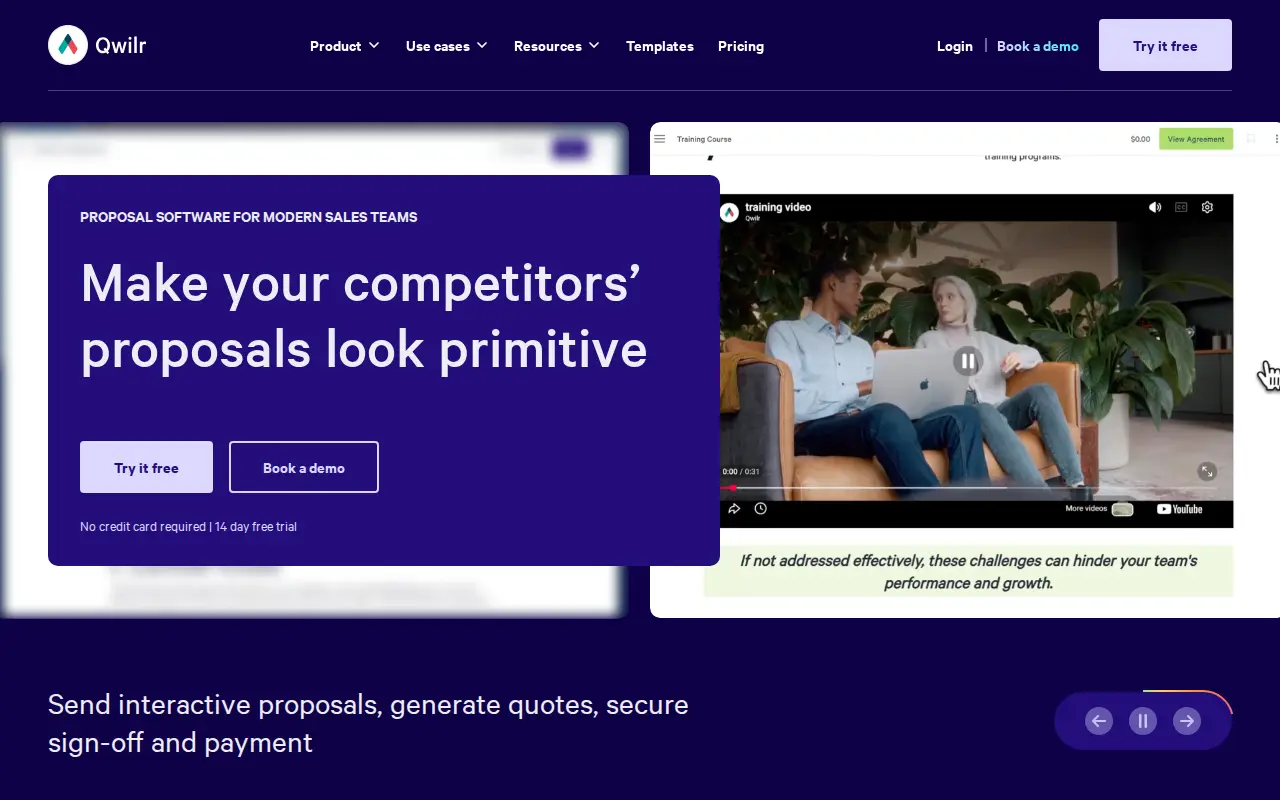
QW Qwilr
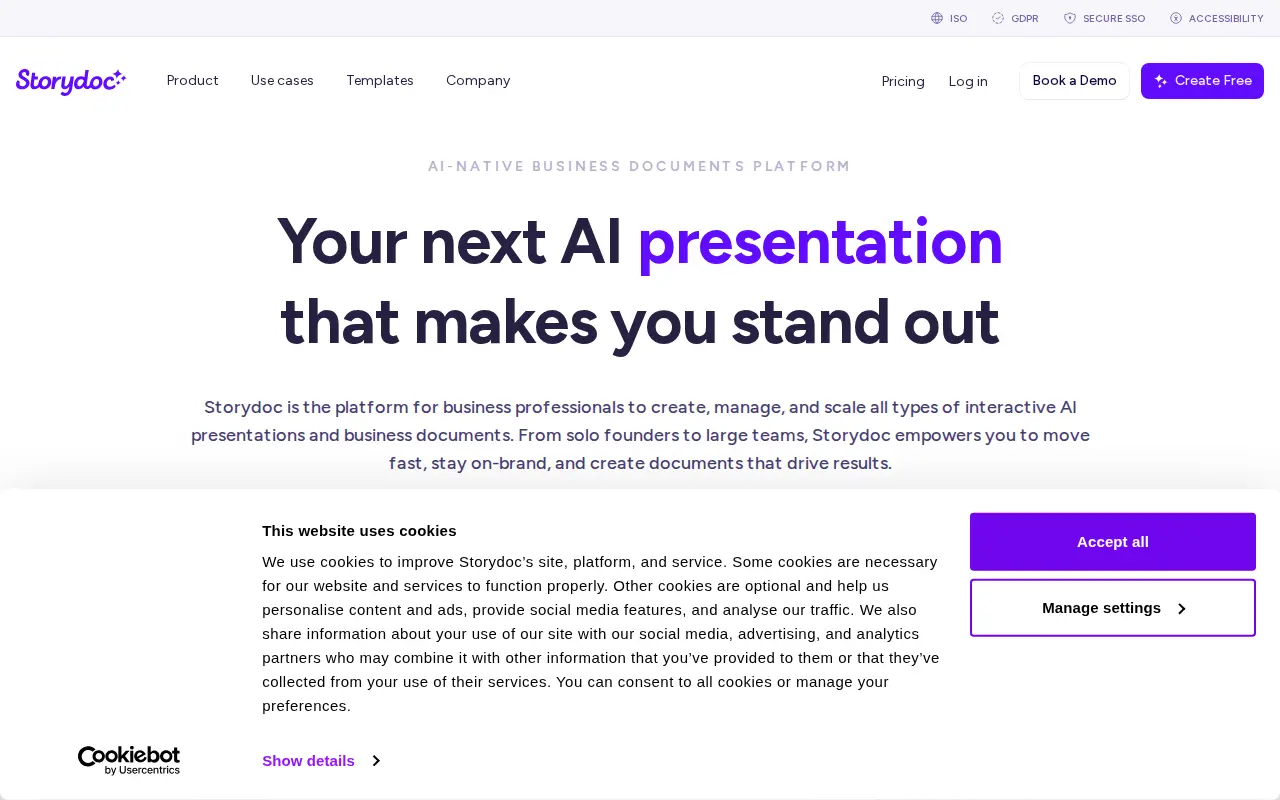
ST Storydoc
Security: ISO 27001, SOC 2, and regional hosting
Put Qwilr and Storydoc through the same three questions a security reviewer will ask: ISO 27001, SOC 2, and whether you can keep the tenancy in the US or the EU. Cells say Not listed when we could not find the claim on a public vendor page.
| Check | Qwilr | Storydoc |
|---|---|---|
| ISO 27001 | Not listed | ISO 27001 |
| SOC 2 | SOC 2 Type II | Not listed |
| US hosting | Not listed | Not listed |
| EU hosting | Not listed | Not listed |
Slack and Microsoft Teams
During a live questionnaire, SMEs get pinged in Slack or Teams, not in a vendor portal. Here is what Qwilr and Storydoc publish for those two connections.
| Connection | Qwilr | Storydoc |
|---|---|---|
| Slack | Not listed | Not listed |
| Microsoft Teams | Not listed | Not listed |
Subprocessors: the big three clouds, then the niche names
Compare Qwilr and Storydoc on AWS, Azure and GCP first. Then scan for niche processors a reviewer should pause on: third-party LLMs, session replay, or support that leaves the region you elected.
| Layer | Qwilr | Storydoc |
|---|---|---|
| AWS, Azure, GCP | Not listed | Not listed |
| Watch-outs | No niche processors flagged in our sourced list. | No niche processors flagged in our sourced list. |
Qwilr and Storydoc both replace the PDF attachment with a tracked web link, so on a shortlist they look like twins. Use them for a week and the difference is obvious. Qwilr is a selling page: quote, terms, signature and payment on one URL, wired into the CRM. Storydoc is a storytelling deck: animated, AI-generated slides built to hold attention and personalize at volume. Pick Qwilr when the document has to close the deal. Pick Storydoc when the document has to earn the next meeting.
The other big difference is how each one charges. Qwilr prices per seat and enforces seat minimums on its upper plans. Storydoc prices per plan and pushes its CRM, signature and payment integrations into a quote-only Teams tier. Those rules shape the real cost far more than the headline numbers do.
Key takeaways
- Core job: Qwilr builds interactive proposals and quotes with built-in e-signatures and QwilrPay payments on every plan. Storydoc builds interactive decks, one-pagers and proposals with an AI assistant that can generate a full story from a prompt.
- Pricing: Qwilr Starter is $35/user/mo billed annually ($49 monthly); Growth is $55/user/mo with a 5-user minimum and Scale $75/user/mo with a 10-user minimum, both annual only. Storydoc Starter is $19.80/mo and Pro $36/mo billed annually, and Teams is quote-only.
- CRM gating: Qwilr includes HubSpot, Zoho and Pipedrive on Starter but holds Salesforce for Scale. Storydoc’s plan comparison places native CRM integrations on Teams.
- Security posture: Qwilr holds a SOC 2 Type 2 report and says it is not ISO 27001 certified. Storydoc is ISO 27001 certified.
- Ratings: Qwilr is rated 4.6/5 on G2 (909 reviews) and 4.6/5 on Capterra (385 reviews); Storydoc is rated 4.7/5 on G2 (67 reviews), all as of July 2026.
- Limitations: Qwilr’s upper tiers lock you into annual seat minimums, and its document automation is metered per document. Storydoc caps active documents on Starter and Pro and cannot export to editable PowerPoint.
Same medium, different message
Qwilr was founded in 2014 and is based in Redfern, in Sydney. It raised a $7.25M Series A led by AirTree Ventures in May 2020, bringing its total at that point to about $9.25M. Its customer list skews toward B2B sales organisations: Thomson Reuters, Drata, Meltwater, Morningstar, OpenTable and Sotheby’s International Realty among them. A Qwilr page reads like a long, responsive web page. Sections stack vertically, the quote block lets buyers adjust options, and the page ends with an accept button that can collect a signature and a payment in one motion.
Storydoc, founded in 2019 in Tel Aviv, starts from the presentation rather than the contract. A Storydoc reads like a deck that moves as you scroll, with animated slides, embedded video and live content from tools such as Calendly or Loom. It was built for founders, marketers and sales teams who pitch, and its site displays logos from Meta, Deloitte, EY and Volkswagen.
The quickest way to see the split is to ask what the buyer does at the bottom of the page. On Qwilr, the buyer typically accepts and pays. On Storydoc, the buyer typically books a call, fills a form, or forwards the link to a colleague.
Where each one is strongest
Qwilr: quote to cash
Qwilr’s quote block is the centre of the product. You build a priced quote, buyers can interact with it, and on acceptance Qwilr captures a legally binding e-signature and, through QwilrPay, a full, partial or recurring payment. All of that is on Starter. For a sales team that lives in HubSpot, a rep can create a Qwilr page straight from the deal, with contact and deal data already filled in; Zoho and Pipedrive connect on Starter as well.
As teams grow, Qwilr adds control rather than design. Growth brings Microsoft Dynamics 365, identity verification, enhanced reporting, template-level settings and a dedicated customer success manager. Scale adds Salesforce, conditional content, team-level permissions, chat support and the two automation features that matter most at volume: the Smart Proposal Engine, which Qwilr says lets sellers build personalized proposals from your rules in a few clicks, and AI Prefill.
Storydoc: attention and personalization
Storydoc’s strength is making a pitch that people actually scroll through. Its “Smart AI assistant” generates an entire deck from a prompt on every plan, and the “Slide magic” assistant redesigns slides with different layouts. You can build a live master template and spin out a personalized version per prospect, with dynamic variables and bulk version creation on Pro and above. Each version has its own link and its own analytics.
For a marketing-led or founder-led sale where the deck is the first serious touch, that is a real advantage. Qwilr pages can be beautiful, but Storydoc’s motion and slide structure are closer to what a design agency would hand you.
Automation, AI and the meter running underneath
Both products sell automation, and both put a meter on it.
Qwilr bills automated document creation per document. Its pricing page lists 40, 200 and 600 free documents on Starter, Growth and Scale respectively, says Starter plans billed monthly get none, and charges $2.50 per document beyond that on a pay-as-you-go basis. Bundles bring the rate down, to $2 per document for 250 and as low as $1.50 per document for 5,000 on Scale. The meter covers the API, the Smart Proposal Engine and pages created through Qwilr’s MCP connection for AI tools. If you plan to generate a proposal automatically for every new opportunity, model that cost before you sign.
Storydoc meters AI instead. Starter includes 25 AI text credits and 20 AI image credits a month, Pro includes 125 and 50, and Teams is listed as extended. Version automations are capped at 10, 25 and 100 a month across the three plans, and API access and deck automation sit on Teams.
Neither tool’s AI writes answers from your approved knowledge base. Qwilr’s AI works from call transcripts and deal context to build proposal blocks; Storydoc’s writes and designs slide copy. That distinction matters later in this article.
The plan gating, in one place
The most useful thing we can give you is a map of which tier unlocks what, because both vendors hide important features one or two plans up. All entries come from each vendor’s pricing page as of October 2026.
| Capability | Qwilr | Storydoc |
|---|---|---|
| E-signature | Every plan | Digital approval from Pro; e-signature integration on Teams |
| Payments | QwilrPay on every plan | Teams only |
| HubSpot | Starter and up | Teams only (native CRM) |
| Salesforce | Scale only | Teams only (native CRM) |
| Team permissions | Team-level permissions on Scale | Roles and SAML SSO on Teams |
| Document volume | Unlimited pages; automation metered | 5 active docs (Starter), 30 (Pro), unlimited (Teams) |
| Seat rules | 1 seat Starter; 5 min Growth; 10 min Scale | Teams designed for 5+ users |
The pattern is clear. Qwilr gives a single seller nearly the full close-and-collect flow on Starter, then charges heavily for enterprise CRM and automation. Storydoc gives a single seller nearly the full design and AI toolset, then reserves the sales-system plumbing for Teams.
What it costs at three team sizes
Qwilr’s verified pricing: Starter is $35/user/mo billed annually ($49 monthly). Growth is $55/user/mo (5-user minimum) and Scale is $75/user/mo (10-user minimum), both billed annually. 14-day free trial, no credit card required. Qwilr adds that annual plans are paid upfront for 12 months.
Storydoc’s verified pricing: two self-serve plans priced per plan rather than per user, Starter at $19.80 a month and Pro at $36 a month on annual billing ($237.60 and $432 a year), or $33 and $60 paid monthly. Teams, aimed at five or more users, is priced on request. The trial runs 14 days with no card.
- One seller. Qwilr Starter costs $420 a year on annual billing. Storydoc Pro costs $432 a year. Near enough identical, and the choice comes down to whether you need payments and HubSpot sync (Qwilr) or AI decks and personalized versions (Storydoc).
- A five-person team. Qwilr Growth is 5 × $55 × 12, or $3,300 a year, paid upfront. Five people could technically stay on Qwilr Starter at $2,100 a year if they don’t need Growth features. Storydoc for five users points you at Teams, so you will need a quote.
- A ten-person team on Salesforce. Qwilr Scale is 10 × $75 × 12, or $9,000 a year, plus any document automation beyond the included 600. Storydoc Teams is again quote-based.
Capterra reviewers have raised cost too. Reviews from July 2022 and August 2023 call Qwilr expensive over the long run or for a single-person business (Qwilr on Capterra).
After you send: analytics and access control
Both products are bought partly for the moment a rep sees “viewed 3 times” on a deal. The fine print on that data is worth reading.
Qwilr gives page and section analytics on every plan, with real-time view notifications. What changes by tier is how long you keep the history: 60 days on Starter, 120 days on Growth, and unlimited on Scale. A Starter team that wants to look back at last year’s won deals will find the trail gone. Growth adds enhanced reporting. Qwilr’s own QwilrPay fee also drops with the tier, listed at 0.09% on Starter and 0% on Growth and Scale.
For controlling who sees a page, Qwilr lists password protection, time limits, view limits, domain-restricted access and identity verification, with identity verification named as a Growth feature. Template-level settings on Growth let an admin apply expiry dates and access rules to every page built from a template, which is the closest Qwilr gets to governance.
Storydoc’s analytics run basic on Starter, extended on Pro, and advanced with custom reporting on Teams. Pro can send events to GA4, Google Tag Manager or HubSpot and set an expiry date on a version. Teams can require readers to identify themselves before viewing and adds smart roles and SSO. Private and public versions are available on every plan.
Integrations and stack fit
Qwilr connects to HubSpot, Salesforce, Zoho, Pipedrive, Microsoft Dynamics 365, QuickBooks, Xero, Stripe, Slack and Zapier. One Capterra reviewer in December 2025 noted that teams in a Microsoft 365 setup may need third-party tools for embedding and Zapier for their CRM, which is worth testing if you are a Dynamics shop on a lower tier.
Storydoc’s list covers CRMs (Salesforce, HubSpot, Pipedrive, Zoho), sales engagement tools (Outreach, Salesloft, Gong, Clay), automation (Zapier, Make, Monday.com) and embeds or transactions (Calendly, Loom, DocuSign, Stripe). It is a strong list for an outbound sales stack, with the caveat already covered: native CRM, e-signature and payments are Teams features.
Trials and leaving
Both trials last 14 days and skip the credit card. Qwilr’s trial is of Starter, and when it ends your published pages stay live for 30 days while you lose access to the account. Storydoc is more generous on the way out of a paid plan: it says the stories you created are yours to keep, and their links stay active after you cancel, though you lose the editor and the analytics panel.
The bigger exit consideration is contractual. Qwilr’s Growth and Scale run on annual terms paid upfront, and you cannot cut seats mid-cycle. If headcount is uncertain, start on Starter or negotiate seat flexibility before you sign.
Known issues and watch-outs
Sources were checked in October 2026. Review-based points carry their dates.
Qwilr
- Salesforce is included only on Scale, which needs at least 10 users on annual billing (Qwilr pricing).
- Growth and Scale have 5-seat and 10-seat minimums, bill annually only, are paid upfront, and seat reductions only take effect at renewal (Qwilr pricing FAQ).
- Automated document creation is billed per document beyond the included allowance, starting at $2.50 each (Qwilr pricing).
- Qwilr says it is not ISO 27001 certified, while it completes an annual SOC 2 Type 2 audit (Qwilr security and compliance FAQ). Some enterprise buyers ask for ISO specifically.
Storydoc
- Native CRM integrations, e-signature integration, online payments, SSO and team roles all require the quote-only Teams plan (Storydoc pricing).
- Active documents are capped at 5 on Starter and 30 on Pro (Storydoc pricing).
- You cannot export a story directly to PowerPoint; the help center points to a static PDF instead (Storydoc help, September 2025).
- PDFs lose animations, video and interactive elements, and PDF export is not in the free trial (Storydoc help, June 2026).
Wrong tool for RFPs, right tool for pitches
A note for anyone who found this page while searching for RFP software. Neither Qwilr nor Storydoc imports a buyer’s RFP, DDQ or security questionnaire, maintains a question-and-answer library, or writes responses back into the buyer’s Word or Excel file. Qwilr’s content library stores visual blocks; Storydoc’s slides library stores slides. Neither is designed to answer “Describe your encryption at rest” two hundred times a quarter.
That is fine. Both are excellent at what their buyers bought them for. If your team also receives formal RFPs and questionnaires, pair one of these with a response platform such as AutoRFP.ai, Loopio or Responsive, and use Qwilr or Storydoc for the proactive proposal that follows the shortlist.
Who should pick Qwilr
- Your proposal ends in a signature and a payment, and you want both on one page without extra tools.
- You run HubSpot, Pipedrive or Zoho and want CRM sync on the entry plan.
- You are a larger Salesforce team and can commit to Scale’s 10 seats and annual billing.
- You want the larger review base: more than 900 G2 reviews as of July 2026.
Who should pick Storydoc
- Your first serious touch is a deck, and engagement and design carry the sale.
- You send many personalized versions of the same pitch and want AI to build the first draft.
- Your buyers ask for ISO 27001 specifically.
- You are a small team that needs design horsepower now and can defer CRM and payments, or budget for Teams.
Final verdict
Qwilr wins on closing: quote, signature and payment on the entry plan, plus the deeper CRM and automation story at the top end, if you accept its seat minimums and per-document fees. Storydoc wins on capturing attention: AI-generated, animated stories with personalization at scale, if you accept that its sales-system integrations live on a plan you have to negotiate.
For most B2B sales teams sending proposals that need to be accepted, Qwilr is the more complete tool. For founders and marketing-led teams whose deck does the persuading, Storydoc is the more striking one. Run both trials on the same live deal and watch what your buyer does at the bottom of the page.
Read the full Qwilr review or Storydoc review, or browse all RFP & DDQ software.
Frequently asked questions
What is the difference between Qwilr and Storydoc?
Qwilr: Interactive web proposals with analytics. Storydoc: Interactive decks and proposals with AI. Qwilr is best for sales teams that want proposals to feel like a polished web page. Storydoc is best for teams that pitch with decks and want interactive documents over static slides.
Which is cheaper, Qwilr or Storydoc?
Storydoc starts lower at $19.80/mo, versus $35/user/mo for Qwilr.
Is Qwilr or Storydoc better for DDQs and security questionnaires?
They are level on DDQ and security-questionnaire handling in our capability model, so test both on one of your own questionnaires.
Do Qwilr and Storydoc both handle RFPs?
Qwilr: limited. Storydoc: limited.
Which should you choose, Qwilr or Storydoc?
Qwilr is the pick for sales teams that want proposals to feel like a polished web page. Storydoc is the pick for teams that pitch with decks and want interactive documents over static slides.
Are there alternatives to Qwilr and Storydoc?
Yes. Browse the full directory of RFP, DDQ, and security-questionnaire platforms for more options and side-by-side comparisons.
Do Qwilr and Storydoc list ISO 27001, SOC 2, and US or EU hosting?
Qwilr: ISO 27001 Not listed, SOC 2 SOC 2 Type II, US Not listed, EU Not listed, Slack Not listed, Teams Not listed, clouds Not listed. Storydoc: ISO 27001 ISO 27001, SOC 2 Not listed, US Not listed, EU Not listed, Slack Not listed, Teams Not listed, clouds Not listed. Confirm both on the vendor sites.
Source registry
Every page we read for these profiles, with the month it was last checked. Anything without a source is shown as not publicly disclosed. Spot an outdated fact? Send it from the corrections page.
Qwilr
Pricing
Security and compliance
- No security source URL recorded. Treat certifications and hosting as not publicly disclosed.
Product and integrations
Third-party reviews
Storydoc
Pricing
Security and compliance
- No security source URL recorded. Treat certifications and hosting as not publicly disclosed.
Product and integrations
Third-party reviews